


 Home
Science Corporation implants vision-restoring chip in first Stargardt disease patient
Science Corporation CEO Max Hodak revealed that the company has successfully implanted its vision-restoring PRIMA chip into its first patient suffering from Stargardt disease, a hereditary condition that progressively destroys central vision. Hodak, formerly the president and co-founder of Neuralink, detailed during a TechCrunch Disrupt presentation how PRIMA aligns with the company’s broader goal of developing a novel brain-computer interface (BCI).
“The retina is an extension of the central nervous system,” Hodak explained on stage. “Cochlear implants, retinal prostheses, and motor prostheses are all forms of BCIs.”
Hodak presented a vision where BCIs expand into diverse medical applications, moving beyond mere computer control.
Although PRIMA is already commercially available in Europe for geographic atrophy—a severe form of age-related macular degeneration—the company believes its technology can treat multiple conditions, including Stargardt disease, which currently has no cure.
Stargardt disease impacts the outer retina, leading to the gradual death of light-sensing cells while potentially preserving the inner retina, which transmits visual signals to the brain. This results in a central blind spot that expands over time, affecting approximately 150,000 people globally.
“The brain processes vision as electrical potential, much like activity in the optic nerve,” Hodak noted. “If we can ensure the optic nerve signals the rest of the brain accurately, we can restore vision.”

Image Credits:Kimberly White/Getty Images for TechCrunch /
The company reports that its first Stargardt patient received the PRIMA implant in May as part of a trial at Sydney Eye Hospital in Australia. During initial rehabilitation, the patient identified a letter and subsequently read a word.
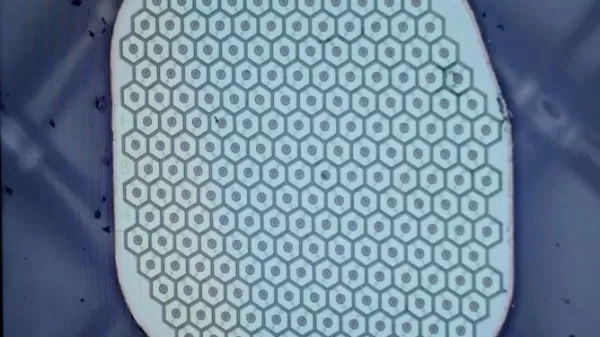
The procedure involves placing a small chip at the back of the eye where photoreceptors have degenerated. Patients then wear glasses with cameras that transmit visual data to the chip, functioning as artificial photoreceptors.
“This two-millimeter-by-two-millimeter implant sits at the back of the eye, creating a view like looking through a straw,” Hodak said. “It does not offer wide-field color vision. Instead, it provides a sharp, high-contrast black-and-white patch in the central vision, allowing patients to see a few letters at a time. Future iterations aim to increase the field of view by addressing eye curvature and reducing electrode size to match native detail levels.”
He added, “We have a clear roadmap. A next-generation device is currently in development for human trials next year, and within five years, we expect to approach native visual acuity.”
After founding Science Corporation in 2021 following his departure from Neuralink, the company aimed to advance neural engineering and BCI technology. However, establishing a sustainable business model by proving efficacy through vision restoration for the visually impaired was the immediate priority.

Image Credits:Kimberly White/Getty Images for TechCrunch
Regarding its broader BCI technology, Science Corporation plans to implant sensors inside the skull, resting on top of the brain, differing from Neuralink’s approach of inserting devices directly into brain tissue.
The company suggests this device could assist with neurological conditions, such as monitoring activity in patients with brain tumors.
“Our first clinical indication, yet to be publicly announced, targets a well-known neurodegenerative disease,” Hodak stated. “We are also exploring stroke recovery. By connecting deep brain areas, we can integrate new cortical regions, a feat impossible with conventional electrodes. Ultimately, our mission is to understand how the brain generates the mind and engineer artificial brains.”
Hodak emphasized that Science Corporation anticipates widespread BCI adoption. While not targeting “healthy 40-year-olds,” the company believes individuals may require BCIs by age 60 or 70.
“Our goal is to extend not just lifespan, but health span,” Hodak concluded.
Related article
 Science Corp. to Implant First Brain Sensor in Human Patient
Science Corporation, the startup founded by former Neuralink president and co-founder Max Hodak, has recruited a leading neurobiologist to spearhead the first U.S. human trials for its biohybrid brain-computer interface.After two years of discussions
Higgsfield secures $400 million funding, reaching $5.4 billion valuation with investments from Goldman Sachs and Intel
AI video platform Higgsfield has secured $400 million in funding from DST Global, Goldman Sachs, Liberty Global, and Intel, achieving a $5.4 billion valuation, per the Financial Times. The two-year-old startup is rapidly scaling enterprise subscripti
OpenAI’s Jev Clone May Help Frontiers Lab Control Swarming Agents
Among the most notable announcements at OpenAI’s Dev Day on Tuesday was a brief remark from CEO Sam Altman regarding the launch of the company’s new “Decisions API.”This API appears to offer capabilities similar to Jev, a model introduced earlier thi
Related Special Topic Recommendations
Design & Art
 Top AI Illustration Tools: Create Editorial Scenes and Cover Art Faster
2026 Latest Top-rated AI Illustration Tools: Our curated list features the best powerfully designed tools for creating stunning editorial scenes and eye-catching cover art quickly. Each option has gone through rigorous real-world tests, offering a free vs paid comparison to help you find the perfect match for your workflow. Try these must-try solutions today to unlock your AI edge and boost your creative productivity. Explore now at XIX.AI.
 10 tools
 xix.ai
Education and Learning
Top AI Tutors for Exam Prep: Practice Math, Science, and English
2026 Latest Top-Rated Best AI Tutors for Exam Prep are here on XIX.AI! Our curated list features powerful game-changing tools that offer free vs paid comparison, real-world tests, and weekly updated rankings. They help boost your writing efficiency, simplify complex topic learning, and unlock your academic potential. Explore now to Discover your perfect exam prep tool and Start creating today to Unlock your AI edge!
10 tools
xix.ai
Finance
AI Budget Planning Tools for Personal Money Management
2026 Latest Best Top-Rated AI Budget Planning Tools for Personal Money Management are here on XIX.AI! This curated collection features powerful, game-changing solutions that help you conduct real-world tests, understand spending habits, and create personalized plans to boost productivity. Enjoy a free vs paid comparison along with detailed rankings. Must-try tools designed to simplify money management and unlock your AI edge. Explore now!
11 tools
xix.ai
Health & Wellness
AI Sleep Tracking Assistants: Improve Recovery with Better Bedtime Habits
2026 Latest Best Top-Rated AI Sleep Tracking Assistants curated for ultimate recovery. This fully updated weekly guide features powerful tools that deliver real-world tests, free vs paid comparison, and detailed rankings to help you find the must-try solution that boosts sleep quality and supports better bedtime habits. Explore now at XIX.AI to Unlock your AI edge.
10 tools
xix.ai
Data Analysis
AI SQL Copilots for Product and Revenue Analytics
2026 Latest Best Top-Rated AI SQL Copilots for Product and Revenue Analytics! XIX.AI has curated a powerful, game-changing collection of must-try tools that undergo real-world tests through weekly updated rankings. These tools help users boost productivity significantly by accelerating data analysis, streamlining complex queries, and generating accurate insights to drive smarter business decisions. Explore now to Discover your perfect tool for unlocking your AI edge!
14 tools
xix.ai
Education and Learning
Best AI Homework Helpers That Teach: Learn Concepts, Not Just Answers
2026 Latest Best Top-Rated AI Homework Helpers That Teach Core Concepts Not Just Answers Powerful Tools for Students Must-Try Curated List Weekly Updated Free vs Paid Comparison Real-World Tests Accurate Rankings to Help You Unlock Your Full Learning Potential Explore now to Discover your perfect tool for smarter studying.
10 tools
xix.ai

 Comments (0)
0/500
Science Corporation CEO Max Hodak revealed that the company has successfully implanted its vision-restoring PRIMA chip into its first patient suffering from Stargardt disease, a hereditary condition that progressively destroys central vision. Hodak, formerly the president and co-founder of Neuralink, detailed during a TechCrunch Disrupt presentation how PRIMA aligns with the company’s broader goal of developing a novel brain-computer interface (BCI).
“The retina is an extension of the central nervous system,” Hodak explained on stage. “Cochlear implants, retinal prostheses, and motor prostheses are all forms of BCIs.”
Hodak presented a vision where BCIs expand into diverse medical applications, moving beyond mere computer control.
Although PRIMA is already commercially available in Europe for geographic atrophy—a severe form of age-related macular degeneration—the company believes its technology can treat multiple conditions, including Stargardt disease, which currently has no cure.
Stargardt disease impacts the outer retina, leading to the gradual death of light-sensing cells while potentially preserving the inner retina, which transmits visual signals to the brain. This results in a central blind spot that expands over time, affecting approximately 150,000 people globally.
“The brain processes vision as electrical potential, much like activity in the optic nerve,” Hodak noted. “If we can ensure the optic nerve signals the rest of the brain accurately, we can restore vision.”
Image Credits:Kimberly White/Getty Images for TechCrunch /
The company reports that its first Stargardt patient received the PRIMA implant in May as part of a trial at Sydney Eye Hospital in Australia. During initial rehabilitation, the patient identified a letter and subsequently read a word.
The procedure involves placing a small chip at the back of the eye where photoreceptors have degenerated. Patients then wear glasses with cameras that transmit visual data to the chip, functioning as artificial photoreceptors.
“This two-millimeter-by-two-millimeter implant sits at the back of the eye, creating a view like looking through a straw,” Hodak said. “It does not offer wide-field color vision. Instead, it provides a sharp, high-contrast black-and-white patch in the central vision, allowing patients to see a few letters at a time. Future iterations aim to increase the field of view by addressing eye curvature and reducing electrode size to match native detail levels.”
He added, “We have a clear roadmap. A next-generation device is currently in development for human trials next year, and within five years, we expect to approach native visual acuity.”
After founding Science Corporation in 2021 following his departure from Neuralink, the company aimed to advance neural engineering and BCI technology. However, establishing a sustainable business model by proving efficacy through vision restoration for the visually impaired was the immediate priority.
Image Credits:Kimberly White/Getty Images for TechCrunch
Regarding its broader BCI technology, Science Corporation plans to implant sensors inside the skull, resting on top of the brain, differing from Neuralink’s approach of inserting devices directly into brain tissue.
The company suggests this device could assist with neurological conditions, such as monitoring activity in patients with brain tumors.
“Our first clinical indication, yet to be publicly announced, targets a well-known neurodegenerative disease,” Hodak stated. “We are also exploring stroke recovery. By connecting deep brain areas, we can integrate new cortical regions, a feat impossible with conventional electrodes. Ultimately, our mission is to understand how the brain generates the mind and engineer artificial brains.”
Hodak emphasized that Science Corporation anticipates widespread BCI adoption. While not targeting “healthy 40-year-olds,” the company believes individuals may require BCIs by age 60 or 70.
“Our goal is to extend not just lifespan, but health span,” Hodak concluded.








 Science Corp. to Implant First Brain Sensor in Human Patient
Science Corporation, the startup founded by former Neuralink president and co-founder Max Hodak, has recruited a leading neurobiologist to spearhead the first U.S. human trials for its biohybrid brain-computer interface.After two years of discussions
 Higgsfield secures $400 million funding, reaching $5.4 billion valuation with investments from Goldman Sachs and Intel
AI video platform Higgsfield has secured $400 million in funding from DST Global, Goldman Sachs, Liberty Global, and Intel, achieving a $5.4 billion valuation, per the Financial Times. The two-year-old startup is rapidly scaling enterprise subscripti
 OpenAI’s Jev Clone May Help Frontiers Lab Control Swarming Agents
Among the most notable announcements at OpenAI’s Dev Day on Tuesday was a brief remark from CEO Sam Altman regarding the launch of the company’s new “Decisions API.”This API appears to offer capabilities similar to Jev, a model introduced earlier thi

2026 Latest Top-rated AI Illustration Tools: Our curated list features the best powerfully designed tools for creating stunning editorial scenes and eye-catching cover art quickly. Each option has gone through rigorous real-world tests, offering a free vs paid comparison to help you find the perfect match for your workflow. Try these must-try solutions today to unlock your AI edge and boost your creative productivity. Explore now at XIX.AI.
10 tools
xix.ai

2026 Latest Top-Rated Best AI Tutors for Exam Prep are here on XIX.AI! Our curated list features powerful game-changing tools that offer free vs paid comparison, real-world tests, and weekly updated rankings. They help boost your writing efficiency, simplify complex topic learning, and unlock your academic potential. Explore now to Discover your perfect exam prep tool and Start creating today to Unlock your AI edge!
10 tools
xix.ai

2026 Latest Best Top-Rated AI Budget Planning Tools for Personal Money Management are here on XIX.AI! This curated collection features powerful, game-changing solutions that help you conduct real-world tests, understand spending habits, and create personalized plans to boost productivity. Enjoy a free vs paid comparison along with detailed rankings. Must-try tools designed to simplify money management and unlock your AI edge. Explore now!
11 tools
xix.ai

2026 Latest Best Top-Rated AI Sleep Tracking Assistants curated for ultimate recovery. This fully updated weekly guide features powerful tools that deliver real-world tests, free vs paid comparison, and detailed rankings to help you find the must-try solution that boosts sleep quality and supports better bedtime habits. Explore now at XIX.AI to Unlock your AI edge.
10 tools
xix.ai

2026 Latest Best Top-Rated AI SQL Copilots for Product and Revenue Analytics! XIX.AI has curated a powerful, game-changing collection of must-try tools that undergo real-world tests through weekly updated rankings. These tools help users boost productivity significantly by accelerating data analysis, streamlining complex queries, and generating accurate insights to drive smarter business decisions. Explore now to Discover your perfect tool for unlocking your AI edge!
14 tools
xix.ai

2026 Latest Best Top-Rated AI Homework Helpers That Teach Core Concepts Not Just Answers Powerful Tools for Students Must-Try Curated List Weekly Updated Free vs Paid Comparison Real-World Tests Accurate Rankings to Help You Unlock Your Full Learning Potential Explore now to Discover your perfect tool for smarter studying.
10 tools
xix.ai












