


 Home
HomeQwen Streamlines Resume, PPT, and Data Cleaning into a Replicable AI Workflow
Resumes that vanish into thin air, the headache of staring at a blank report document, and the confusion of a messy sales table—these are everyday stressors for professionals. Yesterday, Qwen APP demonstrated how to tackle these scenarios live in Wuhan.
This AI-powered job-hunting workshop, guided by the Wuhan Human Resources and Social Security Bureau and hosted by Qwen APP and Wuhan Release, moved beyond dry theory. It walked on-site job seekers and fresh graduates through three practical tasks: resume diagnosis, business report writing, and sales table analysis, using AI step by step. The goal was to transform raw materials into polished documents, not just add more text. Jin Shixing, Qwen APP's product manager, framed the value of AI documents this way, setting the tone for the session.
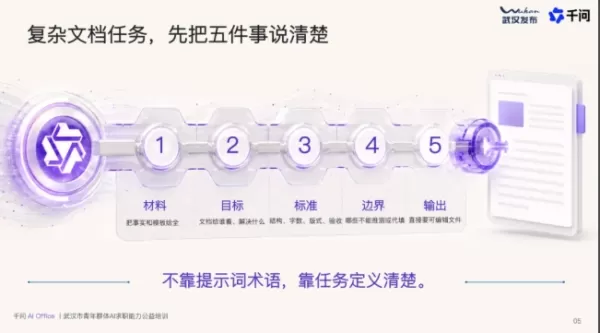
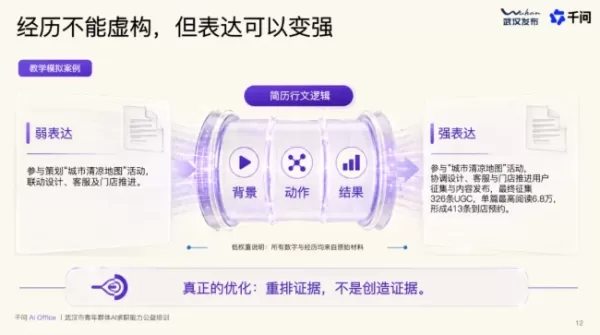
For resume writing, Qwen recommends clarifying five key points: provide all materials, state the goal, define standards, set boundaries, and request an editable file. Many people simply ask for "help writing a paragraph," but crafting a strong resume requires treating scattered experiences as raw materials. Use the target job's requirements as a benchmark, then work backward to highlight relevant facts. Transform a vague statement like "participated in organizing an event" into a compelling narrative with context, actions, and results, boosting its persuasive power.
Qwen also introduced a three-step prompt template that can be used directly. The first step is purely diagnostic: let the AI read the attached resume without rewriting it. Instead, summarize the job description into no more than seven core requirements, ranked by importance. Then create a five-column comparison table: core job requirements, existing evidence in the resume, strength of evidence, gaps or unconfirmed information, and suggested actions. Any information not present in the attachment should be marked as "not provided" to avoid speculation or fabrication. Finally, provide three most urgent revision suggestions.
The second step is to rewrite based on factual information. Only use real content from the original resume, rewriting personal summaries and work experience into action, methods, and results structures. Keep each section to three to four points, and keep each point to no more than 65 Chinese characters. Mark any evidence not in the material as "to be supplemented" and include a comparison table showing the modified content and its factual sources for user verification. The third step is to generate a formatted Word resume. There are clear rules for file names, margins, font size, line spacing, and module title styles. After generation, it requires self-checking for page breaks, fonts, and punctuation.
Being given a stack of unfamiliar files and asked to create a PowerPoint presentation on short notice is another workplace nightmare. Qwen APP's product manager, Jingjing, demonstrated a three-step emergency solution. First, establish the context of the task by clearly explaining four background elements: objective and theme, presenter and audience, supporting materials, and presentation format. For instance, when reporting on short drama transformation research to a team leader, specify the core conclusion—that short dramas are a key breakthrough direction—the planner's role, why the report focuses on suitability for self-media transformation, how to quickly gain traction, and the monetization path, along with the format of 15 slides for a 15-minute presentation. Second, let the AI read all files, summarize them, then restructure the content based on the speaker's department responsibilities and recent business priorities to generate a draft. Third, use Qwen's four skill kits to fine-tune and personalize the PPT.
The toughest part is using AI to extract key metrics from messy data. Jin Shixing demonstrated a fictional tea shop operations case, walking through the entire process of building, organizing, calculating, analyzing, and presenting. Given a raw sales detail sheet, first clean up the messy data while preserving the original table, unify naming formats, then input formulas to calculate gross profit and gross margin. This provides a foundation for business review. Finally, a sales table with 486 rows of messy data is condensed into a single clear PPT page with obvious conclusions.
The accompanying six-step data analysis prompt words break down this methodology in detail. The first step is to set up an analysis workspace: process only the uploaded files, do not supplement with online information or speculate on missing facts, retain the original data, and ensure all conclusions can be traced back to the data and calculation methods in the table. Create five workbooks: cleaned data, data processing log, indicator summary, business report, and definition explanation. Set filters, freeze headers, and standardize formats.
The second step is to clean the original data: unify the aliases of three stores and four channels, standardize product names, convert dates to YYYY-MM-DD, transform amounts with currency symbols or text formats into numbers, delete completely duplicate records, mark missing items as "to be confirmed" instead of guessing, and output the number of rows before and after processing, the count of various issues, and pending confirmations.
The third step is to enter traceable formulas: use Excel formulas rather than static results to populate standard sales, product cost, gross profit, gross margin, discount rate, average revenue per cup, and date type indicators. Handle division by zero and missing values carefully, retain two decimal places for amounts and one decimal place for ratios, simultaneously record indicator definitions in the definition explanation, and generate a general verification table.
The fourth step is to perform business analysis using natural language: summarize by store, product, channel, and time period, answering questions like which store has the largest scale, whether the highest sales also imply the highest gross profit, which channel has high volume but low gross profit, and which two periods contribute the most revenue. Each conclusion should list the data, the comparison object, and the calculation basis, and remind not to generalize hypothetical samples into long-term trends.
The fifth step is to generate a one-page business report: display key indicators at the top, produce four charts—store revenue comparison, product cup count and gross profit comparison, channel gross profit comparison, and time period revenue comparison. Each chart title should directly convey the main finding rather than using vague titles. Below each chart, list three data insights and three action recommendations. The sixth step is for the data auditor to perform a final check: verify the number of rows before and after cleaning, whether all summaries equal the total, whether formulas cover everything, whether percentage denominators are consistent, whether charts are misleading, and whether conclusions exceed the data range. Output a four-column list of checking items, results, evidence, and matters requiring manual confirmation, without directly modifying the data.
Related article
 Tencent Accelerates AI Push With Doubled-Size Hunyuan Hy4, Morgan Stanley Lifts Target to HKD 550
Tencent has officially unveiled the preview of HuanYuan Hy4, accelerating its timeline ahead of Morgan Stanley’s September forecast and fulfilling the company’s Q2 earnings commitment to launch the model within the year. Since appointing Yao Shunyu a
Pearson’s Dave Treat: AI Should Guide Learning, Not Cheat
Pearson’s Chief Technology Officer, Dave TreatOn academic integrity, AI adoption, and the critical skills that matter as agentic AI transforms educationDave Treat joined Pearson nearly two years ago as Chief Technology Officer, later assuming the rol
OpenAI Launches GPT-5.6-Cyber, Boosting Zero-Day Detection with AI Automation
OpenAI has expanded its Daybreak cybersecurity initiative, introducing a two-tier access system and launching GPT-5.6-Cyber, a model purpose-built for security operations. This move addresses the growing reality that threat actors are leveraging AI t
Related Special Topic Recommendations
code
Tencent Accelerates AI Push With Doubled-Size Hunyuan Hy4, Morgan Stanley Lifts Target to HKD 550
Tencent has officially unveiled the preview of HuanYuan Hy4, accelerating its timeline ahead of Morgan Stanley’s September forecast and fulfilling the company’s Q2 earnings commitment to launch the model within the year. Since appointing Yao Shunyu a
Pearson’s Dave Treat: AI Should Guide Learning, Not Cheat
Pearson’s Chief Technology Officer, Dave TreatOn academic integrity, AI adoption, and the critical skills that matter as agentic AI transforms educationDave Treat joined Pearson nearly two years ago as Chief Technology Officer, later assuming the rol
OpenAI Launches GPT-5.6-Cyber, Boosting Zero-Day Detection with AI Automation
OpenAI has expanded its Daybreak cybersecurity initiative, introducing a two-tier access system and launching GPT-5.6-Cyber, a model purpose-built for security operations. This move addresses the growing reality that threat actors are leveraging AI t
Related Special Topic Recommendations
code
 Best AI Coding Chatbots: Debug Python, JS, and SQL in One Place
2026 Latest Best Top-Rated AI Coding Chatbots Curated for Developers! Experience powerful game-changing tools that help you debug Python, JS, and SQL issues quickly. Get a free vs paid comparison along with real-world tests and detailed rankings to find the perfect fit for boosting your coding productivity. Try XIX.AI today to unlock your AI edge! Explore now.
 12 tools
 xix.ai
Prompt
AI Prompt Versioning Platforms for Reusable Claude and ChatGPT Playbooks
xix.ai
Prompt
AI Prompt Versioning Platforms for Reusable Claude and ChatGPT Playbooks
2026 Latest Best Top-rated AI Prompt Versioning Platforms for Reusable Playbooks are here on XIX.AI! Our curated list includes powerful game-changing tools that help you keep track of all prompts, test variations efficiently, and boost productivity across writing, content creation, and more. Get a free vs paid comparison along with real-world tests and updated rankings weekly. Explore now to discover your perfect tool for staying ahead in AI tasks!
9 tools
xix.ai
writing
Best AI Writing Assistants for Long Articles: Outline and Draft Faster
2026 Latest Best AI Writing Assistants for Long Articles: Outline and Draft Faster. XIX.AI curates the top-rated, must-try tools that offer powerful, game-changing support to boost writing efficiency significantly. You’ll find detailed free vs paid comparison, real-world tests, and updated rankings weekly. Explore now to Discover your perfect tool and Start creating today to Unlock your AI edge.
8 tools
xix.ai
Education and Learning
ChatGPT Study Tools for Exam Revision, Flashcards, and Homework Explanations
2026 Latest Best ChatGPT Study Tools for Exam Revision, Flashcards, and Homework Explanations! XIX.AI has curated a top-rated list of powerful game-changing tools designed to boost your productivity. These must-try solutions offer free vs paid comparison, real-world tests, and detailed rankings to help you find the perfect option for efficient exam preparation and homework support. Explore now to unlock your AI edge!
10 tools
xix.ai
Education and Learning
AI Study Planner Tools for Exam Preparation
2026 Latest Best Top-Rated AI Study Planner Tools for Exam Preparation are here on XIX.AI! This curated collection features powerful, game-changing tools that help you streamline your review process, boost focus, and create personalized study schedules. We conduct real-world tests to determine the top options, offering a free vs paid comparison along with weekly updated rankings. Must-try solutions designed to maximize your productivity and help you ace every exam. Explore now to find your perfect tool!
14 tools
xix.ai
SEO
Best AI Keyword Gap Tools for Organic Growth
2026 Latest Best Top-rated AI Keyword Gap Tools for Organic Growth! XIX.AI has carefully curated a powerful, game-changing collection of the best tools available, featuring weekly updated rankings and real-world tests. You can find a detailed free vs paid comparison to help you choose the perfect option that boosts your content creation efficiency and unlocks your AI edge. Explore now!
8 tools
xix.ai

 Comments (0)
0/500
Comments (0)
0/500
Resumes that vanish into thin air, the headache of staring at a blank report document, and the confusion of a messy sales table—these are everyday stressors for professionals. Yesterday, Qwen APP demonstrated how to tackle these scenarios live in Wuhan.
This AI-powered job-hunting workshop, guided by the Wuhan Human Resources and Social Security Bureau and hosted by Qwen APP and Wuhan Release, moved beyond dry theory. It walked on-site job seekers and fresh graduates through three practical tasks: resume diagnosis, business report writing, and sales table analysis, using AI step by step. The goal was to transform raw materials into polished documents, not just add more text. Jin Shixing, Qwen APP's product manager, framed the value of AI documents this way, setting the tone for the session.
For resume writing, Qwen recommends clarifying five key points: provide all materials, state the goal, define standards, set boundaries, and request an editable file. Many people simply ask for "help writing a paragraph," but crafting a strong resume requires treating scattered experiences as raw materials. Use the target job's requirements as a benchmark, then work backward to highlight relevant facts. Transform a vague statement like "participated in organizing an event" into a compelling narrative with context, actions, and results, boosting its persuasive power.
Qwen also introduced a three-step prompt template that can be used directly. The first step is purely diagnostic: let the AI read the attached resume without rewriting it. Instead, summarize the job description into no more than seven core requirements, ranked by importance. Then create a five-column comparison table: core job requirements, existing evidence in the resume, strength of evidence, gaps or unconfirmed information, and suggested actions. Any information not present in the attachment should be marked as "not provided" to avoid speculation or fabrication. Finally, provide three most urgent revision suggestions.
The second step is to rewrite based on factual information. Only use real content from the original resume, rewriting personal summaries and work experience into action, methods, and results structures. Keep each section to three to four points, and keep each point to no more than 65 Chinese characters. Mark any evidence not in the material as "to be supplemented" and include a comparison table showing the modified content and its factual sources for user verification. The third step is to generate a formatted Word resume. There are clear rules for file names, margins, font size, line spacing, and module title styles. After generation, it requires self-checking for page breaks, fonts, and punctuation.
Being given a stack of unfamiliar files and asked to create a PowerPoint presentation on short notice is another workplace nightmare. Qwen APP's product manager, Jingjing, demonstrated a three-step emergency solution. First, establish the context of the task by clearly explaining four background elements: objective and theme, presenter and audience, supporting materials, and presentation format. For instance, when reporting on short drama transformation research to a team leader, specify the core conclusion—that short dramas are a key breakthrough direction—the planner's role, why the report focuses on suitability for self-media transformation, how to quickly gain traction, and the monetization path, along with the format of 15 slides for a 15-minute presentation. Second, let the AI read all files, summarize them, then restructure the content based on the speaker's department responsibilities and recent business priorities to generate a draft. Third, use Qwen's four skill kits to fine-tune and personalize the PPT.
The toughest part is using AI to extract key metrics from messy data. Jin Shixing demonstrated a fictional tea shop operations case, walking through the entire process of building, organizing, calculating, analyzing, and presenting. Given a raw sales detail sheet, first clean up the messy data while preserving the original table, unify naming formats, then input formulas to calculate gross profit and gross margin. This provides a foundation for business review. Finally, a sales table with 486 rows of messy data is condensed into a single clear PPT page with obvious conclusions.
The accompanying six-step data analysis prompt words break down this methodology in detail. The first step is to set up an analysis workspace: process only the uploaded files, do not supplement with online information or speculate on missing facts, retain the original data, and ensure all conclusions can be traced back to the data and calculation methods in the table. Create five workbooks: cleaned data, data processing log, indicator summary, business report, and definition explanation. Set filters, freeze headers, and standardize formats.
The second step is to clean the original data: unify the aliases of three stores and four channels, standardize product names, convert dates to YYYY-MM-DD, transform amounts with currency symbols or text formats into numbers, delete completely duplicate records, mark missing items as "to be confirmed" instead of guessing, and output the number of rows before and after processing, the count of various issues, and pending confirmations.
The third step is to enter traceable formulas: use Excel formulas rather than static results to populate standard sales, product cost, gross profit, gross margin, discount rate, average revenue per cup, and date type indicators. Handle division by zero and missing values carefully, retain two decimal places for amounts and one decimal place for ratios, simultaneously record indicator definitions in the definition explanation, and generate a general verification table.
The fourth step is to perform business analysis using natural language: summarize by store, product, channel, and time period, answering questions like which store has the largest scale, whether the highest sales also imply the highest gross profit, which channel has high volume but low gross profit, and which two periods contribute the most revenue. Each conclusion should list the data, the comparison object, and the calculation basis, and remind not to generalize hypothetical samples into long-term trends.
The fifth step is to generate a one-page business report: display key indicators at the top, produce four charts—store revenue comparison, product cup count and gross profit comparison, channel gross profit comparison, and time period revenue comparison. Each chart title should directly convey the main finding rather than using vague titles. Below each chart, list three data insights and three action recommendations. The sixth step is for the data auditor to perform a final check: verify the number of rows before and after cleaning, whether all summaries equal the total, whether formulas cover everything, whether percentage denominators are consistent, whether charts are misleading, and whether conclusions exceed the data range. Output a four-column list of checking items, results, evidence, and matters requiring manual confirmation, without directly modifying the data.








 Tencent Accelerates AI Push With Doubled-Size Hunyuan Hy4, Morgan Stanley Lifts Target to HKD 550
Tencent has officially unveiled the preview of HuanYuan Hy4, accelerating its timeline ahead of Morgan Stanley’s September forecast and fulfilling the company’s Q2 earnings commitment to launch the model within the year. Since appointing Yao Shunyu a
Tencent Accelerates AI Push With Doubled-Size Hunyuan Hy4, Morgan Stanley Lifts Target to HKD 550
Tencent has officially unveiled the preview of HuanYuan Hy4, accelerating its timeline ahead of Morgan Stanley’s September forecast and fulfilling the company’s Q2 earnings commitment to launch the model within the year. Since appointing Yao Shunyu a
 Pearson’s Dave Treat: AI Should Guide Learning, Not Cheat
Pearson’s Chief Technology Officer, Dave TreatOn academic integrity, AI adoption, and the critical skills that matter as agentic AI transforms educationDave Treat joined Pearson nearly two years ago as Chief Technology Officer, later assuming the rol
Pearson’s Dave Treat: AI Should Guide Learning, Not Cheat
Pearson’s Chief Technology Officer, Dave TreatOn academic integrity, AI adoption, and the critical skills that matter as agentic AI transforms educationDave Treat joined Pearson nearly two years ago as Chief Technology Officer, later assuming the rol
 OpenAI Launches GPT-5.6-Cyber, Boosting Zero-Day Detection with AI Automation
OpenAI has expanded its Daybreak cybersecurity initiative, introducing a two-tier access system and launching GPT-5.6-Cyber, a model purpose-built for security operations. This move addresses the growing reality that threat actors are leveraging AI t
OpenAI Launches GPT-5.6-Cyber, Boosting Zero-Day Detection with AI Automation
OpenAI has expanded its Daybreak cybersecurity initiative, introducing a two-tier access system and launching GPT-5.6-Cyber, a model purpose-built for security operations. This move addresses the growing reality that threat actors are leveraging AI t

2026 Latest Best Top-Rated AI Coding Chatbots Curated for Developers! Experience powerful game-changing tools that help you debug Python, JS, and SQL issues quickly. Get a free vs paid comparison along with real-world tests and detailed rankings to find the perfect fit for boosting your coding productivity. Try XIX.AI today to unlock your AI edge! Explore now.
12 tools
xix.ai

2026 Latest Best Top-rated AI Prompt Versioning Platforms for Reusable Playbooks are here on XIX.AI! Our curated list includes powerful game-changing tools that help you keep track of all prompts, test variations efficiently, and boost productivity across writing, content creation, and more. Get a free vs paid comparison along with real-world tests and updated rankings weekly. Explore now to discover your perfect tool for staying ahead in AI tasks!
9 tools
xix.ai
2026 Latest Best AI Writing Assistants for Long Articles: Outline and Draft Faster. XIX.AI curates the top-rated, must-try tools that offer powerful, game-changing support to boost writing efficiency significantly. You’ll find detailed free vs paid comparison, real-world tests, and updated rankings weekly. Explore now to Discover your perfect tool and Start creating today to Unlock your AI edge.
8 tools
xix.ai

2026 Latest Best ChatGPT Study Tools for Exam Revision, Flashcards, and Homework Explanations! XIX.AI has curated a top-rated list of powerful game-changing tools designed to boost your productivity. These must-try solutions offer free vs paid comparison, real-world tests, and detailed rankings to help you find the perfect option for efficient exam preparation and homework support. Explore now to unlock your AI edge!
10 tools
xix.ai

2026 Latest Best Top-Rated AI Study Planner Tools for Exam Preparation are here on XIX.AI! This curated collection features powerful, game-changing tools that help you streamline your review process, boost focus, and create personalized study schedules. We conduct real-world tests to determine the top options, offering a free vs paid comparison along with weekly updated rankings. Must-try solutions designed to maximize your productivity and help you ace every exam. Explore now to find your perfect tool!
14 tools
xix.ai

2026 Latest Best Top-rated AI Keyword Gap Tools for Organic Growth! XIX.AI has carefully curated a powerful, game-changing collection of the best tools available, featuring weekly updated rankings and real-world tests. You can find a detailed free vs paid comparison to help you choose the perfect option that boosts your content creation efficiency and unlocks your AI edge. Explore now!
8 tools
xix.ai












