


 Home
HomePhysical Intelligence Unveils Robot Brain Capable of Learning Unseen Tasks
Physical Intelligence, a two-year-old robotics startup based in San Francisco that has emerged as one of the Bay Area's most closely monitored AI firms, released new research on Thursday. The findings reveal that its latest model can guide robots to perform tasks they were never specifically trained for—a capability that even the company's own researchers admit took them by surprise.
The new model, named π0.7, marks what the company calls an early yet significant stride toward the long-standing ambition of a general-purpose robot brain. This system can be directed toward an unfamiliar task, instructed using simple language, and successfully complete it. If these results withstand scrutiny, they indicate that robotic AI may be nearing a turning point akin to the evolution of large language models—where abilities begin to compound in ways that surpass what the foundational data might suggest.
At the heart of the paper is the concept of compositional generalization: the ability to blend skills learned in distinct contexts to tackle entirely new problems. Traditionally, robot training has relied on rote memorization—gathering data for a specific task, training a specialized model on it, and repeating the process for each new chore. Physical Intelligence asserts that π0.7 breaks this cycle.
"Once it crosses the threshold from merely replicating the exact data it was trained on to creatively recombining elements in novel ways," explains Sergey Levine, a co-founder of Physical Intelligence and a UC Berkeley professor specializing in AI for robotics, "capabilities start to increase at a rate greater than linear relative to the data volume. This more favorable scaling dynamic is something we've observed in other fields, like language and vision."
The paper's most compelling demonstration involves an air fryer the model had virtually no exposure to during training. Upon investigation, the team found only two relevant instances in the entire dataset: one where a different robot simply pushed the air fryer's door shut, and another from an open-source dataset where a robot placed a plastic bottle inside one on command. Somehow, the model synthesized these fragments, along with broader web-based pretraining data, into a practical understanding of how the appliance operates.
"It's incredibly difficult to pinpoint exactly where the knowledge originates or predict where it will succeed or fail," notes Ashwin Balakrishna, a research scientist at Physical Intelligence and a Stanford computer science PhD student. Nevertheless, without any prior coaching, the model made a credible attempt at using the appliance to cook a sweet potato. When provided with step-by-step verbal instructions—essentially, a human talking the robot through the process as one would train a new employee—it completed the task successfully.
This coaching capability is significant because it implies robots could be deployed in novel settings and refined in real time, eliminating the need for additional data collection or model retraining.
So, what are the broader implications? The researchers are upfront about the model's limitations and cautious about overstating its progress. In at least one instance, they attribute a failure directly to their own team.
"Sometimes the failure isn't due to the robot or the model," Balakrishna says. "It's on us—not being skilled at prompt engineering." He cites an early air fryer experiment that achieved only a 5% success rate. After spending roughly thirty minutes refining how the task was explained to the model, the success rate soared to 95%.
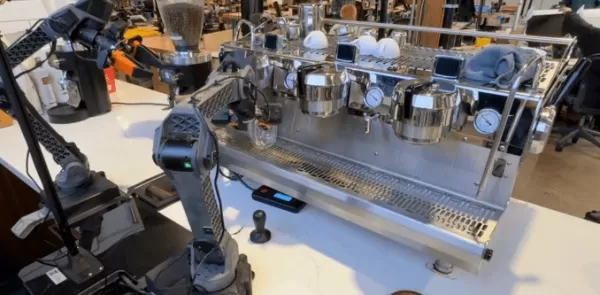
Image Credits:Physical Intelligence
The model is also not yet able to autonomously execute complex, multi-step tasks from a single high-level command. "You can't just tell it, 'Go make me some toast,'" Levine states. "But if you guide it through the steps—'open this part of the toaster, press that button, do this'—then it tends to perform quite well."
The team also acknowledges the lack of standardized benchmarks in robotics, which complicates external validation of their claims. Instead, the company compared π0.7 against its own earlier specialist models—systems custom-built and trained for individual tasks—and found that the generalist model matched their performance across a variety of complex activities, including making coffee, folding laundry, and assembling boxes.
Perhaps the most remarkable aspect of the research—taking the researchers at their word—is not any single demonstration, but the extent to which the results astonished the very people whose job is to know the training data inside out and, consequently, what the model should and shouldn't be capable of.
"My experience has always been that when I have a deep understanding of the data, I can usually predict what the model will be able to do," Balakrishna reflects. "I'm rarely surprised. But the past few months have been the first time I've been genuinely taken aback. I randomly bought a gear set and asked the robot, 'Can you rotate this gear?' And it just worked."
Levine recalls the moment researchers first witnessed GPT-2 generate a story about unicorns in the Andes. "Where on earth did it learn about unicorns in Peru?" he says. "It's such an odd combination. Seeing that kind of emergent capability in robotics is truly special."
Naturally, critics will highlight an inherent asymmetry: language models were trained on the entire internet. Robots do not have that luxury, and no amount of clever prompting can fully bridge that gap. However, when asked where he anticipates skepticism, Levine points in a different direction entirely.
"The criticism that can always be leveled at any robotic generalization demo is that the tasks seem somewhat mundane," he observes. "The robot isn't doing a backflip." He challenges this perspective, arguing that the difference between a flashy robot demo and a system that genuinely generalizes is precisely the point. True generalization, he suggests, will always appear less dramatic than a carefully orchestrated stunt—but it is far more practical.
The paper itself employs cautious language throughout, describing π0.7 as exhibiting "early signs" of generalization and "initial demonstrations" of new capabilities. These are research findings, not a commercial product, and Physical Intelligence has been consistently reserved about its timeline for commercialization.
When asked directly when a system based on this research might be ready for real-world use, Levine declines to speculate. "There's good reason for optimism, and progress is certainly faster than I anticipated a couple of years ago," he says. "But it's very difficult for me to give a definitive answer."
To date, Physical Intelligence has raised over $1 billion and was most recently valued at $5.6 billion. A significant portion of the investor excitement surrounding the company is linked to co-founder Lachy Groom, who spent years as one of Silicon Valley's most respected angel investors—backing companies like Figma, Notion, and Ramp—before concluding that Physical Intelligence was the venture he had been seeking. This pedigree has helped the startup attract substantial institutional funding, even as it has refrained from providing investors with a specific commercialization roadmap.
The company is now reportedly in talks for a new funding round that would nearly double its valuation to $11 billion. The team declined to comment on the matter.
Related article
 Crypto exchange OKX aims to empower AI agents to hire and pay each other
As AI agents start serving individuals and collaborating with each other, they require mechanisms to locate tasks, compensate for services, and establish credibility. Crypto exchange OKX anticipates this future is arriving sooner than anticipated, in
Thiel-backed startup claims AI can judge journalism, despite risks to whistleblowers
Following his role in the lawsuit that led to Gawker’s bankruptcy, Aron D’Souza identified a critical flaw in the American media landscape: individuals harmed by coverage lacked effective means to respond.His answer is technology. D’Souza’s new ventu
Prentis, New AI Lab Co-Founded by Reid Hoffman and Marc Pincus, in Talks to Raise $100M
Prentis, an emerging AI research lab specializing in computer-use models, is co-founded by serial entrepreneur Ritankar Das alongside tech industry leaders Reid Hoffman and Marc Pincus. According to two individuals familiar with the matter, the compa
Related Special Topic Recommendations
Music composition
Crypto exchange OKX aims to empower AI agents to hire and pay each other
As AI agents start serving individuals and collaborating with each other, they require mechanisms to locate tasks, compensate for services, and establish credibility. Crypto exchange OKX anticipates this future is arriving sooner than anticipated, in
Thiel-backed startup claims AI can judge journalism, despite risks to whistleblowers
Following his role in the lawsuit that led to Gawker’s bankruptcy, Aron D’Souza identified a critical flaw in the American media landscape: individuals harmed by coverage lacked effective means to respond.His answer is technology. D’Souza’s new ventu
Prentis, New AI Lab Co-Founded by Reid Hoffman and Marc Pincus, in Talks to Raise $100M
Prentis, an emerging AI research lab specializing in computer-use models, is co-founded by serial entrepreneur Ritankar Das alongside tech industry leaders Reid Hoffman and Marc Pincus. According to two individuals familiar with the matter, the compa
Related Special Topic Recommendations
Music composition
 AI Stem Separation Tools for Remix Production, Sampling Prep, and Karaoke Masters
2026 Latest Best Top-rated AI Stem Separation Tools Curated for Remix Production, Sampling Prep, and Karaoke Masters. These powerful game-changing tools offer real-world tests to deliver precise audio isolation, boosting productivity significantly. XIX.AI provides a weekly updated free vs paid comparison guide to help you find the must-try solution that suits your needs. Explore now to unlock your AI edge.
 8 tools
 xix.ai
Data Analysis
AI SQL Copilots for Revenue Dashboards, Funnel Analysis, and Product Metrics
xix.ai
Data Analysis
AI SQL Copilots for Revenue Dashboards, Funnel Analysis, and Product Metrics
2026 Latest Best AI SQL Copilots Ranked Top-Rated! XIX.AI curates a powerful game-changing collection for weekly updated real-world tests. These must-try tools help you generate accurate revenue dashboards, analyze sales funnels, and track product metrics swiftly, boosting productivity massively. Explore now to Discover your perfect tool for data-driven decision making! 238 characters
9 tools
xix.ai
Music composition
Best AI Melody Writing Tools for Song Drafts
2026 Latest Best Top-Rated AI Melody Writing Tools for Song Drafts! XIX.AI has curated a highly powerful game-changing collection that goes through rigorous real-world tests to deliver the best writing experience. You can find detailed free vs paid comparisons, accurate rankings, and must-try options designed to help you create stunning song drafts effortlessly and boost your creative productivity significantly. Explore now to discover your perfect tool!
8 tools
xix.ai
chatbot
Best AI Conversation Trainer Tools for Interview Practice
2026 Latest Best Top-rated AI Conversation Trainer Tools for Interview Practice are here on XIX.AI! This curated collection features powerful, game-changing tools that go through rigorous real-world tests to deliver accurate feedback. You’ll find a free vs paid comparison and detailed rankings to help you choose the must-try option that boosts your confidence and skills. Explore now to Discover your perfect tool for interview success!
12 tools
xix.ai
Design & Art
Best AI Style Transfer Tools for Creative Experiments
2026 Latest Best Top-rated AI Style Transfer Tools for Creative Experiments! XIX.AI has curated a powerful, game-changing collection of must-try tools that deliver exceptional results through real-world tests and rigorous rankings. These top solutions help creatives boost productivity significantly by accelerating content creation and unlocking endless creative possibilities. Explore now to discover your perfect tool and start creating today!
9 tools
xix.ai
Comic Creation
Best AI Dialogue Bubble Tools for Visual Storytelling
2026 Latest Best Top-Rated AI Dialogue Bubble Tools for Visual Storytelling are here on XIX.AI! This curated collection features powerful, game-changing tools that help creators boost productivity and overcome creative bottlenecks. Get a free vs paid comparison, see real-world tests, and check the latest rankings to find the must-try solutions perfect for crafting engaging visual narratives. Explore now to discover your ideal tool!
10 tools
xix.ai

 Comments (1)
0/500
Comments (1)
0/500
![PeterPerez]()
Wait, so they've built a robot brain that can handle tasks it never saw before? That's either genius or the start of a sci-fi nightmare. I'm curious how they prevent it from learning the wrong things—like, what stops it from deciding that 'unseen tasks' includes rearranging my furniture at 3 AM? 🤔
Physical Intelligence, a two-year-old robotics startup based in San Francisco that has emerged as one of the Bay Area's most closely monitored AI firms, released new research on Thursday. The findings reveal that its latest model can guide robots to perform tasks they were never specifically trained for—a capability that even the company's own researchers admit took them by surprise.
The new model, named π0.7, marks what the company calls an early yet significant stride toward the long-standing ambition of a general-purpose robot brain. This system can be directed toward an unfamiliar task, instructed using simple language, and successfully complete it. If these results withstand scrutiny, they indicate that robotic AI may be nearing a turning point akin to the evolution of large language models—where abilities begin to compound in ways that surpass what the foundational data might suggest.
At the heart of the paper is the concept of compositional generalization: the ability to blend skills learned in distinct contexts to tackle entirely new problems. Traditionally, robot training has relied on rote memorization—gathering data for a specific task, training a specialized model on it, and repeating the process for each new chore. Physical Intelligence asserts that π0.7 breaks this cycle.
"Once it crosses the threshold from merely replicating the exact data it was trained on to creatively recombining elements in novel ways," explains Sergey Levine, a co-founder of Physical Intelligence and a UC Berkeley professor specializing in AI for robotics, "capabilities start to increase at a rate greater than linear relative to the data volume. This more favorable scaling dynamic is something we've observed in other fields, like language and vision."
The paper's most compelling demonstration involves an air fryer the model had virtually no exposure to during training. Upon investigation, the team found only two relevant instances in the entire dataset: one where a different robot simply pushed the air fryer's door shut, and another from an open-source dataset where a robot placed a plastic bottle inside one on command. Somehow, the model synthesized these fragments, along with broader web-based pretraining data, into a practical understanding of how the appliance operates.
"It's incredibly difficult to pinpoint exactly where the knowledge originates or predict where it will succeed or fail," notes Ashwin Balakrishna, a research scientist at Physical Intelligence and a Stanford computer science PhD student. Nevertheless, without any prior coaching, the model made a credible attempt at using the appliance to cook a sweet potato. When provided with step-by-step verbal instructions—essentially, a human talking the robot through the process as one would train a new employee—it completed the task successfully.
This coaching capability is significant because it implies robots could be deployed in novel settings and refined in real time, eliminating the need for additional data collection or model retraining.
So, what are the broader implications? The researchers are upfront about the model's limitations and cautious about overstating its progress. In at least one instance, they attribute a failure directly to their own team.
"Sometimes the failure isn't due to the robot or the model," Balakrishna says. "It's on us—not being skilled at prompt engineering." He cites an early air fryer experiment that achieved only a 5% success rate. After spending roughly thirty minutes refining how the task was explained to the model, the success rate soared to 95%.
Image Credits:Physical Intelligence
The model is also not yet able to autonomously execute complex, multi-step tasks from a single high-level command. "You can't just tell it, 'Go make me some toast,'" Levine states. "But if you guide it through the steps—'open this part of the toaster, press that button, do this'—then it tends to perform quite well."
The team also acknowledges the lack of standardized benchmarks in robotics, which complicates external validation of their claims. Instead, the company compared π0.7 against its own earlier specialist models—systems custom-built and trained for individual tasks—and found that the generalist model matched their performance across a variety of complex activities, including making coffee, folding laundry, and assembling boxes.
Perhaps the most remarkable aspect of the research—taking the researchers at their word—is not any single demonstration, but the extent to which the results astonished the very people whose job is to know the training data inside out and, consequently, what the model should and shouldn't be capable of.
"My experience has always been that when I have a deep understanding of the data, I can usually predict what the model will be able to do," Balakrishna reflects. "I'm rarely surprised. But the past few months have been the first time I've been genuinely taken aback. I randomly bought a gear set and asked the robot, 'Can you rotate this gear?' And it just worked."
Levine recalls the moment researchers first witnessed GPT-2 generate a story about unicorns in the Andes. "Where on earth did it learn about unicorns in Peru?" he says. "It's such an odd combination. Seeing that kind of emergent capability in robotics is truly special."
Naturally, critics will highlight an inherent asymmetry: language models were trained on the entire internet. Robots do not have that luxury, and no amount of clever prompting can fully bridge that gap. However, when asked where he anticipates skepticism, Levine points in a different direction entirely.
"The criticism that can always be leveled at any robotic generalization demo is that the tasks seem somewhat mundane," he observes. "The robot isn't doing a backflip." He challenges this perspective, arguing that the difference between a flashy robot demo and a system that genuinely generalizes is precisely the point. True generalization, he suggests, will always appear less dramatic than a carefully orchestrated stunt—but it is far more practical.
The paper itself employs cautious language throughout, describing π0.7 as exhibiting "early signs" of generalization and "initial demonstrations" of new capabilities. These are research findings, not a commercial product, and Physical Intelligence has been consistently reserved about its timeline for commercialization.
When asked directly when a system based on this research might be ready for real-world use, Levine declines to speculate. "There's good reason for optimism, and progress is certainly faster than I anticipated a couple of years ago," he says. "But it's very difficult for me to give a definitive answer."
To date, Physical Intelligence has raised over $1 billion and was most recently valued at $5.6 billion. A significant portion of the investor excitement surrounding the company is linked to co-founder Lachy Groom, who spent years as one of Silicon Valley's most respected angel investors—backing companies like Figma, Notion, and Ramp—before concluding that Physical Intelligence was the venture he had been seeking. This pedigree has helped the startup attract substantial institutional funding, even as it has refrained from providing investors with a specific commercialization roadmap.
The company is now reportedly in talks for a new funding round that would nearly double its valuation to $11 billion. The team declined to comment on the matter.








 Crypto exchange OKX aims to empower AI agents to hire and pay each other
As AI agents start serving individuals and collaborating with each other, they require mechanisms to locate tasks, compensate for services, and establish credibility. Crypto exchange OKX anticipates this future is arriving sooner than anticipated, in
Crypto exchange OKX aims to empower AI agents to hire and pay each other
As AI agents start serving individuals and collaborating with each other, they require mechanisms to locate tasks, compensate for services, and establish credibility. Crypto exchange OKX anticipates this future is arriving sooner than anticipated, in
 Thiel-backed startup claims AI can judge journalism, despite risks to whistleblowers
Following his role in the lawsuit that led to Gawker’s bankruptcy, Aron D’Souza identified a critical flaw in the American media landscape: individuals harmed by coverage lacked effective means to respond.His answer is technology. D’Souza’s new ventu
Thiel-backed startup claims AI can judge journalism, despite risks to whistleblowers
Following his role in the lawsuit that led to Gawker’s bankruptcy, Aron D’Souza identified a critical flaw in the American media landscape: individuals harmed by coverage lacked effective means to respond.His answer is technology. D’Souza’s new ventu
 Prentis, New AI Lab Co-Founded by Reid Hoffman and Marc Pincus, in Talks to Raise $100M
Prentis, an emerging AI research lab specializing in computer-use models, is co-founded by serial entrepreneur Ritankar Das alongside tech industry leaders Reid Hoffman and Marc Pincus. According to two individuals familiar with the matter, the compa
Prentis, New AI Lab Co-Founded by Reid Hoffman and Marc Pincus, in Talks to Raise $100M
Prentis, an emerging AI research lab specializing in computer-use models, is co-founded by serial entrepreneur Ritankar Das alongside tech industry leaders Reid Hoffman and Marc Pincus. According to two individuals familiar with the matter, the compa

2026 Latest Best Top-rated AI Stem Separation Tools Curated for Remix Production, Sampling Prep, and Karaoke Masters. These powerful game-changing tools offer real-world tests to deliver precise audio isolation, boosting productivity significantly. XIX.AI provides a weekly updated free vs paid comparison guide to help you find the must-try solution that suits your needs. Explore now to unlock your AI edge.
8 tools
xix.ai

2026 Latest Best AI SQL Copilots Ranked Top-Rated! XIX.AI curates a powerful game-changing collection for weekly updated real-world tests. These must-try tools help you generate accurate revenue dashboards, analyze sales funnels, and track product metrics swiftly, boosting productivity massively. Explore now to Discover your perfect tool for data-driven decision making! 238 characters
9 tools
xix.ai

2026 Latest Best Top-Rated AI Melody Writing Tools for Song Drafts! XIX.AI has curated a highly powerful game-changing collection that goes through rigorous real-world tests to deliver the best writing experience. You can find detailed free vs paid comparisons, accurate rankings, and must-try options designed to help you create stunning song drafts effortlessly and boost your creative productivity significantly. Explore now to discover your perfect tool!
8 tools
xix.ai

2026 Latest Best Top-rated AI Conversation Trainer Tools for Interview Practice are here on XIX.AI! This curated collection features powerful, game-changing tools that go through rigorous real-world tests to deliver accurate feedback. You’ll find a free vs paid comparison and detailed rankings to help you choose the must-try option that boosts your confidence and skills. Explore now to Discover your perfect tool for interview success!
12 tools
xix.ai

2026 Latest Best Top-rated AI Style Transfer Tools for Creative Experiments! XIX.AI has curated a powerful, game-changing collection of must-try tools that deliver exceptional results through real-world tests and rigorous rankings. These top solutions help creatives boost productivity significantly by accelerating content creation and unlocking endless creative possibilities. Explore now to discover your perfect tool and start creating today!
9 tools
xix.ai

2026 Latest Best Top-Rated AI Dialogue Bubble Tools for Visual Storytelling are here on XIX.AI! This curated collection features powerful, game-changing tools that help creators boost productivity and overcome creative bottlenecks. Get a free vs paid comparison, see real-world tests, and check the latest rankings to find the must-try solutions perfect for crafting engaging visual narratives. Explore now to discover your ideal tool!
10 tools
xix.ai

Wait, so they've built a robot brain that can handle tasks it never saw before? That's either genius or the start of a sci-fi nightmare. I'm curious how they prevent it from learning the wrong things—like, what stops it from deciding that 'unseen tasks' includes rearranging my furniture at 3 AM? 🤔












