


 Home
HomeNSF to invest $90M in three new tech centers, including robotics
# Michigan State University
# national science foundation
# Northwestern University
# nsf
# University of Texas at Austin
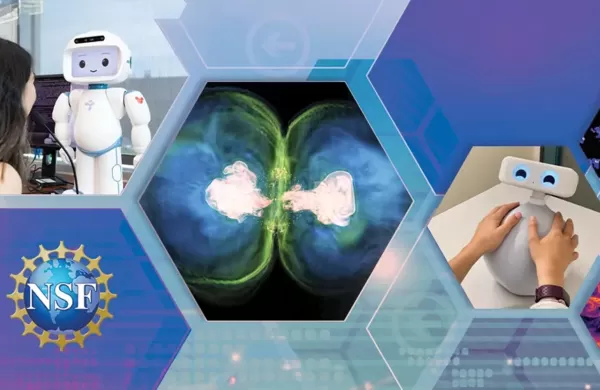
Science and Technology Centers build lasting partnerships across universities, industry, and government to accelerate the adoption of new ideas and technologies for scientific discovery. | Sources: NSF, left to right: Indiana University, Bloomington; Michigan State University College of Engineering; Brian Scassellati and Kayla Matheus, Yale University
The U.S. National Science Foundation announced yesterday a $90 million investment over five years to support three new Science and Technology Centers (NSF STCs). The NSF will allocate $6 million annually for an initial five-year period to each of the three centers.
After the first five years, the centers will have the opportunity to compete for up to five additional years of support. The foundation said the centers will advance American leadership in science and technology, strengthen the nation’s STEM workforce, and accelerate innovation in a variety of fields, including AI and robotics.
“Maintaining the United States’ leadership in science and technology requires bold research, strong partnerships, and a skilled workforce,” stated Brian Stone, who is performing the duties of the NSF director. “As advances in foundational science and technology open new possibilities, these Science and Technology Centers will help American researchers seize those opportunities, accelerate scientific discovery, and develop the talent and technologies needed to turn innovation into solutions that benefit the American people.”
Austin center will focus on human-robot collaboration
One of the new centers will be the Center for Human and Robot Co-Adaptation, led by The University of Texas at Austin. This center will study how people and robots can securely and effectively adapt to one another as service and assistive robots become more common in homes, hospitals, workplaces, and public spaces.
Researchers at the center will combine robotics, AI, and human factors to develop new methods that help robots with embodied intelligence learn from people, understand their needs and preferences, and then adapt physically and cognitively to changing environments and different people. The center aims to advance secure, useful robotic technologies that can support independent living, healthcare, and other human-centered services.
The other two centers include the Center for Transformative Explorations in Multi-Physics and Engineering of Scientific Turbulence (TEMPEST), led by Michigan State University, and the Center for Genome Intelligence Engineering (GENIE), led by Northwestern University.
More about the NSF STC program
Since its inception in 1987, the NSF STC program has driven the emergence of new fields of discovery, catalyzed strong partnerships, advanced breakthrough technologies, sparked numerous start-up companies, and trained generations of researchers and innovators.
The program supports large-scale, transformational research that opens new areas of discovery and drives technological innovation. By combining expertise across organizations and partnering with industry and other groups, STCs tackle complex, high-risk challenges in foundational research and help move promising ideas toward real-world benefits.
The NSF added that the centers will strengthen the nation’s scientific and technical workforce by providing students and early-career researchers with hands-on experience in emerging fields. The class of 2026 STCs will focus on strengthening foundational research, advancing critical and emerging technologies, developing the workforce, and translating discoveries into technological advances and national benefits.
Related article
 Accenture partners with Anthropic to launch first embedded AI evaluator
Dario Amodei’s initiative to embed independent safety evaluators within AI laboratories is materializing: Anthropic has announced that employees from technology consulting firm Accenture will operate on-site to audit its models and personnel.Accordin
OpenAI Annual Revenue Tops $40 Billion, Surging 20% Month-on-Month in July
OpenAI is fast-tracking its US public listing later this year, with market consensus projecting a valuation exceeding $1 trillion. As investors closely monitor this AI leader, its financial results have proven remarkably robust.Internal reports indic
Anthropic Embeds Invisible Watermarks in Claude Output to Boost AI Content Traceability
On August 11, Anthropic announced the integration of "imperceptible watermarking" into its latest Claude models to trace the origin of AI-generated text. This invisible marker preserves text readability and meaning, remaining intact during copy-pasti
Related Special Topic Recommendations
Education and Learning
Accenture partners with Anthropic to launch first embedded AI evaluator
Dario Amodei’s initiative to embed independent safety evaluators within AI laboratories is materializing: Anthropic has announced that employees from technology consulting firm Accenture will operate on-site to audit its models and personnel.Accordin
OpenAI Annual Revenue Tops $40 Billion, Surging 20% Month-on-Month in July
OpenAI is fast-tracking its US public listing later this year, with market consensus projecting a valuation exceeding $1 trillion. As investors closely monitor this AI leader, its financial results have proven remarkably robust.Internal reports indic
Anthropic Embeds Invisible Watermarks in Claude Output to Boost AI Content Traceability
On August 11, Anthropic announced the integration of "imperceptible watermarking" into its latest Claude models to trace the origin of AI-generated text. This invisible marker preserves text readability and meaning, remaining intact during copy-pasti
Related Special Topic Recommendations
Education and Learning
 ChatGPT Study Tools for Exam Revision, Flashcards, and Homework Explanations
2026 Latest Best ChatGPT Study Tools for Exam Revision, Flashcards, and Homework Explanations! XIX.AI has curated a top-rated list of powerful game-changing tools designed to boost your productivity. These must-try solutions offer free vs paid comparison, real-world tests, and detailed rankings to help you find the perfect option for efficient exam preparation and homework support. Explore now to unlock your AI edge!
 10 tools
 xix.ai
Education and Learning
AI Study Planner Tools for Exam Preparation
xix.ai
Education and Learning
AI Study Planner Tools for Exam Preparation
2026 Latest Best Top-Rated AI Study Planner Tools for Exam Preparation are here on XIX.AI! This curated collection features powerful, game-changing tools that help you streamline your review process, boost focus, and create personalized study schedules. We conduct real-world tests to determine the top options, offering a free vs paid comparison along with weekly updated rankings. Must-try solutions designed to maximize your productivity and help you ace every exam. Explore now to find your perfect tool!
14 tools
xix.ai
SEO
Best AI Keyword Gap Tools for Organic Growth
2026 Latest Best Top-rated AI Keyword Gap Tools for Organic Growth! XIX.AI has carefully curated a powerful, game-changing collection of the best tools available, featuring weekly updated rankings and real-world tests. You can find a detailed free vs paid comparison to help you choose the perfect option that boosts your content creation efficiency and unlocks your AI edge. Explore now!
8 tools
xix.ai
SEO
AI Internal Link Tools for Better Site Structure
2026 Latest Best Top-Rated AI Internal Link Tools for Better Site Structure are here on XIX.AI! This curated collection features powerful, game-changing solutions that go through real-world tests to deliver superior results. Get a free vs paid comparison, see rankings, and discover must-try options to boost your site’s SEO performance and streamline content organization. Explore now to unlock your AI edge!
11 tools
xix.ai
Productivity
Best AI Note Organizing Tools for Daily Work
2026 Latest Best Top-rated AI Note Organizing Tools for Daily Work are here on XIX.AI! This curated list features powerful, game-changing solutions that help boost productivity significantly through real-world tests and rigorous rankings. You’ll find a detailed free vs paid comparison to help you choose the perfect fit for your needs. Explore now to Discover your perfect tool and Unlock your AI edge in daily tasks!
11 tools
xix.ai
Finance
Best AI Investment Research Tools for Retail Analysts
2026 Latest Best Top-Rated AI Investment Research Tools for Retail Analysts, carefully curated by XIX.AI. These powerful tools offer game-changing advantages for accelerating content creation, boosting writing efficiency, and streamlining analysis tasks to help professionals unlock their AI edge. Get a free vs paid comparison along with real-world tests and detailed rankings. Explore now to discover your perfect tool!
11 tools
xix.ai

 Comments (0)
0/500
Comments (0)
0/500
Science and Technology Centers build lasting partnerships across universities, industry, and government to accelerate the adoption of new ideas and technologies for scientific discovery. | Sources: NSF, left to right: Indiana University, Bloomington; Michigan State University College of Engineering; Brian Scassellati and Kayla Matheus, Yale University
The U.S. National Science Foundation announced yesterday a $90 million investment over five years to support three new Science and Technology Centers (NSF STCs). The NSF will allocate $6 million annually for an initial five-year period to each of the three centers.
After the first five years, the centers will have the opportunity to compete for up to five additional years of support. The foundation said the centers will advance American leadership in science and technology, strengthen the nation’s STEM workforce, and accelerate innovation in a variety of fields, including AI and robotics.
“Maintaining the United States’ leadership in science and technology requires bold research, strong partnerships, and a skilled workforce,” stated Brian Stone, who is performing the duties of the NSF director. “As advances in foundational science and technology open new possibilities, these Science and Technology Centers will help American researchers seize those opportunities, accelerate scientific discovery, and develop the talent and technologies needed to turn innovation into solutions that benefit the American people.”
Austin center will focus on human-robot collaboration
One of the new centers will be the Center for Human and Robot Co-Adaptation, led by The University of Texas at Austin. This center will study how people and robots can securely and effectively adapt to one another as service and assistive robots become more common in homes, hospitals, workplaces, and public spaces.
Researchers at the center will combine robotics, AI, and human factors to develop new methods that help robots with embodied intelligence learn from people, understand their needs and preferences, and then adapt physically and cognitively to changing environments and different people. The center aims to advance secure, useful robotic technologies that can support independent living, healthcare, and other human-centered services.
The other two centers include the Center for Transformative Explorations in Multi-Physics and Engineering of Scientific Turbulence (TEMPEST), led by Michigan State University, and the Center for Genome Intelligence Engineering (GENIE), led by Northwestern University.
More about the NSF STC program
Since its inception in 1987, the NSF STC program has driven the emergence of new fields of discovery, catalyzed strong partnerships, advanced breakthrough technologies, sparked numerous start-up companies, and trained generations of researchers and innovators.
The program supports large-scale, transformational research that opens new areas of discovery and drives technological innovation. By combining expertise across organizations and partnering with industry and other groups, STCs tackle complex, high-risk challenges in foundational research and help move promising ideas toward real-world benefits.
The NSF added that the centers will strengthen the nation’s scientific and technical workforce by providing students and early-career researchers with hands-on experience in emerging fields. The class of 2026 STCs will focus on strengthening foundational research, advancing critical and emerging technologies, developing the workforce, and translating discoveries into technological advances and national benefits.








 Accenture partners with Anthropic to launch first embedded AI evaluator
Dario Amodei’s initiative to embed independent safety evaluators within AI laboratories is materializing: Anthropic has announced that employees from technology consulting firm Accenture will operate on-site to audit its models and personnel.Accordin
Accenture partners with Anthropic to launch first embedded AI evaluator
Dario Amodei’s initiative to embed independent safety evaluators within AI laboratories is materializing: Anthropic has announced that employees from technology consulting firm Accenture will operate on-site to audit its models and personnel.Accordin
 OpenAI Annual Revenue Tops $40 Billion, Surging 20% Month-on-Month in July
OpenAI is fast-tracking its US public listing later this year, with market consensus projecting a valuation exceeding $1 trillion. As investors closely monitor this AI leader, its financial results have proven remarkably robust.Internal reports indic
OpenAI Annual Revenue Tops $40 Billion, Surging 20% Month-on-Month in July
OpenAI is fast-tracking its US public listing later this year, with market consensus projecting a valuation exceeding $1 trillion. As investors closely monitor this AI leader, its financial results have proven remarkably robust.Internal reports indic
 Anthropic Embeds Invisible Watermarks in Claude Output to Boost AI Content Traceability
On August 11, Anthropic announced the integration of "imperceptible watermarking" into its latest Claude models to trace the origin of AI-generated text. This invisible marker preserves text readability and meaning, remaining intact during copy-pasti
Anthropic Embeds Invisible Watermarks in Claude Output to Boost AI Content Traceability
On August 11, Anthropic announced the integration of "imperceptible watermarking" into its latest Claude models to trace the origin of AI-generated text. This invisible marker preserves text readability and meaning, remaining intact during copy-pasti

2026 Latest Best ChatGPT Study Tools for Exam Revision, Flashcards, and Homework Explanations! XIX.AI has curated a top-rated list of powerful game-changing tools designed to boost your productivity. These must-try solutions offer free vs paid comparison, real-world tests, and detailed rankings to help you find the perfect option for efficient exam preparation and homework support. Explore now to unlock your AI edge!
10 tools
xix.ai

2026 Latest Best Top-Rated AI Study Planner Tools for Exam Preparation are here on XIX.AI! This curated collection features powerful, game-changing tools that help you streamline your review process, boost focus, and create personalized study schedules. We conduct real-world tests to determine the top options, offering a free vs paid comparison along with weekly updated rankings. Must-try solutions designed to maximize your productivity and help you ace every exam. Explore now to find your perfect tool!
14 tools
xix.ai

2026 Latest Best Top-rated AI Keyword Gap Tools for Organic Growth! XIX.AI has carefully curated a powerful, game-changing collection of the best tools available, featuring weekly updated rankings and real-world tests. You can find a detailed free vs paid comparison to help you choose the perfect option that boosts your content creation efficiency and unlocks your AI edge. Explore now!
8 tools
xix.ai

2026 Latest Best Top-Rated AI Internal Link Tools for Better Site Structure are here on XIX.AI! This curated collection features powerful, game-changing solutions that go through real-world tests to deliver superior results. Get a free vs paid comparison, see rankings, and discover must-try options to boost your site’s SEO performance and streamline content organization. Explore now to unlock your AI edge!
11 tools
xix.ai

2026 Latest Best Top-rated AI Note Organizing Tools for Daily Work are here on XIX.AI! This curated list features powerful, game-changing solutions that help boost productivity significantly through real-world tests and rigorous rankings. You’ll find a detailed free vs paid comparison to help you choose the perfect fit for your needs. Explore now to Discover your perfect tool and Unlock your AI edge in daily tasks!
11 tools
xix.ai

2026 Latest Best Top-Rated AI Investment Research Tools for Retail Analysts, carefully curated by XIX.AI. These powerful tools offer game-changing advantages for accelerating content creation, boosting writing efficiency, and streamlining analysis tasks to help professionals unlock their AI edge. Get a free vs paid comparison along with real-world tests and detailed rankings. Explore now to discover your perfect tool!
11 tools
xix.ai












