


 Home
HomeWhat is Array Nesting in LeetCode? A 2025 DFS guide for optimal solutions.
Array nesting may appear complex at first, but with the correct strategy, it transforms into an intriguing challenge. This guide thoroughly examines LeetCode problem 565, Array Nesting, offering a comprehensive exploration of how to solve it using Depth-First Search (DFS). We will walk through the problem description, explain why DFS is an effective method, break down the algorithm, provide detailed code samples, and discuss optimization tactics. By the conclusion, you will possess a solid understanding of both array nesting and DFS, equipping you to confidently handle similar problems.
Key Points
Grasp the problem statement for Array Nesting on LeetCode (problem 565).
Learn why Depth-First Search (DFS) is well-suited for identifying cycles within arrays.
Deconstruct the DFS algorithm into clear, manageable steps.
Review code implementations in both Java and Python.
Analyze considerations for time and space complexity.
Discover optimization methods, such as employing a visited array.
Follow a step-by-step example to reinforce your comprehension.
Understanding Array Nesting
Problem Statement: LeetCode 565
Let's start with a formal definition of the problem. You are given an array 'nums' containing 'n' integers, where each value 'nums[i]' falls within the range [0, n - 1]. This array represents a permutation of the numbers from 0 to n-1. Your objective is to determine the length of the longest set (or cycle) formed by following this sequence:
- Begin at any index 'i'.
- The subsequent element in the set is 'nums[i]'.
- The element after that is 'nums[nums[i]]', and you continue this pattern.
- This process continues until you reach an element that has already been encountered within the current set.
The goal is to return the length of the largest such set found within the array. This problem tests your ability to navigate array structures and identify cyclical patterns.
Why Depth-First Search (DFS) is a Good Fit
Depth-First Search (DFS) is an intuitive and effective strategy for problems involving cycle detection. You can conceptualize the array as a directed graph, where each index directs you to another index. DFS is adept at systematically exploring such graphs by traversing as far as possible along each branch before backtracking. Here are the key reasons it works well for array nesting:
- Systematic Exploration: DFS explores each potential path thoroughly before moving to the next, ensuring complete traversal of any cycles.
- Cycle Detection: If during traversal you encounter a node already visited in the current path, you have successfully identified a cycle. Keeping track of visited nodes is essential for this.
- Efficiency: By marking nodes as visited, we prevent redundant calculations, optimizing the overall solution.
Alternative Solutions
Alternative 1: Iterative Implementation of DFS
This iterative approach to Depth-First Search provides an alternative to recursion. The following Java code detects cycles and calculates their length without recursion, thereby avoiding potential stack overflow issues:
import java.util.Arrays;class Solution {public int arrayNesting(int[] nums) {int n = nums.length;boolean[] visited = new boolean[n];int maxLength = 0;for (int start = 0; start The main advantages of this implementation are:
- Stack Overflow Prevention: An iterative loop replaces recursion, eliminating stack depth concerns.
- Visited Array: It continues to use a separate array to efficiently track which elements have been processed.
- Memory Efficiency: Iteration reduces the memory overhead associated with recursive call stacks.
Alternative 2: In-Place Cycle Length Computation
This method offers a more memory-efficient solution by calculating cycle lengths directly within the input array. The following Python code demonstrates this in-place approach:
class Solution:def arrayNesting(self, nums: List[int]) -> int:n = len(nums)max_length = 0for i in range(n):if nums[i] != -1:# Proceed only if this index hasn't been processedstart = icount = 0while nums[start] != -1:next_index = nums[start]nums[start] = -1# Mark as visited by setting to -1start = next_indexcount += 1max_length = max(max_length, count)return max_length# Example Usagenums = [5,4,0,3,1,6,2]solution = Solution()result = solution.arrayNesting(nums)print(f"Length of the longest cycle: {result}") # Output: 4
Key benefits of this approach include:
- Reduced Memory Footprint: It eliminates the need for a separate visited array by modifying the original list.
- In-Place Modification: Visited elements are marked directly within the input array.
- Optimized Performance: This method minimizes memory allocation and access operations.
DFS Algorithm: Step-by-Step Implementation
Visited Array
We utilize a Boolean array named ‘visited’, which has the same length as the ‘nums’ array. The value visited[i] is set to true once we have explored the element at index 'i' in any cycle. This array is critical for efficiency, as it prevents us from recalculating cycle lengths for elements we have already processed.
The DFS Function (dfs(nums, i, visited))
This recursive function accepts the 'nums' array, a starting index 'i', and the 'visited' array. It performs a depth-first search beginning at index 'i' and returns the length of the cycle discovered.
Base Case: If visited[i] is already true, it indicates this element is part of a cycle we have already measured. The function returns 0 to avoid redundant work.
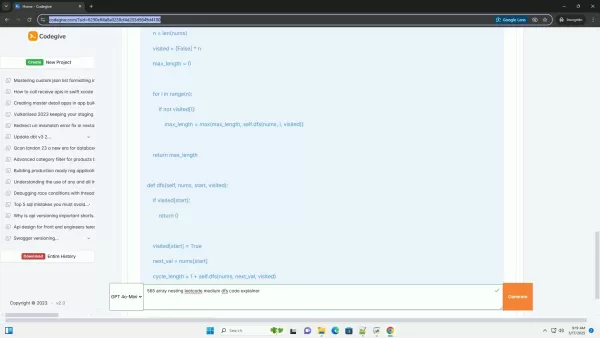
Mark as Visited: We immediately mark visited[i] as true to prevent re-entering the same cycle from a different starting point.
Recursive Exploration: We determine the next index using next = nums[i] and then make a recursive call to dfs(nums, next, visited) to continue exploring the cycle.
Calculate Cycle Length: The total length of the cycle is 1 (for the current node) plus the length returned from the recursive call. This value is then returned.cycle_length = 1 + dfs(nums, next, visited).
The Main Function (arrayNesting(nums))
- Initialize the 'visited' array: Create a boolean array of size n, setting all values to false.
- Initialize 'maxLength' to 0: This variable will track the longest cycle found.
- Iterate through each index: Loop through every index 'i' in the 'nums' array.
- Check if visited: If
visited[i] is false, initiate a DFS traversal from that index. - Update 'maxLength': Compare the length of the cycle found with the current
maxLength and update it if the new length is greater. max_length = Math.max(max_length, dfs(nums, i, visited)). - Return 'maxLength': After processing all indices, return the final value of
maxLength.
pricing
title
pricing
Advantages and Disadvantages of the DFS Approach
Pros
Effective Cycle Detection: Excellently suited for finding cycles in graph-like structures such as this array.
Systematic Traversal: Guarantees that every potential path and cycle is fully explored.
Clear Recursive Structure: The recursive nature provides a straightforward, logical flow for solving the problem.
Cons
Potential for Stack Overflow: For very large input sizes, deep recursion might cause stack overflow errors.
Space Complexity: Requires additional memory for the visited array and the recursion stack, increasing space usage.
Core Features and Benefits of Using DFS for Array Nesting
Key Code Concepts and How They Help
The DFS implementation for solving the Array Nesting problem incorporates several important programming concepts that contribute to its success:
- Recursion: The recursive nature of DFS allows it to fully explore each potential path in the array, ensuring no cycle is missed.
- Boolean Visited Array: This array is fundamental for efficiency, preventing the algorithm from processing any element more than once.
- Cycle Detection Logic: The algorithm inherently detects a cycle when it attempts to visit a node that is already part of the current traversal path.
- Dynamic Cycle Length Calculation: The length of each cycle is calculated on the fly as the DFS progresses through the array.
- Maximization Step: Continuously updating the maximum length ensures the final answer is the largest cycle found.
Enhanced Understanding Through Code Example
To illustrate the DFS process, consider this example:
Given the array nums = [5,4,0,3,1,6,2], the DFS algorithm would execute as follows:
- Starting at index 0, it marks index 0 as visited and proceeds to the value at
nums[0], which is 5. - From index 5, it marks index 5 as visited and moves to
nums[5], which is 6. - From index 6, it marks index 6 as visited and moves to
nums[6], which is 2. - At index 2, the algorithm marks it as visited and finds that
nums[2] is 0. Since 0 was already visited, the cycle [0, 5, 6, 2] is complete, with a length of 4.
The algorithm correctly identifies this as the longest cycle.
Use Cases
title
use_cases
Frequently Asked Questions
Why is DFS preferred over other graph traversal algorithms like BFS for this problem?
DFS is generally more suitable for cycle detection because it explores one path as deeply as possible before backtracking. This deep exploration makes it natural to detect when a path loops back to a previously visited node, forming a cycle. Breadth-First Search (BFS) is better suited for finding shortest paths and is less intuitive for this specific task.
Can this problem be solved without using extra space?
Yes, an O(1) space solution is possible by modifying the original input array. Instead of a separate 'visited' array, you can mark visited indices directly within the 'nums' array by changing their values to a sentinel value like -1. It is important to note that this approach alters the original input data.
How does the range of numbers in the array (0 to n-1) influence the solution?
The constraint that all values are between 0 and n-1 is crucial. It guarantees that every value in the array is a valid index within the array itself. This property is what makes the cycle detection problem well-defined and solvable using graph traversal techniques like DFS.
Related Questions
Given an array nums of n integers where nums[i] is in the range [0, n - 1], can you write a function to find and return the longest cycle in the array? Provide both Java and Python implementations.
Certainly. Here are implementations in Java and Python designed to find the longest cycle length:import java.util.Arrays;class Solution {public int arrayNesting(int[] nums) {int n = nums.length;boolean[] visited = new boolean[n];int maxLength = 0;for (int i = 0; i int:n = len(nums)visited = [False] * nmax_length = 0for i in range(n):if not visited[i]:max_length = max(max_length, self.dfs(nums, i, visited))return max_lengthdef dfs(self, nums: List[int], start: int, visited: List[bool]) -> int:if visited[start]:return 0visited[start] = Truenext_val = nums[start]cycle_length = 1 + self.dfs(nums, next_val, visited)return cycle_length# Example Usagenums = [5,4,0,3,1,6,2]solution = Solution()result = solution.arrayNesting(nums)print(f"Length of the longest cycle: {result}")# Output: 4These implementations are optimized to efficiently detect cycles and calculate their lengths, using a visited array to prevent unnecessary reprocessing.
Related article
 DeepMind CEO Hassabis: I sleep six hours a day, usually feel energetic around 1 a.m.
Fortune recently featured an interview with Demis Hassabis, CEO of Google DeepMind, revealing his unconventional approach to rest and productivity. Hassabis disclosed that he sleeps very little, structuring his waking hours into two distinct work blo
OpenAI, Anthropic Vie for Market Share Despite Revenue Shortfalls
Despite recent reports suggesting OpenAI missed revenue targets, creating pressure on tech stocks this Tuesday, private AI lab investors remain resilient. Seasoned backers have confirmed they will not reduce investment despite negative media coverage
California AV Compliance: A New Era of Tickets, Geofences, and 1M Miles
Guident operates an AuveTech shuttle in South Florida, managing a four-mile route in West Palm Beach and a one-mile route in Boca Raton using its remote monitoring technology. | Credit: GuidentCalifornia is redefining the regulatory landscape for dri
Related Special Topic Recommendations
Video creation
DeepMind CEO Hassabis: I sleep six hours a day, usually feel energetic around 1 a.m.
Fortune recently featured an interview with Demis Hassabis, CEO of Google DeepMind, revealing his unconventional approach to rest and productivity. Hassabis disclosed that he sleeps very little, structuring his waking hours into two distinct work blo
OpenAI, Anthropic Vie for Market Share Despite Revenue Shortfalls
Despite recent reports suggesting OpenAI missed revenue targets, creating pressure on tech stocks this Tuesday, private AI lab investors remain resilient. Seasoned backers have confirmed they will not reduce investment despite negative media coverage
California AV Compliance: A New Era of Tickets, Geofences, and 1M Miles
Guident operates an AuveTech shuttle in South Florida, managing a four-mile route in West Palm Beach and a one-mile route in Boca Raton using its remote monitoring technology. | Credit: GuidentCalifornia is redefining the regulatory landscape for dri
Related Special Topic Recommendations
Video creation
 AI Short-Form Video Hook Generators for Reels, Shorts, and Product Launch Campaigns
2026 Latest Best AI Short-Form Video Hook Generators for Reels Shorts and Product Launch Campaigns! XIX.AI curates top-rated powerful game-changing tools that deliver must-try results through real-world tests. This weekly updated page offers free vs paid comparison rankings to help you find the perfect solution for boosting content creativity and productivity. Explore now to Unlock your AI edge!
 11 tools
 xix.ai
writing
AI Article Outline Tools for Long Form Writing
xix.ai
writing
AI Article Outline Tools for Long Form Writing
2026 Latest Best Top-Rated AI Article Outline Tools for Long Form Writing! This curated collection features powerful, game-changing tools that deliver accurate, structured outlines with real-world tests to boost writing efficiency significantly. XIX.AI is part of this elite selection. Get a free vs paid comparison to help you choose the perfect tool. Explore now and Unlock your AI edge!
9 tools
xix.ai
chatbot
Best AI Roleplay Chat Apps for Language Practice, Interview Prep, and Daily Fluency
2026 Latest Best Top-rated AI Roleplay Chat Apps for Language Practice, Interview Prep, and Daily Fluency! XIX.AI curates a powerful game-changing collection that offers free vs paid comparison, real-world tests, and updated rankings weekly. These must-try tools help you boost writing skills, overcome fluency challenges, and improve communication efficiency across all daily scenarios. Explore now to discover your perfect tool for language growth!
10 tools
xix.ai
Music composition
AI Stem Separation Tools for Remix Production, Sampling Prep, and Karaoke Masters
2026 Latest Best Top-rated AI Stem Separation Tools Curated for Remix Production, Sampling Prep, and Karaoke Masters. These powerful game-changing tools offer real-world tests to deliver precise audio isolation, boosting productivity significantly. XIX.AI provides a weekly updated free vs paid comparison guide to help you find the must-try solution that suits your needs. Explore now to unlock your AI edge.
8 tools
xix.ai
Data Analysis
AI SQL Copilots for Revenue Dashboards, Funnel Analysis, and Product Metrics
2026 Latest Best AI SQL Copilots Ranked Top-Rated! XIX.AI curates a powerful game-changing collection for weekly updated real-world tests. These must-try tools help you generate accurate revenue dashboards, analyze sales funnels, and track product metrics swiftly, boosting productivity massively. Explore now to Discover your perfect tool for data-driven decision making! 238 characters
9 tools
xix.ai
Music composition
Best AI Melody Writing Tools for Song Drafts
2026 Latest Best Top-Rated AI Melody Writing Tools for Song Drafts! XIX.AI has curated a highly powerful game-changing collection that goes through rigorous real-world tests to deliver the best writing experience. You can find detailed free vs paid comparisons, accurate rankings, and must-try options designed to help you create stunning song drafts effortlessly and boost your creative productivity significantly. Explore now to discover your perfect tool!
8 tools
xix.ai

 Comments (1)
0/500
Comments (1)
0/500
![NicholasLewis]()
Als ich das Problem gestern selbst probiert habe, habe ich ewig gebraucht. Aber die Erklärung hier, wie man mit DFS die optimalen zyklischen Muster findet, ist super nachvollziehbar. Hoffentlich kann ich das bei der nächsten Interview-Frage anwenden. 🤞
Array nesting may appear complex at first, but with the correct strategy, it transforms into an intriguing challenge. This guide thoroughly examines LeetCode problem 565, Array Nesting, offering a comprehensive exploration of how to solve it using Depth-First Search (DFS). We will walk through the problem description, explain why DFS is an effective method, break down the algorithm, provide detailed code samples, and discuss optimization tactics. By the conclusion, you will possess a solid understanding of both array nesting and DFS, equipping you to confidently handle similar problems.
Key Points
Grasp the problem statement for Array Nesting on LeetCode (problem 565).
Learn why Depth-First Search (DFS) is well-suited for identifying cycles within arrays.
Deconstruct the DFS algorithm into clear, manageable steps.
Review code implementations in both Java and Python.
Analyze considerations for time and space complexity.
Discover optimization methods, such as employing a visited array.
Follow a step-by-step example to reinforce your comprehension.
Understanding Array Nesting
Problem Statement: LeetCode 565
Let's start with a formal definition of the problem. You are given an array 'nums' containing 'n' integers, where each value 'nums[i]' falls within the range [0, n - 1]. This array represents a permutation of the numbers from 0 to n-1. Your objective is to determine the length of the longest set (or cycle) formed by following this sequence:
- Begin at any index 'i'.
- The subsequent element in the set is 'nums[i]'.
- The element after that is 'nums[nums[i]]', and you continue this pattern.
- This process continues until you reach an element that has already been encountered within the current set.
The goal is to return the length of the largest such set found within the array. This problem tests your ability to navigate array structures and identify cyclical patterns.
Why Depth-First Search (DFS) is a Good Fit
Depth-First Search (DFS) is an intuitive and effective strategy for problems involving cycle detection. You can conceptualize the array as a directed graph, where each index directs you to another index. DFS is adept at systematically exploring such graphs by traversing as far as possible along each branch before backtracking. Here are the key reasons it works well for array nesting:
- Systematic Exploration: DFS explores each potential path thoroughly before moving to the next, ensuring complete traversal of any cycles.
- Cycle Detection: If during traversal you encounter a node already visited in the current path, you have successfully identified a cycle. Keeping track of visited nodes is essential for this.
- Efficiency: By marking nodes as visited, we prevent redundant calculations, optimizing the overall solution.
Alternative Solutions
Alternative 1: Iterative Implementation of DFS
This iterative approach to Depth-First Search provides an alternative to recursion. The following Java code detects cycles and calculates their length without recursion, thereby avoiding potential stack overflow issues:
The main advantages of this implementation are: This method offers a more memory-efficient solution by calculating cycle lengths directly within the input array. The following Python code demonstrates this in-place approach: Key benefits of this approach include: We utilize a Boolean array named ‘visited’, which has the same length as the ‘nums’ array. The value This recursive function accepts the 'nums' array, a starting index 'i', and the 'visited' array. It performs a depth-first search beginning at index 'i' and returns the length of the cycle discovered. Base Case: If Mark as Visited: We immediately mark Recursive Exploration: We determine the next index using Calculate Cycle Length: The total length of the cycle is 1 (for the current node) plus the length returned from the recursive call. This value is then returned. pricing Effective Cycle Detection: Excellently suited for finding cycles in graph-like structures such as this array. Systematic Traversal: Guarantees that every potential path and cycle is fully explored. Clear Recursive Structure: The recursive nature provides a straightforward, logical flow for solving the problem. Potential for Stack Overflow: For very large input sizes, deep recursion might cause stack overflow errors. Space Complexity: Requires additional memory for the visited array and the recursion stack, increasing space usage. The DFS implementation for solving the Array Nesting problem incorporates several important programming concepts that contribute to its success: To illustrate the DFS process, consider this example: Given the array The algorithm correctly identifies this as the longest cycle. use_cases DFS is generally more suitable for cycle detection because it explores one path as deeply as possible before backtracking. This deep exploration makes it natural to detect when a path loops back to a previously visited node, forming a cycle. Breadth-First Search (BFS) is better suited for finding shortest paths and is less intuitive for this specific task. Yes, an O(1) space solution is possible by modifying the original input array. Instead of a separate 'visited' array, you can mark visited indices directly within the 'nums' array by changing their values to a sentinel value like -1. It is important to note that this approach alters the original input data. The constraint that all values are between 0 and n-1 is crucial. It guarantees that every value in the array is a valid index within the array itself. This property is what makes the cycle detection problem well-defined and solvable using graph traversal techniques like DFS. Certainly. Here are implementations in Java and Python designed to find the longest cycle length:import java.util.Arrays;class Solution {public int arrayNesting(int[] nums) {int n = nums.length;boolean[] visited = new boolean[n];int maxLength = 0;for (int i = 0; i int:n = len(nums)visited = [False] * nmax_length = 0for i in range(n):if not visited[i]:max_length = max(max_length, self.dfs(nums, i, visited))return max_lengthdef dfs(self, nums: List[int], start: int, visited: List[bool]) -> int:if visited[start]:return 0visited[start] = Truenext_val = nums[start]cycle_length = 1 + self.dfs(nums, next_val, visited)return cycle_length# Example Usagenums = [5,4,0,3,1,6,2]solution = Solution()result = solution.arrayNesting(nums)print(f"Length of the longest cycle: {result}")# Output: 4These implementations are optimized to efficiently detect cycles and calculate their lengths, using a visited array to prevent unnecessary reprocessing.import java.util.Arrays;class Solution {public int arrayNesting(int[] nums) {int n = nums.length;boolean[] visited = new boolean[n];int maxLength = 0;for (int start = 0; start Alternative 2: In-Place Cycle Length Computation
class Solution:def arrayNesting(self, nums: List[int]) -> int:n = len(nums)max_length = 0for i in range(n):if nums[i] != -1:# Proceed only if this index hasn't been processedstart = icount = 0while nums[start] != -1:next_index = nums[start]nums[start] = -1# Mark as visited by setting to -1start = next_indexcount += 1max_length = max(max_length, count)return max_length# Example Usagenums = [5,4,0,3,1,6,2]solution = Solution()result = solution.arrayNesting(nums)print(f"Length of the longest cycle: {result}") # Output: 4DFS Algorithm: Step-by-Step Implementation
Visited Array
visited[i] is set to true once we have explored the element at index 'i' in any cycle. This array is critical for efficiency, as it prevents us from recalculating cycle lengths for elements we have already processed.The DFS Function (dfs(nums, i, visited))
visited[i] is already true, it indicates this element is part of a cycle we have already measured. The function returns 0 to avoid redundant work.visited[i] as true to prevent re-entering the same cycle from a different starting point.next = nums[i] and then make a recursive call to dfs(nums, next, visited) to continue exploring the cycle.cycle_length = 1 + dfs(nums, next, visited).The Main Function (arrayNesting(nums))
visited[i] is false, initiate a DFS traversal from that index.maxLength and update it if the new length is greater. max_length = Math.max(max_length, dfs(nums, i, visited)).maxLength.pricing
title
Advantages and Disadvantages of the DFS Approach
Pros
Cons
Core Features and Benefits of Using DFS for Array Nesting
Key Code Concepts and How They Help
Enhanced Understanding Through Code Example
nums = [5,4,0,3,1,6,2], the DFS algorithm would execute as follows:nums[0], which is 5.nums[5], which is 6.nums[6], which is 2.nums[2] is 0. Since 0 was already visited, the cycle [0, 5, 6, 2] is complete, with a length of 4.Use Cases
title
Frequently Asked Questions
Why is DFS preferred over other graph traversal algorithms like BFS for this problem?
Can this problem be solved without using extra space?
How does the range of numbers in the array (0 to n-1) influence the solution?
Related Questions
Given an array nums of n integers where nums[i] is in the range [0, n - 1], can you write a function to find and return the longest cycle in the array? Provide both Java and Python implementations.








 DeepMind CEO Hassabis: I sleep six hours a day, usually feel energetic around 1 a.m.
Fortune recently featured an interview with Demis Hassabis, CEO of Google DeepMind, revealing his unconventional approach to rest and productivity. Hassabis disclosed that he sleeps very little, structuring his waking hours into two distinct work blo
DeepMind CEO Hassabis: I sleep six hours a day, usually feel energetic around 1 a.m.
Fortune recently featured an interview with Demis Hassabis, CEO of Google DeepMind, revealing his unconventional approach to rest and productivity. Hassabis disclosed that he sleeps very little, structuring his waking hours into two distinct work blo
 OpenAI, Anthropic Vie for Market Share Despite Revenue Shortfalls
Despite recent reports suggesting OpenAI missed revenue targets, creating pressure on tech stocks this Tuesday, private AI lab investors remain resilient. Seasoned backers have confirmed they will not reduce investment despite negative media coverage
California AV Compliance: A New Era of Tickets, Geofences, and 1M Miles
Guident operates an AuveTech shuttle in South Florida, managing a four-mile route in West Palm Beach and a one-mile route in Boca Raton using its remote monitoring technology. | Credit: GuidentCalifornia is redefining the regulatory landscape for dri
OpenAI, Anthropic Vie for Market Share Despite Revenue Shortfalls
Despite recent reports suggesting OpenAI missed revenue targets, creating pressure on tech stocks this Tuesday, private AI lab investors remain resilient. Seasoned backers have confirmed they will not reduce investment despite negative media coverage
California AV Compliance: A New Era of Tickets, Geofences, and 1M Miles
Guident operates an AuveTech shuttle in South Florida, managing a four-mile route in West Palm Beach and a one-mile route in Boca Raton using its remote monitoring technology. | Credit: GuidentCalifornia is redefining the regulatory landscape for dri

2026 Latest Best AI Short-Form Video Hook Generators for Reels Shorts and Product Launch Campaigns! XIX.AI curates top-rated powerful game-changing tools that deliver must-try results through real-world tests. This weekly updated page offers free vs paid comparison rankings to help you find the perfect solution for boosting content creativity and productivity. Explore now to Unlock your AI edge!
11 tools
xix.ai

2026 Latest Best Top-Rated AI Article Outline Tools for Long Form Writing! This curated collection features powerful, game-changing tools that deliver accurate, structured outlines with real-world tests to boost writing efficiency significantly. XIX.AI is part of this elite selection. Get a free vs paid comparison to help you choose the perfect tool. Explore now and Unlock your AI edge!
9 tools
xix.ai

2026 Latest Best Top-rated AI Roleplay Chat Apps for Language Practice, Interview Prep, and Daily Fluency! XIX.AI curates a powerful game-changing collection that offers free vs paid comparison, real-world tests, and updated rankings weekly. These must-try tools help you boost writing skills, overcome fluency challenges, and improve communication efficiency across all daily scenarios. Explore now to discover your perfect tool for language growth!
10 tools
xix.ai

2026 Latest Best Top-rated AI Stem Separation Tools Curated for Remix Production, Sampling Prep, and Karaoke Masters. These powerful game-changing tools offer real-world tests to deliver precise audio isolation, boosting productivity significantly. XIX.AI provides a weekly updated free vs paid comparison guide to help you find the must-try solution that suits your needs. Explore now to unlock your AI edge.
8 tools
xix.ai

2026 Latest Best AI SQL Copilots Ranked Top-Rated! XIX.AI curates a powerful game-changing collection for weekly updated real-world tests. These must-try tools help you generate accurate revenue dashboards, analyze sales funnels, and track product metrics swiftly, boosting productivity massively. Explore now to Discover your perfect tool for data-driven decision making! 238 characters
9 tools
xix.ai

2026 Latest Best Top-Rated AI Melody Writing Tools for Song Drafts! XIX.AI has curated a highly powerful game-changing collection that goes through rigorous real-world tests to deliver the best writing experience. You can find detailed free vs paid comparisons, accurate rankings, and must-try options designed to help you create stunning song drafts effortlessly and boost your creative productivity significantly. Explore now to discover your perfect tool!
8 tools
xix.ai

Als ich das Problem gestern selbst probiert habe, habe ich ewig gebraucht. Aber die Erklärung hier, wie man mit DFS die optimalen zyklischen Muster findet, ist super nachvollziehbar. Hoffentlich kann ich das bei der nächsten Interview-Frage anwenden. 🤞












