


 Home
HomeGoogle DeepMind's TIPSv2: AI That Truly Understands Images, Not Just Glances
AI image understanding currently has a core limitation.
When asked "What is in this picture?" it can provide a detailed response. However, asking "Where is the panda's left hind leg?" leads to vague answers. This is not a flaw in any specific model but a persistent issue across the entire visual-language large model domain: strong global understanding but weak local localization.
Google DeepMind introduced TIPSv2 in their latest paper, specifically designed to address this challenging problem.
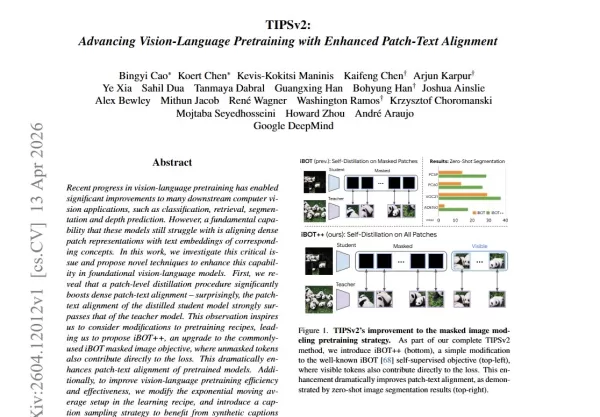
The research team observed a counterintuitive finding: in fine-grained segmentation tasks, smaller student models frequently outperform larger teacher models. This happens because distillation removes the masking mechanism, compelling the model to learn every detail of the entire image, creating a form of "full-area supervision." Motivated by this insight, TIPSv2 introduced three key enhancements.
First, iBOT++. Traditional pre-training only computes loss for masked regions, leaving visible areas in a neglected state that causes local semantics to drift. iBOT++ requires the model to provide precise supervision over all visible areas, effectively upgrading the task from a "puzzle game" to "carefully reading the entire text." This single improvement boosted zero-shot segmentation performance by 14.1 percentage points.
Second, Head-only EMA. Traditional self-supervised training requires keeping two nearly identical large models in memory, which is highly resource-intensive. TIPSv2 discovered that the image-text contrastive loss alone is enough to stabilize the backbone network, so EMA only needs to be applied to the final projection head, eliminating the need to duplicate the backbone. This reduces the training parameter count by about 42%, making it faster with almost no performance drop.
Third, multi-granularity text pairing. During training, short web descriptions, medium-detail descriptions, and long descriptions generated by Gemini are randomly mixed and fed into the model, alternating between easy and hard tasks. This prevents the model from coasting on simple tasks while ensuring no details are overlooked.
The final results are compelling. TIPSv2 underwent frozen evaluation across nine tasks and 20 authoritative datasets. Zero-shot semantic segmentation achieved a new industry benchmark, while image-text retrieval and classification outperformed comparison models with 56% more parameters. Pure visual tasks also placed among the top performers.
The code and model weights for TIPSv2 are fully open-sourced. For teams working in medical imaging, autonomous driving, industrial inspection, and other domains that demand high-precision image understanding, this solution is well worth a close look.
Paper: https://www.alphaxiv.org/abs/2604.12012
Related article
 Anthropic Expands Claude AI Coding Tools to Japan in Push for Overseas Growth
Anthropic, a prominent U.S. artificial intelligence firm, is intensifying its global outreach. On Wednesday, the company hosted a major developer gathering, "Code with Claude," in Tokyo, drawing close to 500 software engineers. This initiative seeks
India’s Software Giant Cuts Hiring, Promises No Layoffs as AI Agents Scale Up
As artificial intelligence reshapes traditional labor-intensive business models, Tata Consultancy Services (TCS), a premier Indian software outsourcing firm, has unveiled its strategic response. During Tuesday’s annual general meeting, the chairman o
China Locks AI Models During Gaokam to Block Instant Homework Help
With the 2026 Gaokao fast approaching, rumors regarding the suspension of AI tools during the exam period have ignited intense online debate. In response to public concern, major AI platforms and educational apps have clarified their stance: rather t
Related Special Topic Recommendations
Design & Art
Anthropic Expands Claude AI Coding Tools to Japan in Push for Overseas Growth
Anthropic, a prominent U.S. artificial intelligence firm, is intensifying its global outreach. On Wednesday, the company hosted a major developer gathering, "Code with Claude," in Tokyo, drawing close to 500 software engineers. This initiative seeks
India’s Software Giant Cuts Hiring, Promises No Layoffs as AI Agents Scale Up
As artificial intelligence reshapes traditional labor-intensive business models, Tata Consultancy Services (TCS), a premier Indian software outsourcing firm, has unveiled its strategic response. During Tuesday’s annual general meeting, the chairman o
China Locks AI Models During Gaokam to Block Instant Homework Help
With the 2026 Gaokao fast approaching, rumors regarding the suspension of AI tools during the exam period have ignited intense online debate. In response to public concern, major AI platforms and educational apps have clarified their stance: rather t
Related Special Topic Recommendations
Design & Art
 Best AI Style Transfer Tools for Creative Experiments
2026 Latest Best Top-rated AI Style Transfer Tools for Creative Experiments! XIX.AI has curated a powerful, game-changing collection of must-try tools that deliver exceptional results through real-world tests and rigorous rankings. These top solutions help creatives boost productivity significantly by accelerating content creation and unlocking endless creative possibilities. Explore now to discover your perfect tool and start creating today!
 9 tools
 xix.ai
Comic Creation
Best AI Dialogue Bubble Tools for Visual Storytelling
xix.ai
Comic Creation
Best AI Dialogue Bubble Tools for Visual Storytelling
2026 Latest Best Top-Rated AI Dialogue Bubble Tools for Visual Storytelling are here on XIX.AI! This curated collection features powerful, game-changing tools that help creators boost productivity and overcome creative bottlenecks. Get a free vs paid comparison, see real-world tests, and check the latest rankings to find the must-try solutions perfect for crafting engaging visual narratives. Explore now to discover your ideal tool!
10 tools
xix.ai
Meeting Assistant
Top AI Meeting Summary Tools: Track Decisions and Follow-Ups Clearly
2026 Latest Top-Rated Best AI Meeting Summary Tools for Clear Decision Tracking and Effortless Follow-Ups. This curated list showcases powerful, game-changing solutions that boost productivity dramatically by automating meeting notes, identifying key action items, and streamlining team coordination across all projects. Get a free vs paid comparison along with real-world tests and weekly updated rankings to help you find the perfect tool. Explore now to unlock your AI edge!
9 tools
xix.ai
Data Analysis
Best AI Data Cleaning Tools: Fix Missing Values and Duplicates Fast
2026 Latest Best Top-rated AI Data Cleaning Tools for quick fixing of missing values and duplicates. This curated list showcases powerful, game-changing solutions that boost productivity significantly. Each option has undergone rigorous real-world tests to ensure reliability. Get a free vs paid comparison and discover the must-try tool that fits your needs best. Explore now at XIX.AI to Unlock your AI edge.
11 tools
xix.ai
Design & Art
Best AI Creative Ideation Tools for Artists: Break Through Visual Blocks
2026 Latest Best Top-Rated AI Creative Ideation Tools for Artists are curated by XIX.AI to help creators break through visual blocks and boost creativity instantly. These powerful game-changing tools offer real-world tests, detailed free vs paid comparison, and weekly updated rankings. Discover your perfect tool to accelerate content creation and unlock your AI edge today. Explore now!
14 tools
xix.ai
Music composition
AI Beat Makers for TikTok Background Tracks, Reels Audio, and Creator Promo Music
2026 Latest Best AI Beat Makers for TikTok Background Tracks, Reels Audio, and Creator Promo Music! XIX.AI has curated a top-rated list of powerful game-changing tools that go through real-world tests to deliver flawless music for every content need. You’ll find detailed free vs paid comparison data, weekly updated rankings, and must-try options to help you boost creativity and productivity. Explore now to discover your perfect tool!
11 tools
xix.ai

 Comments (0)
0/500
Comments (0)
0/500
AI image understanding currently has a core limitation.
When asked "What is in this picture?" it can provide a detailed response. However, asking "Where is the panda's left hind leg?" leads to vague answers. This is not a flaw in any specific model but a persistent issue across the entire visual-language large model domain: strong global understanding but weak local localization.
Google DeepMind introduced TIPSv2 in their latest paper, specifically designed to address this challenging problem.
The research team observed a counterintuitive finding: in fine-grained segmentation tasks, smaller student models frequently outperform larger teacher models. This happens because distillation removes the masking mechanism, compelling the model to learn every detail of the entire image, creating a form of "full-area supervision." Motivated by this insight, TIPSv2 introduced three key enhancements.
First, iBOT++. Traditional pre-training only computes loss for masked regions, leaving visible areas in a neglected state that causes local semantics to drift. iBOT++ requires the model to provide precise supervision over all visible areas, effectively upgrading the task from a "puzzle game" to "carefully reading the entire text." This single improvement boosted zero-shot segmentation performance by 14.1 percentage points.
Second, Head-only EMA. Traditional self-supervised training requires keeping two nearly identical large models in memory, which is highly resource-intensive. TIPSv2 discovered that the image-text contrastive loss alone is enough to stabilize the backbone network, so EMA only needs to be applied to the final projection head, eliminating the need to duplicate the backbone. This reduces the training parameter count by about 42%, making it faster with almost no performance drop.
Third, multi-granularity text pairing. During training, short web descriptions, medium-detail descriptions, and long descriptions generated by Gemini are randomly mixed and fed into the model, alternating between easy and hard tasks. This prevents the model from coasting on simple tasks while ensuring no details are overlooked.
The final results are compelling. TIPSv2 underwent frozen evaluation across nine tasks and 20 authoritative datasets. Zero-shot semantic segmentation achieved a new industry benchmark, while image-text retrieval and classification outperformed comparison models with 56% more parameters. Pure visual tasks also placed among the top performers.
The code and model weights for TIPSv2 are fully open-sourced. For teams working in medical imaging, autonomous driving, industrial inspection, and other domains that demand high-precision image understanding, this solution is well worth a close look.
Paper: https://www.alphaxiv.org/abs/2604.12012








 Anthropic Expands Claude AI Coding Tools to Japan in Push for Overseas Growth
Anthropic, a prominent U.S. artificial intelligence firm, is intensifying its global outreach. On Wednesday, the company hosted a major developer gathering, "Code with Claude," in Tokyo, drawing close to 500 software engineers. This initiative seeks
Anthropic Expands Claude AI Coding Tools to Japan in Push for Overseas Growth
Anthropic, a prominent U.S. artificial intelligence firm, is intensifying its global outreach. On Wednesday, the company hosted a major developer gathering, "Code with Claude," in Tokyo, drawing close to 500 software engineers. This initiative seeks
 India’s Software Giant Cuts Hiring, Promises No Layoffs as AI Agents Scale Up
As artificial intelligence reshapes traditional labor-intensive business models, Tata Consultancy Services (TCS), a premier Indian software outsourcing firm, has unveiled its strategic response. During Tuesday’s annual general meeting, the chairman o
India’s Software Giant Cuts Hiring, Promises No Layoffs as AI Agents Scale Up
As artificial intelligence reshapes traditional labor-intensive business models, Tata Consultancy Services (TCS), a premier Indian software outsourcing firm, has unveiled its strategic response. During Tuesday’s annual general meeting, the chairman o
 China Locks AI Models During Gaokam to Block Instant Homework Help
With the 2026 Gaokao fast approaching, rumors regarding the suspension of AI tools during the exam period have ignited intense online debate. In response to public concern, major AI platforms and educational apps have clarified their stance: rather t
China Locks AI Models During Gaokam to Block Instant Homework Help
With the 2026 Gaokao fast approaching, rumors regarding the suspension of AI tools during the exam period have ignited intense online debate. In response to public concern, major AI platforms and educational apps have clarified their stance: rather t

2026 Latest Best Top-rated AI Style Transfer Tools for Creative Experiments! XIX.AI has curated a powerful, game-changing collection of must-try tools that deliver exceptional results through real-world tests and rigorous rankings. These top solutions help creatives boost productivity significantly by accelerating content creation and unlocking endless creative possibilities. Explore now to discover your perfect tool and start creating today!
9 tools
xix.ai
2026 Latest Best Top-Rated AI Dialogue Bubble Tools for Visual Storytelling are here on XIX.AI! This curated collection features powerful, game-changing tools that help creators boost productivity and overcome creative bottlenecks. Get a free vs paid comparison, see real-world tests, and check the latest rankings to find the must-try solutions perfect for crafting engaging visual narratives. Explore now to discover your ideal tool!
10 tools
xix.ai
2026 Latest Top-Rated Best AI Meeting Summary Tools for Clear Decision Tracking and Effortless Follow-Ups. This curated list showcases powerful, game-changing solutions that boost productivity dramatically by automating meeting notes, identifying key action items, and streamlining team coordination across all projects. Get a free vs paid comparison along with real-world tests and weekly updated rankings to help you find the perfect tool. Explore now to unlock your AI edge!
9 tools
xix.ai

2026 Latest Best Top-rated AI Data Cleaning Tools for quick fixing of missing values and duplicates. This curated list showcases powerful, game-changing solutions that boost productivity significantly. Each option has undergone rigorous real-world tests to ensure reliability. Get a free vs paid comparison and discover the must-try tool that fits your needs best. Explore now at XIX.AI to Unlock your AI edge.
11 tools
xix.ai
2026 Latest Best Top-Rated AI Creative Ideation Tools for Artists are curated by XIX.AI to help creators break through visual blocks and boost creativity instantly. These powerful game-changing tools offer real-world tests, detailed free vs paid comparison, and weekly updated rankings. Discover your perfect tool to accelerate content creation and unlock your AI edge today. Explore now!
14 tools
xix.ai

2026 Latest Best AI Beat Makers for TikTok Background Tracks, Reels Audio, and Creator Promo Music! XIX.AI has curated a top-rated list of powerful game-changing tools that go through real-world tests to deliver flawless music for every content need. You’ll find detailed free vs paid comparison data, weekly updated rankings, and must-try options to help you boost creativity and productivity. Explore now to discover your perfect tool!
11 tools
xix.ai












