


 Home
Flash Launches Mark the Arrival of a Revolution in Agent Efficiency
Today marks the official release of Step3.7Flash. This open-source model is specifically designed to tackle the key challenges associated with the Agent era, including improving efficiency, ensuring reliability, and enhancing multimodal processing capabilities. It has quickly gained significant attention within the industry due to its release under an open weights model license (Apache 2.0).
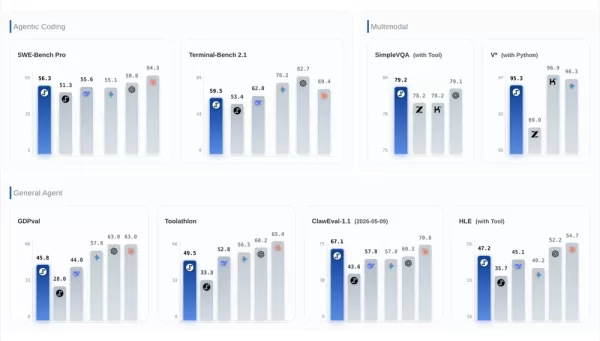
Outstanding Benchmark Results and Strong Practical Performance
Step3.7Flash has delivered exceptional performance across a variety of critical evaluation tests:
First place in ClawEval-1.1 with 67.1 points
First place in SimpleVQA Search with 79.2 points
Second place in SWE-PRO with 56.3 points
A score of 95.3 in V* Python assessments
These results confirm its strong competitive edge in complex use cases such as Agent tasks, code generation, and visual search applications.
Optimized Parameters: Balancing Speed, Cost, and Performance
Developed specifically for Agentic, coding, searching, and multimodal workflows, Step3.7Flash has made significant advancements in speed and efficiency:
Reasoning Speed: Up to 400 TPS
Architecture: 198B sparse MoE structure featuring approximately 11B active parameters
Context Length: Supports up to 256K characters
Reasoning Level: Offers three different levels of reasoning depth
While maintaining high performance, this model also reduces actual deployment costs, making it an efficient choice for developers.
Multimodal Understanding Combined with Reliable Execution, Truly Enabling "See and Act"
The most notable feature of Step3.7Flash is its robust perception-action loop capability. It can interpret UI interfaces, charts, documents, and images, then automatically generate code or invoke tools to carry out the necessary actions.
In addition, its enhanced Web+ visual search function allows access to a wider range of information sources and supports more detailed follow-up queries. The reliability of tool calls has also been greatly improved, achieving a success rate of over 98% across all difficulty levels of the τ²-bench, which helps minimize issues such as target drift and tool call failures.
Compatibility with Existing Ecosystems and Easy Local Deployment
This model works well with popular agent frameworks including Claude Code, KiloCode, Hermes Agent, and OpenClaw, as well as MCP protocols. It is also compatible with local hardware such as Mac Studio M4Max, DGX Spark, and AMD AI Max+395, facilitating local deployment and use in scenarios where data privacy is a priority.
AIbase Commentary
Related article
 Former OpenAI Researcher Barrett Zoph Returns to Google to Support Gemini Development
Barret Zoph, who previously abruptly left and joined OpenAI due to a disagreement with Thinking Machines Lab CEO Miriam Mularati, has once again changed employers. Alphabet's Google announced that Zoph will return as Vice President of Research, bring
How Recursive Intelligence Raised $335M at $4B Valuation in 4 Months
The co-founders of startup Ricursive Intelligence seemed destined to be co-founders.Anna Goldie, CEO, and Azalia Mirhoseini, CTO, are so well-known in the AI community that they were among those AI engineers who “got those weird emails from Zuckerber
AI race won’t wait, nor will this TechCrunch Disrupt 25% discount
Every founder building in AI right now is asking the same question: Are we moving fast enough, and effectively enough? TechCrunch Disrupt 2026 puts you in the same room as the people wrestling with that existential question at the highest levels. Fro
Related Special Topic Recommendations
Design & Art
 Top AI Illustration Tools: Create Editorial Scenes and Cover Art Faster
2026 Latest Top-rated AI Illustration Tools: Our curated list features the best powerfully designed tools for creating stunning editorial scenes and eye-catching cover art quickly. Each option has gone through rigorous real-world tests, offering a free vs paid comparison to help you find the perfect match for your workflow. Try these must-try solutions today to unlock your AI edge and boost your creative productivity. Explore now at XIX.AI.
 10 tools
 xix.ai
Education and Learning
Top AI Tutors for Exam Prep: Practice Math, Science, and English
2026 Latest Top-Rated Best AI Tutors for Exam Prep are here on XIX.AI! Our curated list features powerful game-changing tools that offer free vs paid comparison, real-world tests, and weekly updated rankings. They help boost your writing efficiency, simplify complex topic learning, and unlock your academic potential. Explore now to Discover your perfect exam prep tool and Start creating today to Unlock your AI edge!
10 tools
xix.ai
Finance
AI Budget Planning Tools for Personal Money Management
2026 Latest Best Top-Rated AI Budget Planning Tools for Personal Money Management are here on XIX.AI! This curated collection features powerful, game-changing solutions that help you conduct real-world tests, understand spending habits, and create personalized plans to boost productivity. Enjoy a free vs paid comparison along with detailed rankings. Must-try tools designed to simplify money management and unlock your AI edge. Explore now!
11 tools
xix.ai
Health & Wellness
AI Sleep Tracking Assistants: Improve Recovery with Better Bedtime Habits
2026 Latest Best Top-Rated AI Sleep Tracking Assistants curated for ultimate recovery. This fully updated weekly guide features powerful tools that deliver real-world tests, free vs paid comparison, and detailed rankings to help you find the must-try solution that boosts sleep quality and supports better bedtime habits. Explore now at XIX.AI to Unlock your AI edge.
10 tools
xix.ai
Data Analysis
AI SQL Copilots for Product and Revenue Analytics
2026 Latest Best Top-Rated AI SQL Copilots for Product and Revenue Analytics! XIX.AI has curated a powerful, game-changing collection of must-try tools that undergo real-world tests through weekly updated rankings. These tools help users boost productivity significantly by accelerating data analysis, streamlining complex queries, and generating accurate insights to drive smarter business decisions. Explore now to Discover your perfect tool for unlocking your AI edge!
14 tools
xix.ai
Education and Learning
Best AI Homework Helpers That Teach: Learn Concepts, Not Just Answers
2026 Latest Best Top-Rated AI Homework Helpers That Teach Core Concepts Not Just Answers Powerful Tools for Students Must-Try Curated List Weekly Updated Free vs Paid Comparison Real-World Tests Accurate Rankings to Help You Unlock Your Full Learning Potential Explore now to Discover your perfect tool for smarter studying.
10 tools
xix.ai

 Comments (0)
0/500
Today marks the official release of Step3.7Flash. This open-source model is specifically designed to tackle the key challenges associated with the Agent era, including improving efficiency, ensuring reliability, and enhancing multimodal processing capabilities. It has quickly gained significant attention within the industry due to its release under an open weights model license (Apache 2.0).
Outstanding Benchmark Results and Strong Practical Performance
Step3.7Flash has delivered exceptional performance across a variety of critical evaluation tests:
First place in ClawEval-1.1 with 67.1 points
First place in SimpleVQA Search with 79.2 points
Second place in SWE-PRO with 56.3 points
A score of 95.3 in V* Python assessments
These results confirm its strong competitive edge in complex use cases such as Agent tasks, code generation, and visual search applications.
Optimized Parameters: Balancing Speed, Cost, and Performance
Developed specifically for Agentic, coding, searching, and multimodal workflows, Step3.7Flash has made significant advancements in speed and efficiency:
Reasoning Speed: Up to 400 TPS
Architecture: 198B sparse MoE structure featuring approximately 11B active parameters
Context Length: Supports up to 256K characters
Reasoning Level: Offers three different levels of reasoning depth
While maintaining high performance, this model also reduces actual deployment costs, making it an efficient choice for developers.
Multimodal Understanding Combined with Reliable Execution, Truly Enabling "See and Act"
The most notable feature of Step3.7Flash is its robust perception-action loop capability. It can interpret UI interfaces, charts, documents, and images, then automatically generate code or invoke tools to carry out the necessary actions.
In addition, its enhanced Web+ visual search function allows access to a wider range of information sources and supports more detailed follow-up queries. The reliability of tool calls has also been greatly improved, achieving a success rate of over 98% across all difficulty levels of the τ²-bench, which helps minimize issues such as target drift and tool call failures.
Compatibility with Existing Ecosystems and Easy Local Deployment
This model works well with popular agent frameworks including Claude Code, KiloCode, Hermes Agent, and OpenClaw, as well as MCP protocols. It is also compatible with local hardware such as Mac Studio M4Max, DGX Spark, and AMD AI Max+395, facilitating local deployment and use in scenarios where data privacy is a priority.
AIbase Commentary








 Former OpenAI Researcher Barrett Zoph Returns to Google to Support Gemini Development
Barret Zoph, who previously abruptly left and joined OpenAI due to a disagreement with Thinking Machines Lab CEO Miriam Mularati, has once again changed employers. Alphabet's Google announced that Zoph will return as Vice President of Research, bring
 How Recursive Intelligence Raised $335M at $4B Valuation in 4 Months
The co-founders of startup Ricursive Intelligence seemed destined to be co-founders.Anna Goldie, CEO, and Azalia Mirhoseini, CTO, are so well-known in the AI community that they were among those AI engineers who “got those weird emails from Zuckerber
 AI race won’t wait, nor will this TechCrunch Disrupt 25% discount
Every founder building in AI right now is asking the same question: Are we moving fast enough, and effectively enough? TechCrunch Disrupt 2026 puts you in the same room as the people wrestling with that existential question at the highest levels. Fro

2026 Latest Top-rated AI Illustration Tools: Our curated list features the best powerfully designed tools for creating stunning editorial scenes and eye-catching cover art quickly. Each option has gone through rigorous real-world tests, offering a free vs paid comparison to help you find the perfect match for your workflow. Try these must-try solutions today to unlock your AI edge and boost your creative productivity. Explore now at XIX.AI.
10 tools
xix.ai

2026 Latest Top-Rated Best AI Tutors for Exam Prep are here on XIX.AI! Our curated list features powerful game-changing tools that offer free vs paid comparison, real-world tests, and weekly updated rankings. They help boost your writing efficiency, simplify complex topic learning, and unlock your academic potential. Explore now to Discover your perfect exam prep tool and Start creating today to Unlock your AI edge!
10 tools
xix.ai

2026 Latest Best Top-Rated AI Budget Planning Tools for Personal Money Management are here on XIX.AI! This curated collection features powerful, game-changing solutions that help you conduct real-world tests, understand spending habits, and create personalized plans to boost productivity. Enjoy a free vs paid comparison along with detailed rankings. Must-try tools designed to simplify money management and unlock your AI edge. Explore now!
11 tools
xix.ai

2026 Latest Best Top-Rated AI Sleep Tracking Assistants curated for ultimate recovery. This fully updated weekly guide features powerful tools that deliver real-world tests, free vs paid comparison, and detailed rankings to help you find the must-try solution that boosts sleep quality and supports better bedtime habits. Explore now at XIX.AI to Unlock your AI edge.
10 tools
xix.ai

2026 Latest Best Top-Rated AI SQL Copilots for Product and Revenue Analytics! XIX.AI has curated a powerful, game-changing collection of must-try tools that undergo real-world tests through weekly updated rankings. These tools help users boost productivity significantly by accelerating data analysis, streamlining complex queries, and generating accurate insights to drive smarter business decisions. Explore now to Discover your perfect tool for unlocking your AI edge!
14 tools
xix.ai

2026 Latest Best Top-Rated AI Homework Helpers That Teach Core Concepts Not Just Answers Powerful Tools for Students Must-Try Curated List Weekly Updated Free vs Paid Comparison Real-World Tests Accurate Rankings to Help You Unlock Your Full Learning Potential Explore now to Discover your perfect tool for smarter studying.
10 tools
xix.ai












