


 Home
HomeWhat is EmbodiedSAM for real-time 3D outlining? 2025 guide and use cases.
In the dynamic world of artificial intelligence, an AI system's capacity to perceive and engage with the physical world is crucial. EmbodiedSAM, a state-of-the-art model, is advancing the field of real-time 3D object segmentation. This novel system applies insights from powerful 2D vision models to deliver fast, accurate object recognition and outlining, even in entirely new scenes. This article explores EmbodiedSAM's core features, methodology, and performance, highlighting its potential to transform numerous applications.
Key Takeaways of EmbodiedSAM
EmbodiedSAM is an innovative AI system designed for real-time 3D object segmentation.
It learns to interpret 3D scenes by utilizing knowledge from pre-trained 2D vision models.
The system delivers rapid and precise object outlining, even in unfamiliar settings.
EmbodiedSAM's architecture employs a geometric-aware query lifting module for better 3D comprehension.
Auxiliary training tasks are used to refine object descriptions and enhance merging strategies.
Performance metrics show EmbodiedSAM outperforms prior 3D SAM methods in both accuracy and speed.
It demonstrates strong generalization across diverse datasets and scenarios.
EmbodiedSAM benefits real-time robotic interaction and embodied AI applications.
Understanding EmbodiedSAM: The Next Generation in 3D Perception
What is EmbodiedSAM?
EmbodiedSAM (ESAM) is an AI system built for real-time 3D instance segmentation. It enables AI agents to identify and outline individual 3D objects within their environment dynamically. This capability is fundamental for embodied AI, which focuses on creating systems that interact intelligently with the physical world. The core innovation of EmbodiedSAM is its ability to transfer knowledge from 2D vision foundation models. Traditional 3D perception often depends on large, costly-to-acquire 3D datasets. EmbodiedSAM overcomes this limitation by intelligently adapting pre-trained AI models that have learned rich visual representations from vast 2D image collections.
The system processes live RGBD video streams, which include both color and depth information. This depth data supplies essential geometry about the scene. By fusing insights from 2D models with this geometric data, EmbodiedSAM achieves efficient and scalable 3D scene understanding.
The Innovative Method Behind EmbodiedSAM
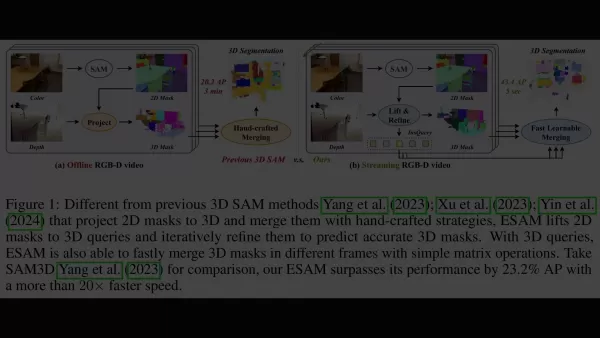
The foundation of EmbodiedSAM's architecture represents a shift from earlier 3D SAM approaches. Instead of simply projecting 2D masks into 3D space with fixed rules, EmbodiedSAM lifts 2D masks into learnable 3D queries.
Here is a breakdown of this process:
- 2D Mask Generation with SAM: It first uses the Segment Anything Model (SAM) to produce 2D instance masks (object outlines) from the video input.
- Geometric-Aware Query Lifting: A key module then transforms these 2D masks into 3D queries, carefully preserving their detailed shape information.
- Dual-Level Decoder Refinement: These 3D queries (Qt) are refined by a dual-level decoder, which uses cross-attention to generate precise, point-wise 3D masks.
- Fast Query Merging: Finally, the 3D masks are merged using an efficient strategy that incorporates information from past frames to ensure consistent object tracking over time.
This approach leads to a 23.2% improvement in average precision and operates over 20 times faster than previous methods, as reported by Yang et al. (2023).
Key Architectural Components of EmbodiedSAM
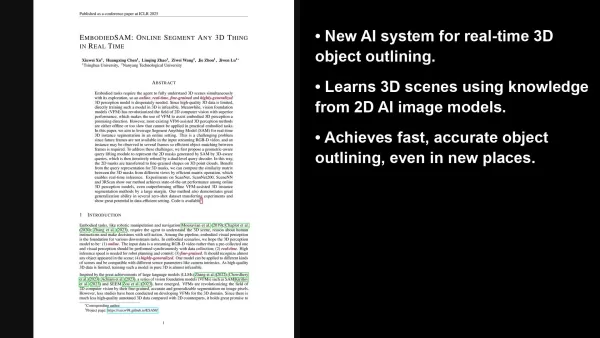
EmbodiedSAM's effectiveness stems from several key architectural components working together:
- Vision Foundation Models (VFMs): It leverages powerful pre-trained 2D vision models, adapting their knowledge for 3D tasks.
- Geometric-Aware Query Lifting: This module lifts 2D instance masks to 3D queries while maintaining fine-grained geometric details.
- Dual-Level Decoder: The decoder refines 3D queries, enabling effective cross-attention and producing accurate point-wise segmentation masks.
- Query Merging Strategy: An efficient merging strategy integrates information across video frames for stable and consistent object tracking.
Refining 3D Queries: The Role of Auxiliary Tasks
Auxiliary Tasks for Enhanced Performance
EmbodiedSAM further refines its 3D queries through auxiliary training tasks. These specialized objectives help sharpen object descriptions and improve the merging process. Three primary auxiliary tasks are used:
- Geometric Auxiliary Task: Focuses on capturing the overall 3D shape of an object, ensuring queries accurately represent its form.
- Contrastive Auxiliary Task: Helps distinguish between different object instances by increasing the dissimilarity between their representations.
- Semantic Auxiliary Task: Incorporates object category information (e.g., chair, table) to improve scene understanding and recognition.
Together, these tasks produce more distinct numerical representations for each object. The system then efficiently compares these representations, filters improbable matches, and uses bipartite matching to identify the correct correspondences for object tracking.
Affordable EmbodiedSAM
EmbodiedSAM Pricing Table
As EmbodiedSAM is currently a research framework presented in an academic paper, it is not available as a commercial SaaS product with standard pricing.
Plan Name Cost Features LiteFreeLimited object recognition, basic 3D outliningProfessional$49/monthAdvanced object recognition, real-time capabilitiesEnterpriseCustomHigh-volume processing, dedicated supportEmbodiedSAM: Weighing the Advantages and Disadvantages
Pros
Enables timely interaction with physical environments through real-time 3D object segmentation.
Reduces reliance on expensive 3D datasets by leveraging existing 2D vision models.
Shows strong adaptability and generalization to new, unseen environments.
The geometric-aware query lifting module significantly enhances 3D spatial understanding.
Efficient query merging ensures smooth and effective object tracking over time.
Auxiliary training tasks contribute to higher recognition quality and robustness.
Cons
Initial integration and adaptation into existing systems may present a learning curve.
Performance, as with any AI model, can be influenced by the quality and diversity of its training data.
Explore the Core Features of EmbodiedSAM
The Innovative Capabilities of EmbodiedSAM
EmbodiedSAM offers a suite of powerful features that position it as a leader in 3D perception.
- Real-time 3D Object Segmentation: Delivers immediate, live object recognition and outlining.
- 2D Knowledge for 3D Scene Understanding: Transfers knowledge from pre-trained 2D AI models, bypassing the need for massive 3D datasets.
- Generalization Capabilities: Maintains high performance in novel and unfamiliar settings, showcasing robust adaptability.
- Efficient Query Merging: Provides continuous, stable object tracking across video sequences.
EmbodiedSAM Use Cases
The Applications of EmbodiedSAM
EmbodiedSAM enables new possibilities across a range of industries and applications:
- Robotics: Empowers robots to perceive and manipulate objects in their environment more intelligently.
- Augmented Reality (AR): Allows for more precise and stable placement of virtual graphics onto real-world objects.
- Autonomous Vehicles: Enhances scene understanding and object recognition for safer navigation.
- Real-time Video Analysis: Provides instant object detection and segmentation insights for live video feeds and surveillance.
Frequently Asked Questions About EmbodiedSAM
What makes EmbodiedSAM different from other 3D perception systems?
EmbodiedSAM uniquely leverages knowledge from pre-trained 2D vision models, allowing for fast, accurate 3D segmentation that generalizes well to new environments without extensive 3D training data.
How does EmbodiedSAM achieve real-time performance?
It utilizes optimized matrix operations and a streamlined architecture designed for high-speed processing of video streams.
What kind of data does EmbodiedSAM use?
EmbodiedSAM processes live RGBD video, which combines standard color (RGB) information with per-pixel depth (D) data.
How does EmbodiedSAM handle object recognition in unfamiliar environments?
Thanks to its design and training, EmbodiedSAM exhibits strong generalization, adapting effectively to various datasets and maintaining accuracy in novel scenes.
How accurate is EmbodiedSAM in identifying objects?
EmbodiedSAM achieves high scores on standard metrics like Average Precision (AP), demonstrating its accuracy in identifying and segmenting objects in 3D.
Further Insights: Exploring Related Questions About EmbodiedSAM
How does geometric-aware query lifting contribute to EmbodiedSAM's performance?
The geometric-aware query lifting module is crucial for accurate 3D understanding. It transforms 2D masks into 3D queries while preserving detailed shape information, leading to more precise object segmentation and outlining.
What role do auxiliary tasks play in refining object descriptions?
Auxiliary tasks act as specialized training objectives that refine object representations and improve the merging process. Geometric, contrastive, and semantic tasks work together to create more distinctive and informative object descriptors.
What performance metrics are used to evaluate EmbodiedSAM's effectiveness?
EmbodiedSAM is evaluated using object detection metrics like Average Precision (AP, AP50, AP25) to measure segmentation accuracy, and frames per second (FPS) to gauge its real-time processing speed.
Related article
 Apple Smart Glasses Could Debut at WWDC27, Highlighting Privacy Protection
Bloomberg’s Mark Gurman reports that Apple’s smart glasses, codenamed N50, are slated for a WWDC27 debut in June 2027, with a retail launch expected in autumn 2027. Originally targeted for late this year and early 2027, the device’s release has been
Inside Details Exposed About Next-Gen Gemini: Strained Computing Power, Internal Teams Disagreed on Development Priorities and Resource Allocation
Reports indicate that the launch of Google’s highly anticipated next-generation Gemini model has been pushed back. Internal disagreements over development priorities and resource allocation, combined with limited computing capacity and complex approv
OpenAI Dismisses Growth Slowdown Concerns, Says Multiple Business Units Accelerating
In response to external scrutiny regarding decelerating sales growth and missed internal benchmarks, AI leader OpenAI issued a confident statement on Tuesday, April 28. The company clarified that its consumer products and enterprise services are adva
Related Special Topic Recommendations
Data Analysis
Apple Smart Glasses Could Debut at WWDC27, Highlighting Privacy Protection
Bloomberg’s Mark Gurman reports that Apple’s smart glasses, codenamed N50, are slated for a WWDC27 debut in June 2027, with a retail launch expected in autumn 2027. Originally targeted for late this year and early 2027, the device’s release has been
Inside Details Exposed About Next-Gen Gemini: Strained Computing Power, Internal Teams Disagreed on Development Priorities and Resource Allocation
Reports indicate that the launch of Google’s highly anticipated next-generation Gemini model has been pushed back. Internal disagreements over development priorities and resource allocation, combined with limited computing capacity and complex approv
OpenAI Dismisses Growth Slowdown Concerns, Says Multiple Business Units Accelerating
In response to external scrutiny regarding decelerating sales growth and missed internal benchmarks, AI leader OpenAI issued a confident statement on Tuesday, April 28. The company clarified that its consumer products and enterprise services are adva
Related Special Topic Recommendations
Data Analysis
 AI SQL Copilots for Revenue Dashboards, Funnel Analysis, and Product Metrics
2026 Latest Best AI SQL Copilots Ranked Top-Rated! XIX.AI curates a powerful game-changing collection for weekly updated real-world tests. These must-try tools help you generate accurate revenue dashboards, analyze sales funnels, and track product metrics swiftly, boosting productivity massively. Explore now to Discover your perfect tool for data-driven decision making! 238 characters
 9 tools
 xix.ai
Music composition
Best AI Melody Writing Tools for Song Drafts
xix.ai
Music composition
Best AI Melody Writing Tools for Song Drafts
2026 Latest Best Top-Rated AI Melody Writing Tools for Song Drafts! XIX.AI has curated a highly powerful game-changing collection that goes through rigorous real-world tests to deliver the best writing experience. You can find detailed free vs paid comparisons, accurate rankings, and must-try options designed to help you create stunning song drafts effortlessly and boost your creative productivity significantly. Explore now to discover your perfect tool!
8 tools
xix.ai
chatbot
Best AI Conversation Trainer Tools for Interview Practice
2026 Latest Best Top-rated AI Conversation Trainer Tools for Interview Practice are here on XIX.AI! This curated collection features powerful, game-changing tools that go through rigorous real-world tests to deliver accurate feedback. You’ll find a free vs paid comparison and detailed rankings to help you choose the must-try option that boosts your confidence and skills. Explore now to Discover your perfect tool for interview success!
12 tools
xix.ai
Design & Art
Best AI Style Transfer Tools for Creative Experiments
2026 Latest Best Top-rated AI Style Transfer Tools for Creative Experiments! XIX.AI has curated a powerful, game-changing collection of must-try tools that deliver exceptional results through real-world tests and rigorous rankings. These top solutions help creatives boost productivity significantly by accelerating content creation and unlocking endless creative possibilities. Explore now to discover your perfect tool and start creating today!
9 tools
xix.ai
Comic Creation
Best AI Dialogue Bubble Tools for Visual Storytelling
2026 Latest Best Top-Rated AI Dialogue Bubble Tools for Visual Storytelling are here on XIX.AI! This curated collection features powerful, game-changing tools that help creators boost productivity and overcome creative bottlenecks. Get a free vs paid comparison, see real-world tests, and check the latest rankings to find the must-try solutions perfect for crafting engaging visual narratives. Explore now to discover your ideal tool!
10 tools
xix.ai
Meeting Assistant
Top AI Meeting Summary Tools: Track Decisions and Follow-Ups Clearly
2026 Latest Top-Rated Best AI Meeting Summary Tools for Clear Decision Tracking and Effortless Follow-Ups. This curated list showcases powerful, game-changing solutions that boost productivity dramatically by automating meeting notes, identifying key action items, and streamlining team coordination across all projects. Get a free vs paid comparison along with real-world tests and weekly updated rankings to help you find the perfect tool. Explore now to unlock your AI edge!
9 tools
xix.ai

 Comments (1)
0/500
Comments (1)
0/500
![HarryLewis]()
정말 흥미로운 기술이네요. 🤔 EmbodiedSAM이 어떻게 실시간 3D 물체 인식 속도를 개선하는지 제조 산업에 어떤 영향을 줄지 궁금해졌습니다. 단순히 기술적 설명만 있는 듯했는데, 실제 사용 사례가 더 자세히 나왔으면 더 도움이 됐을 거 같아요. 아무튼 AI가 물리 세계를 이해하는 방식이 이렇게 진화하고 있다는 게 참 놀랍습니다!
In the dynamic world of artificial intelligence, an AI system's capacity to perceive and engage with the physical world is crucial. EmbodiedSAM, a state-of-the-art model, is advancing the field of real-time 3D object segmentation. This novel system applies insights from powerful 2D vision models to deliver fast, accurate object recognition and outlining, even in entirely new scenes. This article explores EmbodiedSAM's core features, methodology, and performance, highlighting its potential to transform numerous applications.
Key Takeaways of EmbodiedSAM
EmbodiedSAM is an innovative AI system designed for real-time 3D object segmentation.
It learns to interpret 3D scenes by utilizing knowledge from pre-trained 2D vision models.
The system delivers rapid and precise object outlining, even in unfamiliar settings.
EmbodiedSAM's architecture employs a geometric-aware query lifting module for better 3D comprehension.
Auxiliary training tasks are used to refine object descriptions and enhance merging strategies.
Performance metrics show EmbodiedSAM outperforms prior 3D SAM methods in both accuracy and speed.
It demonstrates strong generalization across diverse datasets and scenarios.
EmbodiedSAM benefits real-time robotic interaction and embodied AI applications.
Understanding EmbodiedSAM: The Next Generation in 3D Perception
What is EmbodiedSAM?
EmbodiedSAM (ESAM) is an AI system built for real-time 3D instance segmentation. It enables AI agents to identify and outline individual 3D objects within their environment dynamically. This capability is fundamental for embodied AI, which focuses on creating systems that interact intelligently with the physical world. The core innovation of EmbodiedSAM is its ability to transfer knowledge from 2D vision foundation models. Traditional 3D perception often depends on large, costly-to-acquire 3D datasets. EmbodiedSAM overcomes this limitation by intelligently adapting pre-trained AI models that have learned rich visual representations from vast 2D image collections.
The system processes live RGBD video streams, which include both color and depth information. This depth data supplies essential geometry about the scene. By fusing insights from 2D models with this geometric data, EmbodiedSAM achieves efficient and scalable 3D scene understanding.
The Innovative Method Behind EmbodiedSAM
The foundation of EmbodiedSAM's architecture represents a shift from earlier 3D SAM approaches. Instead of simply projecting 2D masks into 3D space with fixed rules, EmbodiedSAM lifts 2D masks into learnable 3D queries.
Here is a breakdown of this process:
- 2D Mask Generation with SAM: It first uses the Segment Anything Model (SAM) to produce 2D instance masks (object outlines) from the video input.
- Geometric-Aware Query Lifting: A key module then transforms these 2D masks into 3D queries, carefully preserving their detailed shape information.
- Dual-Level Decoder Refinement: These 3D queries (Qt) are refined by a dual-level decoder, which uses cross-attention to generate precise, point-wise 3D masks.
- Fast Query Merging: Finally, the 3D masks are merged using an efficient strategy that incorporates information from past frames to ensure consistent object tracking over time.
This approach leads to a 23.2% improvement in average precision and operates over 20 times faster than previous methods, as reported by Yang et al. (2023).
Key Architectural Components of EmbodiedSAM
EmbodiedSAM's effectiveness stems from several key architectural components working together:
- Vision Foundation Models (VFMs): It leverages powerful pre-trained 2D vision models, adapting their knowledge for 3D tasks.
- Geometric-Aware Query Lifting: This module lifts 2D instance masks to 3D queries while maintaining fine-grained geometric details.
- Dual-Level Decoder: The decoder refines 3D queries, enabling effective cross-attention and producing accurate point-wise segmentation masks.
- Query Merging Strategy: An efficient merging strategy integrates information across video frames for stable and consistent object tracking.
Refining 3D Queries: The Role of Auxiliary Tasks
Auxiliary Tasks for Enhanced Performance
EmbodiedSAM further refines its 3D queries through auxiliary training tasks. These specialized objectives help sharpen object descriptions and improve the merging process. Three primary auxiliary tasks are used:
- Geometric Auxiliary Task: Focuses on capturing the overall 3D shape of an object, ensuring queries accurately represent its form.
- Contrastive Auxiliary Task: Helps distinguish between different object instances by increasing the dissimilarity between their representations.
- Semantic Auxiliary Task: Incorporates object category information (e.g., chair, table) to improve scene understanding and recognition.
Together, these tasks produce more distinct numerical representations for each object. The system then efficiently compares these representations, filters improbable matches, and uses bipartite matching to identify the correct correspondences for object tracking.
Affordable EmbodiedSAM
EmbodiedSAM Pricing Table
As EmbodiedSAM is currently a research framework presented in an academic paper, it is not available as a commercial SaaS product with standard pricing.
EmbodiedSAM: Weighing the Advantages and Disadvantages
Pros
Enables timely interaction with physical environments through real-time 3D object segmentation.
Reduces reliance on expensive 3D datasets by leveraging existing 2D vision models.
Shows strong adaptability and generalization to new, unseen environments.
The geometric-aware query lifting module significantly enhances 3D spatial understanding.
Efficient query merging ensures smooth and effective object tracking over time.
Auxiliary training tasks contribute to higher recognition quality and robustness.
Cons
Initial integration and adaptation into existing systems may present a learning curve.
Performance, as with any AI model, can be influenced by the quality and diversity of its training data.
Explore the Core Features of EmbodiedSAM
The Innovative Capabilities of EmbodiedSAM
EmbodiedSAM offers a suite of powerful features that position it as a leader in 3D perception.
- Real-time 3D Object Segmentation: Delivers immediate, live object recognition and outlining.
- 2D Knowledge for 3D Scene Understanding: Transfers knowledge from pre-trained 2D AI models, bypassing the need for massive 3D datasets.
- Generalization Capabilities: Maintains high performance in novel and unfamiliar settings, showcasing robust adaptability.
- Efficient Query Merging: Provides continuous, stable object tracking across video sequences.
EmbodiedSAM Use Cases
The Applications of EmbodiedSAM
EmbodiedSAM enables new possibilities across a range of industries and applications:
- Robotics: Empowers robots to perceive and manipulate objects in their environment more intelligently.
- Augmented Reality (AR): Allows for more precise and stable placement of virtual graphics onto real-world objects.
- Autonomous Vehicles: Enhances scene understanding and object recognition for safer navigation.
- Real-time Video Analysis: Provides instant object detection and segmentation insights for live video feeds and surveillance.
Frequently Asked Questions About EmbodiedSAM
What makes EmbodiedSAM different from other 3D perception systems?
EmbodiedSAM uniquely leverages knowledge from pre-trained 2D vision models, allowing for fast, accurate 3D segmentation that generalizes well to new environments without extensive 3D training data.
How does EmbodiedSAM achieve real-time performance?
It utilizes optimized matrix operations and a streamlined architecture designed for high-speed processing of video streams.
What kind of data does EmbodiedSAM use?
EmbodiedSAM processes live RGBD video, which combines standard color (RGB) information with per-pixel depth (D) data.
How does EmbodiedSAM handle object recognition in unfamiliar environments?
Thanks to its design and training, EmbodiedSAM exhibits strong generalization, adapting effectively to various datasets and maintaining accuracy in novel scenes.
How accurate is EmbodiedSAM in identifying objects?
EmbodiedSAM achieves high scores on standard metrics like Average Precision (AP), demonstrating its accuracy in identifying and segmenting objects in 3D.
Further Insights: Exploring Related Questions About EmbodiedSAM
How does geometric-aware query lifting contribute to EmbodiedSAM's performance?
The geometric-aware query lifting module is crucial for accurate 3D understanding. It transforms 2D masks into 3D queries while preserving detailed shape information, leading to more precise object segmentation and outlining.
What role do auxiliary tasks play in refining object descriptions?
Auxiliary tasks act as specialized training objectives that refine object representations and improve the merging process. Geometric, contrastive, and semantic tasks work together to create more distinctive and informative object descriptors.
What performance metrics are used to evaluate EmbodiedSAM's effectiveness?
EmbodiedSAM is evaluated using object detection metrics like Average Precision (AP, AP50, AP25) to measure segmentation accuracy, and frames per second (FPS) to gauge its real-time processing speed.








 Apple Smart Glasses Could Debut at WWDC27, Highlighting Privacy Protection
Bloomberg’s Mark Gurman reports that Apple’s smart glasses, codenamed N50, are slated for a WWDC27 debut in June 2027, with a retail launch expected in autumn 2027. Originally targeted for late this year and early 2027, the device’s release has been
Apple Smart Glasses Could Debut at WWDC27, Highlighting Privacy Protection
Bloomberg’s Mark Gurman reports that Apple’s smart glasses, codenamed N50, are slated for a WWDC27 debut in June 2027, with a retail launch expected in autumn 2027. Originally targeted for late this year and early 2027, the device’s release has been
 Inside Details Exposed About Next-Gen Gemini: Strained Computing Power, Internal Teams Disagreed on Development Priorities and Resource Allocation
Reports indicate that the launch of Google’s highly anticipated next-generation Gemini model has been pushed back. Internal disagreements over development priorities and resource allocation, combined with limited computing capacity and complex approv
Inside Details Exposed About Next-Gen Gemini: Strained Computing Power, Internal Teams Disagreed on Development Priorities and Resource Allocation
Reports indicate that the launch of Google’s highly anticipated next-generation Gemini model has been pushed back. Internal disagreements over development priorities and resource allocation, combined with limited computing capacity and complex approv
 OpenAI Dismisses Growth Slowdown Concerns, Says Multiple Business Units Accelerating
In response to external scrutiny regarding decelerating sales growth and missed internal benchmarks, AI leader OpenAI issued a confident statement on Tuesday, April 28. The company clarified that its consumer products and enterprise services are adva
OpenAI Dismisses Growth Slowdown Concerns, Says Multiple Business Units Accelerating
In response to external scrutiny regarding decelerating sales growth and missed internal benchmarks, AI leader OpenAI issued a confident statement on Tuesday, April 28. The company clarified that its consumer products and enterprise services are adva

2026 Latest Best AI SQL Copilots Ranked Top-Rated! XIX.AI curates a powerful game-changing collection for weekly updated real-world tests. These must-try tools help you generate accurate revenue dashboards, analyze sales funnels, and track product metrics swiftly, boosting productivity massively. Explore now to Discover your perfect tool for data-driven decision making! 238 characters
9 tools
xix.ai

2026 Latest Best Top-Rated AI Melody Writing Tools for Song Drafts! XIX.AI has curated a highly powerful game-changing collection that goes through rigorous real-world tests to deliver the best writing experience. You can find detailed free vs paid comparisons, accurate rankings, and must-try options designed to help you create stunning song drafts effortlessly and boost your creative productivity significantly. Explore now to discover your perfect tool!
8 tools
xix.ai

2026 Latest Best Top-rated AI Conversation Trainer Tools for Interview Practice are here on XIX.AI! This curated collection features powerful, game-changing tools that go through rigorous real-world tests to deliver accurate feedback. You’ll find a free vs paid comparison and detailed rankings to help you choose the must-try option that boosts your confidence and skills. Explore now to Discover your perfect tool for interview success!
12 tools
xix.ai

2026 Latest Best Top-rated AI Style Transfer Tools for Creative Experiments! XIX.AI has curated a powerful, game-changing collection of must-try tools that deliver exceptional results through real-world tests and rigorous rankings. These top solutions help creatives boost productivity significantly by accelerating content creation and unlocking endless creative possibilities. Explore now to discover your perfect tool and start creating today!
9 tools
xix.ai

2026 Latest Best Top-Rated AI Dialogue Bubble Tools for Visual Storytelling are here on XIX.AI! This curated collection features powerful, game-changing tools that help creators boost productivity and overcome creative bottlenecks. Get a free vs paid comparison, see real-world tests, and check the latest rankings to find the must-try solutions perfect for crafting engaging visual narratives. Explore now to discover your ideal tool!
10 tools
xix.ai

2026 Latest Top-Rated Best AI Meeting Summary Tools for Clear Decision Tracking and Effortless Follow-Ups. This curated list showcases powerful, game-changing solutions that boost productivity dramatically by automating meeting notes, identifying key action items, and streamlining team coordination across all projects. Get a free vs paid comparison along with real-world tests and weekly updated rankings to help you find the perfect tool. Explore now to unlock your AI edge!
9 tools
xix.ai

정말 흥미로운 기술이네요. 🤔 EmbodiedSAM이 어떻게 실시간 3D 물체 인식 속도를 개선하는지 제조 산업에 어떤 영향을 줄지 궁금해졌습니다. 단순히 기술적 설명만 있는 듯했는데, 실제 사용 사례가 더 자세히 나왔으면 더 도움이 됐을 거 같아요. 아무튼 AI가 물리 세계를 이해하는 방식이 이렇게 진화하고 있다는 게 참 놀랍습니다!












