


 Home
HomeDeepSeek's V4 Programming Skills Spark Online Buzz and Style Trend Discussions
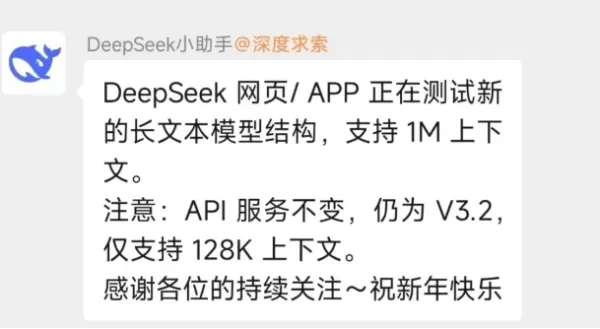
On February 11, DeepSeek started rolling out a gradual update to its web and mobile app platforms. By February 14, the company officially announced this as a trial of its new long-text model architecture. The updated web and app interfaces now handle ultra-long contexts of up to 1 million tokens, with the knowledge base refreshed to include information through May 2025. However, the API service remains on version V3.2, which still supports only 128K context. Industry experts view this update as a technical warm-up and stress test ahead of the launch of its next-generation V4 model. Consequently, online anticipation is building across platforms like Weibo for the upcoming V4 release.
Following the update, DeepSeek's interaction style shifted noticeably, prompting user feedback that it "became less personable." This topic quickly rose to the top of Weibo's trending list, amassing over 68.535 million views. Specific changes include the model no longer using personalized nicknames for users, instead addressing everyone uniformly as "user." In deep thinking mode, responses became shorter and more direct, adopting a straightforward and concise tone. Some replies were even perceived as "ambiguous in tone" or "sarcastic," leaving users accustomed to its previous empathetic style feeling a sense of withdrawal. Netizens' reactions were split: emotional fans missed the earlier warm interactions, while efficiency-minded users praised the rational and streamlined communication, seeing it as the hallmark of a true productivity tool. Notably, the updated model successfully passed the "car wash Turing test," a challenge that often trips up leading AI models.
Regarding the style shift, DeepSeek's official statement clarified that it was not an intentional change but a byproduct of prioritizing efficiency and refining response boundaries. Excessive expressions and filler content could dilute information density in complex queries, and the update also catered to users who prefer clear answers without what they see as "AI pretending to care." This development has further fueled online excitement for DeepSeek V4. Reports suggest the model is slated for release around the Spring Festival in mid-February 2026, possibly on or near February 17, according to Weibo sources.
As a flagship model with trillions of parameters, V4 places a strong emphasis on programming enhancements. Early internal benchmarks indicate that V4 has already outperformed leading models like Claude and GPT in programming tasks, positioning it to potentially reshape the AI programming landscape. Additionally, V4 introduces several key technological advances, allowing it to process and interpret extremely long code prompts and comprehend large codebase contexts in a single pass—a significant advantage for enterprise-level development. Upgraded training algorithms enhance its ability to recognize data patterns and reduce performance degradation. The model's reasoning is more rigorous and dependable, achieving stable performance without regression while striking a better balance across various capabilities.
At the same time, the model will maintain its million-token context advantage, with inference costs significantly lower than those of Western competitors. It is also scheduled to be open-sourced under the Apache 2.0 license.
Related article
 Anthropic Expands Claude AI Coding Tools to Japan in Push for Overseas Growth
Anthropic, a prominent U.S. artificial intelligence firm, is intensifying its global outreach. On Wednesday, the company hosted a major developer gathering, "Code with Claude," in Tokyo, drawing close to 500 software engineers. This initiative seeks
India’s Software Giant Cuts Hiring, Promises No Layoffs as AI Agents Scale Up
As artificial intelligence reshapes traditional labor-intensive business models, Tata Consultancy Services (TCS), a premier Indian software outsourcing firm, has unveiled its strategic response. During Tuesday’s annual general meeting, the chairman o
China Locks AI Models During Gaokam to Block Instant Homework Help
With the 2026 Gaokao fast approaching, rumors regarding the suspension of AI tools during the exam period have ignited intense online debate. In response to public concern, major AI platforms and educational apps have clarified their stance: rather t
Related Special Topic Recommendations
Design & Art
Anthropic Expands Claude AI Coding Tools to Japan in Push for Overseas Growth
Anthropic, a prominent U.S. artificial intelligence firm, is intensifying its global outreach. On Wednesday, the company hosted a major developer gathering, "Code with Claude," in Tokyo, drawing close to 500 software engineers. This initiative seeks
India’s Software Giant Cuts Hiring, Promises No Layoffs as AI Agents Scale Up
As artificial intelligence reshapes traditional labor-intensive business models, Tata Consultancy Services (TCS), a premier Indian software outsourcing firm, has unveiled its strategic response. During Tuesday’s annual general meeting, the chairman o
China Locks AI Models During Gaokam to Block Instant Homework Help
With the 2026 Gaokao fast approaching, rumors regarding the suspension of AI tools during the exam period have ignited intense online debate. In response to public concern, major AI platforms and educational apps have clarified their stance: rather t
Related Special Topic Recommendations
Design & Art
 Best AI Style Transfer Tools for Creative Experiments
2026 Latest Best Top-rated AI Style Transfer Tools for Creative Experiments! XIX.AI has curated a powerful, game-changing collection of must-try tools that deliver exceptional results through real-world tests and rigorous rankings. These top solutions help creatives boost productivity significantly by accelerating content creation and unlocking endless creative possibilities. Explore now to discover your perfect tool and start creating today!
 9 tools
 xix.ai
Comic Creation
Best AI Dialogue Bubble Tools for Visual Storytelling
xix.ai
Comic Creation
Best AI Dialogue Bubble Tools for Visual Storytelling
2026 Latest Best Top-Rated AI Dialogue Bubble Tools for Visual Storytelling are here on XIX.AI! This curated collection features powerful, game-changing tools that help creators boost productivity and overcome creative bottlenecks. Get a free vs paid comparison, see real-world tests, and check the latest rankings to find the must-try solutions perfect for crafting engaging visual narratives. Explore now to discover your ideal tool!
10 tools
xix.ai
Meeting Assistant
Top AI Meeting Summary Tools: Track Decisions and Follow-Ups Clearly
2026 Latest Top-Rated Best AI Meeting Summary Tools for Clear Decision Tracking and Effortless Follow-Ups. This curated list showcases powerful, game-changing solutions that boost productivity dramatically by automating meeting notes, identifying key action items, and streamlining team coordination across all projects. Get a free vs paid comparison along with real-world tests and weekly updated rankings to help you find the perfect tool. Explore now to unlock your AI edge!
9 tools
xix.ai
Data Analysis
Best AI Data Cleaning Tools: Fix Missing Values and Duplicates Fast
2026 Latest Best Top-rated AI Data Cleaning Tools for quick fixing of missing values and duplicates. This curated list showcases powerful, game-changing solutions that boost productivity significantly. Each option has undergone rigorous real-world tests to ensure reliability. Get a free vs paid comparison and discover the must-try tool that fits your needs best. Explore now at XIX.AI to Unlock your AI edge.
11 tools
xix.ai
Design & Art
Best AI Creative Ideation Tools for Artists: Break Through Visual Blocks
2026 Latest Best Top-Rated AI Creative Ideation Tools for Artists are curated by XIX.AI to help creators break through visual blocks and boost creativity instantly. These powerful game-changing tools offer real-world tests, detailed free vs paid comparison, and weekly updated rankings. Discover your perfect tool to accelerate content creation and unlock your AI edge today. Explore now!
14 tools
xix.ai
Music composition
AI Beat Makers for TikTok Background Tracks, Reels Audio, and Creator Promo Music
2026 Latest Best AI Beat Makers for TikTok Background Tracks, Reels Audio, and Creator Promo Music! XIX.AI has curated a top-rated list of powerful game-changing tools that go through real-world tests to deliver flawless music for every content need. You’ll find detailed free vs paid comparison data, weekly updated rankings, and must-try options to help you boost creativity and productivity. Explore now to discover your perfect tool!
11 tools
xix.ai

 Comments (0)
0/500
Comments (0)
0/500
On February 11, DeepSeek started rolling out a gradual update to its web and mobile app platforms. By February 14, the company officially announced this as a trial of its new long-text model architecture. The updated web and app interfaces now handle ultra-long contexts of up to 1 million tokens, with the knowledge base refreshed to include information through May 2025. However, the API service remains on version V3.2, which still supports only 128K context. Industry experts view this update as a technical warm-up and stress test ahead of the launch of its next-generation V4 model. Consequently, online anticipation is building across platforms like Weibo for the upcoming V4 release.
Following the update, DeepSeek's interaction style shifted noticeably, prompting user feedback that it "became less personable." This topic quickly rose to the top of Weibo's trending list, amassing over 68.535 million views. Specific changes include the model no longer using personalized nicknames for users, instead addressing everyone uniformly as "user." In deep thinking mode, responses became shorter and more direct, adopting a straightforward and concise tone. Some replies were even perceived as "ambiguous in tone" or "sarcastic," leaving users accustomed to its previous empathetic style feeling a sense of withdrawal. Netizens' reactions were split: emotional fans missed the earlier warm interactions, while efficiency-minded users praised the rational and streamlined communication, seeing it as the hallmark of a true productivity tool. Notably, the updated model successfully passed the "car wash Turing test," a challenge that often trips up leading AI models.
Regarding the style shift, DeepSeek's official statement clarified that it was not an intentional change but a byproduct of prioritizing efficiency and refining response boundaries. Excessive expressions and filler content could dilute information density in complex queries, and the update also catered to users who prefer clear answers without what they see as "AI pretending to care." This development has further fueled online excitement for DeepSeek V4. Reports suggest the model is slated for release around the Spring Festival in mid-February 2026, possibly on or near February 17, according to Weibo sources.
As a flagship model with trillions of parameters, V4 places a strong emphasis on programming enhancements. Early internal benchmarks indicate that V4 has already outperformed leading models like Claude and GPT in programming tasks, positioning it to potentially reshape the AI programming landscape. Additionally, V4 introduces several key technological advances, allowing it to process and interpret extremely long code prompts and comprehend large codebase contexts in a single pass—a significant advantage for enterprise-level development. Upgraded training algorithms enhance its ability to recognize data patterns and reduce performance degradation. The model's reasoning is more rigorous and dependable, achieving stable performance without regression while striking a better balance across various capabilities.
At the same time, the model will maintain its million-token context advantage, with inference costs significantly lower than those of Western competitors. It is also scheduled to be open-sourced under the Apache 2.0 license.








 Anthropic Expands Claude AI Coding Tools to Japan in Push for Overseas Growth
Anthropic, a prominent U.S. artificial intelligence firm, is intensifying its global outreach. On Wednesday, the company hosted a major developer gathering, "Code with Claude," in Tokyo, drawing close to 500 software engineers. This initiative seeks
Anthropic Expands Claude AI Coding Tools to Japan in Push for Overseas Growth
Anthropic, a prominent U.S. artificial intelligence firm, is intensifying its global outreach. On Wednesday, the company hosted a major developer gathering, "Code with Claude," in Tokyo, drawing close to 500 software engineers. This initiative seeks
 India’s Software Giant Cuts Hiring, Promises No Layoffs as AI Agents Scale Up
As artificial intelligence reshapes traditional labor-intensive business models, Tata Consultancy Services (TCS), a premier Indian software outsourcing firm, has unveiled its strategic response. During Tuesday’s annual general meeting, the chairman o
India’s Software Giant Cuts Hiring, Promises No Layoffs as AI Agents Scale Up
As artificial intelligence reshapes traditional labor-intensive business models, Tata Consultancy Services (TCS), a premier Indian software outsourcing firm, has unveiled its strategic response. During Tuesday’s annual general meeting, the chairman o
 China Locks AI Models During Gaokam to Block Instant Homework Help
With the 2026 Gaokao fast approaching, rumors regarding the suspension of AI tools during the exam period have ignited intense online debate. In response to public concern, major AI platforms and educational apps have clarified their stance: rather t
China Locks AI Models During Gaokam to Block Instant Homework Help
With the 2026 Gaokao fast approaching, rumors regarding the suspension of AI tools during the exam period have ignited intense online debate. In response to public concern, major AI platforms and educational apps have clarified their stance: rather t

2026 Latest Best Top-rated AI Style Transfer Tools for Creative Experiments! XIX.AI has curated a powerful, game-changing collection of must-try tools that deliver exceptional results through real-world tests and rigorous rankings. These top solutions help creatives boost productivity significantly by accelerating content creation and unlocking endless creative possibilities. Explore now to discover your perfect tool and start creating today!
9 tools
xix.ai

2026 Latest Best Top-Rated AI Dialogue Bubble Tools for Visual Storytelling are here on XIX.AI! This curated collection features powerful, game-changing tools that help creators boost productivity and overcome creative bottlenecks. Get a free vs paid comparison, see real-world tests, and check the latest rankings to find the must-try solutions perfect for crafting engaging visual narratives. Explore now to discover your ideal tool!
10 tools
xix.ai

2026 Latest Top-Rated Best AI Meeting Summary Tools for Clear Decision Tracking and Effortless Follow-Ups. This curated list showcases powerful, game-changing solutions that boost productivity dramatically by automating meeting notes, identifying key action items, and streamlining team coordination across all projects. Get a free vs paid comparison along with real-world tests and weekly updated rankings to help you find the perfect tool. Explore now to unlock your AI edge!
9 tools
xix.ai

2026 Latest Best Top-rated AI Data Cleaning Tools for quick fixing of missing values and duplicates. This curated list showcases powerful, game-changing solutions that boost productivity significantly. Each option has undergone rigorous real-world tests to ensure reliability. Get a free vs paid comparison and discover the must-try tool that fits your needs best. Explore now at XIX.AI to Unlock your AI edge.
11 tools
xix.ai

2026 Latest Best Top-Rated AI Creative Ideation Tools for Artists are curated by XIX.AI to help creators break through visual blocks and boost creativity instantly. These powerful game-changing tools offer real-world tests, detailed free vs paid comparison, and weekly updated rankings. Discover your perfect tool to accelerate content creation and unlock your AI edge today. Explore now!
14 tools
xix.ai

2026 Latest Best AI Beat Makers for TikTok Background Tracks, Reels Audio, and Creator Promo Music! XIX.AI has curated a top-rated list of powerful game-changing tools that go through real-world tests to deliver flawless music for every content need. You’ll find detailed free vs paid comparison data, weekly updated rankings, and must-try options to help you boost creativity and productivity. Explore now to discover your perfect tool!
11 tools
xix.ai












