


 Home
Home
Codex Provides One Million New Contextual Data Points for GPT-5.6 Sol, Available to ChatGPT Users Too
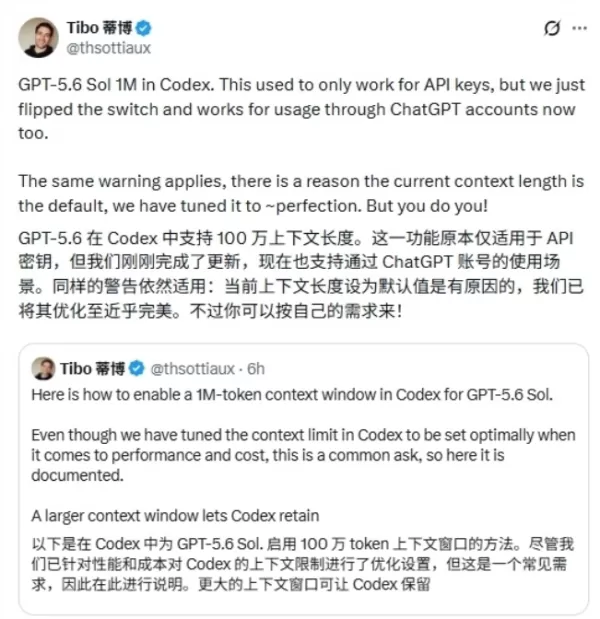
Engineer Tibo, who oversees Codex and ChatGPT at OpenAI, shared news on X indicating that the 1 million-token context window feature of the GPT-5.6 Sol model within Codex is now accessible beyond API key holders and is also available to users of ChatGPT accounts. This change eliminates the previous limitation that forced subscribed users to cut off long-term project histories when dealing with large-scale tasks.
Subscribed users can manually activate the million-token context setting
Tibo explained that GPT-5.6 Sol in Codex now supports a context length of 1 million tokens, a capability previously reserved exclusively for API key holders. He noted that the feature has already been activated through ChatGPT accounts and that users with Plus, Pro, or other subscription plans can manually configure it to utilize the full 1.05 million-token capacity when working with the Codex programming agent.
A larger context window enables Codex to retain more code snippets, tool outputs, and conversation history before automatic compression kicks in, which is particularly beneficial for professional use cases such as large-scale codebase restructuring, intricate debugging, and extended sessions. For developers managing production-level repositories, this improvement directly addresses the previous issue of frequent context exhaustion.
The default setting was carefully chosen; enabling it requires careful consideration
Tibo also stressed that the current default context length represents the outcome of balancing performance needs with cost considerations rather than being set arbitrarily. He advised users to make an informed decision based on their own requirements. Several developers added that, thanks to Codex’s server-side compression technology, the default configuration is sufficient for most routine tasks.
Nevertheless, some users have reported that activating the million-token context setting leads to faster consumption of their subscription quotas, with a single intensive session potentially using up a significant portion of their weekly allowance. Experts recommend enabling this feature only when necessary rather than as the default setting for daily use, to prevent hitting usage limits prematurely on critical projects.
Related article
 German Research Consortium Unveils Open-Source AI Model Soofi
The German Association for Artificial Intelligence has officially launched Soofi S30B-A3B, a new open-source large language model. This milestone advances Europe’s sovereign AI infrastructure and revitalizes the open-source sector with a focus on hig
Toyota’s $6.4bn robotics estimate puts physical AI in focus
Toyota Motor projects that rolling out automation across its manufacturing facilities, subsidiaries, and key suppliers may require approximately 400,000 robots and an annual expenditure of roughly 1 trillion yen ($6.4 billion) starting in 2028.Accord
Meta Open-Sources 30B-Parameter Muse Glimmer for Local AI Agent on Consumer Hardware
On August 10, Meta launched Muse Glimmer, an open-source model designed to empower local AI agents on consumer hardware, marking a key step in its "Personal Superintelligence" strategy. With 30 billion parameters, this model is the open-source counte
Related Special Topic Recommendations
Productivity
German Research Consortium Unveils Open-Source AI Model Soofi
The German Association for Artificial Intelligence has officially launched Soofi S30B-A3B, a new open-source large language model. This milestone advances Europe’s sovereign AI infrastructure and revitalizes the open-source sector with a focus on hig
Toyota’s $6.4bn robotics estimate puts physical AI in focus
Toyota Motor projects that rolling out automation across its manufacturing facilities, subsidiaries, and key suppliers may require approximately 400,000 robots and an annual expenditure of roughly 1 trillion yen ($6.4 billion) starting in 2028.Accord
Meta Open-Sources 30B-Parameter Muse Glimmer for Local AI Agent on Consumer Hardware
On August 10, Meta launched Muse Glimmer, an open-source model designed to empower local AI agents on consumer hardware, marking a key step in its "Personal Superintelligence" strategy. With 30 billion parameters, this model is the open-source counte
Related Special Topic Recommendations
Productivity
 AI Task Planning Tools for Busy Professionals
2026 Latest Best Top-rated AI Task Planning Tools for Busy Professionals! XIX.AI has curated a powerful, game-changing collection of highly efficient tools that help users streamline workflows, boost productivity, and overcome daily scheduling challenges. Each option goes through rigorous real-world tests to ensure reliability. Get a free vs paid comparison and discover the perfect tool to unlock your AI edge. Explore now!
 15 tools
 xix.ai
chatbot
Top AI Customer Chatbots: Answer FAQs and Qualify Leads 24/7
xix.ai
chatbot
Top AI Customer Chatbots: Answer FAQs and Qualify Leads 24/7
2026 Latest Top-rated AI Customer Chatbots featured on this curated list are the best solutions for answering customer FAQs instantly and qualifying leads around the clock. XIX.AI has conducted rigorous real-world tests to deliver a detailed free vs paid comparison along with up-to-date rankings, helping you find a powerful game-changing tool that boosts productivity significantly. Explore now to Discover your perfect AI chatbot solution!
9 tools
xix.ai
Design & Art
AI Storyboard Generators for Ad Creative Teams
2026 Latest Best AI Storyboard Generators for Ad Creative Teams! XIX.AI has curated a top-rated list of powerful, game-changing tools that help teams create stunning visual content faster through real-world tests and rigorous weekly updated rankings. Enjoy a free vs paid comparison to find the perfect fit for your workflow. Explore now to unlock your AI edge in ad creation!
8 tools
xix.ai
chatbot
AI Knowledge Chatbot Tools for Internal Documentation
2026 Latest Best Top-rated AI Knowledge Chatbot Tools for Internal Documentation are here on XIX.AI! This curated list features powerful game-changing solutions that significantly boost productivity by helping teams quickly generate high-quality content, streamline documentation creation, and overcome common writing challenges. We conduct rigorous real-world tests and provide a weekly updated free vs paid comparison along with detailed rankings to help you find the must-try option that fits your needs best. Explore now to Discover your perfect tool!
12 tools
xix.ai
Text-to-speech
Best AI Text-to-Speech Tools: Create Natural Voiceovers for Videos
2026 Latest Best Top-Rated AI Text-to-Speech Tools Curated for Creating Natural Voiceovers in Videos. XIX.AI delivers powerful, game-changing solutions that boost writing efficiency and help you break through creation bottlenecks. We conduct real-world tests, offer free vs paid comparison, and update our rankings weekly. Must-try options are highlighted based on rigorous evaluations. Explore now to Discover your perfect tool for enhancing video quality.
9 tools
xix.ai
Finance
Best AI Fraud Detection Tools: Spot Suspicious Patterns Before Losses Grow
2026 Latest Best Top-rated AI Fraud Detection Tools curated by XIX.AI offer powerful game-changing solutions to spot suspicious patterns swiftly and prevent costly losses. Get a free vs paid comparison, real-world tests, and detailed rankings to help you choose the must-try option that boosts your security efficiency. Explore now to Unlock your AI edge.
10 tools
xix.ai

 Comments (0)
0/500
Comments (0)
0/500
Engineer Tibo, who oversees Codex and ChatGPT at OpenAI, shared news on X indicating that the 1 million-token context window feature of the GPT-5.6 Sol model within Codex is now accessible beyond API key holders and is also available to users of ChatGPT accounts. This change eliminates the previous limitation that forced subscribed users to cut off long-term project histories when dealing with large-scale tasks.
Subscribed users can manually activate the million-token context setting
Tibo explained that GPT-5.6 Sol in Codex now supports a context length of 1 million tokens, a capability previously reserved exclusively for API key holders. He noted that the feature has already been activated through ChatGPT accounts and that users with Plus, Pro, or other subscription plans can manually configure it to utilize the full 1.05 million-token capacity when working with the Codex programming agent.
A larger context window enables Codex to retain more code snippets, tool outputs, and conversation history before automatic compression kicks in, which is particularly beneficial for professional use cases such as large-scale codebase restructuring, intricate debugging, and extended sessions. For developers managing production-level repositories, this improvement directly addresses the previous issue of frequent context exhaustion.
The default setting was carefully chosen; enabling it requires careful consideration
Tibo also stressed that the current default context length represents the outcome of balancing performance needs with cost considerations rather than being set arbitrarily. He advised users to make an informed decision based on their own requirements. Several developers added that, thanks to Codex’s server-side compression technology, the default configuration is sufficient for most routine tasks.
Nevertheless, some users have reported that activating the million-token context setting leads to faster consumption of their subscription quotas, with a single intensive session potentially using up a significant portion of their weekly allowance. Experts recommend enabling this feature only when necessary rather than as the default setting for daily use, to prevent hitting usage limits prematurely on critical projects.








 German Research Consortium Unveils Open-Source AI Model Soofi
The German Association for Artificial Intelligence has officially launched Soofi S30B-A3B, a new open-source large language model. This milestone advances Europe’s sovereign AI infrastructure and revitalizes the open-source sector with a focus on hig
German Research Consortium Unveils Open-Source AI Model Soofi
The German Association for Artificial Intelligence has officially launched Soofi S30B-A3B, a new open-source large language model. This milestone advances Europe’s sovereign AI infrastructure and revitalizes the open-source sector with a focus on hig
 Toyota’s $6.4bn robotics estimate puts physical AI in focus
Toyota Motor projects that rolling out automation across its manufacturing facilities, subsidiaries, and key suppliers may require approximately 400,000 robots and an annual expenditure of roughly 1 trillion yen ($6.4 billion) starting in 2028.Accord
Toyota’s $6.4bn robotics estimate puts physical AI in focus
Toyota Motor projects that rolling out automation across its manufacturing facilities, subsidiaries, and key suppliers may require approximately 400,000 robots and an annual expenditure of roughly 1 trillion yen ($6.4 billion) starting in 2028.Accord
 Meta Open-Sources 30B-Parameter Muse Glimmer for Local AI Agent on Consumer Hardware
On August 10, Meta launched Muse Glimmer, an open-source model designed to empower local AI agents on consumer hardware, marking a key step in its "Personal Superintelligence" strategy. With 30 billion parameters, this model is the open-source counte
Meta Open-Sources 30B-Parameter Muse Glimmer for Local AI Agent on Consumer Hardware
On August 10, Meta launched Muse Glimmer, an open-source model designed to empower local AI agents on consumer hardware, marking a key step in its "Personal Superintelligence" strategy. With 30 billion parameters, this model is the open-source counte

2026 Latest Best Top-rated AI Task Planning Tools for Busy Professionals! XIX.AI has curated a powerful, game-changing collection of highly efficient tools that help users streamline workflows, boost productivity, and overcome daily scheduling challenges. Each option goes through rigorous real-world tests to ensure reliability. Get a free vs paid comparison and discover the perfect tool to unlock your AI edge. Explore now!
15 tools
xix.ai

2026 Latest Top-rated AI Customer Chatbots featured on this curated list are the best solutions for answering customer FAQs instantly and qualifying leads around the clock. XIX.AI has conducted rigorous real-world tests to deliver a detailed free vs paid comparison along with up-to-date rankings, helping you find a powerful game-changing tool that boosts productivity significantly. Explore now to Discover your perfect AI chatbot solution!
9 tools
xix.ai

2026 Latest Best AI Storyboard Generators for Ad Creative Teams! XIX.AI has curated a top-rated list of powerful, game-changing tools that help teams create stunning visual content faster through real-world tests and rigorous weekly updated rankings. Enjoy a free vs paid comparison to find the perfect fit for your workflow. Explore now to unlock your AI edge in ad creation!
8 tools
xix.ai

2026 Latest Best Top-rated AI Knowledge Chatbot Tools for Internal Documentation are here on XIX.AI! This curated list features powerful game-changing solutions that significantly boost productivity by helping teams quickly generate high-quality content, streamline documentation creation, and overcome common writing challenges. We conduct rigorous real-world tests and provide a weekly updated free vs paid comparison along with detailed rankings to help you find the must-try option that fits your needs best. Explore now to Discover your perfect tool!
12 tools
xix.ai

2026 Latest Best Top-Rated AI Text-to-Speech Tools Curated for Creating Natural Voiceovers in Videos. XIX.AI delivers powerful, game-changing solutions that boost writing efficiency and help you break through creation bottlenecks. We conduct real-world tests, offer free vs paid comparison, and update our rankings weekly. Must-try options are highlighted based on rigorous evaluations. Explore now to Discover your perfect tool for enhancing video quality.
9 tools
xix.ai

2026 Latest Best Top-rated AI Fraud Detection Tools curated by XIX.AI offer powerful game-changing solutions to spot suspicious patterns swiftly and prevent costly losses. Get a free vs paid comparison, real-world tests, and detailed rankings to help you choose the must-try option that boosts your security efficiency. Explore now to Unlock your AI edge.
10 tools
xix.ai












