


 Home
Home
Alibaba's Aliyun Unveils Fun-CineForge: Open-Sourcing Movie-Grade Dubbing Model and Dataset
Recently, the Fun-CineForge project, developed by the speech team at Alibaba Tongyi Lab in collaboration with the University of Science and Technology of China, has been officially open-sourced. This initiative tackles core challenges in film and television dubbing—such as lip synchronization, voice style transfer, and emotional expression—by introducing a comprehensive end-to-end production workflow and large model solutions.
Core Breakthroughs: Solving the "Out-of-Sync" Problem in Film Dubbing
Traditional AI dubbing often struggles with issues like mismatched lip movements, robotic emotional delivery, and difficulty adapting to complex cinematic scenes involving dialogue and multi-person acoustics. Fun-CineForge achieves a significant breakthrough through two key innovations:
MLLM Dubbing Model: Moving beyond simple lip-area audio-video alignment, it employs a multimodal large language model (MLLM) architecture capable of deeply understanding a character's identity and emotional nuances within a scene.
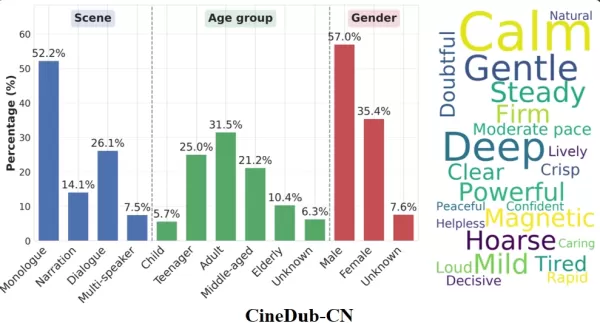
CineDub Large-Scale Dataset: The project created the first richly annotated Chinese TV show dubbing dataset via an automated pipeline, covering diverse scenarios like monologues, narration, dialogue, and multi-speaker interactions.
Project Updates and Open Source Roadmap
The project has seen frequent recent updates, indicating a high level of engineering maturity:
January to March 2026: Released sample datasets and demonstration demos for both Chinese (CineDub-CN) and English (CineDub-EN).
March 16, 2026: Officially open-sourced the inference code and model weights (Checkpoints), allowing developers to access these resources on GitHub.
Dataset Access: Several classic series datasets are now available for research, including the Chinese series "Dream of the Red Chamber" and the English series "Downton Abbey."
Technical Application: From "Dialogue" to "Performance"
Official demos show the model delivering impressive results in remaking classic series like "Romance of the Three Kingdoms." By inputting specific "emotional clues," the model can accurately capture a character's emotional shift—from fear to defiance—achieving high-fidelity voice cloning and natural lip sync.
The launch of Fun-CineForge signals a shift in film and TV AI dubbing from basic "text-to-speech" to an "automated post-production" tool with artistic comprehension. This advancement is poised to significantly reduce production costs for dubbed film and television content.
Project: https://funcineforge.github.io/
Related article
 DeepMind CEO Hassabis: I sleep six hours a day, usually feel energetic around 1 a.m.
Fortune recently featured an interview with Demis Hassabis, CEO of Google DeepMind, revealing his unconventional approach to rest and productivity. Hassabis disclosed that he sleeps very little, structuring his waking hours into two distinct work blo
OpenAI, Anthropic Vie for Market Share Despite Revenue Shortfalls
Despite recent reports suggesting OpenAI missed revenue targets, creating pressure on tech stocks this Tuesday, private AI lab investors remain resilient. Seasoned backers have confirmed they will not reduce investment despite negative media coverage
California AV Compliance: A New Era of Tickets, Geofences, and 1M Miles
Guident operates an AuveTech shuttle in South Florida, managing a four-mile route in West Palm Beach and a one-mile route in Boca Raton using its remote monitoring technology. | Credit: GuidentCalifornia is redefining the regulatory landscape for dri
Related Special Topic Recommendations
chatbot
DeepMind CEO Hassabis: I sleep six hours a day, usually feel energetic around 1 a.m.
Fortune recently featured an interview with Demis Hassabis, CEO of Google DeepMind, revealing his unconventional approach to rest and productivity. Hassabis disclosed that he sleeps very little, structuring his waking hours into two distinct work blo
OpenAI, Anthropic Vie for Market Share Despite Revenue Shortfalls
Despite recent reports suggesting OpenAI missed revenue targets, creating pressure on tech stocks this Tuesday, private AI lab investors remain resilient. Seasoned backers have confirmed they will not reduce investment despite negative media coverage
California AV Compliance: A New Era of Tickets, Geofences, and 1M Miles
Guident operates an AuveTech shuttle in South Florida, managing a four-mile route in West Palm Beach and a one-mile route in Boca Raton using its remote monitoring technology. | Credit: GuidentCalifornia is redefining the regulatory landscape for dri
Related Special Topic Recommendations
chatbot
 Best AI Roleplay Chat Apps for Language Practice, Interview Prep, and Daily Fluency
2026 Latest Best Top-rated AI Roleplay Chat Apps for Language Practice, Interview Prep, and Daily Fluency! XIX.AI curates a powerful game-changing collection that offers free vs paid comparison, real-world tests, and updated rankings weekly. These must-try tools help you boost writing skills, overcome fluency challenges, and improve communication efficiency across all daily scenarios. Explore now to discover your perfect tool for language growth!
 10 tools
 xix.ai
Music composition
AI Stem Separation Tools for Remix Production, Sampling Prep, and Karaoke Masters
xix.ai
Music composition
AI Stem Separation Tools for Remix Production, Sampling Prep, and Karaoke Masters
2026 Latest Best Top-rated AI Stem Separation Tools Curated for Remix Production, Sampling Prep, and Karaoke Masters. These powerful game-changing tools offer real-world tests to deliver precise audio isolation, boosting productivity significantly. XIX.AI provides a weekly updated free vs paid comparison guide to help you find the must-try solution that suits your needs. Explore now to unlock your AI edge.
8 tools
xix.ai
Data Analysis
AI SQL Copilots for Revenue Dashboards, Funnel Analysis, and Product Metrics
2026 Latest Best AI SQL Copilots Ranked Top-Rated! XIX.AI curates a powerful game-changing collection for weekly updated real-world tests. These must-try tools help you generate accurate revenue dashboards, analyze sales funnels, and track product metrics swiftly, boosting productivity massively. Explore now to Discover your perfect tool for data-driven decision making! 238 characters
9 tools
xix.ai
Music composition
Best AI Melody Writing Tools for Song Drafts
2026 Latest Best Top-Rated AI Melody Writing Tools for Song Drafts! XIX.AI has curated a highly powerful game-changing collection that goes through rigorous real-world tests to deliver the best writing experience. You can find detailed free vs paid comparisons, accurate rankings, and must-try options designed to help you create stunning song drafts effortlessly and boost your creative productivity significantly. Explore now to discover your perfect tool!
8 tools
xix.ai
chatbot
Best AI Conversation Trainer Tools for Interview Practice
2026 Latest Best Top-rated AI Conversation Trainer Tools for Interview Practice are here on XIX.AI! This curated collection features powerful, game-changing tools that go through rigorous real-world tests to deliver accurate feedback. You’ll find a free vs paid comparison and detailed rankings to help you choose the must-try option that boosts your confidence and skills. Explore now to Discover your perfect tool for interview success!
12 tools
xix.ai
Design & Art
Best AI Style Transfer Tools for Creative Experiments
2026 Latest Best Top-rated AI Style Transfer Tools for Creative Experiments! XIX.AI has curated a powerful, game-changing collection of must-try tools that deliver exceptional results through real-world tests and rigorous rankings. These top solutions help creatives boost productivity significantly by accelerating content creation and unlocking endless creative possibilities. Explore now to discover your perfect tool and start creating today!
9 tools
xix.ai

 Comments (0)
0/500
Comments (0)
0/500
Recently, the Fun-CineForge project, developed by the speech team at Alibaba Tongyi Lab in collaboration with the University of Science and Technology of China, has been officially open-sourced. This initiative tackles core challenges in film and television dubbing—such as lip synchronization, voice style transfer, and emotional expression—by introducing a comprehensive end-to-end production workflow and large model solutions.
Core Breakthroughs: Solving the "Out-of-Sync" Problem in Film Dubbing
Traditional AI dubbing often struggles with issues like mismatched lip movements, robotic emotional delivery, and difficulty adapting to complex cinematic scenes involving dialogue and multi-person acoustics. Fun-CineForge achieves a significant breakthrough through two key innovations:
MLLM Dubbing Model: Moving beyond simple lip-area audio-video alignment, it employs a multimodal large language model (MLLM) architecture capable of deeply understanding a character's identity and emotional nuances within a scene.
CineDub Large-Scale Dataset: The project created the first richly annotated Chinese TV show dubbing dataset via an automated pipeline, covering diverse scenarios like monologues, narration, dialogue, and multi-speaker interactions.
Project Updates and Open Source Roadmap
The project has seen frequent recent updates, indicating a high level of engineering maturity:
January to March 2026: Released sample datasets and demonstration demos for both Chinese (CineDub-CN) and English (CineDub-EN).
March 16, 2026: Officially open-sourced the inference code and model weights (Checkpoints), allowing developers to access these resources on GitHub.
Dataset Access: Several classic series datasets are now available for research, including the Chinese series "Dream of the Red Chamber" and the English series "Downton Abbey."
Technical Application: From "Dialogue" to "Performance"
Official demos show the model delivering impressive results in remaking classic series like "Romance of the Three Kingdoms." By inputting specific "emotional clues," the model can accurately capture a character's emotional shift—from fear to defiance—achieving high-fidelity voice cloning and natural lip sync.
The launch of Fun-CineForge signals a shift in film and TV AI dubbing from basic "text-to-speech" to an "automated post-production" tool with artistic comprehension. This advancement is poised to significantly reduce production costs for dubbed film and television content.
Project: https://funcineforge.github.io/








 DeepMind CEO Hassabis: I sleep six hours a day, usually feel energetic around 1 a.m.
Fortune recently featured an interview with Demis Hassabis, CEO of Google DeepMind, revealing his unconventional approach to rest and productivity. Hassabis disclosed that he sleeps very little, structuring his waking hours into two distinct work blo
DeepMind CEO Hassabis: I sleep six hours a day, usually feel energetic around 1 a.m.
Fortune recently featured an interview with Demis Hassabis, CEO of Google DeepMind, revealing his unconventional approach to rest and productivity. Hassabis disclosed that he sleeps very little, structuring his waking hours into two distinct work blo
 OpenAI, Anthropic Vie for Market Share Despite Revenue Shortfalls
Despite recent reports suggesting OpenAI missed revenue targets, creating pressure on tech stocks this Tuesday, private AI lab investors remain resilient. Seasoned backers have confirmed they will not reduce investment despite negative media coverage
California AV Compliance: A New Era of Tickets, Geofences, and 1M Miles
Guident operates an AuveTech shuttle in South Florida, managing a four-mile route in West Palm Beach and a one-mile route in Boca Raton using its remote monitoring technology. | Credit: GuidentCalifornia is redefining the regulatory landscape for dri
OpenAI, Anthropic Vie for Market Share Despite Revenue Shortfalls
Despite recent reports suggesting OpenAI missed revenue targets, creating pressure on tech stocks this Tuesday, private AI lab investors remain resilient. Seasoned backers have confirmed they will not reduce investment despite negative media coverage
California AV Compliance: A New Era of Tickets, Geofences, and 1M Miles
Guident operates an AuveTech shuttle in South Florida, managing a four-mile route in West Palm Beach and a one-mile route in Boca Raton using its remote monitoring technology. | Credit: GuidentCalifornia is redefining the regulatory landscape for dri

2026 Latest Best Top-rated AI Roleplay Chat Apps for Language Practice, Interview Prep, and Daily Fluency! XIX.AI curates a powerful game-changing collection that offers free vs paid comparison, real-world tests, and updated rankings weekly. These must-try tools help you boost writing skills, overcome fluency challenges, and improve communication efficiency across all daily scenarios. Explore now to discover your perfect tool for language growth!
10 tools
xix.ai
2026 Latest Best Top-rated AI Stem Separation Tools Curated for Remix Production, Sampling Prep, and Karaoke Masters. These powerful game-changing tools offer real-world tests to deliver precise audio isolation, boosting productivity significantly. XIX.AI provides a weekly updated free vs paid comparison guide to help you find the must-try solution that suits your needs. Explore now to unlock your AI edge.
8 tools
xix.ai
2026 Latest Best AI SQL Copilots Ranked Top-Rated! XIX.AI curates a powerful game-changing collection for weekly updated real-world tests. These must-try tools help you generate accurate revenue dashboards, analyze sales funnels, and track product metrics swiftly, boosting productivity massively. Explore now to Discover your perfect tool for data-driven decision making! 238 characters
9 tools
xix.ai

2026 Latest Best Top-Rated AI Melody Writing Tools for Song Drafts! XIX.AI has curated a highly powerful game-changing collection that goes through rigorous real-world tests to deliver the best writing experience. You can find detailed free vs paid comparisons, accurate rankings, and must-try options designed to help you create stunning song drafts effortlessly and boost your creative productivity significantly. Explore now to discover your perfect tool!
8 tools
xix.ai

2026 Latest Best Top-rated AI Conversation Trainer Tools for Interview Practice are here on XIX.AI! This curated collection features powerful, game-changing tools that go through rigorous real-world tests to deliver accurate feedback. You’ll find a free vs paid comparison and detailed rankings to help you choose the must-try option that boosts your confidence and skills. Explore now to Discover your perfect tool for interview success!
12 tools
xix.ai

2026 Latest Best Top-rated AI Style Transfer Tools for Creative Experiments! XIX.AI has curated a powerful, game-changing collection of must-try tools that deliver exceptional results through real-world tests and rigorous rankings. These top solutions help creatives boost productivity significantly by accelerating content creation and unlocking endless creative possibilities. Explore now to discover your perfect tool and start creating today!
9 tools
xix.ai












