


 Home
HomeAgentic AI Expansion Demands Advanced Memory Systems
Agentic AI marks a significant shift from simple chatbots to managing complex workflows, and scaling it demands a new approach to memory architecture.
As foundation models grow to trillions of parameters and context windows expand to millions of tokens, the computational expense of retaining history is outpacing our ability to process it effectively.
Organizations implementing these systems now encounter a bottleneck where the immense volume of "long-term memory" (technically the Key-Value (KV) cache) exceeds the capabilities of current hardware designs.
Existing infrastructure presents a limited choice: store inference context in scarce, high-bandwidth GPU memory (HBM) or move it to slower, general-purpose storage. The first option becomes too costly for large contexts, while the second introduces latency that makes real-time agentic interactions impractical.
To bridge this growing gap that hinders agentic AI scaling, NVIDIA has launched the Inference Context Memory Storage (ICMS) platform within its Rubin architecture, introducing a new storage tier built specifically for the temporary, high-speed demands of AI memory.
"AI is transforming the entire computing stack—and now, storage," Huang stated. "AI has evolved beyond single-response chatbots into intelligent collaborators that comprehend the physical world, reason over extended periods, remain fact-based, utilize tools for practical tasks, and maintain both short-term and long-term memory."
The core operational issue stems from how transformer-based models function. To prevent recalculating an entire conversation for every new word generated, models save previous states in the KV cache. In agentic workflows, this cache serves as persistent memory across tools and sessions, expanding in direct proportion to the sequence length.
This creates a unique data category. Unlike financial records or customer logs, the KV cache is derived data; it's crucial for immediate performance but doesn't need the robust durability assurances of enterprise file systems. General-purpose storage systems, running on standard CPUs, consume energy on metadata management and replication that agentic workloads don't benefit from.
The existing hierarchy, ranging from GPU HBM (G1) to shared storage (G4), is proving increasingly inefficient:
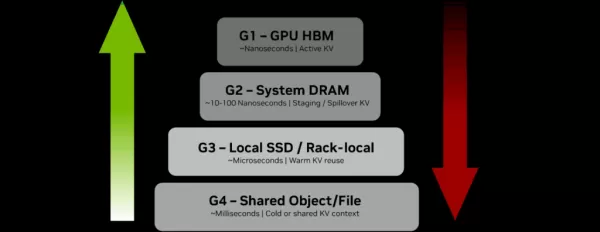
(Credit: NVIDIA) As context data moves from the GPU (G1) to system RAM (G2) and finally to shared storage (G4), efficiency drops significantly. Transferring active context to the G4 tier introduces millisecond-level delays and raises the energy cost per token, leaving costly GPUs idle while waiting for data.
For businesses, this results in a higher Total Cost of Ownership (TCO), where power is consumed by infrastructure overhead instead of active reasoning tasks.
A new memory tier for the AI factory
The industry's solution involves adding a custom-built layer to this hierarchy. The ICMS platform creates a "G3.5" tier—an Ethernet-connected flash storage layer designed specifically for large-scale inference.
This method integrates storage directly into the compute pod. By leveraging the NVIDIA BlueField-4 data processor, the platform shifts the management of this context data away from the host CPU. The system offers petabytes of shared capacity per pod, enhancing agentic AI scaling by enabling agents to hold vast amounts of history without consuming expensive HBM.
The operational advantage is measurable in both throughput and energy use. By storing relevant context in this intermediate tier—which is faster than standard storage but more affordable than HBM—the system can "preload" memory back to the GPU ahead of time. This cuts down on GPU decoder idle time, allowing for up to 5 times higher tokens-per-second (TPS) in long-context workloads.
From an energy standpoint, the benefits are equally significant. Since the architecture eliminates the overhead of general-purpose storage protocols, it achieves 5 times better power efficiency than conventional approaches.
Integrating the data plane
Deploying this architecture necessitates a shift in how IT teams perceive storage networking. The ICMS platform depends on NVIDIA Spectrum-X Ethernet to deliver the high-bandwidth, low-jitter connectivity needed to treat flash storage almost like local memory.
For enterprise infrastructure teams, the key integration point is the orchestration layer. Frameworks such as NVIDIA Dynamo and the Inference Transfer Library (NIXL) handle the movement of KV blocks between different tiers.
These tools work with the storage layer to ensure the correct context is loaded into GPU memory (G1) or host memory (G2) precisely when the AI model needs it. The NVIDIA DOCA framework further supports this by providing a KV communication layer that treats context cache as a primary resource.
Leading storage vendors are already adopting this architecture. Companies including AIC, Cloudian, DDN, Dell Technologies, HPE, Hitachi Vantara, IBM, Nutanix, Pure Storage, Supermicro, VAST Data, and WEKA are developing platforms with BlueField-4. These solutions are anticipated to be available in the second half of this year.
Redefining infrastructure for scaling agentic AI
Adopting a dedicated context memory tier influences capacity planning and data center design.
- Reclassifying data: CIOs must acknowledge KV cache as a distinct data type. It is "temporary but latency-sensitive," different from "durable and cold" compliance data. The G3.5 tier manages the former, enabling durable G4 storage to concentrate on long-term logs and artifacts.
- Orchestration maturity: Success relies on software that can intelligently allocate workloads. The system uses topology-aware orchestration (via NVIDIA Grove) to position jobs close to their cached context, reducing data movement across the network.
- Power density: By packing more usable capacity into the same rack space, organizations can extend the lifespan of their current facilities. However, this increases compute density per square meter, necessitating careful planning for cooling and power distribution.
The move to agentic AI necessitates a physical redesign of the data center. The common practice of completely separating compute from slow, persistent storage is unsuitable for the real-time retrieval requirements of agents with extensive memories.
By introducing a specialized context tier, businesses can separate the growth of model memory from the cost of GPU HBM. This agentic AI architecture allows multiple agents to share a large, low-power memory pool, lowering the cost of handling complex queries and enhancing scaling by supporting high-throughput reasoning.
As organizations prepare for their next round of infrastructure investment, assessing the efficiency of the memory hierarchy will be just as critical as choosing the GPU itself.
See also: 2025’s AI chip wars: What enterprise leaders learned about supply chain reality

Want to learn more about AI and big data from industry leaders? Check out AI & Big Data Expo taking place in Amsterdam, California, and London. The comprehensive event is part of TechEx and is co-located with other leading technology events. Click here for more information.
AI News is powered by TechForge Media. Explore other upcoming enterprise technology events and webinars here.
Related article
 Stripe to Acquire OpenRouter as AI Model Routing Gains Momentum
Stripe has agreed to acquire OpenRouter, an AI model-routing platform that gives developers access to hundreds of models through a single interface. The deal adds model selection and routing to Stripe’s existing work around AI usage and token-based b
Former OpenAI Researcher Barrett Zoph Returns to Google to Support Gemini Development
Barret Zoph, who previously abruptly left and joined OpenAI due to a disagreement with Thinking Machines Lab CEO Miriam Mularati, has once again changed employers. Alphabet's Google announced that Zoph will return as Vice President of Research, bring
How Recursive Intelligence Raised $335M at $4B Valuation in 4 Months
The co-founders of startup Ricursive Intelligence seemed destined to be co-founders.Anna Goldie, CEO, and Azalia Mirhoseini, CTO, are so well-known in the AI community that they were among those AI engineers who “got those weird emails from Zuckerber
Related Special Topic Recommendations
Design & Art
Stripe to Acquire OpenRouter as AI Model Routing Gains Momentum
Stripe has agreed to acquire OpenRouter, an AI model-routing platform that gives developers access to hundreds of models through a single interface. The deal adds model selection and routing to Stripe’s existing work around AI usage and token-based b
Former OpenAI Researcher Barrett Zoph Returns to Google to Support Gemini Development
Barret Zoph, who previously abruptly left and joined OpenAI due to a disagreement with Thinking Machines Lab CEO Miriam Mularati, has once again changed employers. Alphabet's Google announced that Zoph will return as Vice President of Research, bring
How Recursive Intelligence Raised $335M at $4B Valuation in 4 Months
The co-founders of startup Ricursive Intelligence seemed destined to be co-founders.Anna Goldie, CEO, and Azalia Mirhoseini, CTO, are so well-known in the AI community that they were among those AI engineers who “got those weird emails from Zuckerber
Related Special Topic Recommendations
Design & Art
 Top AI Illustration Tools: Create Editorial Scenes and Cover Art Faster
2026 Latest Top-rated AI Illustration Tools: Our curated list features the best powerfully designed tools for creating stunning editorial scenes and eye-catching cover art quickly. Each option has gone through rigorous real-world tests, offering a free vs paid comparison to help you find the perfect match for your workflow. Try these must-try solutions today to unlock your AI edge and boost your creative productivity. Explore now at XIX.AI.
 10 tools
 xix.ai
Education and Learning
Top AI Tutors for Exam Prep: Practice Math, Science, and English
xix.ai
Education and Learning
Top AI Tutors for Exam Prep: Practice Math, Science, and English
2026 Latest Top-Rated Best AI Tutors for Exam Prep are here on XIX.AI! Our curated list features powerful game-changing tools that offer free vs paid comparison, real-world tests, and weekly updated rankings. They help boost your writing efficiency, simplify complex topic learning, and unlock your academic potential. Explore now to Discover your perfect exam prep tool and Start creating today to Unlock your AI edge!
10 tools
xix.ai
Finance
AI Budget Planning Tools for Personal Money Management
2026 Latest Best Top-Rated AI Budget Planning Tools for Personal Money Management are here on XIX.AI! This curated collection features powerful, game-changing solutions that help you conduct real-world tests, understand spending habits, and create personalized plans to boost productivity. Enjoy a free vs paid comparison along with detailed rankings. Must-try tools designed to simplify money management and unlock your AI edge. Explore now!
11 tools
xix.ai
Health & Wellness
AI Sleep Tracking Assistants: Improve Recovery with Better Bedtime Habits
2026 Latest Best Top-Rated AI Sleep Tracking Assistants curated for ultimate recovery. This fully updated weekly guide features powerful tools that deliver real-world tests, free vs paid comparison, and detailed rankings to help you find the must-try solution that boosts sleep quality and supports better bedtime habits. Explore now at XIX.AI to Unlock your AI edge.
10 tools
xix.ai
Data Analysis
AI SQL Copilots for Product and Revenue Analytics
2026 Latest Best Top-Rated AI SQL Copilots for Product and Revenue Analytics! XIX.AI has curated a powerful, game-changing collection of must-try tools that undergo real-world tests through weekly updated rankings. These tools help users boost productivity significantly by accelerating data analysis, streamlining complex queries, and generating accurate insights to drive smarter business decisions. Explore now to Discover your perfect tool for unlocking your AI edge!
14 tools
xix.ai
Education and Learning
Best AI Homework Helpers That Teach: Learn Concepts, Not Just Answers
2026 Latest Best Top-Rated AI Homework Helpers That Teach Core Concepts Not Just Answers Powerful Tools for Students Must-Try Curated List Weekly Updated Free vs Paid Comparison Real-World Tests Accurate Rankings to Help You Unlock Your Full Learning Potential Explore now to Discover your perfect tool for smarter studying.
10 tools
xix.ai

 Comments (0)
0/500
Comments (0)
0/500
Agentic AI marks a significant shift from simple chatbots to managing complex workflows, and scaling it demands a new approach to memory architecture.
As foundation models grow to trillions of parameters and context windows expand to millions of tokens, the computational expense of retaining history is outpacing our ability to process it effectively.
Organizations implementing these systems now encounter a bottleneck where the immense volume of "long-term memory" (technically the Key-Value (KV) cache) exceeds the capabilities of current hardware designs.
Existing infrastructure presents a limited choice: store inference context in scarce, high-bandwidth GPU memory (HBM) or move it to slower, general-purpose storage. The first option becomes too costly for large contexts, while the second introduces latency that makes real-time agentic interactions impractical.
To bridge this growing gap that hinders agentic AI scaling, NVIDIA has launched the Inference Context Memory Storage (ICMS) platform within its Rubin architecture, introducing a new storage tier built specifically for the temporary, high-speed demands of AI memory.
"AI is transforming the entire computing stack—and now, storage," Huang stated. "AI has evolved beyond single-response chatbots into intelligent collaborators that comprehend the physical world, reason over extended periods, remain fact-based, utilize tools for practical tasks, and maintain both short-term and long-term memory."
The core operational issue stems from how transformer-based models function. To prevent recalculating an entire conversation for every new word generated, models save previous states in the KV cache. In agentic workflows, this cache serves as persistent memory across tools and sessions, expanding in direct proportion to the sequence length.
This creates a unique data category. Unlike financial records or customer logs, the KV cache is derived data; it's crucial for immediate performance but doesn't need the robust durability assurances of enterprise file systems. General-purpose storage systems, running on standard CPUs, consume energy on metadata management and replication that agentic workloads don't benefit from.
The existing hierarchy, ranging from GPU HBM (G1) to shared storage (G4), is proving increasingly inefficient:
As context data moves from the GPU (G1) to system RAM (G2) and finally to shared storage (G4), efficiency drops significantly. Transferring active context to the G4 tier introduces millisecond-level delays and raises the energy cost per token, leaving costly GPUs idle while waiting for data.
For businesses, this results in a higher Total Cost of Ownership (TCO), where power is consumed by infrastructure overhead instead of active reasoning tasks.
A new memory tier for the AI factory
The industry's solution involves adding a custom-built layer to this hierarchy. The ICMS platform creates a "G3.5" tier—an Ethernet-connected flash storage layer designed specifically for large-scale inference.
This method integrates storage directly into the compute pod. By leveraging the NVIDIA BlueField-4 data processor, the platform shifts the management of this context data away from the host CPU. The system offers petabytes of shared capacity per pod, enhancing agentic AI scaling by enabling agents to hold vast amounts of history without consuming expensive HBM.
The operational advantage is measurable in both throughput and energy use. By storing relevant context in this intermediate tier—which is faster than standard storage but more affordable than HBM—the system can "preload" memory back to the GPU ahead of time. This cuts down on GPU decoder idle time, allowing for up to 5 times higher tokens-per-second (TPS) in long-context workloads.
From an energy standpoint, the benefits are equally significant. Since the architecture eliminates the overhead of general-purpose storage protocols, it achieves 5 times better power efficiency than conventional approaches.
Integrating the data plane
Deploying this architecture necessitates a shift in how IT teams perceive storage networking. The ICMS platform depends on NVIDIA Spectrum-X Ethernet to deliver the high-bandwidth, low-jitter connectivity needed to treat flash storage almost like local memory.
For enterprise infrastructure teams, the key integration point is the orchestration layer. Frameworks such as NVIDIA Dynamo and the Inference Transfer Library (NIXL) handle the movement of KV blocks between different tiers.
These tools work with the storage layer to ensure the correct context is loaded into GPU memory (G1) or host memory (G2) precisely when the AI model needs it. The NVIDIA DOCA framework further supports this by providing a KV communication layer that treats context cache as a primary resource.
Leading storage vendors are already adopting this architecture. Companies including AIC, Cloudian, DDN, Dell Technologies, HPE, Hitachi Vantara, IBM, Nutanix, Pure Storage, Supermicro, VAST Data, and WEKA are developing platforms with BlueField-4. These solutions are anticipated to be available in the second half of this year.
Redefining infrastructure for scaling agentic AI
Adopting a dedicated context memory tier influences capacity planning and data center design.
- Reclassifying data: CIOs must acknowledge KV cache as a distinct data type. It is "temporary but latency-sensitive," different from "durable and cold" compliance data. The G3.5 tier manages the former, enabling durable G4 storage to concentrate on long-term logs and artifacts.
- Orchestration maturity: Success relies on software that can intelligently allocate workloads. The system uses topology-aware orchestration (via NVIDIA Grove) to position jobs close to their cached context, reducing data movement across the network.
- Power density: By packing more usable capacity into the same rack space, organizations can extend the lifespan of their current facilities. However, this increases compute density per square meter, necessitating careful planning for cooling and power distribution.
The move to agentic AI necessitates a physical redesign of the data center. The common practice of completely separating compute from slow, persistent storage is unsuitable for the real-time retrieval requirements of agents with extensive memories.
By introducing a specialized context tier, businesses can separate the growth of model memory from the cost of GPU HBM. This agentic AI architecture allows multiple agents to share a large, low-power memory pool, lowering the cost of handling complex queries and enhancing scaling by supporting high-throughput reasoning.
As organizations prepare for their next round of infrastructure investment, assessing the efficiency of the memory hierarchy will be just as critical as choosing the GPU itself.
See also: 2025’s AI chip wars: What enterprise leaders learned about supply chain reality
Want to learn more about AI and big data from industry leaders? Check out AI & Big Data Expo taking place in Amsterdam, California, and London. The comprehensive event is part of TechEx and is co-located with other leading technology events. Click here for more information.
AI News is powered by TechForge Media. Explore other upcoming enterprise technology events and webinars here.








 Stripe to Acquire OpenRouter as AI Model Routing Gains Momentum
Stripe has agreed to acquire OpenRouter, an AI model-routing platform that gives developers access to hundreds of models through a single interface. The deal adds model selection and routing to Stripe’s existing work around AI usage and token-based b
Stripe to Acquire OpenRouter as AI Model Routing Gains Momentum
Stripe has agreed to acquire OpenRouter, an AI model-routing platform that gives developers access to hundreds of models through a single interface. The deal adds model selection and routing to Stripe’s existing work around AI usage and token-based b
 Former OpenAI Researcher Barrett Zoph Returns to Google to Support Gemini Development
Barret Zoph, who previously abruptly left and joined OpenAI due to a disagreement with Thinking Machines Lab CEO Miriam Mularati, has once again changed employers. Alphabet's Google announced that Zoph will return as Vice President of Research, bring
Former OpenAI Researcher Barrett Zoph Returns to Google to Support Gemini Development
Barret Zoph, who previously abruptly left and joined OpenAI due to a disagreement with Thinking Machines Lab CEO Miriam Mularati, has once again changed employers. Alphabet's Google announced that Zoph will return as Vice President of Research, bring
 How Recursive Intelligence Raised $335M at $4B Valuation in 4 Months
The co-founders of startup Ricursive Intelligence seemed destined to be co-founders.Anna Goldie, CEO, and Azalia Mirhoseini, CTO, are so well-known in the AI community that they were among those AI engineers who “got those weird emails from Zuckerber
How Recursive Intelligence Raised $335M at $4B Valuation in 4 Months
The co-founders of startup Ricursive Intelligence seemed destined to be co-founders.Anna Goldie, CEO, and Azalia Mirhoseini, CTO, are so well-known in the AI community that they were among those AI engineers who “got those weird emails from Zuckerber

2026 Latest Top-rated AI Illustration Tools: Our curated list features the best powerfully designed tools for creating stunning editorial scenes and eye-catching cover art quickly. Each option has gone through rigorous real-world tests, offering a free vs paid comparison to help you find the perfect match for your workflow. Try these must-try solutions today to unlock your AI edge and boost your creative productivity. Explore now at XIX.AI.
10 tools
xix.ai

2026 Latest Top-Rated Best AI Tutors for Exam Prep are here on XIX.AI! Our curated list features powerful game-changing tools that offer free vs paid comparison, real-world tests, and weekly updated rankings. They help boost your writing efficiency, simplify complex topic learning, and unlock your academic potential. Explore now to Discover your perfect exam prep tool and Start creating today to Unlock your AI edge!
10 tools
xix.ai

2026 Latest Best Top-Rated AI Budget Planning Tools for Personal Money Management are here on XIX.AI! This curated collection features powerful, game-changing solutions that help you conduct real-world tests, understand spending habits, and create personalized plans to boost productivity. Enjoy a free vs paid comparison along with detailed rankings. Must-try tools designed to simplify money management and unlock your AI edge. Explore now!
11 tools
xix.ai

2026 Latest Best Top-Rated AI Sleep Tracking Assistants curated for ultimate recovery. This fully updated weekly guide features powerful tools that deliver real-world tests, free vs paid comparison, and detailed rankings to help you find the must-try solution that boosts sleep quality and supports better bedtime habits. Explore now at XIX.AI to Unlock your AI edge.
10 tools
xix.ai

2026 Latest Best Top-Rated AI SQL Copilots for Product and Revenue Analytics! XIX.AI has curated a powerful, game-changing collection of must-try tools that undergo real-world tests through weekly updated rankings. These tools help users boost productivity significantly by accelerating data analysis, streamlining complex queries, and generating accurate insights to drive smarter business decisions. Explore now to Discover your perfect tool for unlocking your AI edge!
14 tools
xix.ai

2026 Latest Best Top-Rated AI Homework Helpers That Teach Core Concepts Not Just Answers Powerful Tools for Students Must-Try Curated List Weekly Updated Free vs Paid Comparison Real-World Tests Accurate Rankings to Help You Unlock Your Full Learning Potential Explore now to Discover your perfect tool for smarter studying.
10 tools
xix.ai












