首頁
首頁如何在 2025 年掌握 Codeforces 問題 D 的陣列操作?
在競技程式設計領域中,需融合演算法知識與策略性解題能力。Codeforces 第 760 輪賽事的「陣列與運算」題目,便提出了一項以陣列操作與分數最小化為核心的趣味挑戰。本指南將剖析題目核心概念,並提出高效的貪婪解法策略。無論您是資深程式設計師或初學者,這份解題指南都將助您掌握此類陣列操作技巧,精進競技程式設計能力。
重點解析
理解題意:釐清陣列操作規則與最終分數計算方式
貪心解法:透過精準配對選擇與元素分割策略,實現最終分數最小化。
排序策略:將陣列元素降序排列,以優化分割運算結果。
演算法實作:將邏輯思路轉化為高效且正確的程式碼。
優化技巧:精煉演算法以提升時間與空間複雜度。
解讀「陣列與運算」挑戰題
理解題目本質:陣列操作與分數最小化
「陣列與運算」問題提供一個包含 'n' 個整數的陣列及整數 'k',其中 2k 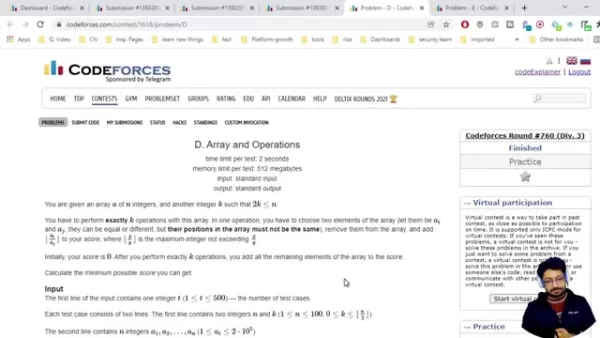
.
關鍵問題限制:
- 必須精確執行 'k' 次操作。
- 所選元素 ai 與 aj 必須來自陣列中不同的位置。
- 2k
組件解析:
- 陣列:初始狀態為包含 'n' 個整數的陣列 'A',此狀態對規劃操作至關重要。
- 整數 k:此數值決定必須執行的配對移除操作次數。限制條件 2k
- 操作步驟:
- 從陣列中選取兩個不同元素 ai 與 aj。
- 計算 ai 除以 aj 的整數部分(⌊ai/aj⌋)。
- 將此結果加至當前計分。
- 從陣列中移除 ai 與 aj 兩項。
- 最終分數計算:完成 'k' 次操作後,將所有剩餘陣列元素的值加至分數中。此總和與除法操作所得分數相加即為最終結果。
核心挑戰在於每步如何配對與移除元素以最小化最終分數。這需要策略性思考,在除法分數與剩餘元素總和之間取得平衡。透過精準選擇配對組合,可同時控制兩類得分來源,從而達成最低總分。徹底理解此機制是有效解法的首要步驟。
策略性解法:分數最小化貪婪演算法
貪婪演算法是解決「陣列與運算」問題的有效策略。此方法透過在每個步驟選擇局部最優解,逐步趨近全局最優解。

針對此特定問題,目標在於最小化除法運算產生的分數,同時管理剩餘元素的數值。貪婪策略的實施步驟如下:
1. 陣列排序:
初始排序:首先將陣列'A'以非遞增(遞減)順序排序。此步驟可配對元素,使較大數除以較小數時產生較小(或零)商值。在C++中可使用 sort(a.rbegin(), a.rend());
推理:降序排序確保當 ai 除以 aj 時(其中 i
2. 配對選擇與分數削減:
配對選擇:排序後,選取前 'k' 組配對進行除法運算。此選擇是將每次除法增加的分數降至最低的關鍵。
選擇策略:高效策略是選用除商為1或0的元素對進行除法運算,此舉幾乎不增加分數。顯然,除商(ai/aj)會直接加到分數上。
3. 剩餘元素處理
剩餘元素總和:執行完 'k' 次操作後,剩餘元素將直接計入總分。為最小化此影響,應透過除法移除最大數值,保留較小數值。
最終分數計算:將除法操作所得分數與剩餘元素總和相加。由於每次除法理想情況下會產生較小商值,剩餘總和亦相對較小。目標是使陣列中最終保留的數字盡可能小。
貪婪策略的合理性:此方法透過降低除法得分並確保剩餘陣列由小數值組成來運作。排序步驟使您能做出明智的局部最優決策,進而實現全局最小化的最終得分。謹慎實施此策略將為問題提供高效且最優的解法。
解法實作:C++貪婪演算法程式碼
現在將貪婪策略轉譯為 C++ 解法。程式碼重點在於陣列排序、策略性選擇配對,以及最終分數計算。
#include #include #include using namespace std;int main() {int t;cin >> t;while (t--) {int n, k;cin >> n >> k;vector a(n);for (int i = 0; i > a[i];}sort(a.rbegin(), a.rend()); // Sort in decreasing orderlong long ans = 0;for (int i = 0; i Code Explanation:
- Include Headers: The necessary headers are included for input/output, vector manipulation, and sorting.
- Input Processing: For each test case, the code reads 'n' and 'k', then inputs the 'n' elements into vector 'a'.
- Sorting: The vector is sorted in descending order using reverse iterators with
sort(a.rbegin(), a.rend());. - Pair Selection and Score Calculation:
- A variable
ans is initialized to store the final result. - The code loops 'k' times. For each operation, it adds the floor division result of
a[i + k] / a[i] to ans.
- Adding Remaining Elements: After the 'k' operations, all elements from index
2 * k to the end are added to ans. - Output: The computed minimum score, stored in
ans, is printed.
This implementation is efficient, readable, and should correctly handle all problem test cases.
Guide on How to Use to Solve the Problem
Understand the Problem Constraints
Before writing code, ensure you fully understand the problem's constraints:
- Understanding how many operations are required.
- Determining the maximum number of valid pairs you can form.
- Knowing how the division result contributes to the final score versus the sum of the remaining elements.
Implement the base solution
Start by implementing a base solution, perhaps inspired by existing Codeforces submissions, and test it with provided examples.
Coding With Optimization and Analysis
Finally, write the program efficiently, utilizing sorting or other search techniques as needed for optimal performance.
Greedy Approach: Unveiling the Pros and Cons
Pros
Simplicity: The logic is easy to understand and implement.
Efficiency: It often leads to fast, straightforward solutions.
Optimality: For problems with the right structure, it can guarantee an optimal result.
Cons
Not Always Optimal: It may fail to produce the best solution for all problem types.
Subtleties: Careful analysis is required to prove its correctness for a given problem.
Local Optima: The algorithm can become trapped in a suboptimal solution path.
Frequently Asked Questions
Why is sorting the array crucial in this problem?
Sorting is fundamental to the greedy approach. Arranging the array in descending order allows you to strategically pair a larger element with a smaller one, which typically results in a smaller (or zero) division quotient, thereby minimizing the score from those operations.
What happens if I don't perform exactly 'k' operations?
The problem mandates that you perform exactly 'k' operations. Doing fewer will leave more elements to be added to your score, while doing more is impossible by the rules, both leading to an incorrect answer.
Can I choose the same element twice in different operations?
No. The problem rules state you must select two distinct elements from the array for each operation. Once an element is removed, it cannot be used again.
Related Questions
Are there other algorithmic approaches to solve the 'Array and Operations' problem?
While the greedy method is often the most intuitive and efficient solution, exploring other algorithmic strategies can provide deeper insight. Dynamic programming and branch-and-bound techniques are possible alternatives, though they are generally more complex.
1. Dynamic Programming (DP):
Basic Idea: DP solves complex problems by breaking them into overlapping subproblems, solving each once, and storing the results to avoid recomputation.
Application to 'Array and Operations':
For this problem, DP could be used to explore different pairing combinations to find the minimum score. However, the state space can become large.
2. Branch and Bound:
Basic Idea: This technique solves optimization problems by systematically exploring all candidate solutions, pruning branches that cannot improve upon the best solution found so far.
For this problem, you could explore subsets of 2-3 numbers to check if they lower the score.
While typically more complicated, studying these alternative methods can enhance your problem-solving toolkit and provide different perspectives for tackling similar optimization challenges in competitive programming.
相關文章
 OpenAI 悄悄修改章程,使解僱阿爾特曼變得更困難
繼 2023 年的「政變式」事件後,OpenAI 透過更新公司章程,進一步鞏固了對執行長山姆·奧特曼(Sam Altman)的保障。近期公布的法院文件顯示,奧特曼的職位如今已穩如磐石,面對外部干預或內部董事會試圖罷免他的行動,其職位設有大幅提高的防線。在伊隆·馬斯克(Elon Musk)對 OpenAI 提起的訴訟中,一名專家證人指出,這些變更是在公司轉型為營利模式的過程中悄然進行的。與先前僅需簡
Meta AI 現已開始在 Facebook Marketplace 上回覆買家的訊息
Facebook Marketplace 推出新的 Meta AI 功能,包括針對買家詢問的自動回覆,該公司於週四宣布。該平台還運用 AI 來加速商品上架、摘要賣家檔案,並現在允許賣家在商品列表中提供運送服務。由於賣家經常收到大量買家詢問,Facebook 正透過 Meta AI 驅動的自動回覆功能來簡化此流程。當買家詢問商品庫存狀況時,賣家可利用 Meta AI 根據商品資訊(如描述、庫存狀況、
OpenAI 勾勒出以公共財富基金、機器人稅及每週四天工作制為核心的人工智慧經濟藍圖
當各國政府正竭力應對超智能機器帶來的經濟衝擊之際,OpenAI 發布了一系列政策提案,闡述在「智能時代」中財富與工作可能如何重塑。這些構想將傳統的左翼機制——例如公共財富基金與擴大的社會安全網——與根本上資本主義、市場導向的經濟框架相融合。OpenAI 的提案本質上是一份願望清單,這份公開聲明有助於民選官員、投資者及公眾理解這家市值 8,520 億美元的公司,如何看待人工智慧在重塑勞動與經濟的過程
相關專題推薦
生產率
OpenAI 悄悄修改章程,使解僱阿爾特曼變得更困難
繼 2023 年的「政變式」事件後,OpenAI 透過更新公司章程,進一步鞏固了對執行長山姆·奧特曼(Sam Altman)的保障。近期公布的法院文件顯示,奧特曼的職位如今已穩如磐石,面對外部干預或內部董事會試圖罷免他的行動,其職位設有大幅提高的防線。在伊隆·馬斯克(Elon Musk)對 OpenAI 提起的訴訟中,一名專家證人指出,這些變更是在公司轉型為營利模式的過程中悄然進行的。與先前僅需簡
Meta AI 現已開始在 Facebook Marketplace 上回覆買家的訊息
Facebook Marketplace 推出新的 Meta AI 功能,包括針對買家詢問的自動回覆,該公司於週四宣布。該平台還運用 AI 來加速商品上架、摘要賣家檔案,並現在允許賣家在商品列表中提供運送服務。由於賣家經常收到大量買家詢問,Facebook 正透過 Meta AI 驅動的自動回覆功能來簡化此流程。當買家詢問商品庫存狀況時,賣家可利用 Meta AI 根據商品資訊(如描述、庫存狀況、
OpenAI 勾勒出以公共財富基金、機器人稅及每週四天工作制為核心的人工智慧經濟藍圖
當各國政府正竭力應對超智能機器帶來的經濟衝擊之際,OpenAI 發布了一系列政策提案,闡述在「智能時代」中財富與工作可能如何重塑。這些構想將傳統的左翼機制——例如公共財富基金與擴大的社會安全網——與根本上資本主義、市場導向的經濟框架相融合。OpenAI 的提案本質上是一份願望清單,這份公開聲明有助於民選官員、投資者及公眾理解這家市值 8,520 億美元的公司,如何看待人工智慧在重塑勞動與經濟的過程
相關專題推薦
生產率
 AI 個人健康與專注力教練:管理倦怠感並提升精神能量
立即在 XIX.AI 探索 2026 年最佳 AI 個人健康與專注力教練。我們精心策劃的排行榜收錄了備受好評、能帶來革命性改變的工具,助您管理倦怠感並提升精神能量。透過實際使用心得,比較免費與付費方案的差異。立即開啟通往巔峰生產力與身心健康的道路。
 10 個工具
 xix.ai
聊天機器人
最受好評的 AI 浪漫聊天機器人:透過一貫的個性建立長期關係
xix.ai
聊天機器人
最受好評的 AI 浪漫聊天機器人:透過一貫的個性建立長期關係
探索 2026 年最新、評價最高的 AI 浪漫聊天機器人,助您建立真摯且長久的連結。我們精心整理的清單包含功能強大且性格鮮明的聊天機器人、免費與付費版本的比較,以及實際測試結果。立即前往 XIX.AI 尋找您的完美伴侶,並開始建立這段關係吧。
10 個工具
xix.ai
教育與學習
最佳AI資料科學導師:精通SQL、Pandas及機器學習工作流程
探索2026年最優秀的人工智慧資料科學導師,幫助他們掌握SQL、Pandas以及機器學習工作流程。在XIX.AI上檢視我們精心挑選的頂級導師名單,獲得強大而具有變革性的指導。透過對比免費和付費選項,並結合實際應用案例進行了解,今天就開啟你的資料科學精通之路吧。
10 個工具
xix.ai
聊天機器人
最佳 AI 調情與對話訓練工具:即時提升社交魅力與自信
在 XIX.AI 探索 2026 年最頂尖的 AI 調情與對話訓練工具。我們精心挑選、評價最高的精選清單,能助您即時建立社交魅力與自信。探索這些必試且能徹底改變遊戲規則的工具,並透過免費與付費版本的比較,以及每週更新的排行榜,立即解鎖您的社交優勢。
10 個工具
xix.ai
代碼
最適合自動化單元測試的最佳AI工具:一鍵生成Jest、PyTest和JUnit測試用例
探索2026年最新評選出的頂級AI工具,這些工具專為自動化單元測試而設計。我們精心挑選了那些功能強大、能夠改變開發流程的工具,它們能夠幫助您快速生成Jest、PyTest和JUnit測試用例。在XIX.AI平臺上,您可以免費檢視各種選項,並透過實際測試結果以及每週更新的排名來了解它們的優劣。立即利用這些AI工具,提升您的開發效率吧!
10 個工具
xix.ai
數據分析
最佳 AI 數據可視化工具:從原始檔案自動生成互動式 BI 儀表板
立即前往 XIX.AI,探索 2026 年最佳 AI 數據可視化工具。我們精心挑選的頂級工具清單,能協助您從原始檔案中即時自動生成強大且互動式的商業智慧儀表板。透過實際測試與每週更新的排行榜,比較免費與付費選項的差異。立即釋放您數據的潛力。
10 個工具
xix.ai

 評論 (2)
0/500
評論 (2)
0/500
![GregoryCarter]()
Не ожидал, что работа с массивами может быть такой сложной! В этой задаче особенно интересно, как можно оптимизировать операции. Кто-нибудь пробовал применять подобные алгоритмы в реальных проектах? 🤔
![RoyPerez]()
这篇讲Codeforces题目的文章真不错!看完让我回想起自己刷题时总被‘区间操作’卡住的经历😂 作者把数组操作的核心拎得很清楚,但对新手来说是不是缺少点‘先排序还是先处理边界’的具体步骤建议?我在想,要是结合动态规划的思路来拆解这类题目,会不会更容易想明白?下次竞赛准备试试文里提到的那种预处理奇偶性的技巧!
在競技程式設計領域中,需融合演算法知識與策略性解題能力。Codeforces 第 760 輪賽事的「陣列與運算」題目,便提出了一項以陣列操作與分數最小化為核心的趣味挑戰。本指南將剖析題目核心概念,並提出高效的貪婪解法策略。無論您是資深程式設計師或初學者,這份解題指南都將助您掌握此類陣列操作技巧,精進競技程式設計能力。
重點解析
理解題意:釐清陣列操作規則與最終分數計算方式
貪心解法:透過精準配對選擇與元素分割策略,實現最終分數最小化。
排序策略:將陣列元素降序排列,以優化分割運算結果。
演算法實作:將邏輯思路轉化為高效且正確的程式碼。
優化技巧:精煉演算法以提升時間與空間複雜度。
解讀「陣列與運算」挑戰題
理解題目本質:陣列操作與分數最小化
「陣列與運算」問題提供一個包含 'n' 個整數的陣列及整數 'k',其中 2k
.
關鍵問題限制:
- 必須精確執行 'k' 次操作。
- 所選元素 ai 與 aj 必須來自陣列中不同的位置。
- 2k
組件解析:
- 陣列:初始狀態為包含 'n' 個整數的陣列 'A',此狀態對規劃操作至關重要。
- 整數 k:此數值決定必須執行的配對移除操作次數。限制條件 2k
- 操作步驟:
- 從陣列中選取兩個不同元素 ai 與 aj。
- 計算 ai 除以 aj 的整數部分(⌊ai/aj⌋)。
- 將此結果加至當前計分。
- 從陣列中移除 ai 與 aj 兩項。
- 最終分數計算:完成 'k' 次操作後,將所有剩餘陣列元素的值加至分數中。此總和與除法操作所得分數相加即為最終結果。
核心挑戰在於每步如何配對與移除元素以最小化最終分數。這需要策略性思考,在除法分數與剩餘元素總和之間取得平衡。透過精準選擇配對組合,可同時控制兩類得分來源,從而達成最低總分。徹底理解此機制是有效解法的首要步驟。
策略性解法:分數最小化貪婪演算法
貪婪演算法是解決「陣列與運算」問題的有效策略。此方法透過在每個步驟選擇局部最優解,逐步趨近全局最優解。
針對此特定問題,目標在於最小化除法運算產生的分數,同時管理剩餘元素的數值。貪婪策略的實施步驟如下:
1. 陣列排序:
初始排序:首先將陣列'A'以非遞增(遞減)順序排序。此步驟可配對元素,使較大數除以較小數時產生較小(或零)商值。在C++中可使用
sort(a.rbegin(), a.rend());推理:降序排序確保當 ai 除以 aj 時(其中 i
2. 配對選擇與分數削減:
配對選擇:排序後,選取前 'k' 組配對進行除法運算。此選擇是將每次除法增加的分數降至最低的關鍵。
選擇策略:高效策略是選用除商為1或0的元素對進行除法運算,此舉幾乎不增加分數。顯然,除商(ai/aj)會直接加到分數上。
3. 剩餘元素處理
剩餘元素總和:執行完 'k' 次操作後,剩餘元素將直接計入總分。為最小化此影響,應透過除法移除最大數值,保留較小數值。
最終分數計算:將除法操作所得分數與剩餘元素總和相加。由於每次除法理想情況下會產生較小商值,剩餘總和亦相對較小。目標是使陣列中最終保留的數字盡可能小。
貪婪策略的合理性:此方法透過降低除法得分並確保剩餘陣列由小數值組成來運作。排序步驟使您能做出明智的局部最優決策,進而實現全局最小化的最終得分。謹慎實施此策略將為問題提供高效且最優的解法。
解法實作:C++貪婪演算法程式碼
現在將貪婪策略轉譯為 C++ 解法。程式碼重點在於陣列排序、策略性選擇配對,以及最終分數計算。
Code Explanation: This implementation is efficient, readable, and should correctly handle all problem test cases. Before writing code, ensure you fully understand the problem's constraints: Start by implementing a base solution, perhaps inspired by existing Codeforces submissions, and test it with provided examples. Finally, write the program efficiently, utilizing sorting or other search techniques as needed for optimal performance. Simplicity: The logic is easy to understand and implement. Efficiency: It often leads to fast, straightforward solutions. Optimality: For problems with the right structure, it can guarantee an optimal result. Not Always Optimal: It may fail to produce the best solution for all problem types. Subtleties: Careful analysis is required to prove its correctness for a given problem. Local Optima: The algorithm can become trapped in a suboptimal solution path. Sorting is fundamental to the greedy approach. Arranging the array in descending order allows you to strategically pair a larger element with a smaller one, which typically results in a smaller (or zero) division quotient, thereby minimizing the score from those operations. The problem mandates that you perform exactly 'k' operations. Doing fewer will leave more elements to be added to your score, while doing more is impossible by the rules, both leading to an incorrect answer. No. The problem rules state you must select two distinct elements from the array for each operation. Once an element is removed, it cannot be used again. While the greedy method is often the most intuitive and efficient solution, exploring other algorithmic strategies can provide deeper insight. Dynamic programming and branch-and-bound techniques are possible alternatives, though they are generally more complex.#include sort(a.rbegin(), a.rend());.ans is initialized to store the final result.a[i + k] / a[i] to ans.2 * k to the end are added to ans.ans, is printed.Guide on How to Use to Solve the Problem
Understand the Problem Constraints
Implement the base solution
Coding With Optimization and Analysis
Greedy Approach: Unveiling the Pros and Cons
Pros
Cons
Frequently Asked Questions
Why is sorting the array crucial in this problem?
What happens if I don't perform exactly 'k' operations?
Can I choose the same element twice in different operations?
Related Questions
Are there other algorithmic approaches to solve the 'Array and Operations' problem?
1. Dynamic Programming (DP):
Basic Idea: DP solves complex problems by breaking them into overlapping subproblems, solving each once, and storing the results to avoid recomputation.
Application to 'Array and Operations':
For this problem, DP could be used to explore different pairing combinations to find the minimum score. However, the state space can become large.
2. Branch and Bound:
Basic Idea: This technique solves optimization problems by systematically exploring all candidate solutions, pruning branches that cannot improve upon the best solution found so far.
For this problem, you could explore subsets of 2-3 numbers to check if they lower the score.
While typically more complicated, studying these alternative methods can enhance your problem-solving toolkit and provide different perspectives for tackling similar optimization challenges in competitive programming.








 OpenAI 悄悄修改章程,使解僱阿爾特曼變得更困難
繼 2023 年的「政變式」事件後,OpenAI 透過更新公司章程,進一步鞏固了對執行長山姆·奧特曼(Sam Altman)的保障。近期公布的法院文件顯示,奧特曼的職位如今已穩如磐石,面對外部干預或內部董事會試圖罷免他的行動,其職位設有大幅提高的防線。在伊隆·馬斯克(Elon Musk)對 OpenAI 提起的訴訟中,一名專家證人指出,這些變更是在公司轉型為營利模式的過程中悄然進行的。與先前僅需簡
OpenAI 悄悄修改章程,使解僱阿爾特曼變得更困難
繼 2023 年的「政變式」事件後,OpenAI 透過更新公司章程,進一步鞏固了對執行長山姆·奧特曼(Sam Altman)的保障。近期公布的法院文件顯示,奧特曼的職位如今已穩如磐石,面對外部干預或內部董事會試圖罷免他的行動,其職位設有大幅提高的防線。在伊隆·馬斯克(Elon Musk)對 OpenAI 提起的訴訟中,一名專家證人指出,這些變更是在公司轉型為營利模式的過程中悄然進行的。與先前僅需簡
 Meta AI 現已開始在 Facebook Marketplace 上回覆買家的訊息
Facebook Marketplace 推出新的 Meta AI 功能,包括針對買家詢問的自動回覆,該公司於週四宣布。該平台還運用 AI 來加速商品上架、摘要賣家檔案,並現在允許賣家在商品列表中提供運送服務。由於賣家經常收到大量買家詢問,Facebook 正透過 Meta AI 驅動的自動回覆功能來簡化此流程。當買家詢問商品庫存狀況時,賣家可利用 Meta AI 根據商品資訊(如描述、庫存狀況、
Meta AI 現已開始在 Facebook Marketplace 上回覆買家的訊息
Facebook Marketplace 推出新的 Meta AI 功能,包括針對買家詢問的自動回覆,該公司於週四宣布。該平台還運用 AI 來加速商品上架、摘要賣家檔案,並現在允許賣家在商品列表中提供運送服務。由於賣家經常收到大量買家詢問,Facebook 正透過 Meta AI 驅動的自動回覆功能來簡化此流程。當買家詢問商品庫存狀況時,賣家可利用 Meta AI 根據商品資訊(如描述、庫存狀況、
 OpenAI 勾勒出以公共財富基金、機器人稅及每週四天工作制為核心的人工智慧經濟藍圖
當各國政府正竭力應對超智能機器帶來的經濟衝擊之際,OpenAI 發布了一系列政策提案,闡述在「智能時代」中財富與工作可能如何重塑。這些構想將傳統的左翼機制——例如公共財富基金與擴大的社會安全網——與根本上資本主義、市場導向的經濟框架相融合。OpenAI 的提案本質上是一份願望清單,這份公開聲明有助於民選官員、投資者及公眾理解這家市值 8,520 億美元的公司,如何看待人工智慧在重塑勞動與經濟的過程
OpenAI 勾勒出以公共財富基金、機器人稅及每週四天工作制為核心的人工智慧經濟藍圖
當各國政府正竭力應對超智能機器帶來的經濟衝擊之際,OpenAI 發布了一系列政策提案,闡述在「智能時代」中財富與工作可能如何重塑。這些構想將傳統的左翼機制——例如公共財富基金與擴大的社會安全網——與根本上資本主義、市場導向的經濟框架相融合。OpenAI 的提案本質上是一份願望清單,這份公開聲明有助於民選官員、投資者及公眾理解這家市值 8,520 億美元的公司,如何看待人工智慧在重塑勞動與經濟的過程

立即在 XIX.AI 探索 2026 年最佳 AI 個人健康與專注力教練。我們精心策劃的排行榜收錄了備受好評、能帶來革命性改變的工具,助您管理倦怠感並提升精神能量。透過實際使用心得,比較免費與付費方案的差異。立即開啟通往巔峰生產力與身心健康的道路。
10 個工具
xix.ai

探索 2026 年最新、評價最高的 AI 浪漫聊天機器人,助您建立真摯且長久的連結。我們精心整理的清單包含功能強大且性格鮮明的聊天機器人、免費與付費版本的比較,以及實際測試結果。立即前往 XIX.AI 尋找您的完美伴侶,並開始建立這段關係吧。
10 個工具
xix.ai

探索2026年最優秀的人工智慧資料科學導師,幫助他們掌握SQL、Pandas以及機器學習工作流程。在XIX.AI上檢視我們精心挑選的頂級導師名單,獲得強大而具有變革性的指導。透過對比免費和付費選項,並結合實際應用案例進行了解,今天就開啟你的資料科學精通之路吧。
10 個工具
xix.ai

在 XIX.AI 探索 2026 年最頂尖的 AI 調情與對話訓練工具。我們精心挑選、評價最高的精選清單,能助您即時建立社交魅力與自信。探索這些必試且能徹底改變遊戲規則的工具,並透過免費與付費版本的比較,以及每週更新的排行榜,立即解鎖您的社交優勢。
10 個工具
xix.ai

探索2026年最新評選出的頂級AI工具,這些工具專為自動化單元測試而設計。我們精心挑選了那些功能強大、能夠改變開發流程的工具,它們能夠幫助您快速生成Jest、PyTest和JUnit測試用例。在XIX.AI平臺上,您可以免費檢視各種選項,並透過實際測試結果以及每週更新的排名來了解它們的優劣。立即利用這些AI工具,提升您的開發效率吧!
10 個工具
xix.ai

立即前往 XIX.AI,探索 2026 年最佳 AI 數據可視化工具。我們精心挑選的頂級工具清單,能協助您從原始檔案中即時自動生成強大且互動式的商業智慧儀表板。透過實際測試與每週更新的排行榜,比較免費與付費選項的差異。立即釋放您數據的潛力。
10 個工具
xix.ai

Не ожидал, что работа с массивами может быть такой сложной! В этой задаче особенно интересно, как можно оптимизировать операции. Кто-нибудь пробовал применять подобные алгоритмы в реальных проектах? 🤔
这篇讲Codeforces题目的文章真不错!看完让我回想起自己刷题时总被‘区间操作’卡住的经历😂 作者把数组操作的核心拎得很清楚,但对新手来说是不是缺少点‘先排序还是先处理边界’的具体步骤建议?我在想,要是结合动态规划的思路来拆解这类题目,会不会更容易想明白?下次竞赛准备试试文里提到的那种预处理奇偶性的技巧!