


 집
집2025년 코드포스 문제 D의 배열 연산을 마스터하는 방법은?
경쟁 프로그래밍 환경을 탐색하려면 알고리즘 지식과 전략적 문제 해결 능력이 조화를 이루어야 합니다. Codeforces Round #760의 '배열과 연산' 문제는 배열 조작과 점수 최소화에 초점을 맞춘 흥미로운 도전 과제입니다. 본 가이드는 문제의 핵심 개념을 분석하고 효율적인 탐욕적 전략을 제시합니다. 숙련된 코더든 초보자든, 이 단계별 설명을 통해 경쟁 코딩에서 이러한 유형의 배열 연산을 마스터할 수 있을 것입니다.
핵심 포인트
문제 이해: 배열 조작 규칙과 최종 점수 계산 방식을 명확히 파악하세요.
탐욕적 방법: 신중한 쌍 선택과 요소 분할을 통해 최종 점수를 최소화하는 전략을 수립합니다.
정렬 전략: 배열 요소를 내림차순으로 정렬하여 분할 연산 결과를 최적화합니다.
알고리즘 구현: 논리적 접근법을 효율적이고 정확한 코드로 전환합니다.
최적화 기법: 시간 및 공간 복잡도를 개선하기 위해 알고리즘을 정교화한다.
'배열과 연산' 문제의 해독
문제 정의 이해: 배열 조작과 점수 최소화
'배열과 연산' 문제는 'n'개의 정수 배열과 정수 'k'를 제시하며, 여기서 2k 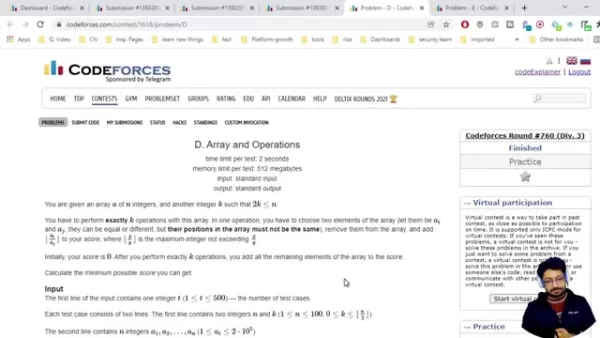
.
핵심 문제 제약 조건:
- 정확히 'k'개의 연산을 수행해야 합니다.
- 선택된 요소 ai와 aj는 배열에서 서로 다른 위치에 있어야 합니다.
- 2k
구성 요소 분석:
- 배열: 'n'개의 정수로 구성된 배열 'A'로 시작합니다. 초기 상태는 연산 계획을 세우는 데 중요합니다.
- 정수 k: 이 숫자는 수행해야 하는 쌍 제거 연산 횟수를 결정합니다. 제약 조건 2k
- 작업:
- 배열에서 서로 다른 두 요소 ai와 aj를 선택합니다.
- ai를 aj로 나눈 값의 바닥값(⌊ai/aj⌋)을 계산합니다.
- 이 결과를 누적 점수에 더합니다.
- 배열에서 ai와 aj를 모두 제거합니다.
- 최종 점수 계산: 'k'번의 연산을 완료한 후, 남은 배열 요소들의 값을 모두 합산하여 점수에 추가합니다. 이 합계와 나눗셈 연산에서 얻은 점수를 합친 것이 최종 결과입니다.
핵심 과제는 최종 점수를 최소화하기 위해 각 단계에서 어떤 요소를 짝지어 제거할지 식별하는 것입니다. 이는 나눗셈 점수와 남은 요소들의 합계를 균형 있게 고려하는 전략적 사고가 필요합니다. 짝을 신중하게 선택함으로써 두 점수 원천을 모두 제어하여 가능한 최저 총점을 달성할 수 있습니다. 이러한 메커니즘을 명확히 이해하는 것이 효과적인 해결책으로 가는 첫걸음입니다.
전략적 접근: 점수 최소화를 위한 탐욕 알고리즘
탐욕 알고리즘은 '배열과 연산' 문제에서 점수를 최소화하는 효과적인 전략을 제공합니다. 이 접근법은 각 단계에서 국소적으로 최적의 선택을 하여 전역적으로 최적의 해를 도출합니다.

이 특정 문제에서 목표는 나눗셈 연산으로 인한 점수를 최소화하면서 남은 요소들의 값을 관리하는 것입니다. 탐욕적 접근법을 구현하는 방법은 다음과 같습니다:
1. 배열 정렬:
초기 정렬: 첫 단계는 배열 'A'를 비증가(내림차순) 순서로 정렬하는 것입니다. 이렇게 하면 더 큰 수를 더 작은 수로 나눌 때 더 작은(또는 0) 상수를 얻는 요소들을 짝지을 수 있습니다. C++에서는 sort(a.rbegin(), a.rend());
이유: 내림차순 정렬은 ai를 aj로 나눌 때(여기서 i
2. 쌍 선택 및 점수 감소:
쌍 선택: 정렬 후, 나눗셈 연산을 위한 첫 번째 'k' 쌍을 선택합니다. 이 선택은 각 나눗셈에서 추가되는 점수를 최소화하는 핵심입니다.
선택 전략: 1 또는 0의 몫을 생성하는 요소 쌍을 사용하여 나눗셈 연산을 수행하는 것이 매우 효과적인 전술입니다. 이는 점수에 거의 추가되지 않기 때문입니다. 몫(ai/aj)이 점수에 직접 추가된다는 것은 분명합니다.
3. 잔여 요소 처리
남은 요소들의 합계: 'k'번의 연산 후 남은 요소들은 점수에 직접 합산됩니다. 이를 최소화하려면 나눗셈을 통해 가장 큰 숫자들을 제거하고 작은 숫자들만 남기는 것을 목표로 해야 합니다.
최종 점수 계산: 나눗셈 연산 점수와 잔여 요소 합계를 합산합니다. 각 나눗셈이 이상적으로 작은 상수를 생성하므로 잔여 합계 역시 상대적으로 작아집니다. 목표는 배열에 가능한 한 작은 숫자들만 남기는 것입니다.
탐욕적 접근법의 타당성: 이 방법은 나눗셈 점수를 줄이고 남은 배열이 작은 값들로 구성되도록 함으로써 작동합니다. 정렬 단계는 전역적으로 최소화된 최종 점수에 기여하는 정보에 기반한 지역 최적의 결정을 내릴 수 있게 합니다. 이 전략을 신중하게 구현하면 문제에 대한 효율적이고 최적의 해결책을 얻을 수 있습니다.
해결책 코딩: C++로 탐욕 알고리즘 구현
탐욕적 전략을 C++ 솔루션으로 구현해 보겠습니다. 코드는 배열 정렬, 전략적 쌍 선택, 최종 점수 계산에 중점을 둡니다.
#include #include #include using namespace std;int main() {int t;cin >> t;while (t--) {int n, k;cin >> n >> k;vector a(n);for (int i = 0; i > a[i];}sort(a.rbegin(), a.rend()); // Sort in decreasing orderlong long ans = 0;for (int i = 0; i Code Explanation:
- Include Headers: The necessary headers are included for input/output, vector manipulation, and sorting.
- Input Processing: For each test case, the code reads 'n' and 'k', then inputs the 'n' elements into vector 'a'.
- Sorting: The vector is sorted in descending order using reverse iterators with
sort(a.rbegin(), a.rend());. - Pair Selection and Score Calculation:
- A variable
ans is initialized to store the final result. - The code loops 'k' times. For each operation, it adds the floor division result of
a[i + k] / a[i] to ans.
- Adding Remaining Elements: After the 'k' operations, all elements from index
2 * k to the end are added to ans. - Output: The computed minimum score, stored in
ans, is printed.
This implementation is efficient, readable, and should correctly handle all problem test cases.
Guide on How to Use to Solve the Problem
Understand the Problem Constraints
Before writing code, ensure you fully understand the problem's constraints:
- Understanding how many operations are required.
- Determining the maximum number of valid pairs you can form.
- Knowing how the division result contributes to the final score versus the sum of the remaining elements.
Implement the base solution
Start by implementing a base solution, perhaps inspired by existing Codeforces submissions, and test it with provided examples.
Coding With Optimization and Analysis
Finally, write the program efficiently, utilizing sorting or other search techniques as needed for optimal performance.
Greedy Approach: Unveiling the Pros and Cons
Pros
Simplicity: The logic is easy to understand and implement.
Efficiency: It often leads to fast, straightforward solutions.
Optimality: For problems with the right structure, it can guarantee an optimal result.
Cons
Not Always Optimal: It may fail to produce the best solution for all problem types.
Subtleties: Careful analysis is required to prove its correctness for a given problem.
Local Optima: The algorithm can become trapped in a suboptimal solution path.
Frequently Asked Questions
Why is sorting the array crucial in this problem?
Sorting is fundamental to the greedy approach. Arranging the array in descending order allows you to strategically pair a larger element with a smaller one, which typically results in a smaller (or zero) division quotient, thereby minimizing the score from those operations.
What happens if I don't perform exactly 'k' operations?
The problem mandates that you perform exactly 'k' operations. Doing fewer will leave more elements to be added to your score, while doing more is impossible by the rules, both leading to an incorrect answer.
Can I choose the same element twice in different operations?
No. The problem rules state you must select two distinct elements from the array for each operation. Once an element is removed, it cannot be used again.
Related Questions
Are there other algorithmic approaches to solve the 'Array and Operations' problem?
While the greedy method is often the most intuitive and efficient solution, exploring other algorithmic strategies can provide deeper insight. Dynamic programming and branch-and-bound techniques are possible alternatives, though they are generally more complex.
1. Dynamic Programming (DP):
Basic Idea: DP solves complex problems by breaking them into overlapping subproblems, solving each once, and storing the results to avoid recomputation.
Application to 'Array and Operations':
For this problem, DP could be used to explore different pairing combinations to find the minimum score. However, the state space can become large.
2. Branch and Bound:
Basic Idea: This technique solves optimization problems by systematically exploring all candidate solutions, pruning branches that cannot improve upon the best solution found so far.
For this problem, you could explore subsets of 2-3 numbers to check if they lower the score.
While typically more complicated, studying these alternative methods can enhance your problem-solving toolkit and provide different perspectives for tackling similar optimization challenges in competitive programming.
관련 기사
 AI 모델 라우팅이 주목받으면서 스트라이프, 오픈라우터 인수 예정
스트라이프(Stripe)는 개발자들이 단일 인터페이스를 통해 수백 개의 모델에 접근할 수 있게 해주는 AI 모델 라우팅 플랫폼인 오픈라우터(OpenRouter)를 인수하기로 합의했습니다. 이번 인수를 통해 스트라이프의 기존 AI 활용 및 토큰 기반 청구 관련 사업에 모델 선택 및 라우팅 기능이 추가됩니다.스트라이프에 따르면, 오픈라우터는 80개 이상의 공급
전 OpenAI 연구원 배럿 조프, 제미니 개발 지원을 위해 구글로 복귀
이전에 Thinking Machines Lab의 CEO인 미리암 물라라티와 의견 차이로 갑작스럽게 퇴사한 뒤 OpenAI에 합류했던 바렛 조프가 다시 한 번 직장을 옮겼다. 알파벳 산하 구글은 조프가 연구 부사장으로 복귀해 강화 학습 및 사후 훈련 분야의 전문성을 제미니 팀에 기여할 것이라고 발표했다.“회전문” 연구원의 순환조프의 경력은 AI 인재 이동의
Recursive Intelligence가 4개월 만에 기업 가치 40억 달러로 3억 3,500만 달러를 유치한 방법
스타트업 ‘Ricursive Intelligence’의 공동 창업자들은 마치 공동 창업자가 될 운명이었던 듯하다.CEO인 안나 골디와 CTO인 아잘리아 미르호세이니는 AI 커뮤니티에서 너무나도 잘 알려진 인물들이어서, “저커버그로부터 터무니없는 제안을 담은 이상한 이메일을 받은” AI 엔지니어들 중 하나였다고 골디는 테크크런치에 웃으며 말했다. (그들은 그
관련 특별 주제 추천
디자인과 예술
AI 모델 라우팅이 주목받으면서 스트라이프, 오픈라우터 인수 예정
스트라이프(Stripe)는 개발자들이 단일 인터페이스를 통해 수백 개의 모델에 접근할 수 있게 해주는 AI 모델 라우팅 플랫폼인 오픈라우터(OpenRouter)를 인수하기로 합의했습니다. 이번 인수를 통해 스트라이프의 기존 AI 활용 및 토큰 기반 청구 관련 사업에 모델 선택 및 라우팅 기능이 추가됩니다.스트라이프에 따르면, 오픈라우터는 80개 이상의 공급
전 OpenAI 연구원 배럿 조프, 제미니 개발 지원을 위해 구글로 복귀
이전에 Thinking Machines Lab의 CEO인 미리암 물라라티와 의견 차이로 갑작스럽게 퇴사한 뒤 OpenAI에 합류했던 바렛 조프가 다시 한 번 직장을 옮겼다. 알파벳 산하 구글은 조프가 연구 부사장으로 복귀해 강화 학습 및 사후 훈련 분야의 전문성을 제미니 팀에 기여할 것이라고 발표했다.“회전문” 연구원의 순환조프의 경력은 AI 인재 이동의
Recursive Intelligence가 4개월 만에 기업 가치 40억 달러로 3억 3,500만 달러를 유치한 방법
스타트업 ‘Ricursive Intelligence’의 공동 창업자들은 마치 공동 창업자가 될 운명이었던 듯하다.CEO인 안나 골디와 CTO인 아잘리아 미르호세이니는 AI 커뮤니티에서 너무나도 잘 알려진 인물들이어서, “저커버그로부터 터무니없는 제안을 담은 이상한 이메일을 받은” AI 엔지니어들 중 하나였다고 골디는 테크크런치에 웃으며 말했다. (그들은 그
관련 특별 주제 추천
디자인과 예술
 최고의 AI 일러스트레이션 도구: 편집용 장면과 표지 아트를 더 빠르게 제작하세요
2026년 최신 최고 평점 AI 일러스트레이션 도구: 저희가 엄선한 이 목록에는 멋진 편집용 장면과 눈길을 사로잡는 표지 아트를 빠르게 제작할 수 있는, 강력하고 정교하게 설계된 최고의 도구들이 포함되어 있습니다. 각 도구는 엄격한 실전 테스트를 거쳤으며, 무료 버전과 유료 버전을 비교해 드려 여러분의 워크플로우에 딱 맞는 도구를 찾으실 수 있도록 도와드립니다. 오늘 바로 이 필수 솔루션을 사용해 AI의 장점을 극대화하고 창의적인 생산성을 높여보세요. 지금 XIX.AI에서 확인해 보세요.
 10 도구
10 도구
 xix.ai
교육 및 학습
시험 준비를 위한 최고의 AI 과외 선생님: 수학, 과학, 영어 실전 연습
xix.ai
교육 및 학습
시험 준비를 위한 최고의 AI 과외 선생님: 수학, 과학, 영어 실전 연습
2026년 최신 최고 평점을 받은 최고의 시험 대비 AI 튜터들이 XIX.AI에 모였습니다! 저희가 엄선한 이 목록에는 무료와 유료 서비스 비교, 실제 시험 문제, 매주 업데이트되는 순위 정보를 제공하는 획기적인 도구들이 포함되어 있습니다. 이 도구들은 여러분의 글쓰기 효율을 높이고, 복잡한 주제 학습을 단순화하며, 학업적 잠재력을 최대한 발휘할 수 있도록 도와줍니다. 지금 바로 탐색하여 여러분에게 딱 맞는 시험 준비 도구를 찾아보세요. 오늘부터 창작을 시작하여 AI의 장점을 최대한 활용하세요!
10 도구
xix.ai
재원
개인 자금 관리를 위한 AI 예산 계획 도구
2026년 최신 최고의 평점 높은 AI 예산 관리 도구들이 XIX.AI에서 만나보세요! 이 선별된 컬렉션은 실제 테스트를 수행하고, 지출 습관을 이해하며, 생산성을 높일 수 있는 맞춤형 계획을 수립할 수 있도록 도와주는 강력한 혁신 솔루션을 제공합니다. 무료와 유료 버전을 비교하고 상세한 순위도 확인하세요. 돈 관리를 간소화하고 AI의 이점을 극대화하도록 설계된 필수 도구들을 지금 바로 탐색해 보세요!
11 도구
xix.ai
건강과 웰니스
AI 수면 추적 어시스턴트: 더 나은 취침 습관으로 회복력 향상
2026년 최신의 우수하고 평점이 높은 AI 수면 추적 보조 도구들을 엄선하여 최상의 회복 효과를 제공합니다. 완전히 새롭게 업데이트된 이 주간 가이드에는 실제 환경에서의 테스트 결과, 무료 버전과 유료 버전의 비교 내용, 그리고 상세한 순위 정보가 담겨 있어 수면의 질을 향상시키고 보다 건강한 취침 습관을 형성하는 데 도움이 되는 최적의 솔루션을 찾는 데 유용합니다. 지금 바로 XIX.AI에서 확인하여 AI 기술의 장점을 활용해 보세요.
10 도구
xix.ai
데이터 분석
제품 및 매출 분석을 위한 AI SQL 코파일럿
2026년 제품 및 매출 분석을 위한 최신 최고 평점 AI SQL 코파일럿! XIX.AI는 매주 업데이트되는 랭킹을 통해 실제 환경에서 검증된, 강력하고 판도를 바꿀 만한 필수 도구를 엄선했습니다. 이 도구들은 데이터 분석 속도를 높이고, 복잡한 쿼리를 간소화하며, 정확한 인사이트를 도출하여 더 현명한 비즈니스 의사결정을 내릴 수 있도록 지원함으로써 사용자의 생산성을 획기적으로 향상시킵니다. 지금 바로 살펴보고, 여러분의 AI 경쟁력을 극대화할 완벽한 도구를 찾아보세요!
14 도구
xix.ai
교육 및 학습
배움을 돕는 최고의 AI 숙제 도우미: 단순한 정답이 아닌 개념을 익히세요
2026년 최신 최고 평점을 받은 AI 숙제 도우미: 단순한 정답 제공이 아닌 핵심 개념을 가르쳐 주는 학생들을 위한 강력한 도구. 꼭 사용해 봐야 할 엄선된 목록, 매주 업데이트, 무료 vs 유료 비교, 실제 사용 후기, 정확한 순위 정보를 통해 여러분의 학습 잠재력을 최대한 발휘할 수 있도록 도와드립니다. 지금 바로 살펴보고 더 스마트한 공부를 위한 완벽한 도구를 찾아보세요.
10 도구
xix.ai

 의견 (2)
0/500
의견 (2)
0/500
![GregoryCarter]()
Не ожидал, что работа с массивами может быть такой сложной! В этой задаче особенно интересно, как можно оптимизировать операции. Кто-нибудь пробовал применять подобные алгоритмы в реальных проектах? 🤔
![RoyPerez]()
这篇讲Codeforces题目的文章真不错!看完让我回想起自己刷题时总被‘区间操作’卡住的经历😂 作者把数组操作的核心拎得很清楚,但对新手来说是不是缺少点‘先排序还是先处理边界’的具体步骤建议?我在想,要是结合动态规划的思路来拆解这类题目,会不会更容易想明白?下次竞赛准备试试文里提到的那种预处理奇偶性的技巧!
경쟁 프로그래밍 환경을 탐색하려면 알고리즘 지식과 전략적 문제 해결 능력이 조화를 이루어야 합니다. Codeforces Round #760의 '배열과 연산' 문제는 배열 조작과 점수 최소화에 초점을 맞춘 흥미로운 도전 과제입니다. 본 가이드는 문제의 핵심 개념을 분석하고 효율적인 탐욕적 전략을 제시합니다. 숙련된 코더든 초보자든, 이 단계별 설명을 통해 경쟁 코딩에서 이러한 유형의 배열 연산을 마스터할 수 있을 것입니다.
핵심 포인트
문제 이해: 배열 조작 규칙과 최종 점수 계산 방식을 명확히 파악하세요.
탐욕적 방법: 신중한 쌍 선택과 요소 분할을 통해 최종 점수를 최소화하는 전략을 수립합니다.
정렬 전략: 배열 요소를 내림차순으로 정렬하여 분할 연산 결과를 최적화합니다.
알고리즘 구현: 논리적 접근법을 효율적이고 정확한 코드로 전환합니다.
최적화 기법: 시간 및 공간 복잡도를 개선하기 위해 알고리즘을 정교화한다.
'배열과 연산' 문제의 해독
문제 정의 이해: 배열 조작과 점수 최소화
'배열과 연산' 문제는 'n'개의 정수 배열과 정수 'k'를 제시하며, 여기서 2k
.
핵심 문제 제약 조건:
- 정확히 'k'개의 연산을 수행해야 합니다.
- 선택된 요소 ai와 aj는 배열에서 서로 다른 위치에 있어야 합니다.
- 2k
구성 요소 분석:
- 배열: 'n'개의 정수로 구성된 배열 'A'로 시작합니다. 초기 상태는 연산 계획을 세우는 데 중요합니다.
- 정수 k: 이 숫자는 수행해야 하는 쌍 제거 연산 횟수를 결정합니다. 제약 조건 2k
- 작업:
- 배열에서 서로 다른 두 요소 ai와 aj를 선택합니다.
- ai를 aj로 나눈 값의 바닥값(⌊ai/aj⌋)을 계산합니다.
- 이 결과를 누적 점수에 더합니다.
- 배열에서 ai와 aj를 모두 제거합니다.
- 최종 점수 계산: 'k'번의 연산을 완료한 후, 남은 배열 요소들의 값을 모두 합산하여 점수에 추가합니다. 이 합계와 나눗셈 연산에서 얻은 점수를 합친 것이 최종 결과입니다.
핵심 과제는 최종 점수를 최소화하기 위해 각 단계에서 어떤 요소를 짝지어 제거할지 식별하는 것입니다. 이는 나눗셈 점수와 남은 요소들의 합계를 균형 있게 고려하는 전략적 사고가 필요합니다. 짝을 신중하게 선택함으로써 두 점수 원천을 모두 제어하여 가능한 최저 총점을 달성할 수 있습니다. 이러한 메커니즘을 명확히 이해하는 것이 효과적인 해결책으로 가는 첫걸음입니다.
전략적 접근: 점수 최소화를 위한 탐욕 알고리즘
탐욕 알고리즘은 '배열과 연산' 문제에서 점수를 최소화하는 효과적인 전략을 제공합니다. 이 접근법은 각 단계에서 국소적으로 최적의 선택을 하여 전역적으로 최적의 해를 도출합니다.
이 특정 문제에서 목표는 나눗셈 연산으로 인한 점수를 최소화하면서 남은 요소들의 값을 관리하는 것입니다. 탐욕적 접근법을 구현하는 방법은 다음과 같습니다:
1. 배열 정렬:
초기 정렬: 첫 단계는 배열 'A'를 비증가(내림차순) 순서로 정렬하는 것입니다. 이렇게 하면 더 큰 수를 더 작은 수로 나눌 때 더 작은(또는 0) 상수를 얻는 요소들을 짝지을 수 있습니다. C++에서는
sort(a.rbegin(), a.rend());이유: 내림차순 정렬은 ai를 aj로 나눌 때(여기서 i
2. 쌍 선택 및 점수 감소:
쌍 선택: 정렬 후, 나눗셈 연산을 위한 첫 번째 'k' 쌍을 선택합니다. 이 선택은 각 나눗셈에서 추가되는 점수를 최소화하는 핵심입니다.
선택 전략: 1 또는 0의 몫을 생성하는 요소 쌍을 사용하여 나눗셈 연산을 수행하는 것이 매우 효과적인 전술입니다. 이는 점수에 거의 추가되지 않기 때문입니다. 몫(ai/aj)이 점수에 직접 추가된다는 것은 분명합니다.
3. 잔여 요소 처리
남은 요소들의 합계: 'k'번의 연산 후 남은 요소들은 점수에 직접 합산됩니다. 이를 최소화하려면 나눗셈을 통해 가장 큰 숫자들을 제거하고 작은 숫자들만 남기는 것을 목표로 해야 합니다.
최종 점수 계산: 나눗셈 연산 점수와 잔여 요소 합계를 합산합니다. 각 나눗셈이 이상적으로 작은 상수를 생성하므로 잔여 합계 역시 상대적으로 작아집니다. 목표는 배열에 가능한 한 작은 숫자들만 남기는 것입니다.
탐욕적 접근법의 타당성: 이 방법은 나눗셈 점수를 줄이고 남은 배열이 작은 값들로 구성되도록 함으로써 작동합니다. 정렬 단계는 전역적으로 최소화된 최종 점수에 기여하는 정보에 기반한 지역 최적의 결정을 내릴 수 있게 합니다. 이 전략을 신중하게 구현하면 문제에 대한 효율적이고 최적의 해결책을 얻을 수 있습니다.
해결책 코딩: C++로 탐욕 알고리즘 구현
탐욕적 전략을 C++ 솔루션으로 구현해 보겠습니다. 코드는 배열 정렬, 전략적 쌍 선택, 최종 점수 계산에 중점을 둡니다.
Code Explanation: This implementation is efficient, readable, and should correctly handle all problem test cases. Before writing code, ensure you fully understand the problem's constraints: Start by implementing a base solution, perhaps inspired by existing Codeforces submissions, and test it with provided examples. Finally, write the program efficiently, utilizing sorting or other search techniques as needed for optimal performance. Simplicity: The logic is easy to understand and implement. Efficiency: It often leads to fast, straightforward solutions. Optimality: For problems with the right structure, it can guarantee an optimal result. Not Always Optimal: It may fail to produce the best solution for all problem types. Subtleties: Careful analysis is required to prove its correctness for a given problem. Local Optima: The algorithm can become trapped in a suboptimal solution path. Sorting is fundamental to the greedy approach. Arranging the array in descending order allows you to strategically pair a larger element with a smaller one, which typically results in a smaller (or zero) division quotient, thereby minimizing the score from those operations. The problem mandates that you perform exactly 'k' operations. Doing fewer will leave more elements to be added to your score, while doing more is impossible by the rules, both leading to an incorrect answer. No. The problem rules state you must select two distinct elements from the array for each operation. Once an element is removed, it cannot be used again. While the greedy method is often the most intuitive and efficient solution, exploring other algorithmic strategies can provide deeper insight. Dynamic programming and branch-and-bound techniques are possible alternatives, though they are generally more complex.#include sort(a.rbegin(), a.rend());.ans is initialized to store the final result.a[i + k] / a[i] to ans.2 * k to the end are added to ans.ans, is printed.Guide on How to Use to Solve the Problem
Understand the Problem Constraints
Implement the base solution
Coding With Optimization and Analysis
Greedy Approach: Unveiling the Pros and Cons
Pros
Cons
Frequently Asked Questions
Why is sorting the array crucial in this problem?
What happens if I don't perform exactly 'k' operations?
Can I choose the same element twice in different operations?
Related Questions
Are there other algorithmic approaches to solve the 'Array and Operations' problem?
1. Dynamic Programming (DP):
Basic Idea: DP solves complex problems by breaking them into overlapping subproblems, solving each once, and storing the results to avoid recomputation.
Application to 'Array and Operations':
For this problem, DP could be used to explore different pairing combinations to find the minimum score. However, the state space can become large.
2. Branch and Bound:
Basic Idea: This technique solves optimization problems by systematically exploring all candidate solutions, pruning branches that cannot improve upon the best solution found so far.
For this problem, you could explore subsets of 2-3 numbers to check if they lower the score.
While typically more complicated, studying these alternative methods can enhance your problem-solving toolkit and provide different perspectives for tackling similar optimization challenges in competitive programming.








 AI 모델 라우팅이 주목받으면서 스트라이프, 오픈라우터 인수 예정
스트라이프(Stripe)는 개발자들이 단일 인터페이스를 통해 수백 개의 모델에 접근할 수 있게 해주는 AI 모델 라우팅 플랫폼인 오픈라우터(OpenRouter)를 인수하기로 합의했습니다. 이번 인수를 통해 스트라이프의 기존 AI 활용 및 토큰 기반 청구 관련 사업에 모델 선택 및 라우팅 기능이 추가됩니다.스트라이프에 따르면, 오픈라우터는 80개 이상의 공급
AI 모델 라우팅이 주목받으면서 스트라이프, 오픈라우터 인수 예정
스트라이프(Stripe)는 개발자들이 단일 인터페이스를 통해 수백 개의 모델에 접근할 수 있게 해주는 AI 모델 라우팅 플랫폼인 오픈라우터(OpenRouter)를 인수하기로 합의했습니다. 이번 인수를 통해 스트라이프의 기존 AI 활용 및 토큰 기반 청구 관련 사업에 모델 선택 및 라우팅 기능이 추가됩니다.스트라이프에 따르면, 오픈라우터는 80개 이상의 공급
 전 OpenAI 연구원 배럿 조프, 제미니 개발 지원을 위해 구글로 복귀
이전에 Thinking Machines Lab의 CEO인 미리암 물라라티와 의견 차이로 갑작스럽게 퇴사한 뒤 OpenAI에 합류했던 바렛 조프가 다시 한 번 직장을 옮겼다. 알파벳 산하 구글은 조프가 연구 부사장으로 복귀해 강화 학습 및 사후 훈련 분야의 전문성을 제미니 팀에 기여할 것이라고 발표했다.“회전문” 연구원의 순환조프의 경력은 AI 인재 이동의
전 OpenAI 연구원 배럿 조프, 제미니 개발 지원을 위해 구글로 복귀
이전에 Thinking Machines Lab의 CEO인 미리암 물라라티와 의견 차이로 갑작스럽게 퇴사한 뒤 OpenAI에 합류했던 바렛 조프가 다시 한 번 직장을 옮겼다. 알파벳 산하 구글은 조프가 연구 부사장으로 복귀해 강화 학습 및 사후 훈련 분야의 전문성을 제미니 팀에 기여할 것이라고 발표했다.“회전문” 연구원의 순환조프의 경력은 AI 인재 이동의
 Recursive Intelligence가 4개월 만에 기업 가치 40억 달러로 3억 3,500만 달러를 유치한 방법
스타트업 ‘Ricursive Intelligence’의 공동 창업자들은 마치 공동 창업자가 될 운명이었던 듯하다.CEO인 안나 골디와 CTO인 아잘리아 미르호세이니는 AI 커뮤니티에서 너무나도 잘 알려진 인물들이어서, “저커버그로부터 터무니없는 제안을 담은 이상한 이메일을 받은” AI 엔지니어들 중 하나였다고 골디는 테크크런치에 웃으며 말했다. (그들은 그
Recursive Intelligence가 4개월 만에 기업 가치 40억 달러로 3억 3,500만 달러를 유치한 방법
스타트업 ‘Ricursive Intelligence’의 공동 창업자들은 마치 공동 창업자가 될 운명이었던 듯하다.CEO인 안나 골디와 CTO인 아잘리아 미르호세이니는 AI 커뮤니티에서 너무나도 잘 알려진 인물들이어서, “저커버그로부터 터무니없는 제안을 담은 이상한 이메일을 받은” AI 엔지니어들 중 하나였다고 골디는 테크크런치에 웃으며 말했다. (그들은 그

2026년 최신 최고 평점 AI 일러스트레이션 도구: 저희가 엄선한 이 목록에는 멋진 편집용 장면과 눈길을 사로잡는 표지 아트를 빠르게 제작할 수 있는, 강력하고 정교하게 설계된 최고의 도구들이 포함되어 있습니다. 각 도구는 엄격한 실전 테스트를 거쳤으며, 무료 버전과 유료 버전을 비교해 드려 여러분의 워크플로우에 딱 맞는 도구를 찾으실 수 있도록 도와드립니다. 오늘 바로 이 필수 솔루션을 사용해 AI의 장점을 극대화하고 창의적인 생산성을 높여보세요. 지금 XIX.AI에서 확인해 보세요.
10 도구
xix.ai

2026년 최신 최고 평점을 받은 최고의 시험 대비 AI 튜터들이 XIX.AI에 모였습니다! 저희가 엄선한 이 목록에는 무료와 유료 서비스 비교, 실제 시험 문제, 매주 업데이트되는 순위 정보를 제공하는 획기적인 도구들이 포함되어 있습니다. 이 도구들은 여러분의 글쓰기 효율을 높이고, 복잡한 주제 학습을 단순화하며, 학업적 잠재력을 최대한 발휘할 수 있도록 도와줍니다. 지금 바로 탐색하여 여러분에게 딱 맞는 시험 준비 도구를 찾아보세요. 오늘부터 창작을 시작하여 AI의 장점을 최대한 활용하세요!
10 도구
xix.ai

2026년 최신 최고의 평점 높은 AI 예산 관리 도구들이 XIX.AI에서 만나보세요! 이 선별된 컬렉션은 실제 테스트를 수행하고, 지출 습관을 이해하며, 생산성을 높일 수 있는 맞춤형 계획을 수립할 수 있도록 도와주는 강력한 혁신 솔루션을 제공합니다. 무료와 유료 버전을 비교하고 상세한 순위도 확인하세요. 돈 관리를 간소화하고 AI의 이점을 극대화하도록 설계된 필수 도구들을 지금 바로 탐색해 보세요!
11 도구
xix.ai

2026년 최신의 우수하고 평점이 높은 AI 수면 추적 보조 도구들을 엄선하여 최상의 회복 효과를 제공합니다. 완전히 새롭게 업데이트된 이 주간 가이드에는 실제 환경에서의 테스트 결과, 무료 버전과 유료 버전의 비교 내용, 그리고 상세한 순위 정보가 담겨 있어 수면의 질을 향상시키고 보다 건강한 취침 습관을 형성하는 데 도움이 되는 최적의 솔루션을 찾는 데 유용합니다. 지금 바로 XIX.AI에서 확인하여 AI 기술의 장점을 활용해 보세요.
10 도구
xix.ai

2026년 제품 및 매출 분석을 위한 최신 최고 평점 AI SQL 코파일럿! XIX.AI는 매주 업데이트되는 랭킹을 통해 실제 환경에서 검증된, 강력하고 판도를 바꿀 만한 필수 도구를 엄선했습니다. 이 도구들은 데이터 분석 속도를 높이고, 복잡한 쿼리를 간소화하며, 정확한 인사이트를 도출하여 더 현명한 비즈니스 의사결정을 내릴 수 있도록 지원함으로써 사용자의 생산성을 획기적으로 향상시킵니다. 지금 바로 살펴보고, 여러분의 AI 경쟁력을 극대화할 완벽한 도구를 찾아보세요!
14 도구
xix.ai

2026년 최신 최고 평점을 받은 AI 숙제 도우미: 단순한 정답 제공이 아닌 핵심 개념을 가르쳐 주는 학생들을 위한 강력한 도구. 꼭 사용해 봐야 할 엄선된 목록, 매주 업데이트, 무료 vs 유료 비교, 실제 사용 후기, 정확한 순위 정보를 통해 여러분의 학습 잠재력을 최대한 발휘할 수 있도록 도와드립니다. 지금 바로 살펴보고 더 스마트한 공부를 위한 완벽한 도구를 찾아보세요.
10 도구
xix.ai

Не ожидал, что работа с массивами может быть такой сложной! В этой задаче особенно интересно, как можно оптимизировать операции. Кто-нибудь пробовал применять подобные алгоритмы в реальных проектах? 🤔
这篇讲Codeforces题目的文章真不错!看完让我回想起自己刷题时总被‘区间操作’卡住的经历😂 作者把数组操作的核心拎得很清楚,但对新手来说是不是缺少点‘先排序还是先处理边界’的具体步骤建议?我在想,要是结合动态规划的思路来拆解这类题目,会不会更容易想明白?下次竞赛准备试试文里提到的那种预处理奇偶性的技巧!












