家
家2025年のCodeforces問題Dで配列操作をマスターするには?
競技プログラミングの世界を攻略するには、アルゴリズムの知識と戦略的な問題解決能力の両方が必要です。Codeforces Round #760の「配列と演算」問題は、配列操作とスコア最小化を軸にした興味深い課題です。本ガイドでは問題の核心概念を分解し、効率的な貪欲法による解法を提示します。経験豊富なコーダーでも初心者でも、この解説を通じて競技プログラミングにおける配列操作の技術を習得できるでしょう。
重要なポイント
問題の理解:配列操作のルールと最終スコアの計算方法を明確に把握する。
貪欲法:慎重なペア選択と要素分割を通じて最終スコアを最小化する戦略を構築する。
ソート戦略:除算操作の結果を最適化するため、配列要素を降順でソートする。
アルゴリズム実装:論理的アプローチを効率的で正確なコードに変換する。
最適化技術:アルゴリズムを洗練させ、時間・空間の複雑性を改善する。
「配列と演算」課題の解読
問題文の理解:配列操作とスコア最小化
「配列と演算」問題では、整数n個の配列と整数kが与えられ、2k 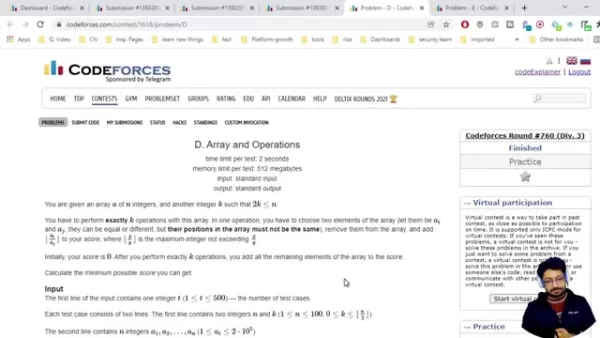
.
主要な制約条件:
- 操作回数は厳密に 'k' 回でなければならない。
- 選択される要素 ai と aj は配列内の異なる位置から選ばれなければならない。
- 2k
構成要素の分解:
- 配列: 整数 'n' 個からなる配列 'A' から開始します。初期状態は操作計画において極めて重要です。
- 整数k:この数値は実行すべきペア除去操作の回数を決定します。制約条件2k
- 操作:
- 配列から異なる2つの要素 ai と aj を選択する。
- ai を aj で割った値の床関数(⌊ai/aj⌋)を計算する。
- この結果を進行中のスコアに加算する。
- 配列から ai と aj の両方を削除する。
- 最終スコアの計算: 'k'回の操作を完了後、残存配列要素の全値をスコアに加算する。この合計値と除算操作によるスコアを合算したものが最終結果となる。
核心的な課題は、最終スコアを最小化するために各ステップでどの要素をペアにして除去すべきかを特定することです。これは、除算による得点と残存要素の合計とのバランスを取る戦略的思考を必要とします。ペアを慎重に選択することで、両方の得点源を制御し、可能な限り低い合計を達成できます。これらの仕組みを明確に理解することが、効果的な解決策への第一歩です。
戦略的アプローチ:スコア最小化のための貪欲アルゴリズム
「配列と演算」問題において、スコアを最小化する効果的な戦略として貪欲アルゴリズムが有効です。この手法は各ステップで局所最適解を選択し、全体最適解を目指すものです。

この特定の問題では、除算演算による得点を最小化しつつ、残存する要素の値を管理することが目標です。貪欲法の実装手順は以下の通りです:
1. 配列のソート:
初期ソート: 最初のステップは配列'A'を非増加順(降順)にソートすることです。これにより、大きい数を小さい数で割った商が小さくなる(またはゼロになる)要素のペアを作成できます。C++では sort(a.rbegin(), a.rend());
理由:降順ソートにより、ai を aj で割った商がより小さくなる(またはゼロになる)組み合わせを確保できる。
2. ペアの選択とスコア削減:
ペアの選択: ソート後、除算操作を行う最初の 'k' 個のペアを選択します。この選択が、各除算で加算されるスコアを最小化する鍵となります。
選択戦略: 非常に効果的な戦術は、商が1または0となる要素のペアを用いて除算操作を行うことです。これによりスコアへの加算が最小限に抑えられます。商(ai/aj)が直接スコアに加算されることは明らかです。
3. 残存要素の処理
残存要素の合計:k回の演算後、残った要素は直接スコアに加算される。これを最小化するには、除算で最大の数値を除去し、小さな数値を残すことを目指す。
最終スコアの計算:除算操作のスコアと残存要素の合計を足し合わせる。各除算で理想的に小さい商が得られるため、残存合計も比較的小さくなる。配列内の数値を可能な限り小さくすることが目標である。
貪欲法採用の根拠:この手法は除算スコアを削減し、残存配列を小さな値で構成することで機能する。ソート工程により、局所最適解を判断し、全体的な最終スコア最小化に寄与できる。この戦略を慎重に実装することで、問題に対する効率的かつ最適な解が得られる。
解法のコーディング:C++での貪欲アルゴリズム実装
貪欲戦略をC++ソリューションに翻訳しましょう。コードは配列のソート、戦略的なペア選択、最終スコアの計算に焦点を当てます。
#include #include #include using namespace std;int main() {int t;cin >> t;while (t--) {int n, k;cin >> n >> k;vector a(n);for (int i = 0; i > a[i];}sort(a.rbegin(), a.rend()); // Sort in decreasing orderlong long ans = 0;for (int i = 0; i Code Explanation:
- Include Headers: The necessary headers are included for input/output, vector manipulation, and sorting.
- Input Processing: For each test case, the code reads 'n' and 'k', then inputs the 'n' elements into vector 'a'.
- Sorting: The vector is sorted in descending order using reverse iterators with
sort(a.rbegin(), a.rend());. - Pair Selection and Score Calculation:
- A variable
ans is initialized to store the final result. - The code loops 'k' times. For each operation, it adds the floor division result of
a[i + k] / a[i] to ans.
- Adding Remaining Elements: After the 'k' operations, all elements from index
2 * k to the end are added to ans. - Output: The computed minimum score, stored in
ans, is printed.
This implementation is efficient, readable, and should correctly handle all problem test cases.
Guide on How to Use to Solve the Problem
Understand the Problem Constraints
Before writing code, ensure you fully understand the problem's constraints:
- Understanding how many operations are required.
- Determining the maximum number of valid pairs you can form.
- Knowing how the division result contributes to the final score versus the sum of the remaining elements.
Implement the base solution
Start by implementing a base solution, perhaps inspired by existing Codeforces submissions, and test it with provided examples.
Coding With Optimization and Analysis
Finally, write the program efficiently, utilizing sorting or other search techniques as needed for optimal performance.
Greedy Approach: Unveiling the Pros and Cons
Pros
Simplicity: The logic is easy to understand and implement.
Efficiency: It often leads to fast, straightforward solutions.
Optimality: For problems with the right structure, it can guarantee an optimal result.
Cons
Not Always Optimal: It may fail to produce the best solution for all problem types.
Subtleties: Careful analysis is required to prove its correctness for a given problem.
Local Optima: The algorithm can become trapped in a suboptimal solution path.
Frequently Asked Questions
Why is sorting the array crucial in this problem?
Sorting is fundamental to the greedy approach. Arranging the array in descending order allows you to strategically pair a larger element with a smaller one, which typically results in a smaller (or zero) division quotient, thereby minimizing the score from those operations.
What happens if I don't perform exactly 'k' operations?
The problem mandates that you perform exactly 'k' operations. Doing fewer will leave more elements to be added to your score, while doing more is impossible by the rules, both leading to an incorrect answer.
Can I choose the same element twice in different operations?
No. The problem rules state you must select two distinct elements from the array for each operation. Once an element is removed, it cannot be used again.
Related Questions
Are there other algorithmic approaches to solve the 'Array and Operations' problem?
While the greedy method is often the most intuitive and efficient solution, exploring other algorithmic strategies can provide deeper insight. Dynamic programming and branch-and-bound techniques are possible alternatives, though they are generally more complex.
1. Dynamic Programming (DP):
Basic Idea: DP solves complex problems by breaking them into overlapping subproblems, solving each once, and storing the results to avoid recomputation.
Application to 'Array and Operations':
For this problem, DP could be used to explore different pairing combinations to find the minimum score. However, the state space can become large.
2. Branch and Bound:
Basic Idea: This technique solves optimization problems by systematically exploring all candidate solutions, pruning branches that cannot improve upon the best solution found so far.
For this problem, you could explore subsets of 2-3 numbers to check if they lower the score.
While typically more complicated, studying these alternative methods can enhance your problem-solving toolkit and provide different perspectives for tackling similar optimization challenges in competitive programming.
関連記事
 カカオ・モビリティ、物理AIに向けたレベル4自動運転のロードマップを提示
カカオ・モビリティは、フィジカルAI戦略の一環として、レベル4の自動運転技術を自社開発する計画だ。ソウルCOEXで開催された「2026ワールドITショー」のカンファレンスにおいて、カカオモビリティのフィジカルAI部門長兼副社長であるキム・ジンギュ氏がロードマップを発表した。同氏の講演は、フィジカルAI時代におけるモビリティプラットフォームを軸とした自動運転サービスに焦点を当てたものだった。聯合
Google NotebookLMのインフォグラフィック用カスタムスタイル機能がリリースされました
GoogleのAIノート作成ツール「NotebookLM」は、インフォグラフィック向けのカスタムスタイル機能を正式にリリースし、ユーザーがより柔軟にビジュアルを作成できるようになりました。ユーザーからのフィードバックによると、この機能には10種類のプリセットスタイルが用意されており、完全なカスタマイズにも対応しています。ユーザーは、「Edit Style」、「Clay Style」、「Brick
雷軍氏、フルHADとXLA認知モデルを搭載したXiaomi SU7シリーズを発表
3月19日に開催されたXiaomiの春季新製品発表会において、雷軍氏はスマートドライビング市場でまたも大きな動きを見せた。彼は、新型「Xiaomi SU7」が技術基盤の全面的なアップグレードを受け、全グレードに「Xiaomi HAD(Hyper Autonomous Driving)」システムが標準装備されると発表した。このアップグレードの中核となるのは、深く統合されたXiaomi XLA認知大型
関連特集おすすめ
データ分析
カカオ・モビリティ、物理AIに向けたレベル4自動運転のロードマップを提示
カカオ・モビリティは、フィジカルAI戦略の一環として、レベル4の自動運転技術を自社開発する計画だ。ソウルCOEXで開催された「2026ワールドITショー」のカンファレンスにおいて、カカオモビリティのフィジカルAI部門長兼副社長であるキム・ジンギュ氏がロードマップを発表した。同氏の講演は、フィジカルAI時代におけるモビリティプラットフォームを軸とした自動運転サービスに焦点を当てたものだった。聯合
Google NotebookLMのインフォグラフィック用カスタムスタイル機能がリリースされました
GoogleのAIノート作成ツール「NotebookLM」は、インフォグラフィック向けのカスタムスタイル機能を正式にリリースし、ユーザーがより柔軟にビジュアルを作成できるようになりました。ユーザーからのフィードバックによると、この機能には10種類のプリセットスタイルが用意されており、完全なカスタマイズにも対応しています。ユーザーは、「Edit Style」、「Clay Style」、「Brick
雷軍氏、フルHADとXLA認知モデルを搭載したXiaomi SU7シリーズを発表
3月19日に開催されたXiaomiの春季新製品発表会において、雷軍氏はスマートドライビング市場でまたも大きな動きを見せた。彼は、新型「Xiaomi SU7」が技術基盤の全面的なアップグレードを受け、全グレードに「Xiaomi HAD(Hyper Autonomous Driving)」システムが標準装備されると発表した。このアップグレードの中核となるのは、深く統合されたXiaomi XLA認知大型
関連特集おすすめ
データ分析
 最高のAIデータ可視化ツール:生データからインタラクティブなBIダッシュボードを自動生成
XIX.AIで、2026年最高のAIデータ可視化ツールをご覧ください。厳選された高評価のツール群を活用すれば、生データから強力でインタラクティブなBIダッシュボードを瞬時に自動生成できます。実環境でのテスト結果や毎週更新されるランキングをもとに、無料版と有料版の比較も可能です。今すぐデータの可能性を引き出しましょう。
 10 ツール
 xix.ai
ソーシャルメディア
ソーシャルメディア向けAIブランディングキット:すべてのチャネルで一貫したブランドビジュアルを維持
xix.ai
ソーシャルメディア
ソーシャルメディア向けAIブランディングキット:すべてのチャネルで一貫したブランドビジュアルを維持
2026年版、ソーシャルメディア向けAIブランディングキットベストセレクションをご紹介。XIX.AIが厳選したこのリストには、あらゆるチャネルでブランドビジュアルの統一感を完璧に保つ、高評価で画期的なツールが揃っています。実際のテスト結果をもとに、無料版と有料版を比較しましょう。今すぐ、ブランドのビジュアル面での優位性を手に入れましょう。
10 ツール
xix.ai
チャットボット
ロールプレイに最適なAIガールフレンドアプリ&AIコンパニオンツール(2026年版ガイド)
没入感のあるロールプレイとつながりを実現する、2026年最新の最高評価AIコンパニオンツールを発見しましょう。XIX.AIが厳選したガイドでは、業界に革新をもたらす強力なアプリを紹介しています。ランキングは毎週更新され、無料版と有料版の比較や実地テストの結果も掲載されています。あなたにぴったりのツールを見つけて、今日から有意義なデジタルコンパニオン体験を始めましょう。
10 ツール
xix.ai
書き込み
最高のAI仙侠・武侠アシスタント:壮大な修練の物語と武術の演出を執筆
2026年版、壮大な仙侠・武侠物語を創作するための最高のAIアシスタントをご紹介。XIX.AIが厳選したこのリストには、修練の進捗管理や武術の演出を完璧にこなす、高評価で画期的なツールが揃っています。無料版と有料版を実際のテスト結果で比較。あなたの創造力を解き放ち、今すぐ執筆を始めましょう!
10 ツール
xix.ai
コード
AIモバイルアプリ開発ツール:プロンプトからクロスプラットフォーム対応のFlutterおよびReact Nativeコードを生成する
2026年に最も優れたAIモバイルアプリ開発ツールをFlutterおよびReact Native向けにご紹介します。当社が厳選した高評価のツール群は、プロンプトからクロスプラットフォーム対応のコードを自動生成する、画期的なソリューションです。無料版と有料版を実際のテストで比較し、より迅速な開発と高品質なアプリの構築を実現してください。XIX.AIでランキングをご確認ください!
10 ツール
xix.ai
コード
おすすめのAI Chrome拡張機能ジェネレーター:プログラミングの知識がなくてもカスタムブラウザ拡張機能を作成
XIX.AIで、2026年おすすめのAI Chrome拡張機能ジェネレーターを発見しましょう。厳選されたこのリストには、コーディング不要で独自のブラウザ拡張機能を作成できる、高評価の「必見」ツールが揃っています。無料版と有料版の比較や実機テストの結果を確認し、生産性を飛躍的に向上させましょう。最新のランキングをチェックして、あなたにぴったりのツールを今すぐ見つけましょう!
10 ツール
xix.ai

 コメント (2)
0/500
コメント (2)
0/500
![GregoryCarter]()
Не ожидал, что работа с массивами может быть такой сложной! В этой задаче особенно интересно, как можно оптимизировать операции. Кто-нибудь пробовал применять подобные алгоритмы в реальных проектах? 🤔
![RoyPerez]()
这篇讲Codeforces题目的文章真不错!看完让我回想起自己刷题时总被‘区间操作’卡住的经历😂 作者把数组操作的核心拎得很清楚,但对新手来说是不是缺少点‘先排序还是先处理边界’的具体步骤建议?我在想,要是结合动态规划的思路来拆解这类题目,会不会更容易想明白?下次竞赛准备试试文里提到的那种预处理奇偶性的技巧!
競技プログラミングの世界を攻略するには、アルゴリズムの知識と戦略的な問題解決能力の両方が必要です。Codeforces Round #760の「配列と演算」問題は、配列操作とスコア最小化を軸にした興味深い課題です。本ガイドでは問題の核心概念を分解し、効率的な貪欲法による解法を提示します。経験豊富なコーダーでも初心者でも、この解説を通じて競技プログラミングにおける配列操作の技術を習得できるでしょう。
重要なポイント
問題の理解:配列操作のルールと最終スコアの計算方法を明確に把握する。
貪欲法:慎重なペア選択と要素分割を通じて最終スコアを最小化する戦略を構築する。
ソート戦略:除算操作の結果を最適化するため、配列要素を降順でソートする。
アルゴリズム実装:論理的アプローチを効率的で正確なコードに変換する。
最適化技術:アルゴリズムを洗練させ、時間・空間の複雑性を改善する。
「配列と演算」課題の解読
問題文の理解:配列操作とスコア最小化
「配列と演算」問題では、整数n個の配列と整数kが与えられ、2k
.
主要な制約条件:
- 操作回数は厳密に 'k' 回でなければならない。
- 選択される要素 ai と aj は配列内の異なる位置から選ばれなければならない。
- 2k
構成要素の分解:
- 配列: 整数 'n' 個からなる配列 'A' から開始します。初期状態は操作計画において極めて重要です。
- 整数k:この数値は実行すべきペア除去操作の回数を決定します。制約条件2k
- 操作:
- 配列から異なる2つの要素 ai と aj を選択する。
- ai を aj で割った値の床関数(⌊ai/aj⌋)を計算する。
- この結果を進行中のスコアに加算する。
- 配列から ai と aj の両方を削除する。
- 最終スコアの計算: 'k'回の操作を完了後、残存配列要素の全値をスコアに加算する。この合計値と除算操作によるスコアを合算したものが最終結果となる。
核心的な課題は、最終スコアを最小化するために各ステップでどの要素をペアにして除去すべきかを特定することです。これは、除算による得点と残存要素の合計とのバランスを取る戦略的思考を必要とします。ペアを慎重に選択することで、両方の得点源を制御し、可能な限り低い合計を達成できます。これらの仕組みを明確に理解することが、効果的な解決策への第一歩です。
戦略的アプローチ:スコア最小化のための貪欲アルゴリズム
「配列と演算」問題において、スコアを最小化する効果的な戦略として貪欲アルゴリズムが有効です。この手法は各ステップで局所最適解を選択し、全体最適解を目指すものです。
この特定の問題では、除算演算による得点を最小化しつつ、残存する要素の値を管理することが目標です。貪欲法の実装手順は以下の通りです:
1. 配列のソート:
初期ソート: 最初のステップは配列'A'を非増加順(降順)にソートすることです。これにより、大きい数を小さい数で割った商が小さくなる(またはゼロになる)要素のペアを作成できます。C++では
sort(a.rbegin(), a.rend());理由:降順ソートにより、ai を aj で割った商がより小さくなる(またはゼロになる)組み合わせを確保できる。
2. ペアの選択とスコア削減:
ペアの選択: ソート後、除算操作を行う最初の 'k' 個のペアを選択します。この選択が、各除算で加算されるスコアを最小化する鍵となります。
選択戦略: 非常に効果的な戦術は、商が1または0となる要素のペアを用いて除算操作を行うことです。これによりスコアへの加算が最小限に抑えられます。商(ai/aj)が直接スコアに加算されることは明らかです。
3. 残存要素の処理
残存要素の合計:k回の演算後、残った要素は直接スコアに加算される。これを最小化するには、除算で最大の数値を除去し、小さな数値を残すことを目指す。
最終スコアの計算:除算操作のスコアと残存要素の合計を足し合わせる。各除算で理想的に小さい商が得られるため、残存合計も比較的小さくなる。配列内の数値を可能な限り小さくすることが目標である。
貪欲法採用の根拠:この手法は除算スコアを削減し、残存配列を小さな値で構成することで機能する。ソート工程により、局所最適解を判断し、全体的な最終スコア最小化に寄与できる。この戦略を慎重に実装することで、問題に対する効率的かつ最適な解が得られる。
解法のコーディング:C++での貪欲アルゴリズム実装
貪欲戦略をC++ソリューションに翻訳しましょう。コードは配列のソート、戦略的なペア選択、最終スコアの計算に焦点を当てます。
Code Explanation: This implementation is efficient, readable, and should correctly handle all problem test cases. Before writing code, ensure you fully understand the problem's constraints: Start by implementing a base solution, perhaps inspired by existing Codeforces submissions, and test it with provided examples. Finally, write the program efficiently, utilizing sorting or other search techniques as needed for optimal performance. Simplicity: The logic is easy to understand and implement. Efficiency: It often leads to fast, straightforward solutions. Optimality: For problems with the right structure, it can guarantee an optimal result. Not Always Optimal: It may fail to produce the best solution for all problem types. Subtleties: Careful analysis is required to prove its correctness for a given problem. Local Optima: The algorithm can become trapped in a suboptimal solution path. Sorting is fundamental to the greedy approach. Arranging the array in descending order allows you to strategically pair a larger element with a smaller one, which typically results in a smaller (or zero) division quotient, thereby minimizing the score from those operations. The problem mandates that you perform exactly 'k' operations. Doing fewer will leave more elements to be added to your score, while doing more is impossible by the rules, both leading to an incorrect answer. No. The problem rules state you must select two distinct elements from the array for each operation. Once an element is removed, it cannot be used again. While the greedy method is often the most intuitive and efficient solution, exploring other algorithmic strategies can provide deeper insight. Dynamic programming and branch-and-bound techniques are possible alternatives, though they are generally more complex.#include sort(a.rbegin(), a.rend());.ans is initialized to store the final result.a[i + k] / a[i] to ans.2 * k to the end are added to ans.ans, is printed.Guide on How to Use to Solve the Problem
Understand the Problem Constraints
Implement the base solution
Coding With Optimization and Analysis
Greedy Approach: Unveiling the Pros and Cons
Pros
Cons
Frequently Asked Questions
Why is sorting the array crucial in this problem?
What happens if I don't perform exactly 'k' operations?
Can I choose the same element twice in different operations?
Related Questions
Are there other algorithmic approaches to solve the 'Array and Operations' problem?
1. Dynamic Programming (DP):
Basic Idea: DP solves complex problems by breaking them into overlapping subproblems, solving each once, and storing the results to avoid recomputation.
Application to 'Array and Operations':
For this problem, DP could be used to explore different pairing combinations to find the minimum score. However, the state space can become large.
2. Branch and Bound:
Basic Idea: This technique solves optimization problems by systematically exploring all candidate solutions, pruning branches that cannot improve upon the best solution found so far.
For this problem, you could explore subsets of 2-3 numbers to check if they lower the score.
While typically more complicated, studying these alternative methods can enhance your problem-solving toolkit and provide different perspectives for tackling similar optimization challenges in competitive programming.







 カカオ・モビリティ、物理AIに向けたレベル4自動運転のロードマップを提示
カカオ・モビリティは、フィジカルAI戦略の一環として、レベル4の自動運転技術を自社開発する計画だ。ソウルCOEXで開催された「2026ワールドITショー」のカンファレンスにおいて、カカオモビリティのフィジカルAI部門長兼副社長であるキム・ジンギュ氏がロードマップを発表した。同氏の講演は、フィジカルAI時代におけるモビリティプラットフォームを軸とした自動運転サービスに焦点を当てたものだった。聯合
カカオ・モビリティ、物理AIに向けたレベル4自動運転のロードマップを提示
カカオ・モビリティは、フィジカルAI戦略の一環として、レベル4の自動運転技術を自社開発する計画だ。ソウルCOEXで開催された「2026ワールドITショー」のカンファレンスにおいて、カカオモビリティのフィジカルAI部門長兼副社長であるキム・ジンギュ氏がロードマップを発表した。同氏の講演は、フィジカルAI時代におけるモビリティプラットフォームを軸とした自動運転サービスに焦点を当てたものだった。聯合
 Google NotebookLMのインフォグラフィック用カスタムスタイル機能がリリースされました
GoogleのAIノート作成ツール「NotebookLM」は、インフォグラフィック向けのカスタムスタイル機能を正式にリリースし、ユーザーがより柔軟にビジュアルを作成できるようになりました。ユーザーからのフィードバックによると、この機能には10種類のプリセットスタイルが用意されており、完全なカスタマイズにも対応しています。ユーザーは、「Edit Style」、「Clay Style」、「Brick
Google NotebookLMのインフォグラフィック用カスタムスタイル機能がリリースされました
GoogleのAIノート作成ツール「NotebookLM」は、インフォグラフィック向けのカスタムスタイル機能を正式にリリースし、ユーザーがより柔軟にビジュアルを作成できるようになりました。ユーザーからのフィードバックによると、この機能には10種類のプリセットスタイルが用意されており、完全なカスタマイズにも対応しています。ユーザーは、「Edit Style」、「Clay Style」、「Brick
 雷軍氏、フルHADとXLA認知モデルを搭載したXiaomi SU7シリーズを発表
3月19日に開催されたXiaomiの春季新製品発表会において、雷軍氏はスマートドライビング市場でまたも大きな動きを見せた。彼は、新型「Xiaomi SU7」が技術基盤の全面的なアップグレードを受け、全グレードに「Xiaomi HAD(Hyper Autonomous Driving)」システムが標準装備されると発表した。このアップグレードの中核となるのは、深く統合されたXiaomi XLA認知大型
雷軍氏、フルHADとXLA認知モデルを搭載したXiaomi SU7シリーズを発表
3月19日に開催されたXiaomiの春季新製品発表会において、雷軍氏はスマートドライビング市場でまたも大きな動きを見せた。彼は、新型「Xiaomi SU7」が技術基盤の全面的なアップグレードを受け、全グレードに「Xiaomi HAD(Hyper Autonomous Driving)」システムが標準装備されると発表した。このアップグレードの中核となるのは、深く統合されたXiaomi XLA認知大型

XIX.AIで、2026年最高のAIデータ可視化ツールをご覧ください。厳選された高評価のツール群を活用すれば、生データから強力でインタラクティブなBIダッシュボードを瞬時に自動生成できます。実環境でのテスト結果や毎週更新されるランキングをもとに、無料版と有料版の比較も可能です。今すぐデータの可能性を引き出しましょう。
10 ツール
xix.ai

2026年版、ソーシャルメディア向けAIブランディングキットベストセレクションをご紹介。XIX.AIが厳選したこのリストには、あらゆるチャネルでブランドビジュアルの統一感を完璧に保つ、高評価で画期的なツールが揃っています。実際のテスト結果をもとに、無料版と有料版を比較しましょう。今すぐ、ブランドのビジュアル面での優位性を手に入れましょう。
10 ツール
xix.ai

没入感のあるロールプレイとつながりを実現する、2026年最新の最高評価AIコンパニオンツールを発見しましょう。XIX.AIが厳選したガイドでは、業界に革新をもたらす強力なアプリを紹介しています。ランキングは毎週更新され、無料版と有料版の比較や実地テストの結果も掲載されています。あなたにぴったりのツールを見つけて、今日から有意義なデジタルコンパニオン体験を始めましょう。
10 ツール
xix.ai

2026年版、壮大な仙侠・武侠物語を創作するための最高のAIアシスタントをご紹介。XIX.AIが厳選したこのリストには、修練の進捗管理や武術の演出を完璧にこなす、高評価で画期的なツールが揃っています。無料版と有料版を実際のテスト結果で比較。あなたの創造力を解き放ち、今すぐ執筆を始めましょう!
10 ツール
xix.ai

2026年に最も優れたAIモバイルアプリ開発ツールをFlutterおよびReact Native向けにご紹介します。当社が厳選した高評価のツール群は、プロンプトからクロスプラットフォーム対応のコードを自動生成する、画期的なソリューションです。無料版と有料版を実際のテストで比較し、より迅速な開発と高品質なアプリの構築を実現してください。XIX.AIでランキングをご確認ください!
10 ツール
xix.ai

XIX.AIで、2026年おすすめのAI Chrome拡張機能ジェネレーターを発見しましょう。厳選されたこのリストには、コーディング不要で独自のブラウザ拡張機能を作成できる、高評価の「必見」ツールが揃っています。無料版と有料版の比較や実機テストの結果を確認し、生産性を飛躍的に向上させましょう。最新のランキングをチェックして、あなたにぴったりのツールを今すぐ見つけましょう!
10 ツール
xix.ai

Не ожидал, что работа с массивами может быть такой сложной! В этой задаче особенно интересно, как можно оптимизировать операции. Кто-нибудь пробовал применять подобные алгоритмы в реальных проектах? 🤔
这篇讲Codeforces题目的文章真不错!看完让我回想起自己刷题时总被‘区间操作’卡住的经历😂 作者把数组操作的核心拎得很清楚,但对新手来说是不是缺少点‘先排序还是先处理边界’的具体步骤建议?我在想,要是结合动态规划的思路来拆解这类题目,会不会更容易想明白?下次竞赛准备试试文里提到的那种预处理奇偶性的技巧!