
option
Home
Flash News
Content
RyanLopez
RyanLopez
May 25, 2026

A joint team from Tsinghua University and Tencent won the global championship at MLSys2026's MoE Model Inference Optimization Challenge. They developed a full-chain optimization solution for trillion-parameter MoE models on NPU hardware, featuring novel strategies like E-Shard partitioning and PSUM/GEMV concurrency. Their approach, aided by an automated optimizer called Knight, reduced end-to-end inference time from 14.91s to 3.56s, achieving a 4.1x performance acceleration. This provides a key engineering paradigm for deploying large MoE models on future super-node computing platforms.
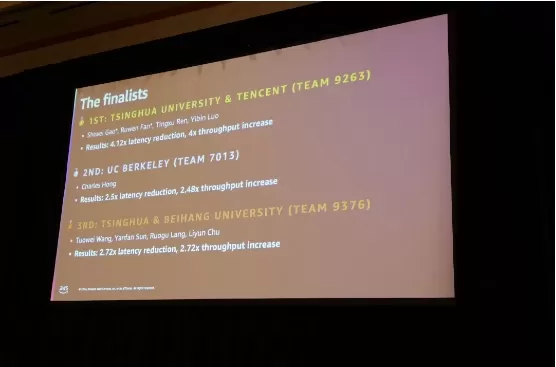
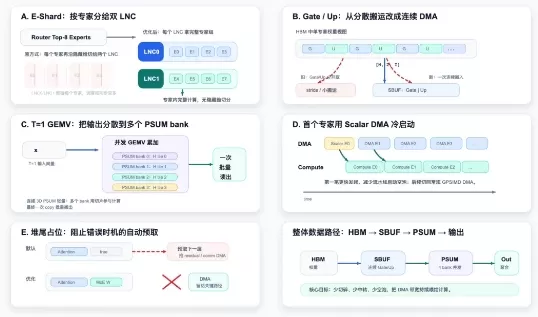
A joint team from Tsinghua University and Tencent won the global championship at MLSys2026's MoE Model Inference Optimization Challenge. They developed a full-chain optimization solution for trillion-parameter MoE models on NPU hardware, featuring novel strategies like E-Shard partitioning and PSUM/GEMV concurrency. Their approach, aided by an automated optimizer called Knight, reduced end-to-end inference time from 14.91s to 3.56s, achieving a 4.1x performance acceleration. This provides a key engineering paradigm for deploying large MoE models on future super-node computing platforms. A joint team from Tsinghua University and Tencent won the global championship at MLSys2026's MoE Model Inference Optimization Challenge. They developed a full-chain optimization solution for trillion-parameter MoE models on NPU hardware, featuring novel strategies like E-Shard partitioning and PSUM/GEMV concurrency. Their approach, aided by an automated optimizer called Knight, reduced end-to-end inference time from 14.91s to 3.56s, achieving a 4.1x performance acceleration. This provides a key engineering paradigm for deploying large MoE models on future super-node computing platforms.
Comments (0)
0/300

OR