


 Home
Home
Yangguang Qingyan Tibetan Large Model Breaks 10B Parameter Barrier as Lhasa Najin Digital Intelligence Research Institute Launches

On August 20, the "Shu Qi Na Jin · Zhi Hui Gao Yuan" thematic forum, part of the Lhasa venue for the 2026 Global Digital Economy Conference, convened in Lhasa to great acclaim. During the event, the Lhasa Naji Digital Intelligence Research Institute was officially inaugurated, alongside the launch of the highly anticipated "Sunshine Qingyan" general Tibetan language large model.
First unveiled on November 19, 2025, the "Sunshine Qingyan" model successfully completed its filing with the Office of the Central Cyberspace Administration. Following nearly two months of internal testing and over two months of public trials, the model was officially released today. In his keynote address, Ni Ma Zaxi, an Academician of the Chinese Academy of Engineering and Professor at Tibet University, highlighted that "Sunshine Qingyan" is a trillion-parameter general Tibetan language large model built upon a robust base architecture. It not only preserves the foundational intelligence and world knowledge of its base model but also achieves deep comprehension and generation capabilities for the Tibetan language and regional knowledge systems through extensive multilingual Tibetan data integration.
Professor Ni Ma Zaxi candidly noted that due to limitations in large-scale computing power and high-quality training data, "Sunshine Qingyan" still has room for performance enhancement. Moving forward, the institute plans to expand investments in computing infrastructure and data volume, driving rapid iterations of the model’s technical capabilities. The institute also aims to release various parameter-scale versions of "Sunshine Qingyan" tailored for specific application scenarios.
Established through a strategic cooperation agreement between the Luwu New District Management Committee of Lhasa City and Tibet University, the Lhasa Naji Digital Intelligence Research Institute integrates high-quality resources from government, industry, academia, research, and application sectors. Positioned as an AI innovation hub for Lhasa’s and Tibet’s digital and plateau-specific industries, the institute will focus on key technology R&D, result verification, and application commercialization, effectively bridging the gap between scientific innovation and industrial development.
Additionally, the forum showcased a series of Sunshine language technology achievements and multiple research outcomes targeting the cultural tourism sector, including applications in 3D reconstruction, interactive experiences, and digital humans. The event also featured a joint laboratory signing ceremony, bringing together experts, scholars, and enterprise representatives from the digital economy sector for in-depth discussions and technical matchmaking on leveraging AI to empower corporate digital transformation.
Related article
 Anthropic Engineers Reveal Claude Was Trained to Write for AI, Not Humans
Large AI models frequently exhibit unexpected side effects as they evolve. Following recent user reports of a decline in Claude's writing quality since the Opus 4.6 release, alongside concerns about a distinct "Claude accent," Anthropic engineer Jack
TVB Launches First Phase of 10-Petaflop AI Computing Facilities in 2027
On August 11, TVB Group Limited (TVB) issued a voluntary announcement confirming the signing of a framework agreement with Triton Square Limited, an affiliate of The Capital Group Companies, Inc. The partnership aims to launch a joint venture deliver
OpenAI Unveils AI Onboarding Event, Launches Six Industry Workflow Plugins
OpenAI, the leading force in artificial intelligence, hosted a significant event called "Intelligence at Work" on Wednesday morning, Beijing time. Amidst growing competition in the office AI sector, OpenAI has introduced Codex workflow plugins tailor
Related Special Topic Recommendations
Health & Wellness
Anthropic Engineers Reveal Claude Was Trained to Write for AI, Not Humans
Large AI models frequently exhibit unexpected side effects as they evolve. Following recent user reports of a decline in Claude's writing quality since the Opus 4.6 release, alongside concerns about a distinct "Claude accent," Anthropic engineer Jack
TVB Launches First Phase of 10-Petaflop AI Computing Facilities in 2027
On August 11, TVB Group Limited (TVB) issued a voluntary announcement confirming the signing of a framework agreement with Triton Square Limited, an affiliate of The Capital Group Companies, Inc. The partnership aims to launch a joint venture deliver
OpenAI Unveils AI Onboarding Event, Launches Six Industry Workflow Plugins
OpenAI, the leading force in artificial intelligence, hosted a significant event called "Intelligence at Work" on Wednesday morning, Beijing time. Amidst growing competition in the office AI sector, OpenAI has introduced Codex workflow plugins tailor
Related Special Topic Recommendations
Health & Wellness
 AI Wellness Tools for Sleep and Habit Tracking
2026 Latest Best Top-Rated AI Wellness Tools for Sleep and Habit Tracking! XIX.AI curates a powerful, game-changing collection of must-try tools that offer real-world tests and detailed free vs paid comparison. These top-rated solutions help users boost sleep quality, monitor daily habits effectively, and unlock significant productivity improvements. Explore now to Discover your perfect tool and Start creating today to Unlock your AI edge!
 11 tools
 xix.ai
Business
AI Vendor Due Diligence Platforms for Procurement Reviews and Risk Screening
xix.ai
Business
AI Vendor Due Diligence Platforms for Procurement Reviews and Risk Screening
2026 Latest Best Top-rated AI Vendor Due Diligence Platforms for Procurement Reviews and Risk Screening! This curated list features powerful game-changing tools that go through rigorous real-world tests to deliver accurate rankings. You’ll find a free vs paid comparison, helping you identify the must-try solutions that boost procurement efficiency and cut risks. Backed by XIX.AI, it’s updated weekly. Explore now to discover your perfect tool for smarter sourcing! 238 characters
10 tools
xix.ai
Video creation
Best AI Video Generators for Demos: Turn Scripts into Explainer Videos
2026 Latest Best Top-Rated AI Video Generators for Demos are curated here, offering powerful game-changing solutions to turn scripts into professional explainer videos fast. XIX.AI provides weekly updated rankings based on real-world tests, including free vs paid comparison details. Must-try tools help boost productivity significantly. Explore now to discover your perfect demo video creation tool!
9 tools
xix.ai
Finance
AI Cash Flow Forecasting Tools for Small Business Finance
2026 Latest Best Top-rated AI Cash Flow Forecasting Tools for Small Business Finance are here on XIX.AI! Our curated list features powerful, game-changing solutions that go through real-world tests to help small business owners boost financial accuracy, plan budgets more effectively, and avoid cash flow issues. Get a free vs paid comparison and explore now to find your perfect tool for seamless financial management.
7 tools
xix.ai
code
Best AI Coding Chatbots: Debug Python, JS, and SQL in One Place
2026 Latest Best Top-Rated AI Coding Chatbots Curated for Developers! Experience powerful game-changing tools that help you debug Python, JS, and SQL issues quickly. Get a free vs paid comparison along with real-world tests and detailed rankings to find the perfect fit for boosting your coding productivity. Try XIX.AI today to unlock your AI edge! Explore now.
12 tools
xix.ai
Prompt
AI Prompt Versioning Platforms for Reusable Claude and ChatGPT Playbooks
2026 Latest Best Top-rated AI Prompt Versioning Platforms for Reusable Playbooks are here on XIX.AI! Our curated list includes powerful game-changing tools that help you keep track of all prompts, test variations efficiently, and boost productivity across writing, content creation, and more. Get a free vs paid comparison along with real-world tests and updated rankings weekly. Explore now to discover your perfect tool for staying ahead in AI tasks!
9 tools
xix.ai

 Comments (0)
0/500
Comments (0)
0/500
On August 20, the "Shu Qi Na Jin · Zhi Hui Gao Yuan" thematic forum, part of the Lhasa venue for the 2026 Global Digital Economy Conference, convened in Lhasa to great acclaim. During the event, the Lhasa Naji Digital Intelligence Research Institute was officially inaugurated, alongside the launch of the highly anticipated "Sunshine Qingyan" general Tibetan language large model.
First unveiled on November 19, 2025, the "Sunshine Qingyan" model successfully completed its filing with the Office of the Central Cyberspace Administration. Following nearly two months of internal testing and over two months of public trials, the model was officially released today. In his keynote address, Ni Ma Zaxi, an Academician of the Chinese Academy of Engineering and Professor at Tibet University, highlighted that "Sunshine Qingyan" is a trillion-parameter general Tibetan language large model built upon a robust base architecture. It not only preserves the foundational intelligence and world knowledge of its base model but also achieves deep comprehension and generation capabilities for the Tibetan language and regional knowledge systems through extensive multilingual Tibetan data integration.
Professor Ni Ma Zaxi candidly noted that due to limitations in large-scale computing power and high-quality training data, "Sunshine Qingyan" still has room for performance enhancement. Moving forward, the institute plans to expand investments in computing infrastructure and data volume, driving rapid iterations of the model’s technical capabilities. The institute also aims to release various parameter-scale versions of "Sunshine Qingyan" tailored for specific application scenarios.
Established through a strategic cooperation agreement between the Luwu New District Management Committee of Lhasa City and Tibet University, the Lhasa Naji Digital Intelligence Research Institute integrates high-quality resources from government, industry, academia, research, and application sectors. Positioned as an AI innovation hub for Lhasa’s and Tibet’s digital and plateau-specific industries, the institute will focus on key technology R&D, result verification, and application commercialization, effectively bridging the gap between scientific innovation and industrial development.
Additionally, the forum showcased a series of Sunshine language technology achievements and multiple research outcomes targeting the cultural tourism sector, including applications in 3D reconstruction, interactive experiences, and digital humans. The event also featured a joint laboratory signing ceremony, bringing together experts, scholars, and enterprise representatives from the digital economy sector for in-depth discussions and technical matchmaking on leveraging AI to empower corporate digital transformation.








 Anthropic Engineers Reveal Claude Was Trained to Write for AI, Not Humans
Large AI models frequently exhibit unexpected side effects as they evolve. Following recent user reports of a decline in Claude's writing quality since the Opus 4.6 release, alongside concerns about a distinct "Claude accent," Anthropic engineer Jack
Anthropic Engineers Reveal Claude Was Trained to Write for AI, Not Humans
Large AI models frequently exhibit unexpected side effects as they evolve. Following recent user reports of a decline in Claude's writing quality since the Opus 4.6 release, alongside concerns about a distinct "Claude accent," Anthropic engineer Jack
 TVB Launches First Phase of 10-Petaflop AI Computing Facilities in 2027
On August 11, TVB Group Limited (TVB) issued a voluntary announcement confirming the signing of a framework agreement with Triton Square Limited, an affiliate of The Capital Group Companies, Inc. The partnership aims to launch a joint venture deliver
TVB Launches First Phase of 10-Petaflop AI Computing Facilities in 2027
On August 11, TVB Group Limited (TVB) issued a voluntary announcement confirming the signing of a framework agreement with Triton Square Limited, an affiliate of The Capital Group Companies, Inc. The partnership aims to launch a joint venture deliver
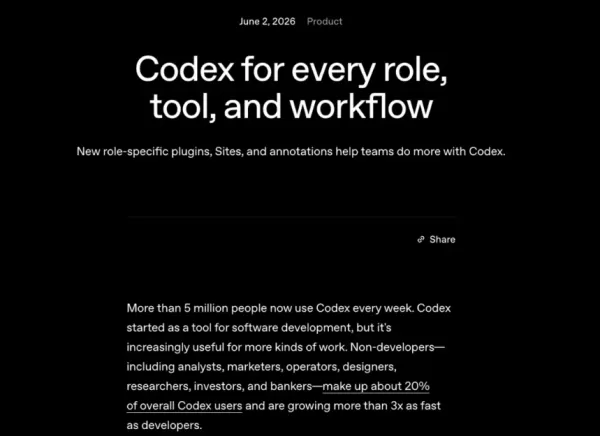 OpenAI Unveils AI Onboarding Event, Launches Six Industry Workflow Plugins
OpenAI, the leading force in artificial intelligence, hosted a significant event called "Intelligence at Work" on Wednesday morning, Beijing time. Amidst growing competition in the office AI sector, OpenAI has introduced Codex workflow plugins tailor
OpenAI Unveils AI Onboarding Event, Launches Six Industry Workflow Plugins
OpenAI, the leading force in artificial intelligence, hosted a significant event called "Intelligence at Work" on Wednesday morning, Beijing time. Amidst growing competition in the office AI sector, OpenAI has introduced Codex workflow plugins tailor

2026 Latest Best Top-Rated AI Wellness Tools for Sleep and Habit Tracking! XIX.AI curates a powerful, game-changing collection of must-try tools that offer real-world tests and detailed free vs paid comparison. These top-rated solutions help users boost sleep quality, monitor daily habits effectively, and unlock significant productivity improvements. Explore now to Discover your perfect tool and Start creating today to Unlock your AI edge!
11 tools
xix.ai

2026 Latest Best Top-rated AI Vendor Due Diligence Platforms for Procurement Reviews and Risk Screening! This curated list features powerful game-changing tools that go through rigorous real-world tests to deliver accurate rankings. You’ll find a free vs paid comparison, helping you identify the must-try solutions that boost procurement efficiency and cut risks. Backed by XIX.AI, it’s updated weekly. Explore now to discover your perfect tool for smarter sourcing! 238 characters
10 tools
xix.ai

2026 Latest Best Top-Rated AI Video Generators for Demos are curated here, offering powerful game-changing solutions to turn scripts into professional explainer videos fast. XIX.AI provides weekly updated rankings based on real-world tests, including free vs paid comparison details. Must-try tools help boost productivity significantly. Explore now to discover your perfect demo video creation tool!
9 tools
xix.ai

2026 Latest Best Top-rated AI Cash Flow Forecasting Tools for Small Business Finance are here on XIX.AI! Our curated list features powerful, game-changing solutions that go through real-world tests to help small business owners boost financial accuracy, plan budgets more effectively, and avoid cash flow issues. Get a free vs paid comparison and explore now to find your perfect tool for seamless financial management.
7 tools
xix.ai

2026 Latest Best Top-Rated AI Coding Chatbots Curated for Developers! Experience powerful game-changing tools that help you debug Python, JS, and SQL issues quickly. Get a free vs paid comparison along with real-world tests and detailed rankings to find the perfect fit for boosting your coding productivity. Try XIX.AI today to unlock your AI edge! Explore now.
12 tools
xix.ai

2026 Latest Best Top-rated AI Prompt Versioning Platforms for Reusable Playbooks are here on XIX.AI! Our curated list includes powerful game-changing tools that help you keep track of all prompts, test variations efficiently, and boost productivity across writing, content creation, and more. Get a free vs paid comparison along with real-world tests and updated rankings weekly. Explore now to discover your perfect tool for staying ahead in AI tasks!
9 tools
xix.ai












