


 Home
HomeXi'an Network Releases 2025 Guide for AI-Powered Smart Contract Development
In 2025, platforms such as Xian Network and its suite of AI-assisted tools are dramatically lowering the barrier to entry for blockchain development. Whether you are an experienced developer or new to smart contracts, Xian Network provides the resources to streamline the creation and deployment of decentralized applications. This guide will walk you through using Xian Network's AI tools to write smart contracts, even without deep Python expertise.
Key Points
Xian Network simplifies smart contract development with AI-assisted guides.
The Xian AI Guides repository on GitHub offers contextual knowledge for generating code.
Xian Network's documentation provides a comprehensive understanding of smart contracts and their related tools.
The Xian Wallet features an integrated IDE for deploying smart contracts directly onto the network.
AI models, such as Claude, can generate smart contracts based on the provided contracting guide.
Thoroughly reviewing AI-generated code is essential to ensure its correctness and security.
Getting Started with Xian Network and AI Smart Contracts
Navigating Xian Network for Smart Contract Creation
Xian Network is designed for accessibility, even if you are not deeply familiar with its specific infrastructure or smart contract language
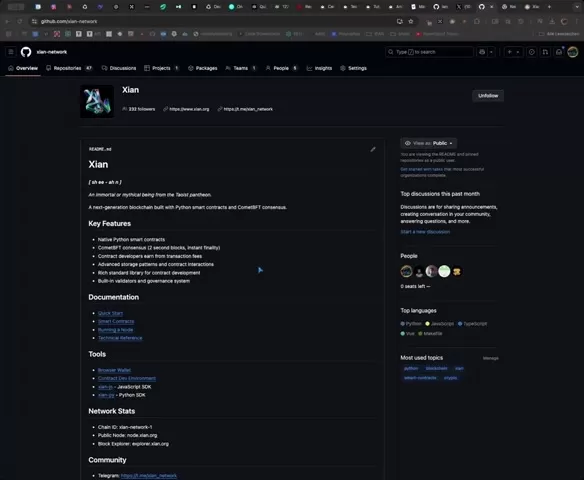
. The network utilizes Python for smart contracts and CometBFT consensus, delivering a robust and fast blockchain experience. For those new to the ecosystem or even to Python, Xian Network offers a sophisticated approach to smart contract generation using AI. The key is to leverage the available tools and documentation to create and deploy your own decentralized applications. One of the most straightforward paths to generating your contracts is through AI. The Xian Network team has focused on making it easy to start with minimal prior expertise.
Key Features of Xian Network:
- Native Python smart contracts
- CometBFT consensus mechanism
- Contract developers can earn transaction fees
- Advanced storage patterns and contract interactions
- Comprehensive standard library for contract development
- Built-in validators and governance system
Accessing the Xian AI Guides Repository
To begin, navigate to the Xian Network's GitHub repository
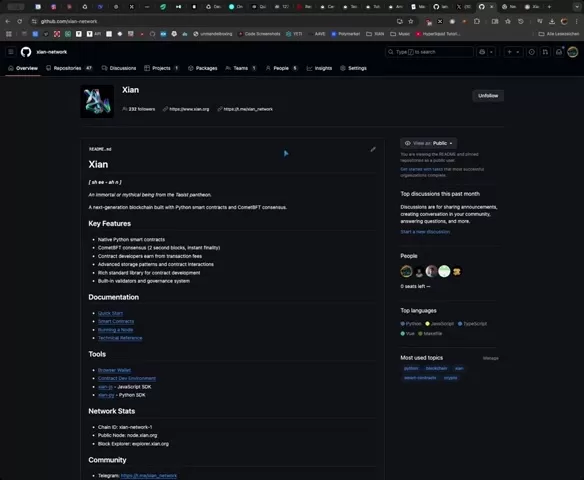
. This repository hosts numerous projects and resources. The key resource for AI-assisted development is the `xian-ai-guides` repository, which contains contextual knowledge specifically created to guide large language models (LLMs) in generating code.
Within this repository, you will find a critical file: `contracting-guide.txt`. This file acts as a comprehensive guide summarizing everything needed to understand how to create a smart contract on Xian Network. It covers core language rules, contract structure, type system annotations, state management, block context utilities, permitted control flow patterns, assertions, cross-contract calls, optimization rules, key validation checklists, and event logging. However, reading this entire guide is not the primary goal.
Instead, the purpose is to feed this information directly into an AI model for code generation.
Utilizing the Documentation for Deep Understanding
While the contracting guide is structured for quick onboarding and AI consumption, the official Xian Network documentation at docs.xian.org offers a more detailed and organized overview
. This documentation delves deeper into areas like the contracting engine, cheat sheets, context, functions, events, modules, concepts, standards, testing, and examples. If your goal is to gain a thorough understanding of smart contract development on Xian Network, the official documentation is the superior resource. For rapid prototyping and generating initial code, however, the AI guides are more efficient.
AI-Assisted Smart Contract Generation
Leveraging AI Models for Code Generation
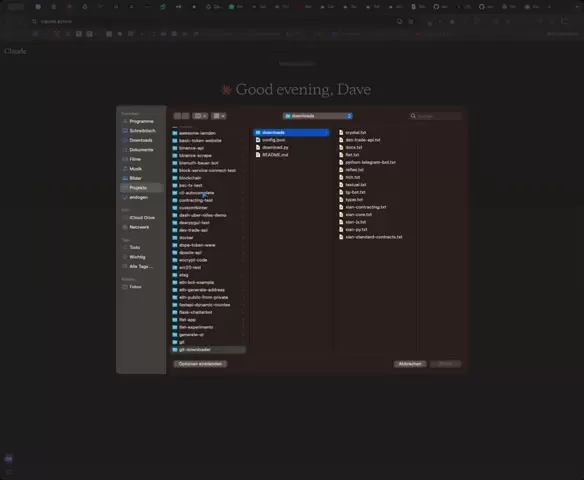
Now, let's proceed to generate a smart contract with the help of an AI model. The first step is to download the `contracting-guide.txt` file from the `xian-ai-guides` GitHub repository
. Next, upload this guide to your preferred AI model. The accompanying video uses Claude, but you can also use other LLMs like ChatGPT, Google Gemini, or any similar model.
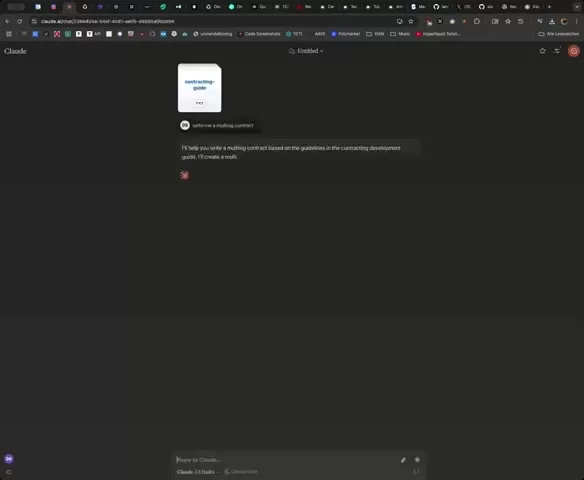
After uploading the file, prompt the AI model to write a smart contract based on the document's information. A simple prompt like "Write me a multisig contract" is an excellent starting point
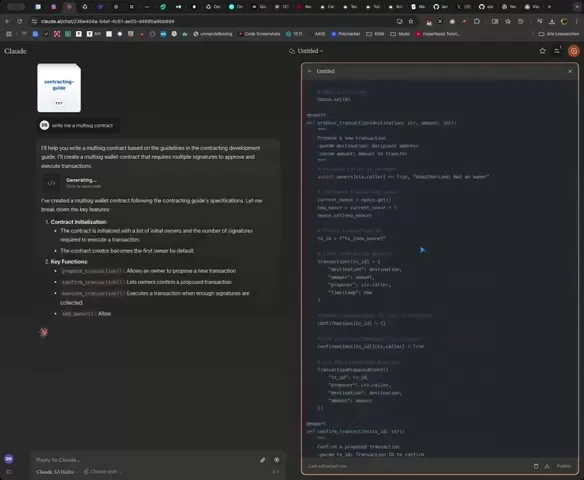
. The AI will then generate code adhering to the specifications in the contracting guide. It is important to note that while this process is streamlined, you must review the generated code to ensure it meets your specifications and is error-free. Key aspects to understand include:
- Contract Initialization: The contract is initiated with a list of initial owners and the number of required signatures to execute a transaction.
- Key Functions: Allows an owner to propose a new transaction; lets owners confirm a proposed transaction; and permits the addition or removal of owners.
- Security Features: Only registered owners can propose, confirm, and execute transactions; prevents double confirmations; requires a minimum number of signatures to execute; and uses a nonce to prevent replay attacks.
- Event Logging: Includes events for transaction proposals, executions, and owner management.
- Compliance with Contract Rules: Uses only allowed built-ins; follows type annotation requirements; and avoids forbidden constructs like classes and exception handling.
Deploying the AI Generated Contract with the Xian Wallet
The Xian Wallet includes an integrated development environment (IDE) that simplifies contract deployment
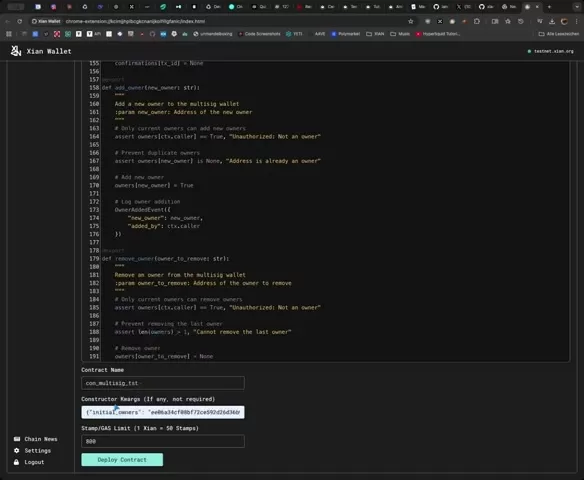
. After generating code with an AI model, you can paste it directly into the IDE within the Xian Wallet. Before deployment, ensure you are connected to the test network. Every contract name must begin with `con_` to conform to Xian's formatting rules.
To deploy, you will need to name the contract and, for a multisig example, fill in the initial owners and the required signature count. Once these steps are complete, simply click "Deploy Contract". After the process finishes, the Xian Explorer will be available to confirm the contract's successful deployment.
Important Considerations: A successful deployment does not guarantee the code is free of errors or bugs. Always double-check AI-generated code to ensure it is safe and functions as intended.
Step-by-Step Guide: AI-Powered Smart Contract Creation on Xian
Step 1: Access the Xian Network GitHub Repository
Open your web browser and go to the Xian Network's GitHub repository: github.com/xian-network.
Step 2: Navigate to the AI Guides Repository
Within the Xian Network repository, locate and enter the `xian-ai-guides` repository.
Step 3: Download the Contracting Guide
Locate the `contracting-guide.txt` file and download it to your computer.
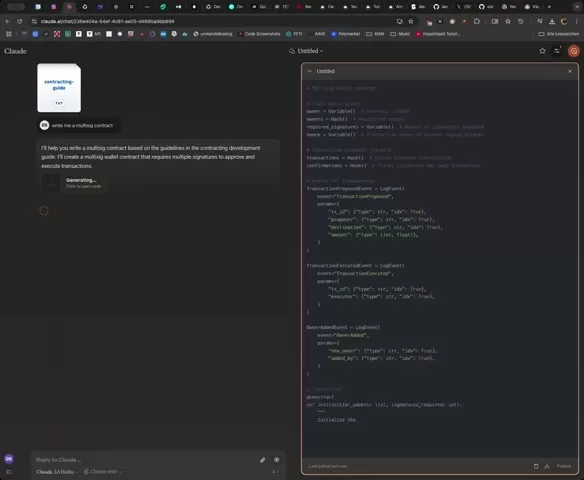
Step 4: Upload the Guide to Your AI Model
Open your preferred AI model (e.g., Claude, ChatGPT, Gemini) and upload the `contracting-guide.txt` file
.
Step 5: Prompt the AI Model for Code Generation
Provide the AI model with a specific prompt. For instance: "Write me a multisig contract." Be as descriptive as possible about your requirements.
Step 6: Review the Generated Code
Carefully review the generated smart contract code for correctness and security.
Step 7: Access the Xian Wallet
Open the Xian Wallet in your web browser. Ensure you are connected to the test network.
Step 8: Paste the Code into the IDE
In the Xian Wallet, navigate to the IDE tab and paste the AI-generated smart contract code.
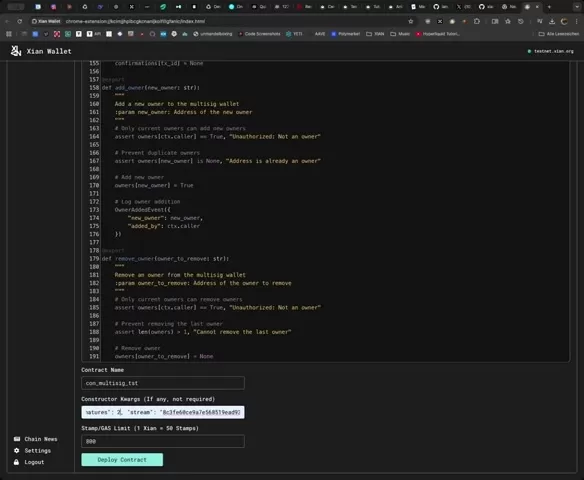
Step 9: Deploy the Smart Contract
Name the contract (starting with `con_`) and fill out other parameters as needed. Set the stamp/gas limit and deploy the contract to the Xian testnet
.
Step 10: Verify Deployment
Use the Xian Explorer to verify that the contract was successfully deployed on the testnet.
Xian Network: Potential Costs & Pricing (2025)
Understanding Transaction Costs and Gas
While this tutorial focuses on the free use of AI and the test network for development, real-world deployment and execution of smart contracts on a blockchain involve costs. On Xian Network, transaction fees are typically represented in stamps or gas, where 1 Xian coin equals 50 stamps. Allocating sufficient gas is crucial for a successful deployment. Note that even with correct code, a transaction can fail due to insufficient stamps. Ensure you are connected to the testnet, as gas costs on the mainnet can be significantly higher.
Xian Network Smart Contract Development: Evaluating the AI Approach
Pros
Simplified development: AI lowers the barrier to entry for non-experts.
Rapid prototyping: Quickly generate initial contract code.
Learning tool: Provides examples and structures for understanding smart contracts.
Cons
Security risks: AI-generated code requires thorough review and testing.
Limited understanding: Users may not fully grasp the underlying code logic.
Dependence on AI: Over-reliance can hinder the development of core programming skills.
Frequently Asked Questions about Xian Network and AI Smart Contracts
What is Xian Network?
Xian Network is a next-generation blockchain built with Python smart contracts and CometBFT consensus, focused on making blockchain technology more accessible.
What is the Xian AI Guides repository?
The xian-ai-guides repository on GitHub contains contextual knowledge designed to guide large language models (LLMs) in generating code, simplifying the smart contract creation process.
Do I need to know how to code to use Xian Network?
While coding knowledge is beneficial, Xian Network's AI-assisted tools enable you to generate smart contracts without extensive programming expertise. However, reviewing and understanding the generated code is highly recommended. If you have no coding experience, this network might not be the best starting point for you.
What are the benefits of using AI for smart contract creation?
AI can significantly accelerate development, lower the entry barrier for newcomers, and provide a starting point for complex contracts. It is also useful for observing how AI approaches complicated scenarios.
Is the code generated by AI secure?
While AI can produce functional code, it is critical to thoroughly review and test all AI-generated code to ensure its security and correctness. Treat AI as another tool in your development toolkit.
Related Questions about Xian Network
What is the Xian Wallet and how do I use it?
The Xian Wallet is a browser extension for interacting with the Xian Network. It provides a user-friendly interface for managing Xian coins, deploying smart contracts, and interacting with decentralized applications. First, install the Xian Wallet extension via the Chrome Web Store or the official website. During setup, you will be asked to record and securely store your security key. You can also choose to import an existing wallet. Next, configure your wallet settings. Within the wallet, you can view and edit RPC settings. For this tutorial, you will need to connect to the Xian testnet. You can also export your private key for secure backup. Once complete, you are ready to use the network and explore Web3.
Related article
 DeepMind CEO Hassabis: I sleep six hours a day, usually feel energetic around 1 a.m.
Fortune recently featured an interview with Demis Hassabis, CEO of Google DeepMind, revealing his unconventional approach to rest and productivity. Hassabis disclosed that he sleeps very little, structuring his waking hours into two distinct work blo
OpenAI, Anthropic Vie for Market Share Despite Revenue Shortfalls
Despite recent reports suggesting OpenAI missed revenue targets, creating pressure on tech stocks this Tuesday, private AI lab investors remain resilient. Seasoned backers have confirmed they will not reduce investment despite negative media coverage
California AV Compliance: A New Era of Tickets, Geofences, and 1M Miles
Guident operates an AuveTech shuttle in South Florida, managing a four-mile route in West Palm Beach and a one-mile route in Boca Raton using its remote monitoring technology. | Credit: GuidentCalifornia is redefining the regulatory landscape for dri
Related Special Topic Recommendations
writing
DeepMind CEO Hassabis: I sleep six hours a day, usually feel energetic around 1 a.m.
Fortune recently featured an interview with Demis Hassabis, CEO of Google DeepMind, revealing his unconventional approach to rest and productivity. Hassabis disclosed that he sleeps very little, structuring his waking hours into two distinct work blo
OpenAI, Anthropic Vie for Market Share Despite Revenue Shortfalls
Despite recent reports suggesting OpenAI missed revenue targets, creating pressure on tech stocks this Tuesday, private AI lab investors remain resilient. Seasoned backers have confirmed they will not reduce investment despite negative media coverage
California AV Compliance: A New Era of Tickets, Geofences, and 1M Miles
Guident operates an AuveTech shuttle in South Florida, managing a four-mile route in West Palm Beach and a one-mile route in Boca Raton using its remote monitoring technology. | Credit: GuidentCalifornia is redefining the regulatory landscape for dri
Related Special Topic Recommendations
writing
 AI Article Outline Tools for Long Form Writing
2026 Latest Best Top-Rated AI Article Outline Tools for Long Form Writing! This curated collection features powerful, game-changing tools that deliver accurate, structured outlines with real-world tests to boost writing efficiency significantly. XIX.AI is part of this elite selection. Get a free vs paid comparison to help you choose the perfect tool. Explore now and Unlock your AI edge!
 9 tools
 xix.ai
chatbot
Best AI Roleplay Chat Apps for Language Practice, Interview Prep, and Daily Fluency
xix.ai
chatbot
Best AI Roleplay Chat Apps for Language Practice, Interview Prep, and Daily Fluency
2026 Latest Best Top-rated AI Roleplay Chat Apps for Language Practice, Interview Prep, and Daily Fluency! XIX.AI curates a powerful game-changing collection that offers free vs paid comparison, real-world tests, and updated rankings weekly. These must-try tools help you boost writing skills, overcome fluency challenges, and improve communication efficiency across all daily scenarios. Explore now to discover your perfect tool for language growth!
10 tools
xix.ai
Music composition
AI Stem Separation Tools for Remix Production, Sampling Prep, and Karaoke Masters
2026 Latest Best Top-rated AI Stem Separation Tools Curated for Remix Production, Sampling Prep, and Karaoke Masters. These powerful game-changing tools offer real-world tests to deliver precise audio isolation, boosting productivity significantly. XIX.AI provides a weekly updated free vs paid comparison guide to help you find the must-try solution that suits your needs. Explore now to unlock your AI edge.
8 tools
xix.ai
Data Analysis
AI SQL Copilots for Revenue Dashboards, Funnel Analysis, and Product Metrics
2026 Latest Best AI SQL Copilots Ranked Top-Rated! XIX.AI curates a powerful game-changing collection for weekly updated real-world tests. These must-try tools help you generate accurate revenue dashboards, analyze sales funnels, and track product metrics swiftly, boosting productivity massively. Explore now to Discover your perfect tool for data-driven decision making! 238 characters
9 tools
xix.ai
Music composition
Best AI Melody Writing Tools for Song Drafts
2026 Latest Best Top-Rated AI Melody Writing Tools for Song Drafts! XIX.AI has curated a highly powerful game-changing collection that goes through rigorous real-world tests to deliver the best writing experience. You can find detailed free vs paid comparisons, accurate rankings, and must-try options designed to help you create stunning song drafts effortlessly and boost your creative productivity significantly. Explore now to discover your perfect tool!
8 tools
xix.ai
chatbot
Best AI Conversation Trainer Tools for Interview Practice
2026 Latest Best Top-rated AI Conversation Trainer Tools for Interview Practice are here on XIX.AI! This curated collection features powerful, game-changing tools that go through rigorous real-world tests to deliver accurate feedback. You’ll find a free vs paid comparison and detailed rankings to help you choose the must-try option that boosts your confidence and skills. Explore now to Discover your perfect tool for interview success!
12 tools
xix.ai

 Comments (1)
0/500
Comments (1)
0/500
![JuanAdams]()
Quand on voit ça, on se dit : enfin un truc qui peut aider les nouveaux à s'initier ! Sérieux, les contrats intelligents, ça fait peur. Mais bon, est-ce que cette IA ne cache pas des outils trop basiques pour les devs chevronnés ? 🤨 À suivre...
In 2025, platforms such as Xian Network and its suite of AI-assisted tools are dramatically lowering the barrier to entry for blockchain development. Whether you are an experienced developer or new to smart contracts, Xian Network provides the resources to streamline the creation and deployment of decentralized applications. This guide will walk you through using Xian Network's AI tools to write smart contracts, even without deep Python expertise.
Key Points
Xian Network simplifies smart contract development with AI-assisted guides.
The Xian AI Guides repository on GitHub offers contextual knowledge for generating code.
Xian Network's documentation provides a comprehensive understanding of smart contracts and their related tools.
The Xian Wallet features an integrated IDE for deploying smart contracts directly onto the network.
AI models, such as Claude, can generate smart contracts based on the provided contracting guide.
Thoroughly reviewing AI-generated code is essential to ensure its correctness and security.
Getting Started with Xian Network and AI Smart Contracts
Navigating Xian Network for Smart Contract Creation
Xian Network is designed for accessibility, even if you are not deeply familiar with its specific infrastructure or smart contract language
. The network utilizes Python for smart contracts and CometBFT consensus, delivering a robust and fast blockchain experience. For those new to the ecosystem or even to Python, Xian Network offers a sophisticated approach to smart contract generation using AI. The key is to leverage the available tools and documentation to create and deploy your own decentralized applications. One of the most straightforward paths to generating your contracts is through AI. The Xian Network team has focused on making it easy to start with minimal prior expertise.
Key Features of Xian Network:
- Native Python smart contracts
- CometBFT consensus mechanism
- Contract developers can earn transaction fees
- Advanced storage patterns and contract interactions
- Comprehensive standard library for contract development
- Built-in validators and governance system
Accessing the Xian AI Guides Repository
To begin, navigate to the Xian Network's GitHub repository
. This repository hosts numerous projects and resources. The key resource for AI-assisted development is the `xian-ai-guides` repository, which contains contextual knowledge specifically created to guide large language models (LLMs) in generating code.
Within this repository, you will find a critical file: `contracting-guide.txt`. This file acts as a comprehensive guide summarizing everything needed to understand how to create a smart contract on Xian Network. It covers core language rules, contract structure, type system annotations, state management, block context utilities, permitted control flow patterns, assertions, cross-contract calls, optimization rules, key validation checklists, and event logging. However, reading this entire guide is not the primary goal.
Instead, the purpose is to feed this information directly into an AI model for code generation.
Utilizing the Documentation for Deep Understanding
While the contracting guide is structured for quick onboarding and AI consumption, the official Xian Network documentation at docs.xian.org offers a more detailed and organized overview
. This documentation delves deeper into areas like the contracting engine, cheat sheets, context, functions, events, modules, concepts, standards, testing, and examples. If your goal is to gain a thorough understanding of smart contract development on Xian Network, the official documentation is the superior resource. For rapid prototyping and generating initial code, however, the AI guides are more efficient.
AI-Assisted Smart Contract Generation
Leveraging AI Models for Code Generation
Now, let's proceed to generate a smart contract with the help of an AI model. The first step is to download the `contracting-guide.txt` file from the `xian-ai-guides` GitHub repository
. Next, upload this guide to your preferred AI model. The accompanying video uses Claude, but you can also use other LLMs like ChatGPT, Google Gemini, or any similar model.
After uploading the file, prompt the AI model to write a smart contract based on the document's information. A simple prompt like "Write me a multisig contract" is an excellent starting point
. The AI will then generate code adhering to the specifications in the contracting guide. It is important to note that while this process is streamlined, you must review the generated code to ensure it meets your specifications and is error-free. Key aspects to understand include:
- Contract Initialization: The contract is initiated with a list of initial owners and the number of required signatures to execute a transaction.
- Key Functions: Allows an owner to propose a new transaction; lets owners confirm a proposed transaction; and permits the addition or removal of owners.
- Security Features: Only registered owners can propose, confirm, and execute transactions; prevents double confirmations; requires a minimum number of signatures to execute; and uses a nonce to prevent replay attacks.
- Event Logging: Includes events for transaction proposals, executions, and owner management.
- Compliance with Contract Rules: Uses only allowed built-ins; follows type annotation requirements; and avoids forbidden constructs like classes and exception handling.
Deploying the AI Generated Contract with the Xian Wallet
The Xian Wallet includes an integrated development environment (IDE) that simplifies contract deployment
. After generating code with an AI model, you can paste it directly into the IDE within the Xian Wallet. Before deployment, ensure you are connected to the test network. Every contract name must begin with `con_` to conform to Xian's formatting rules.
To deploy, you will need to name the contract and, for a multisig example, fill in the initial owners and the required signature count. Once these steps are complete, simply click "Deploy Contract". After the process finishes, the Xian Explorer will be available to confirm the contract's successful deployment.
Important Considerations: A successful deployment does not guarantee the code is free of errors or bugs. Always double-check AI-generated code to ensure it is safe and functions as intended.
Step-by-Step Guide: AI-Powered Smart Contract Creation on Xian
Step 1: Access the Xian Network GitHub Repository
Open your web browser and go to the Xian Network's GitHub repository: github.com/xian-network.
Step 2: Navigate to the AI Guides Repository
Within the Xian Network repository, locate and enter the `xian-ai-guides` repository.
Step 3: Download the Contracting Guide
Locate the `contracting-guide.txt` file and download it to your computer.
Step 4: Upload the Guide to Your AI Model
Open your preferred AI model (e.g., Claude, ChatGPT, Gemini) and upload the `contracting-guide.txt` file
.
Step 5: Prompt the AI Model for Code Generation
Provide the AI model with a specific prompt. For instance: "Write me a multisig contract." Be as descriptive as possible about your requirements.
Step 6: Review the Generated Code
Carefully review the generated smart contract code for correctness and security.
Step 7: Access the Xian Wallet
Open the Xian Wallet in your web browser. Ensure you are connected to the test network.
Step 8: Paste the Code into the IDE
In the Xian Wallet, navigate to the IDE tab and paste the AI-generated smart contract code.
Step 9: Deploy the Smart Contract
Name the contract (starting with `con_`) and fill out other parameters as needed. Set the stamp/gas limit and deploy the contract to the Xian testnet
.
Step 10: Verify Deployment
Use the Xian Explorer to verify that the contract was successfully deployed on the testnet.
Xian Network: Potential Costs & Pricing (2025)
Understanding Transaction Costs and Gas
While this tutorial focuses on the free use of AI and the test network for development, real-world deployment and execution of smart contracts on a blockchain involve costs. On Xian Network, transaction fees are typically represented in stamps or gas, where 1 Xian coin equals 50 stamps. Allocating sufficient gas is crucial for a successful deployment. Note that even with correct code, a transaction can fail due to insufficient stamps. Ensure you are connected to the testnet, as gas costs on the mainnet can be significantly higher.
Xian Network Smart Contract Development: Evaluating the AI Approach
Pros
Simplified development: AI lowers the barrier to entry for non-experts.
Rapid prototyping: Quickly generate initial contract code.
Learning tool: Provides examples and structures for understanding smart contracts.
Cons
Security risks: AI-generated code requires thorough review and testing.
Limited understanding: Users may not fully grasp the underlying code logic.
Dependence on AI: Over-reliance can hinder the development of core programming skills.
Frequently Asked Questions about Xian Network and AI Smart Contracts
What is Xian Network?
Xian Network is a next-generation blockchain built with Python smart contracts and CometBFT consensus, focused on making blockchain technology more accessible.
What is the Xian AI Guides repository?
The xian-ai-guides repository on GitHub contains contextual knowledge designed to guide large language models (LLMs) in generating code, simplifying the smart contract creation process.
Do I need to know how to code to use Xian Network?
While coding knowledge is beneficial, Xian Network's AI-assisted tools enable you to generate smart contracts without extensive programming expertise. However, reviewing and understanding the generated code is highly recommended. If you have no coding experience, this network might not be the best starting point for you.
What are the benefits of using AI for smart contract creation?
AI can significantly accelerate development, lower the entry barrier for newcomers, and provide a starting point for complex contracts. It is also useful for observing how AI approaches complicated scenarios.
Is the code generated by AI secure?
While AI can produce functional code, it is critical to thoroughly review and test all AI-generated code to ensure its security and correctness. Treat AI as another tool in your development toolkit.
Related Questions about Xian Network
What is the Xian Wallet and how do I use it?
The Xian Wallet is a browser extension for interacting with the Xian Network. It provides a user-friendly interface for managing Xian coins, deploying smart contracts, and interacting with decentralized applications. First, install the Xian Wallet extension via the Chrome Web Store or the official website. During setup, you will be asked to record and securely store your security key. You can also choose to import an existing wallet. Next, configure your wallet settings. Within the wallet, you can view and edit RPC settings. For this tutorial, you will need to connect to the Xian testnet. You can also export your private key for secure backup. Once complete, you are ready to use the network and explore Web3.








 DeepMind CEO Hassabis: I sleep six hours a day, usually feel energetic around 1 a.m.
Fortune recently featured an interview with Demis Hassabis, CEO of Google DeepMind, revealing his unconventional approach to rest and productivity. Hassabis disclosed that he sleeps very little, structuring his waking hours into two distinct work blo
DeepMind CEO Hassabis: I sleep six hours a day, usually feel energetic around 1 a.m.
Fortune recently featured an interview with Demis Hassabis, CEO of Google DeepMind, revealing his unconventional approach to rest and productivity. Hassabis disclosed that he sleeps very little, structuring his waking hours into two distinct work blo
 OpenAI, Anthropic Vie for Market Share Despite Revenue Shortfalls
Despite recent reports suggesting OpenAI missed revenue targets, creating pressure on tech stocks this Tuesday, private AI lab investors remain resilient. Seasoned backers have confirmed they will not reduce investment despite negative media coverage
California AV Compliance: A New Era of Tickets, Geofences, and 1M Miles
Guident operates an AuveTech shuttle in South Florida, managing a four-mile route in West Palm Beach and a one-mile route in Boca Raton using its remote monitoring technology. | Credit: GuidentCalifornia is redefining the regulatory landscape for dri
OpenAI, Anthropic Vie for Market Share Despite Revenue Shortfalls
Despite recent reports suggesting OpenAI missed revenue targets, creating pressure on tech stocks this Tuesday, private AI lab investors remain resilient. Seasoned backers have confirmed they will not reduce investment despite negative media coverage
California AV Compliance: A New Era of Tickets, Geofences, and 1M Miles
Guident operates an AuveTech shuttle in South Florida, managing a four-mile route in West Palm Beach and a one-mile route in Boca Raton using its remote monitoring technology. | Credit: GuidentCalifornia is redefining the regulatory landscape for dri

2026 Latest Best Top-Rated AI Article Outline Tools for Long Form Writing! This curated collection features powerful, game-changing tools that deliver accurate, structured outlines with real-world tests to boost writing efficiency significantly. XIX.AI is part of this elite selection. Get a free vs paid comparison to help you choose the perfect tool. Explore now and Unlock your AI edge!
9 tools
xix.ai
2026 Latest Best Top-rated AI Roleplay Chat Apps for Language Practice, Interview Prep, and Daily Fluency! XIX.AI curates a powerful game-changing collection that offers free vs paid comparison, real-world tests, and updated rankings weekly. These must-try tools help you boost writing skills, overcome fluency challenges, and improve communication efficiency across all daily scenarios. Explore now to discover your perfect tool for language growth!
10 tools
xix.ai
2026 Latest Best Top-rated AI Stem Separation Tools Curated for Remix Production, Sampling Prep, and Karaoke Masters. These powerful game-changing tools offer real-world tests to deliver precise audio isolation, boosting productivity significantly. XIX.AI provides a weekly updated free vs paid comparison guide to help you find the must-try solution that suits your needs. Explore now to unlock your AI edge.
8 tools
xix.ai

2026 Latest Best AI SQL Copilots Ranked Top-Rated! XIX.AI curates a powerful game-changing collection for weekly updated real-world tests. These must-try tools help you generate accurate revenue dashboards, analyze sales funnels, and track product metrics swiftly, boosting productivity massively. Explore now to Discover your perfect tool for data-driven decision making! 238 characters
9 tools
xix.ai

2026 Latest Best Top-Rated AI Melody Writing Tools for Song Drafts! XIX.AI has curated a highly powerful game-changing collection that goes through rigorous real-world tests to deliver the best writing experience. You can find detailed free vs paid comparisons, accurate rankings, and must-try options designed to help you create stunning song drafts effortlessly and boost your creative productivity significantly. Explore now to discover your perfect tool!
8 tools
xix.ai

2026 Latest Best Top-rated AI Conversation Trainer Tools for Interview Practice are here on XIX.AI! This curated collection features powerful, game-changing tools that go through rigorous real-world tests to deliver accurate feedback. You’ll find a free vs paid comparison and detailed rankings to help you choose the must-try option that boosts your confidence and skills. Explore now to Discover your perfect tool for interview success!
12 tools
xix.ai

Quand on voit ça, on se dit : enfin un truc qui peut aider les nouveaux à s'initier ! Sérieux, les contrats intelligents, ça fait peur. Mais bon, est-ce que cette IA ne cache pas des outils trop basiques pour les devs chevronnés ? 🤨 À suivre...












