In the fast-paced world of Artificial Intelligence, a key challenge for tech leaders is moving beyond experimental projects to building enterprise-ready solutions. While consumer-facing chatbots capture public attention, businesses require more than just a conversational interface to thrive. In today's intensely competitive environment, companies need a robust, scalable, and secure AI ecosystem. This is the gap Google aims to fill with Vertex AI, its unified AI and Machine Learning platform on Google Cloud.
Vertex AI positions itself as the foundational layer for integrating Generative AI with modern cloud infrastructure. It delivers a comprehensive suite of tools designed to bridge the divide between raw foundation models and production-grade applications. More than just a wrapper for large language models (LLMs), Vertex AI is a unified Machine Learning and AI ecosystem where Generative AI is a core component of the cloud infrastructure.
Central to Vertex AI is the Model Garden, a centralized marketplace offering access to over 200 curated foundation models. This includes the multimodal Gemini 2.5 Pro, which boasts an impressive 2-million-token context window. This article will break down the architecture of Vertex AI, examine how the Model Garden acts as an industry "App Store" for intelligence, and explore the technical pillars that establish this platform as the backbone for the next generation of enterprise software.
The Core Architecture : A Unified Platform
Vertex AI is not a disjointed collection of tools; it is a unified data and AI ecosystem built to overcome the fragmentation of data, tools, and teams that still hinders machine learning. Traditional AI development often occurs in isolated environments, with data scattered across multiple repositories. For instance, an organization might store customer data in SQL data warehouses while unstructured documents reside in a Data Lake. When data is siloed, AI models only see a partial picture, leading to biased outcomes or high hallucination rates due to a lack of full enterprise context.
Vertex AI seeks to integrate the entire AI lifecycle, from ingesting raw data in BigQuery and Cloud Storage to monitoring production systems. It acts as a "connective tissue" between these data silos. With native integration into Cloud Storage and BigQuery, Vertex AI enables models to access data directly, eliminating the need for complex Extraction, Transformation, and Load (ETL) pipelines.
The Foundation : Google’s AI Hypercomputer
The Generative AI layer of Vertex AI is built upon Google's AI Hypercomputer architecture, an integrated supercomputing system composed of:
TPU v5p & v5e (Tensor Processing Units)
Google's Tensor Processing Units are custom-built Application-Specific Integrated Circuits (ASICs) optimized for the matrix multiplication operations fundamental to deep learning.
TPU v5p (Performance): This is the flagship accelerator for large-scale model training. A single TPU v5p pod can scale to 8,960 chips, interconnected by Google's high-bandwidth Inter-Chip Interconnect (ICI) at 4,800 Gbps. For technical leaders, this translates to training a GPT-3 scale model (175 billion parameters) 2.8 times faster than the previous generation, significantly accelerating time-to-market.
TPU v5e (Efficiency): Engineered for cost-optimized performance, the v5e is the workhorse for medium-scale training and high-throughput inference. It delivers up to 2.5 times better price-performance, making it an ideal choice for businesses requiring continuous inference without a massive budget.
NVIDIA H100/A100 GPUs for Flexibility
While TPUs are specialized, many development teams depend on the NVIDIA CUDA ecosystem. Vertex AI offers first-class support for NVIDIA's latest hardware:
NVIDIA H100 (Hopper): Excellent for fine-tuning the largest open-source models, such as Llama 3.1 405B, which demand substantial memory bandwidth.
Jupiter Networking: To prevent network bottlenecks, Google employs its Jupiter data center network fabric. This ensures rapid data transfer between GPUs, supporting Remote Direct Memory Access (RDMA) to bypass CPU overhead and deliver performance across distributed nodes that is nearly as fast as local processing.
Dynamic Orchestration
A crucial technical advancement in Vertex AI is Dynamic Orchestration. In legacy setups, a GPU node failure during a multi-week training job could cause the entire process to crash.
Automated Resiliency: Vertex AI, often powered by Google Kubernetes Engine (GKE) in the background, includes "self-healing" nodes. If a hardware fault is detected, the platform automatically transfers the workload to a healthy node.
Dynamic Workload Scheduler: This tool enables teams to request computing capacity based on urgency. Options include Flex Start (more cost-effective, begins when resources are free) or Guaranteed Capacity for mission-critical deployments.
Serverless Training: For teams seeking to avoid infrastructure management, Vertex AI Serverless Training lets you submit your code and data. The platform provisions the cluster, runs the job, and dismantles it afterward—charging only for the compute seconds used.
The Three Entry Points: Discovery, Experimentation, and Automation
To serve different technical roles—from data scientists to application developers—Vertex AI provides three main entry points:
Model Garden: The Marketplace for Discovery.
Vertex AI Studio: The Playground for Experimentation.
Vertex AI Agent Builder: The Factory for Automation.
Model Garden: The Marketplace for Discovery
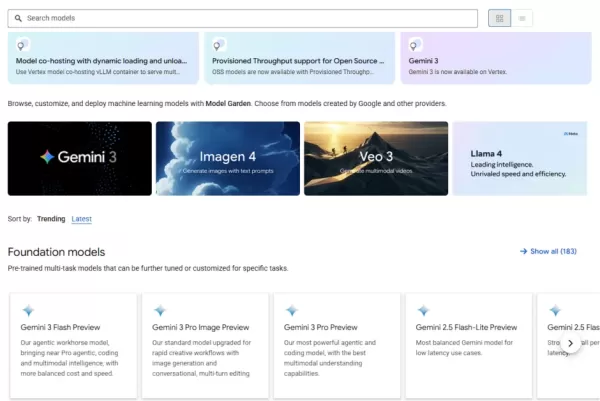
Google Cloud's Vertex AI Model Garden is a centralized platform for discovering, testing, customizing, and deploying a wide array of first-party, open-source, and third-party AI models, including multimodal options for vision, text, and code. It offers seamless integration with Vertex AI's MLOps tools, functioning as a comprehensive library that helps developers and businesses choose the right model for their tasks, whether for text generation, image analysis, or code completion, and deploy them efficiently within their Google Cloud environment.
Model Garden organizes its 200+ models into three distinct tiers, enabling architects to balance performance, cost, and control:
First-Party (Google) Models: These are Google's flagship multimodal models available in Vertex AI, offered in various sizes from Pro for complex reasoning to Flash for low-latency, high-volume tasks. This allows developers to optimize model selection based on their specific use cases.
Third-Party (Proprietary) Models: Through strategic partnerships, Vertex AI provides "Model-as-a-Service" access to leading models from companies like Anthropic (Claude 3.5) and Mistral AI. Instead of managing separate billing and security for multiple AI providers, a technical team can access them all through their existing Google Cloud project using a unified API.
Open-Source & Open-Weight Models: This tier includes models like Meta's Llama 3.2, Mistral, and Google's own Gemma. These are ideal for organizations that prefer to self-deploy models within their own Virtual Private Cloud to ensure maximum data isolation.
In a non-unified environment, deploying an open-source model like Llama involves setting up a PyTorch environment, configuring CUDA drivers, and creating a Flask or FastAPI wrapper.
Model Garden removes this cumbersome setup phase through Unified Managed Endpoints:
One-Click Deployment: For many models, clicking "Deploy" automatically provisions the necessary TPU/GPU resources, packages the model in a production-ready container, and supplies a REST API endpoint.
Hugging Face Integration: Vertex AI now lets developers deploy models directly from the Hugging Face Hub into a Vertex endpoint, vastly expanding the range of available intelligence.
Private Service Connect (PSC): For highly regulated industries, models can be deployed using Private Service Connect, ensuring the model endpoint is never exposed to the public internet and keeping all data traffic within the corporate network.
Vertex AI Studio: The Playground for Experimentation
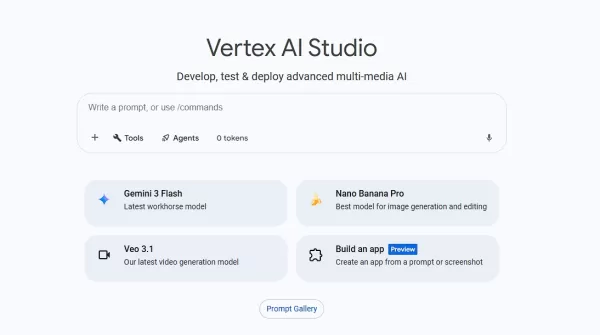
While Model Garden focuses on model selection, Vertex AI Studio is about refinement. It can be compared to the compilers and debuggers used in traditional software development. Vertex AI Studio is the workspace where raw models are tailored into specific business tools through prompt engineering, multimodal testing, and advanced hyperparameter tuning.
Multimodal Prototyping: Beyond Text
A standout feature of the Studio is its native support for multimodality. While other platforms often require complex coding to handle non-text data, Vertex AI Studio lets you drag and drop files directly into the interface to test capabilities like the reasoning of Gemini 2.5.
Video Intelligence: You can upload a 45-minute technical keynote and ask the model to "identify every mention of a specific API and provide a timestamped summary."
Document Analysis: The model can analyze not just the text but also the visual layout of a 1,000-page PDF, understanding the relationships between charts, tables, and surrounding text.
Code Execution: The Studio now supports code execution in its playground. If you ask a model to solve a complex math problem or analyze a CSV file, the model can write and run Python code in a secure, sandboxed environment to deliver a verified answer.
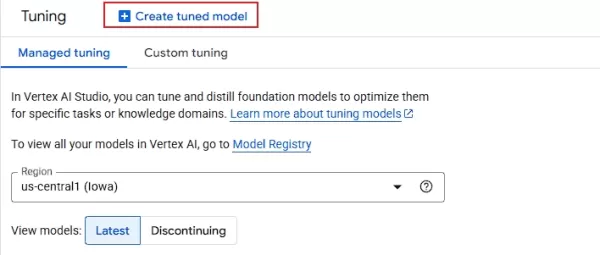
Advanced Customization: The Tuning Pathway
When prompt engineering (using zero-shot or few-shot learning) reaches its limits, Vertex AI Studio provides more powerful tools: Model Tuning.
Supervised Fine-Tuning (SFT): Developers supply a dataset of "prompt/response" pairs (ideally 100+ examples). This trains the model to adopt a specific brand voice, output format (like a specialized JSON schema), or domain-specific terminology.
Context Caching: For enterprises working with large, static datasets such as legal libraries or codebases, the Studio supports Context Caching. This allows you to "pre-load" a million tokens of data into the model's memory, significantly cutting latency and costs for subsequent queries.
Distillation (Teacher-Student): This is an advanced architectural technique. You can use a large model (like Gemini 2.5 Pro) to "teach" a smaller, faster model (like Gemini 2.0 Flash). The outcome is a lightweight model that performs at a "Pro" level but operates at "Flash" speed and cost.
Vertex AI Agent Builder: The Factory for Automation
Vertex AI Agent Builder is a high-level orchestration framework that enables developers to create intelligent agents by combining foundation models with enterprise data and external APIs.
The Architecture of “Truth”: Grounding & RAG
The main technical obstacle for enterprise AI is hallucination. Agent Builder addresses this through a sophisticated Grounding engine.
Grounding with Google Search: For queries needing real-time information (e.g., "What are the current mortgage rates in New York?"), the agent can perform a Google Search, extract relevant facts, and cite its sources.
Vertex AI Search (RAG-as-a-Service): Instead of manually constructing a vector database (using tools like Pinecone or Weaviate), developers can use Vertex AI Search to index their own documents (PDFs, HTML, BigQuery tables). It automates the "chunking," "embedding," and "retrieval" steps, ensuring the agent's answers are based solely on your internal "Source of Truth."
Vertex AI RAG Engine: For large-scale, custom implementations, this managed service supports hybrid search (combining vector-based and keyword-based results), which can improve accuracy by up to 30% compared to standard LLM outputs.
Multi-Agent Orchestration (A2A Protocol)
Complex enterprise workflows often require multiple specialized agents to collaborate. Vertex AI introduces the Agent-to-Agent (A2A) Protocol, an open standard that enables:
A "Travel Agent" to consult a "Finance Agent" to confirm a flight booking stays within the corporate budget.
Interoperability: Because it uses an open protocol, agents built on Vertex AI can communicate with those developed on other frameworks like LangChain or CrewAI.
The Developer Stack: ADK and Agent Engine
For technical platform audiences, the Agent Builder offers two distinct development paths:
No-Code Console: A visual, drag-and-drop interface for rapid prototyping and configuration by business users.
Agent Development Kit (ADK): A code-first Python toolkit for engineers. It supports "Prompt-as-Code," integrates with version control systems, and allows deployment to the Vertex AI Agent Engine—a managed runtime that automatically handles session persistence, scaling, and state management.
Conclusion: From “What if” to “What’s Next”
The journey from a compelling AI demo to a production-ready enterprise application has often been the "valley of death" for digital transformation initiatives. As we've seen, Vertex AI is specifically engineered to bridge this gap. By unifying the fragmented silos of data, infrastructure, and model orchestration, Google Cloud shifts the focus from the raw power of Large Language Models to the operational maturity of the entire AI lifecycle.
Alibaba Super Cup: Qwen3.8-Max Debuts with Boosted Coding and Office ToolsAlibaba has officially unveiled Qwen3.8-Max, a next-generation foundation large model boasting 2.4 trillion parameters. This significant AI advancement delivers substantial performance gains in core areas like coding and professional office tasks, sh
2026 Latest Best Top-Rated AI Melody Writing Tools for Song Drafts! XIX.AI has curated a highly powerful game-changing collection that goes through rigorous real-world tests to deliver the best writing experience. You can find detailed free vs paid comparisons, accurate rankings, and must-try options designed to help you create stunning song drafts effortlessly and boost your creative productivity significantly. Explore now to discover your perfect tool!
2026 Latest Best Top-rated AI Conversation Trainer Tools for Interview Practice are here on XIX.AI! This curated collection features powerful, game-changing tools that go through rigorous real-world tests to deliver accurate feedback. You’ll find a free vs paid comparison and detailed rankings to help you choose the must-try option that boosts your confidence and skills. Explore now to Discover your perfect tool for interview success!
2026 Latest Best Top-rated AI Style Transfer Tools for Creative Experiments! XIX.AI has curated a powerful, game-changing collection of must-try tools that deliver exceptional results through real-world tests and rigorous rankings. These top solutions help creatives boost productivity significantly by accelerating content creation and unlocking endless creative possibilities. Explore now to discover your perfect tool and start creating today!
2026 Latest Best Top-Rated AI Dialogue Bubble Tools for Visual Storytelling are here on XIX.AI! This curated collection features powerful, game-changing tools that help creators boost productivity and overcome creative bottlenecks. Get a free vs paid comparison, see real-world tests, and check the latest rankings to find the must-try solutions perfect for crafting engaging visual narratives. Explore now to discover your ideal tool!
2026 Latest Top-Rated Best AI Meeting Summary Tools for Clear Decision Tracking and Effortless Follow-Ups. This curated list showcases powerful, game-changing solutions that boost productivity dramatically by automating meeting notes, identifying key action items, and streamlining team coordination across all projects. Get a free vs paid comparison along with real-world tests and weekly updated rankings to help you find the perfect tool. Explore now to unlock your AI edge!
2026 Latest Best Top-rated AI Data Cleaning Tools for quick fixing of missing values and duplicates. This curated list showcases powerful, game-changing solutions that boost productivity significantly. Each option has undergone rigorous real-world tests to ensure reliability. Get a free vs paid comparison and discover the must-try tool that fits your needs best. Explore now at XIX.AI to Unlock your AI edge.
Interesting read! I've been exploring Vertex AI for a project at work, and the scalability is a game-changer compared to piecing together separate tools. The managed pipelines are a lifesaver for our small team. Still, the cost structure can get complex quickly for smaller-scale experiments. Anyone else find the initial setup a bit daunting? 🤔
By clicking "Accept All Cookies", you agree to the storing of cookies on your device to enhance site navigation, analyze site usage, and assist in our marketing efforts.Privacy Policy Notice
When you visit any website, it may store or retrieve information on your browser, mostly in the form of cookies. This information might be about you, your preferences or your device and is mostly used to make the site work as you expect it to. The information does not usually directly identify you, but it can give you a more personalized web experience. Because we respect your right to privacy, you can choose not to allow some types of cookies. Click on the different category headings to find out more and change our default settings.However, blocking some types of cookies may impact your experience of the site and the services we are able to offer. Privacy PolicyStatement
Manage Preferences
Strictly Necessary Cookie
Always Active
These cookies are necessary for the website to function and cannot be switched off in our systems. They are usually only set in response to actions made by you which amount to a request for services, such as setting your privacy preferences, logging in or filling in forms. You can set your browser to block or alert you about these cookies, but some parts of the site will not then work. These cookies do not store any personally identifiable information.



 Home
Home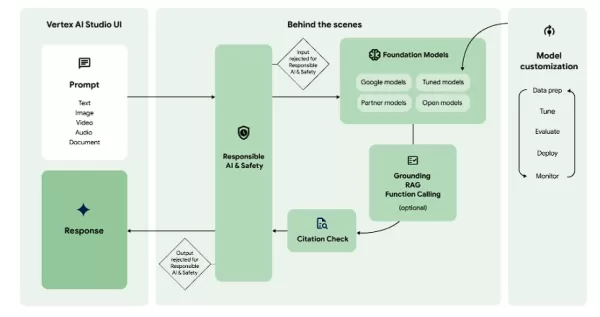
 Inside Details Exposed About Next-Gen Gemini: Strained Computing Power, Internal Teams Disagreed on Development Priorities and Resource Allocation
Reports indicate that the launch of Google’s highly anticipated next-generation Gemini model has been pushed back. Internal disagreements over development priorities and resource allocation, combined with limited computing capacity and complex approv
Inside Details Exposed About Next-Gen Gemini: Strained Computing Power, Internal Teams Disagreed on Development Priorities and Resource Allocation
Reports indicate that the launch of Google’s highly anticipated next-generation Gemini model has been pushed back. Internal disagreements over development priorities and resource allocation, combined with limited computing capacity and complex approv
 Best AI Melody Writing Tools for Song Drafts
 8 tools
 xix.ai
chatbot
xix.ai
chatbot

 Comments (1)
0/500
Comments (1)
0/500








 Inside Details Exposed About Next-Gen Gemini: Strained Computing Power, Internal Teams Disagreed on Development Priorities and Resource Allocation
Reports indicate that the launch of Google’s highly anticipated next-generation Gemini model has been pushed back. Internal disagreements over development priorities and resource allocation, combined with limited computing capacity and complex approv
Inside Details Exposed About Next-Gen Gemini: Strained Computing Power, Internal Teams Disagreed on Development Priorities and Resource Allocation
Reports indicate that the launch of Google’s highly anticipated next-generation Gemini model has been pushed back. Internal disagreements over development priorities and resource allocation, combined with limited computing capacity and complex approv
 OpenAI Dismisses Growth Slowdown Concerns, Says Multiple Business Units Accelerating
In response to external scrutiny regarding decelerating sales growth and missed internal benchmarks, AI leader OpenAI issued a confident statement on Tuesday, April 28. The company clarified that its consumer products and enterprise services are adva
OpenAI Dismisses Growth Slowdown Concerns, Says Multiple Business Units Accelerating
In response to external scrutiny regarding decelerating sales growth and missed internal benchmarks, AI leader OpenAI issued a confident statement on Tuesday, April 28. The company clarified that its consumer products and enterprise services are adva
 Alibaba Super Cup: Qwen3.8-Max Debuts with Boosted Coding and Office Tools
Alibaba has officially unveiled Qwen3.8-Max, a next-generation foundation large model boasting 2.4 trillion parameters. This significant AI advancement delivers substantial performance gains in core areas like coding and professional office tasks, sh
Alibaba Super Cup: Qwen3.8-Max Debuts with Boosted Coding and Office Tools
Alibaba has officially unveiled Qwen3.8-Max, a next-generation foundation large model boasting 2.4 trillion parameters. This significant AI advancement delivers substantial performance gains in core areas like coding and professional office tasks, sh