The data does not strongly support the assumption of a lasting US lead in AI model performance, which is just one of the sobering conclusions from Stanford University's 2026 AI Index Report published this week.
This 423-page annual report from Stanford's Institute for Human-Centered Artificial Intelligence provides a comprehensive assessment of the AI landscape. It examines research output, model capabilities, investment trends, public opinion, and responsible AI practices, revealing several striking headline findings.
However, the most significant insights lie in the less-covered sections, particularly on AI safety, where the gap between model capabilities and rigorous harm evaluation has widened, not narrowed.
That said, three key findings warrant greater attention.
The US-China model performance gap has effectively closed
The narrative of a clear US lead in AI development requires revision. The report indicates that US and Chinese models have repeatedly traded the top performance spot since early 2025. In February 2025, DeepSeek-R1 briefly matched the leading US model. As of March 2026, Anthropic's top model leads by a mere 2.7%.
The US still develops more top-tier AI models—50 compared to China's 30 in 2025—and holds higher-impact patents. However, China now leads in publication volume, citation share, and the number of patents granted. China's share of the top 100 most-cited AI papers grew from 33 in 2021 to 41 in 2024. Notably, South Korea leads the world in AI patents per capita.
The practical takeaway is that the assumption of a durable US technological lead in AI model performance lacks strong data support. The gap from two years ago has closed to a narrow margin that fluctuates with each major model release.
The report identifies a further structural vulnerability. While the US hosts 5,427 data centers—over ten times more than any other country—a single company, TSMC, manufactures nearly every leading AI chip inside them. The entire global AI hardware supply chain depends on one foundry in Taiwan, though a TSMC expansion in the US began operations in 2025.
AI safety benchmarking is lagging, and the data proves it
While nearly every frontier model developer reports results on capability benchmarks, the same is not true for responsible AI benchmarks. The 2026 Index precisely documents this disparity.
The report's safety and responsible AI benchmark table reveals that most entries are simply blank. Only Claude Opus 4.5 reports results on more than two of the tracked responsible AI benchmarks. Only GPT-5.2 reports results for StrongREJECT. Across benchmarks measuring fairness, security, and human agency, most frontier models report no data.
Capability benchmarks are reported consistently across frontier models. Responsible AI benchmarks–covering safety, fairness, and factuality–are largely absent. Source: Stanford HAI 2026 AI Index Report
This does not mean frontier labs are neglecting internal safety work. The report acknowledges ongoing red-teaming and alignment testing but notes that "these efforts are rarely disclosed using a common, externally comparable set of benchmarks." Consequently, external comparison of AI safety features is effectively impossible for most models.
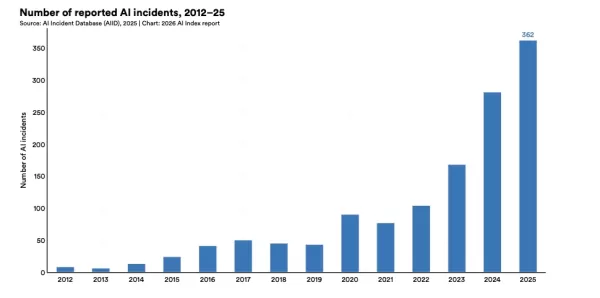
Documented AI incidents rose to 362 in 2025, up from 233 in 2024, according to the AI Incident Database. The OECD's AI Incidents and Hazards Monitor, which uses a broader automated pipeline, recorded a peak of 435 monthly incidents in January 2026, with a six-month moving average of 326.
Documented AI incidents rose to 362 in 2025, up from 233 the previous year and under 100 annually before 2022. Source: AI Incident Database (AIID), via Stanford HAI 2026 AI Index Report
Organizational governance is struggling to keep pace. A joint survey by the AI Index and McKinsey found the share of organizations rating their AI incident response as "excellent" dropped from 28% in 2024 to 18% in 2025. Those reporting "good" responses also fell, from 39% to 24%. Meanwhile, the share experiencing three to five incidents rose from 30% to 50%.
The report also identifies a structural challenge in responsible AI improvement: gains in one area often come at the expense of another. For instance, enhancing safety can reduce accuracy, or improving privacy can diminish fairness. No established framework exists for managing these trade-offs, and for several dimensions, including fairness and explainability, the standardized data needed to track progress over time is still lacking.
Public anxiety grows with adoption, highlighting an expert-public gap
Globally, 59% of surveyed individuals believe AI's benefits outweigh its drawbacks, up from 55% in 2024. Simultaneously, 52% say AI products and services make them nervous, a two-percentage-point increase in one year. Both figures rising together reflects a public that is using AI more while growing more uncertain about its trajectory.
The divide between experts and the public on AI's employment impact is particularly stark. According to the report, 73% of AI experts expect AI to positively impact how people work, compared to just 23% of the general public—a 50-point gap. On the economy, the gap is 48 points (69% of experts are positive versus 21% of the public). Regarding medical care, experts are far more optimistic at 84%, against 44% of the public.
These gaps matter because public trust influences regulatory outcomes, which in turn shape AI deployment. On this front, the report highlights a striking finding: the US reported the lowest level of trust in its own government to regulate AI responsibly among all surveyed countries, at just 31%. The global average was 54%. Southeast Asian countries were the most trusting, with Singapore at 81% and Indonesia at 76%.
Globally, the EU is trusted more than the US or China to regulate AI effectively. A 2025 Pew Research Center survey across 25 countries found a median of 53% trusted the EU to regulate AI, compared to 37% for the US and 27% for China.
The report concludes its public opinion chapter by noting that Southeast Asian countries remain among the world's most optimistic about AI. In China, Malaysia, Thailand, Indonesia, and Singapore, over 80% of respondents believe AI will profoundly change their lives within three to five years. Malaysia saw the largest increase in this view from 2024 to 2025.
See also: IBM: How robust AI governance protects enterprise margins
Want to learn more about AI and big data from industry leaders? Check out AI & Big Data Expo taking place in Amsterdam, California, and London. The comprehensive event is part of TechEx and is co-located with other leading technology events including the Cyber Security & Cloud Expo. Click here for more information.
AI News is powered by TechForge Media. Explore other upcoming enterprise technology events and webinars here.
Lawsuit Alleges xAI Terminated Engineer Who Warned of Grok Safety RisksA former xAI engineer has sued Elon Musk’s company and its parent, SpaceX, alleging termination for raising AI safety concerns.Devin Kim, who departed xAI in September 2025, filed the lawsuit in California state court on Tuesday. The legal action arr
New Relic Unveils AI Agent Platform and OpenTelemetry ToolsBusinesses are rolling out software to build and monitor AI agents, aiming to drive enterprise adoption. New Relic is following this trend. As the data observability firm launches its own AI agent platform, it recognizes it is not the only option ava
Neko Health raises $700 million to expand AI body scans in the USNeko Health has secured $700 million in funding to roll out its AI-driven body scans across the United States, kicking off with a flagship clinic in New York. This preventive screening platform integrates medical imaging, blood analysis, proprietary
2026 Latest Best AI Short-Form Video Hook Generators for Reels Shorts and Product Launch Campaigns! XIX.AI curates top-rated powerful game-changing tools that deliver must-try results through real-world tests. This weekly updated page offers free vs paid comparison rankings to help you find the perfect solution for boosting content creativity and productivity. Explore now to Unlock your AI edge!
2026 Latest Best Top-Rated AI Article Outline Tools for Long Form Writing! This curated collection features powerful, game-changing tools that deliver accurate, structured outlines with real-world tests to boost writing efficiency significantly. XIX.AI is part of this elite selection. Get a free vs paid comparison to help you choose the perfect tool. Explore now and Unlock your AI edge!
2026 Latest Best Top-rated AI Roleplay Chat Apps for Language Practice, Interview Prep, and Daily Fluency! XIX.AI curates a powerful game-changing collection that offers free vs paid comparison, real-world tests, and updated rankings weekly. These must-try tools help you boost writing skills, overcome fluency challenges, and improve communication efficiency across all daily scenarios. Explore now to discover your perfect tool for language growth!
2026 Latest Best Top-rated AI Stem Separation Tools Curated for Remix Production, Sampling Prep, and Karaoke Masters. These powerful game-changing tools offer real-world tests to deliver precise audio isolation, boosting productivity significantly. XIX.AI provides a weekly updated free vs paid comparison guide to help you find the must-try solution that suits your needs. Explore now to unlock your AI edge.
2026 Latest Best AI SQL Copilots Ranked Top-Rated! XIX.AI curates a powerful game-changing collection for weekly updated real-world tests. These must-try tools help you generate accurate revenue dashboards, analyze sales funnels, and track product metrics swiftly, boosting productivity massively. Explore now to Discover your perfect tool for data-driven decision making! 238 characters
2026 Latest Best Top-Rated AI Melody Writing Tools for Song Drafts! XIX.AI has curated a highly powerful game-changing collection that goes through rigorous real-world tests to deliver the best writing experience. You can find detailed free vs paid comparisons, accurate rankings, and must-try options designed to help you create stunning song drafts effortlessly and boost your creative productivity significantly. Explore now to discover your perfect tool!
By clicking "Accept All Cookies", you agree to the storing of cookies on your device to enhance site navigation, analyze site usage, and assist in our marketing efforts.Privacy Policy Notice
When you visit any website, it may store or retrieve information on your browser, mostly in the form of cookies. This information might be about you, your preferences or your device and is mostly used to make the site work as you expect it to. The information does not usually directly identify you, but it can give you a more personalized web experience. Because we respect your right to privacy, you can choose not to allow some types of cookies. Click on the different category headings to find out more and change our default settings.However, blocking some types of cookies may impact your experience of the site and the services we are able to offer. Privacy PolicyStatement
Manage Preferences
Strictly Necessary Cookie
Always Active
These cookies are necessary for the website to function and cannot be switched off in our systems. They are usually only set in response to actions made by you which amount to a request for services, such as setting your privacy preferences, logging in or filling in forms. You can set your browser to block or alert you about these cookies, but some parts of the site will not then work. These cookies do not store any personally identifiable information.



 Home
Home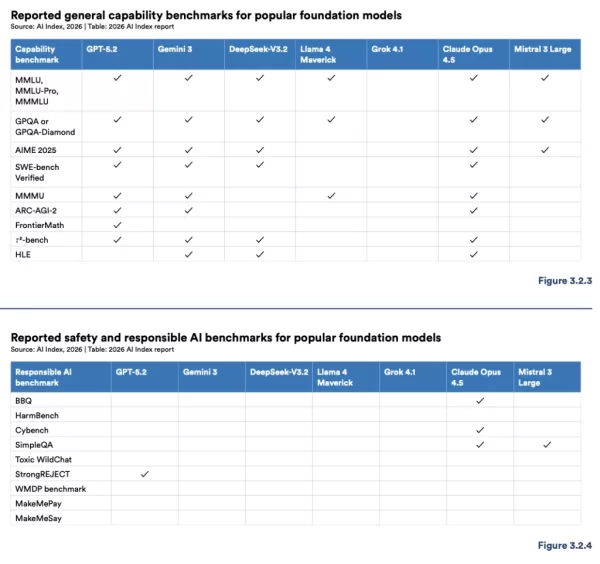

 Lawsuit Alleges xAI Terminated Engineer Who Warned of Grok Safety Risks
A former xAI engineer has sued Elon Musk’s company and its parent, SpaceX, alleging termination for raising AI safety concerns.Devin Kim, who departed xAI in September 2025, filed the lawsuit in California state court on Tuesday. The legal action arr
Lawsuit Alleges xAI Terminated Engineer Who Warned of Grok Safety Risks
A former xAI engineer has sued Elon Musk’s company and its parent, SpaceX, alleging termination for raising AI safety concerns.Devin Kim, who departed xAI in September 2025, filed the lawsuit in California state court on Tuesday. The legal action arr
 AI Short-Form Video Hook Generators for Reels, Shorts, and Product Launch Campaigns
 11 tools
 xix.ai
writing
xix.ai
writing

 Comments (0)
0/500
Comments (0)
0/500








 Lawsuit Alleges xAI Terminated Engineer Who Warned of Grok Safety Risks
A former xAI engineer has sued Elon Musk’s company and its parent, SpaceX, alleging termination for raising AI safety concerns.Devin Kim, who departed xAI in September 2025, filed the lawsuit in California state court on Tuesday. The legal action arr
Lawsuit Alleges xAI Terminated Engineer Who Warned of Grok Safety Risks
A former xAI engineer has sued Elon Musk’s company and its parent, SpaceX, alleging termination for raising AI safety concerns.Devin Kim, who departed xAI in September 2025, filed the lawsuit in California state court on Tuesday. The legal action arr
 New Relic Unveils AI Agent Platform and OpenTelemetry Tools
Businesses are rolling out software to build and monitor AI agents, aiming to drive enterprise adoption. New Relic is following this trend. As the data observability firm launches its own AI agent platform, it recognizes it is not the only option ava
New Relic Unveils AI Agent Platform and OpenTelemetry Tools
Businesses are rolling out software to build and monitor AI agents, aiming to drive enterprise adoption. New Relic is following this trend. As the data observability firm launches its own AI agent platform, it recognizes it is not the only option ava
 Neko Health raises $700 million to expand AI body scans in the US
Neko Health has secured $700 million in funding to roll out its AI-driven body scans across the United States, kicking off with a flagship clinic in New York. This preventive screening platform integrates medical imaging, blood analysis, proprietary
Neko Health raises $700 million to expand AI body scans in the US
Neko Health has secured $700 million in funding to roll out its AI-driven body scans across the United States, kicking off with a flagship clinic in New York. This preventive screening platform integrates medical imaging, blood analysis, proprietary