


 Home
HomeTsinghua's OpenMAIC Opens AI Multi-Agent Virtual Classroom Platform
Recently, the research team at Tsinghua University has open-sourced OpenMAIC (Open Multi-Agent Interactive Classroom), a large language model-driven platform for multi-agent interactive learning environments. This initiative can instantly transform any subject or document into a comprehensive, immersive learning session, signaling a pivotal shift in online education from the "video-based MOOC" model to a new era of "collaborative learning with AI." The platform is currently available for free online testing, and its complete codebase has been published on GitHub, quickly igniting widespread interest within the global AI in education community.
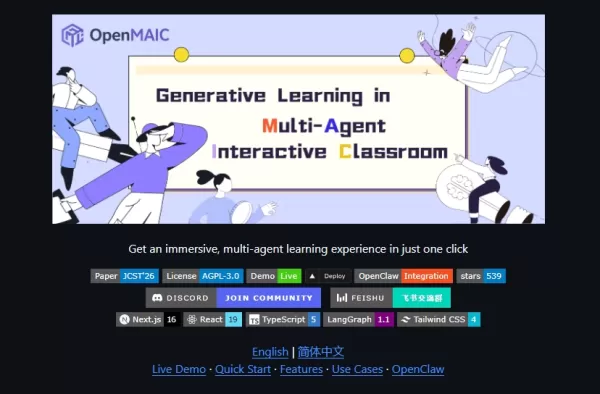
Core Innovation: Evolving from a Single AI Tutor to a Complete Virtual Classroom Ecosystem
While conventional AI educational tools have largely been limited to chatbots or automated note generators, OpenMAIC constructs a fully-fledged "virtual classroom" powered by multi-role collaboration:
AI Teacher: Delivers structured explanations, vocal lectures, and real-time whiteboard writing and diagramming.
AI Teaching Assistant: Offers personalized tutoring and detailed supplementary support.
AI Classmates (with diverse personality archetypes): Simulate real student interactions by participating in discussions, asking questions, raising hands, and engaging in roundtable debates.
This collaborative multi-agent framework makes the learning experience more akin to a physical classroom, significantly boosting interactivity and fostering a sense of companionship.
One-Click Generation, Four Key Educational Components Automatically Created
Users simply need to input a topic or upload a PDF document. The system can then generate a complete course in approximately 30 minutes at minimal cost (under $2), producing:
Presentation slides and notes
Quizzes and practice exercises
Interactive HTML-based simulation experiments
Project-Based Learning (PBL) assignments
By integrating OpenClaw functionalities, the platform allows users to instantly generate and launch classes directly within popular messaging apps like Feishu, Slack, and Telegram, dramatically reducing the barrier to entry.
Technical Architecture Highlights: Adaptive Systems and Multi-Agent Collaboration
OpenMAIC utilizes LangGraph to orchestrate its multi-agent workflows. Its core modules consist of:
MAIC-Craft: Handles multimodal content extraction, course planning, and automatic agent role generation.
Adaptive Engine: Implements token-level personalized instruction based on cognitive student modeling, RAG, and pedagogical theories such as Bloom's Taxonomy, the Zone of Proximal Development (ZPD), and Universal Design for Learning (UDL).
Classroom Management Agent: Monitors real-time classroom dynamics and intelligently manages speaking order and discussion flow.
The project has undergone extensive field testing at Tsinghua University, involving over 500 students and generating more than 100,000 real interaction logs, demonstrating its capability to effectively balance scalability with personalization.
A Milestone for AI-Native Educational Infrastructure
OpenMAIC is recognized as a major infrastructure innovation in AI education. It not only drastically lowers the cost of accessing high-quality educational resources—enabling a smartphone to provide a "Tsinghua-caliber" personalized tutor in remote regions—but also offers developers a highly open platform. It supports one-click local deployment, compatibility with leading large models (Qwen, GLM, OpenAI, etc.), flexible integration with TTS/ASR voice services, and actively encourages community contributions for secondary development focused on course generation, role design, and interaction strategies.
AIbase Review
Transitioning from the MOOC era to the age of AI co-learning, OpenMAIC presents a viable and scalable technical pathway. For educators, content creators, and online education platforms, this open-source project is a valuable resource worthy of deeper exploration. AIbase will continue to monitor OpenMAIC's community developments and real-world implementation, providing further updates from the forefront.
Experience it here: https://open.maic.chat/
Open Source Repository: https://github.com/THU-MAIC/OpenMAIC
Related article
 DeepMind CEO Hassabis: I sleep six hours a day, usually feel energetic around 1 a.m.
Fortune recently featured an interview with Demis Hassabis, CEO of Google DeepMind, revealing his unconventional approach to rest and productivity. Hassabis disclosed that he sleeps very little, structuring his waking hours into two distinct work blo
OpenAI, Anthropic Vie for Market Share Despite Revenue Shortfalls
Despite recent reports suggesting OpenAI missed revenue targets, creating pressure on tech stocks this Tuesday, private AI lab investors remain resilient. Seasoned backers have confirmed they will not reduce investment despite negative media coverage
California AV Compliance: A New Era of Tickets, Geofences, and 1M Miles
Guident operates an AuveTech shuttle in South Florida, managing a four-mile route in West Palm Beach and a one-mile route in Boca Raton using its remote monitoring technology. | Credit: GuidentCalifornia is redefining the regulatory landscape for dri
Related Special Topic Recommendations
Music composition
DeepMind CEO Hassabis: I sleep six hours a day, usually feel energetic around 1 a.m.
Fortune recently featured an interview with Demis Hassabis, CEO of Google DeepMind, revealing his unconventional approach to rest and productivity. Hassabis disclosed that he sleeps very little, structuring his waking hours into two distinct work blo
OpenAI, Anthropic Vie for Market Share Despite Revenue Shortfalls
Despite recent reports suggesting OpenAI missed revenue targets, creating pressure on tech stocks this Tuesday, private AI lab investors remain resilient. Seasoned backers have confirmed they will not reduce investment despite negative media coverage
California AV Compliance: A New Era of Tickets, Geofences, and 1M Miles
Guident operates an AuveTech shuttle in South Florida, managing a four-mile route in West Palm Beach and a one-mile route in Boca Raton using its remote monitoring technology. | Credit: GuidentCalifornia is redefining the regulatory landscape for dri
Related Special Topic Recommendations
Music composition
 AI Stem Separation Tools for Remix Production, Sampling Prep, and Karaoke Masters
2026 Latest Best Top-rated AI Stem Separation Tools Curated for Remix Production, Sampling Prep, and Karaoke Masters. These powerful game-changing tools offer real-world tests to deliver precise audio isolation, boosting productivity significantly. XIX.AI provides a weekly updated free vs paid comparison guide to help you find the must-try solution that suits your needs. Explore now to unlock your AI edge.
 8 tools
 xix.ai
Data Analysis
AI SQL Copilots for Revenue Dashboards, Funnel Analysis, and Product Metrics
xix.ai
Data Analysis
AI SQL Copilots for Revenue Dashboards, Funnel Analysis, and Product Metrics
2026 Latest Best AI SQL Copilots Ranked Top-Rated! XIX.AI curates a powerful game-changing collection for weekly updated real-world tests. These must-try tools help you generate accurate revenue dashboards, analyze sales funnels, and track product metrics swiftly, boosting productivity massively. Explore now to Discover your perfect tool for data-driven decision making! 238 characters
9 tools
xix.ai
Music composition
Best AI Melody Writing Tools for Song Drafts
2026 Latest Best Top-Rated AI Melody Writing Tools for Song Drafts! XIX.AI has curated a highly powerful game-changing collection that goes through rigorous real-world tests to deliver the best writing experience. You can find detailed free vs paid comparisons, accurate rankings, and must-try options designed to help you create stunning song drafts effortlessly and boost your creative productivity significantly. Explore now to discover your perfect tool!
8 tools
xix.ai
chatbot
Best AI Conversation Trainer Tools for Interview Practice
2026 Latest Best Top-rated AI Conversation Trainer Tools for Interview Practice are here on XIX.AI! This curated collection features powerful, game-changing tools that go through rigorous real-world tests to deliver accurate feedback. You’ll find a free vs paid comparison and detailed rankings to help you choose the must-try option that boosts your confidence and skills. Explore now to Discover your perfect tool for interview success!
12 tools
xix.ai
Design & Art
Best AI Style Transfer Tools for Creative Experiments
2026 Latest Best Top-rated AI Style Transfer Tools for Creative Experiments! XIX.AI has curated a powerful, game-changing collection of must-try tools that deliver exceptional results through real-world tests and rigorous rankings. These top solutions help creatives boost productivity significantly by accelerating content creation and unlocking endless creative possibilities. Explore now to discover your perfect tool and start creating today!
9 tools
xix.ai
Comic Creation
Best AI Dialogue Bubble Tools for Visual Storytelling
2026 Latest Best Top-Rated AI Dialogue Bubble Tools for Visual Storytelling are here on XIX.AI! This curated collection features powerful, game-changing tools that help creators boost productivity and overcome creative bottlenecks. Get a free vs paid comparison, see real-world tests, and check the latest rankings to find the must-try solutions perfect for crafting engaging visual narratives. Explore now to discover your ideal tool!
10 tools
xix.ai

 Comments (1)
0/500
Comments (1)
0/500
![CharlesThomas]()
清華大学のOpenMAIC、マルチエージェント型学習プラットフォームをオープンソース化。LLMを活用した対話型環境は教育の未来を変えそうだ。AIが先生役を担うのは少し不安もあるけど、個別指導の効率化には期待大。🎓✨
Recently, the research team at Tsinghua University has open-sourced OpenMAIC (Open Multi-Agent Interactive Classroom), a large language model-driven platform for multi-agent interactive learning environments. This initiative can instantly transform any subject or document into a comprehensive, immersive learning session, signaling a pivotal shift in online education from the "video-based MOOC" model to a new era of "collaborative learning with AI." The platform is currently available for free online testing, and its complete codebase has been published on GitHub, quickly igniting widespread interest within the global AI in education community.
Core Innovation: Evolving from a Single AI Tutor to a Complete Virtual Classroom Ecosystem
While conventional AI educational tools have largely been limited to chatbots or automated note generators, OpenMAIC constructs a fully-fledged "virtual classroom" powered by multi-role collaboration:
AI Teacher: Delivers structured explanations, vocal lectures, and real-time whiteboard writing and diagramming.
AI Teaching Assistant: Offers personalized tutoring and detailed supplementary support.
AI Classmates (with diverse personality archetypes): Simulate real student interactions by participating in discussions, asking questions, raising hands, and engaging in roundtable debates.
This collaborative multi-agent framework makes the learning experience more akin to a physical classroom, significantly boosting interactivity and fostering a sense of companionship.
One-Click Generation, Four Key Educational Components Automatically Created
Users simply need to input a topic or upload a PDF document. The system can then generate a complete course in approximately 30 minutes at minimal cost (under $2), producing:
Presentation slides and notes
Quizzes and practice exercises
Interactive HTML-based simulation experiments
Project-Based Learning (PBL) assignments
By integrating OpenClaw functionalities, the platform allows users to instantly generate and launch classes directly within popular messaging apps like Feishu, Slack, and Telegram, dramatically reducing the barrier to entry.
Technical Architecture Highlights: Adaptive Systems and Multi-Agent Collaboration
OpenMAIC utilizes LangGraph to orchestrate its multi-agent workflows. Its core modules consist of:
MAIC-Craft: Handles multimodal content extraction, course planning, and automatic agent role generation.
Adaptive Engine: Implements token-level personalized instruction based on cognitive student modeling, RAG, and pedagogical theories such as Bloom's Taxonomy, the Zone of Proximal Development (ZPD), and Universal Design for Learning (UDL).
Classroom Management Agent: Monitors real-time classroom dynamics and intelligently manages speaking order and discussion flow.
The project has undergone extensive field testing at Tsinghua University, involving over 500 students and generating more than 100,000 real interaction logs, demonstrating its capability to effectively balance scalability with personalization.
A Milestone for AI-Native Educational Infrastructure
OpenMAIC is recognized as a major infrastructure innovation in AI education. It not only drastically lowers the cost of accessing high-quality educational resources—enabling a smartphone to provide a "Tsinghua-caliber" personalized tutor in remote regions—but also offers developers a highly open platform. It supports one-click local deployment, compatibility with leading large models (Qwen, GLM, OpenAI, etc.), flexible integration with TTS/ASR voice services, and actively encourages community contributions for secondary development focused on course generation, role design, and interaction strategies.
AIbase Review
Transitioning from the MOOC era to the age of AI co-learning, OpenMAIC presents a viable and scalable technical pathway. For educators, content creators, and online education platforms, this open-source project is a valuable resource worthy of deeper exploration. AIbase will continue to monitor OpenMAIC's community developments and real-world implementation, providing further updates from the forefront.
Experience it here: https://open.maic.chat/
Open Source Repository: https://github.com/THU-MAIC/OpenMAIC








 DeepMind CEO Hassabis: I sleep six hours a day, usually feel energetic around 1 a.m.
Fortune recently featured an interview with Demis Hassabis, CEO of Google DeepMind, revealing his unconventional approach to rest and productivity. Hassabis disclosed that he sleeps very little, structuring his waking hours into two distinct work blo
DeepMind CEO Hassabis: I sleep six hours a day, usually feel energetic around 1 a.m.
Fortune recently featured an interview with Demis Hassabis, CEO of Google DeepMind, revealing his unconventional approach to rest and productivity. Hassabis disclosed that he sleeps very little, structuring his waking hours into two distinct work blo
 OpenAI, Anthropic Vie for Market Share Despite Revenue Shortfalls
Despite recent reports suggesting OpenAI missed revenue targets, creating pressure on tech stocks this Tuesday, private AI lab investors remain resilient. Seasoned backers have confirmed they will not reduce investment despite negative media coverage
California AV Compliance: A New Era of Tickets, Geofences, and 1M Miles
Guident operates an AuveTech shuttle in South Florida, managing a four-mile route in West Palm Beach and a one-mile route in Boca Raton using its remote monitoring technology. | Credit: GuidentCalifornia is redefining the regulatory landscape for dri
OpenAI, Anthropic Vie for Market Share Despite Revenue Shortfalls
Despite recent reports suggesting OpenAI missed revenue targets, creating pressure on tech stocks this Tuesday, private AI lab investors remain resilient. Seasoned backers have confirmed they will not reduce investment despite negative media coverage
California AV Compliance: A New Era of Tickets, Geofences, and 1M Miles
Guident operates an AuveTech shuttle in South Florida, managing a four-mile route in West Palm Beach and a one-mile route in Boca Raton using its remote monitoring technology. | Credit: GuidentCalifornia is redefining the regulatory landscape for dri
2026 Latest Best Top-rated AI Stem Separation Tools Curated for Remix Production, Sampling Prep, and Karaoke Masters. These powerful game-changing tools offer real-world tests to deliver precise audio isolation, boosting productivity significantly. XIX.AI provides a weekly updated free vs paid comparison guide to help you find the must-try solution that suits your needs. Explore now to unlock your AI edge.
8 tools
xix.ai

2026 Latest Best AI SQL Copilots Ranked Top-Rated! XIX.AI curates a powerful game-changing collection for weekly updated real-world tests. These must-try tools help you generate accurate revenue dashboards, analyze sales funnels, and track product metrics swiftly, boosting productivity massively. Explore now to Discover your perfect tool for data-driven decision making! 238 characters
9 tools
xix.ai

2026 Latest Best Top-Rated AI Melody Writing Tools for Song Drafts! XIX.AI has curated a highly powerful game-changing collection that goes through rigorous real-world tests to deliver the best writing experience. You can find detailed free vs paid comparisons, accurate rankings, and must-try options designed to help you create stunning song drafts effortlessly and boost your creative productivity significantly. Explore now to discover your perfect tool!
8 tools
xix.ai
2026 Latest Best Top-rated AI Conversation Trainer Tools for Interview Practice are here on XIX.AI! This curated collection features powerful, game-changing tools that go through rigorous real-world tests to deliver accurate feedback. You’ll find a free vs paid comparison and detailed rankings to help you choose the must-try option that boosts your confidence and skills. Explore now to Discover your perfect tool for interview success!
12 tools
xix.ai

2026 Latest Best Top-rated AI Style Transfer Tools for Creative Experiments! XIX.AI has curated a powerful, game-changing collection of must-try tools that deliver exceptional results through real-world tests and rigorous rankings. These top solutions help creatives boost productivity significantly by accelerating content creation and unlocking endless creative possibilities. Explore now to discover your perfect tool and start creating today!
9 tools
xix.ai

2026 Latest Best Top-Rated AI Dialogue Bubble Tools for Visual Storytelling are here on XIX.AI! This curated collection features powerful, game-changing tools that help creators boost productivity and overcome creative bottlenecks. Get a free vs paid comparison, see real-world tests, and check the latest rankings to find the must-try solutions perfect for crafting engaging visual narratives. Explore now to discover your ideal tool!
10 tools
xix.ai

清華大学のOpenMAIC、マルチエージェント型学習プラットフォームをオープンソース化。LLMを活用した対話型環境は教育の未来を変えそうだ。AIが先生役を担うのは少し不安もあるけど、個別指導の効率化には期待大。🎓✨












