


 Home
Home
Tongyi Lab Unveils Qwen3.7-Max with Orthogonal Decoupling Tech, Tops Multiple Domestic Benchmarks
Tongyi Lab has officially launched the next-generation AI Agent foundation model, Qwen3.7-Max , which tops multiple authoritative benchmarks and addresses key industry challenges like the fragility and instability of intelligent agents in long-chain production environments.
In rigorous stress tests on the unknown hardware platform ZW-M890L PPU, the model demonstrated robust long-term strategic coherence and In-Context generalization via runtime feedback. It sustained uninterrupted operation for 35 hours with 1,158 tool calls, successfully executing deep autonomous reasoning while achieving a geometric mean acceleration of 10.0x across various workloads.
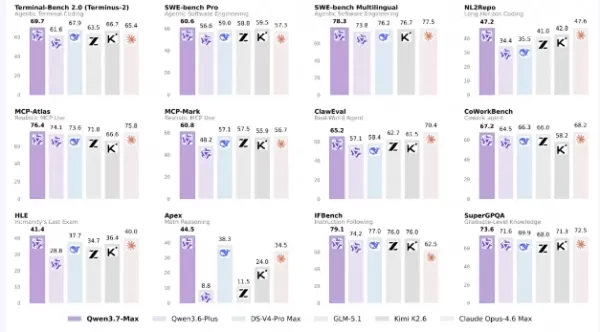
To resolve the industry-wide issue of AI models being "overfitted" to specific development frameworks, Qwen3.7-Max introduces a unique orthogonal decoupling design of "task-runtime framework-validator" in its training architecture. By shifting reinforcement learning from synthetic data to real-world distributions, it achieves true universal agent strategies and cross-framework generalization. This breakthrough enables end-to-end delivery of complex applications, such as real-time interactive 3D particle system web pages, within professional workflows from front-end prototypes to sophisticated software engineering.
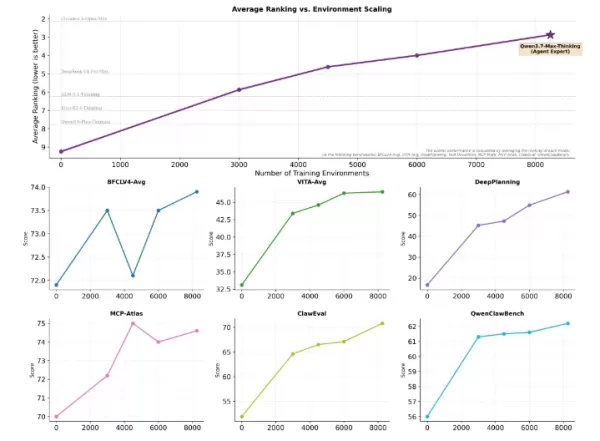
Additionally, the model integrates office productivity tools like office-cli via the Model Context Protocol (MCP), supporting multi-agent orchestration and embodied intelligence control extensions. The newly upgraded Qwen3.7-Max will be officially released through the Alibaba Cloud BaiLian platform, fully compatible with OpenAI and Anthropic API protocols, ensuring seamless plug-and-play integration with mainstream agent frameworks including Claude Code, OpenClaw, and Qwen Code.
This milestone signals that AI Agents are rapidly transitioning from "theoretically feasible" to "engineering reality," establishing a highly reliable technical foundation for automating complex distributed industrial workflows.
Related article
 Genesis AI Master Robot Tasks With Single Model, Marking a ChatGPT-Like Moment
As global interest in robotics accelerates, Genesis AI has introduced GENE-26.5, its inaugural robot foundation model. This launch represents a major leap forward in general-purpose robotics, particularly in managing intricate and unstructured tasks.
Microsoft Unveils First Self-Developed Full-Duplex AI Speech Model Capable of Simultaneous Listening and Speaking Across 16 Languages
According to Technology media TestingCatalog, Microsoft is currently testing its inaugural native real-time voice model, MAI Realtime. Supporting 16 languages and two distinct voice styles, this system enables simultaneous listening and speaking, all
Apple unveils iOS 27 with local AI and Google partnership boosting Siri
The Information recently highlighted Apple’s strategic approach to integrating artificial intelligence into the upcoming OS 27. By leveraging Google’s Gemini model to train a more efficient, lightweight AI, Apple aims to deliver robust local edge AI
Related Special Topic Recommendations
Comic Creation
Genesis AI Master Robot Tasks With Single Model, Marking a ChatGPT-Like Moment
As global interest in robotics accelerates, Genesis AI has introduced GENE-26.5, its inaugural robot foundation model. This launch represents a major leap forward in general-purpose robotics, particularly in managing intricate and unstructured tasks.
Microsoft Unveils First Self-Developed Full-Duplex AI Speech Model Capable of Simultaneous Listening and Speaking Across 16 Languages
According to Technology media TestingCatalog, Microsoft is currently testing its inaugural native real-time voice model, MAI Realtime. Supporting 16 languages and two distinct voice styles, this system enables simultaneous listening and speaking, all
Apple unveils iOS 27 with local AI and Google partnership boosting Siri
The Information recently highlighted Apple’s strategic approach to integrating artificial intelligence into the upcoming OS 27. By leveraging Google’s Gemini model to train a more efficient, lightweight AI, Apple aims to deliver robust local edge AI
Related Special Topic Recommendations
Comic Creation
 Best AI Manga Background Generators for Serialized Stories
2026 Latest Best Top-rated AI Manga Background Generators for Serialized Stories! This curated list features powerful game-changing tools that help creators craft stunning visual content fast, boosting productivity significantly. Every option has undergone real-world tests to ensure top quality. Check out the free vs paid comparison and rankings to find your perfect fit. Explore now at XIX.AI to unlock your AI edge in manga creation.
 9 tools
 xix.ai
chatbot
Best AI Chat Companions: Hold Natural Talks with Long-Term Memory
xix.ai
chatbot
Best AI Chat Companions: Hold Natural Talks with Long-Term Memory
2026 Latest Best AI Chat Companions Ranking features top-rated, powerful tools known for their ability to hold natural conversations and retain long-term memory. This curated list includes must-try options across free and paid tiers, backed by real-world tests and weekly updated rankings. XIX.AI stands out as a trusted choice in this elite collection. Explore now to discover your perfect AI chat companion and unlock your productivity edge today.
11 tools
xix.ai
Animation Creation
Best AI Animation Generators: Turn Ideas into Motion Clips Fast
2026 Latest Best Top-Rated AI Animation Generators! XIX.AI curates a powerful game-changing collection of must-try tools for turning creative ideas into high-quality motion clips swiftly. Each option has undergone rigorous real-world tests, featuring detailed free vs paid comparison and updated weekly rankings to help you find the perfect fit for boosting your animation productivity. Explore now to unlock your AI edge!
11 tools
xix.ai
Text-to-speech
Top Multilingual AI Voice Generators: Localize Audio at Scale
2026 Latest Top-Rated Best Multilingual AI Voice Generators for Large-Scale Audio Localization. This curated list features powerful, game-changing tools that deliver high-quality localized audio fast. Each option has undergone rigorous real-world tests to ensure reliability. Get a free vs paid comparison and discover the perfect fit for your projects. Explore now at XIX.AI to unlock your AI edge.
18 tools
xix.ai
writing
Best AI Outline Generators for Long-Form SEO Articles, Briefs, and Pillar Pages
2026 Latest Best Top-rated AI Outline Generators for Long-Form SEO Articles, Briefs, and Pillar Pages. XIX.AI curates a powerful game-changing collection that undergoes weekly updated real-world tests to deliver must-try tools perfect for boosting writing efficiency, streamlining content creation, and unlocking your AI edge. Explore now to discover your perfect tool for top SEO results.
11 tools
xix.ai
Meeting Assistant
AI Voice-to-Minutes Assistants: Convert Team Talks into Clean Notes
2026 Latest Best Top-Rated AI Voice-to-Minutes Assistants Guide! XIX.AI has curated a highly powerful, game-changing collection of tools designed to transform every team conversation into flawless, organized notes instantly. Our weekly updated rankings cover free vs paid options, along with real-world tests showing their effectiveness for boosting productivity across all work scenarios. Must-try for anyone looking to unlock their AI edge. Explore now!
9 tools
xix.ai

 Comments (0)
0/500
Comments (0)
0/500
Tongyi Lab has officially launched the next-generation AI Agent foundation model,
In rigorous stress tests on the unknown hardware platform ZW-M890L PPU, the model demonstrated robust long-term strategic coherence and In-Context generalization via runtime feedback. It sustained uninterrupted operation for 35 hours with 1,158 tool calls, successfully executing deep autonomous reasoning while achieving a geometric mean acceleration of 10.0x across various workloads.
To resolve the industry-wide issue of AI models being "overfitted" to specific development frameworks, Qwen3.7-Max introduces a unique orthogonal decoupling design of "task-runtime framework-validator" in its training architecture. By shifting reinforcement learning from synthetic data to real-world distributions, it achieves true universal agent strategies and cross-framework generalization. This breakthrough enables end-to-end delivery of complex applications, such as real-time interactive 3D particle system web pages, within professional workflows from front-end prototypes to sophisticated software engineering.
Additionally, the model integrates office productivity tools like office-cli via the Model Context Protocol (MCP), supporting multi-agent orchestration and embodied intelligence control extensions. The newly upgraded
This milestone signals that AI Agents are rapidly transitioning from "theoretically feasible" to "engineering reality," establishing a highly reliable technical foundation for automating complex distributed industrial workflows.








 Genesis AI Master Robot Tasks With Single Model, Marking a ChatGPT-Like Moment
As global interest in robotics accelerates, Genesis AI has introduced GENE-26.5, its inaugural robot foundation model. This launch represents a major leap forward in general-purpose robotics, particularly in managing intricate and unstructured tasks.
Genesis AI Master Robot Tasks With Single Model, Marking a ChatGPT-Like Moment
As global interest in robotics accelerates, Genesis AI has introduced GENE-26.5, its inaugural robot foundation model. This launch represents a major leap forward in general-purpose robotics, particularly in managing intricate and unstructured tasks.
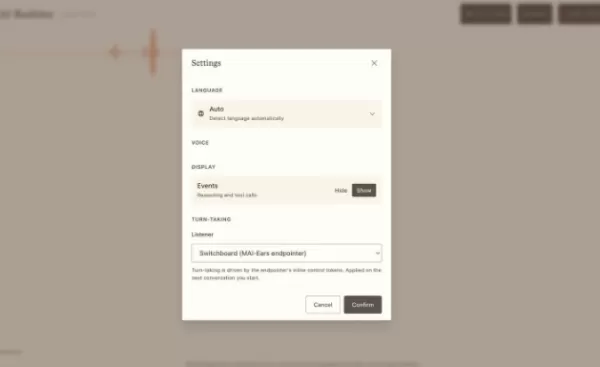 Microsoft Unveils First Self-Developed Full-Duplex AI Speech Model Capable of Simultaneous Listening and Speaking Across 16 Languages
According to Technology media TestingCatalog, Microsoft is currently testing its inaugural native real-time voice model, MAI Realtime. Supporting 16 languages and two distinct voice styles, this system enables simultaneous listening and speaking, all
Microsoft Unveils First Self-Developed Full-Duplex AI Speech Model Capable of Simultaneous Listening and Speaking Across 16 Languages
According to Technology media TestingCatalog, Microsoft is currently testing its inaugural native real-time voice model, MAI Realtime. Supporting 16 languages and two distinct voice styles, this system enables simultaneous listening and speaking, all
 Apple unveils iOS 27 with local AI and Google partnership boosting Siri
The Information recently highlighted Apple’s strategic approach to integrating artificial intelligence into the upcoming OS 27. By leveraging Google’s Gemini model to train a more efficient, lightweight AI, Apple aims to deliver robust local edge AI
Apple unveils iOS 27 with local AI and Google partnership boosting Siri
The Information recently highlighted Apple’s strategic approach to integrating artificial intelligence into the upcoming OS 27. By leveraging Google’s Gemini model to train a more efficient, lightweight AI, Apple aims to deliver robust local edge AI
2026 Latest Best Top-rated AI Manga Background Generators for Serialized Stories! This curated list features powerful game-changing tools that help creators craft stunning visual content fast, boosting productivity significantly. Every option has undergone real-world tests to ensure top quality. Check out the free vs paid comparison and rankings to find your perfect fit. Explore now at XIX.AI to unlock your AI edge in manga creation.
9 tools
xix.ai

2026 Latest Best AI Chat Companions Ranking features top-rated, powerful tools known for their ability to hold natural conversations and retain long-term memory. This curated list includes must-try options across free and paid tiers, backed by real-world tests and weekly updated rankings. XIX.AI stands out as a trusted choice in this elite collection. Explore now to discover your perfect AI chat companion and unlock your productivity edge today.
11 tools
xix.ai

2026 Latest Best Top-Rated AI Animation Generators! XIX.AI curates a powerful game-changing collection of must-try tools for turning creative ideas into high-quality motion clips swiftly. Each option has undergone rigorous real-world tests, featuring detailed free vs paid comparison and updated weekly rankings to help you find the perfect fit for boosting your animation productivity. Explore now to unlock your AI edge!
11 tools
xix.ai

2026 Latest Top-Rated Best Multilingual AI Voice Generators for Large-Scale Audio Localization. This curated list features powerful, game-changing tools that deliver high-quality localized audio fast. Each option has undergone rigorous real-world tests to ensure reliability. Get a free vs paid comparison and discover the perfect fit for your projects. Explore now at XIX.AI to unlock your AI edge.
18 tools
xix.ai

2026 Latest Best Top-rated AI Outline Generators for Long-Form SEO Articles, Briefs, and Pillar Pages. XIX.AI curates a powerful game-changing collection that undergoes weekly updated real-world tests to deliver must-try tools perfect for boosting writing efficiency, streamlining content creation, and unlocking your AI edge. Explore now to discover your perfect tool for top SEO results.
11 tools
xix.ai

2026 Latest Best Top-Rated AI Voice-to-Minutes Assistants Guide! XIX.AI has curated a highly powerful, game-changing collection of tools designed to transform every team conversation into flawless, organized notes instantly. Our weekly updated rankings cover free vs paid options, along with real-world tests showing their effectiveness for boosting productivity across all work scenarios. Must-try for anyone looking to unlock their AI edge. Explore now!
9 tools
xix.ai












