


 Home
HomeTencent's WeChat Unveils ClawBot Plugin for AI Assistant Lobster
Tencent has introduced the "WeChat ClawBot" plugin, creating a dedicated private link between its personal AI assistant "OpenClaw" (also known as Lobster) and the WeChat platform. This development signals Tencent's push to more deeply integrate its AI model ecosystem with widely-used social applications, offering users a streamlined way to access their personal AI assistant within the high-frequency mobile environment of WeChat.
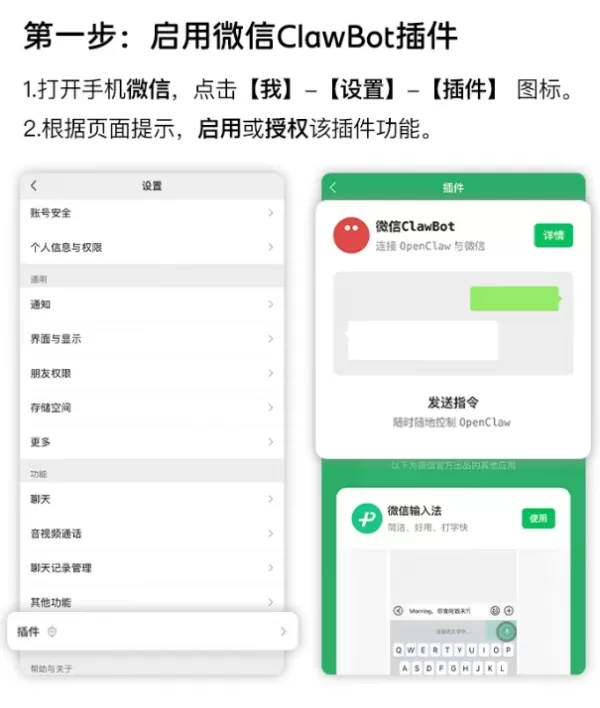
The plugin is currently in a phased rollout. To set it up, users simply need to follow a quick two-step process: first, activate "WeChat ClawBot" within WeChat's settings under "Me - Settings - Plugins". Then, on the device running OpenClaw, execute the official installation command and use WeChat to scan the generated QR code for binding. Once connected, users can seamlessly send instructions to their AI assistant and receive responses directly within any WeChat chat window. This functionality is ideal for personal learning, tackling work tasks, or generating content on the go.
Tencent has clarified that this connection channel is strictly for personal use and cannot be added by other contacts. It currently does not support group chats and operates as a one-way communication link from the user to the assistant. Importantly, it does not perform automated actions on the user's WeChat account, safeguarding privacy and security. Beyond this personal WeChat plugin, other products from Tencent's "Lobster" task force also facilitate access in enterprise settings. QClaw and Workbuddy are available for download from the official website and can be linked to Enterprise WeChat via a QR code scan on a PC. Tencent Cloud further offers a cloud-based quick-configuration solution, reducing the technical complexity for businesses looking to embed AI assistants into their internal workflows.
The launch of WeChat ClawBot is a strategic move by Tencent to embed advanced AI capabilities into its super-app ecosystem and explore consumer-facing AI service entry points. It offers OpenClaw developers and users a more immediate and integrated interaction method. This shift also suggests that the concept of an "AI assistant as a service" is evolving from a standalone tool to one deeply embedded within everyday communication platforms. As tech companies vie to connect their models with popular applications, finding secure and user-friendly ways to integrate personal AI within social ecosystems has become a key industry focus.
 DeepMind CEO Hassabis: I sleep six hours a day, usually feel energetic around 1 a.m.
Fortune recently featured an interview with Demis Hassabis, CEO of Google DeepMind, revealing his unconventional approach to rest and productivity. Hassabis disclosed that he sleeps very little, structuring his waking hours into two distinct work blo
OpenAI, Anthropic Vie for Market Share Despite Revenue Shortfalls
Despite recent reports suggesting OpenAI missed revenue targets, creating pressure on tech stocks this Tuesday, private AI lab investors remain resilient. Seasoned backers have confirmed they will not reduce investment despite negative media coverage
California AV Compliance: A New Era of Tickets, Geofences, and 1M Miles
Guident operates an AuveTech shuttle in South Florida, managing a four-mile route in West Palm Beach and a one-mile route in Boca Raton using its remote monitoring technology. | Credit: GuidentCalifornia is redefining the regulatory landscape for dri
Related Special Topic Recommendations
writing
DeepMind CEO Hassabis: I sleep six hours a day, usually feel energetic around 1 a.m.
Fortune recently featured an interview with Demis Hassabis, CEO of Google DeepMind, revealing his unconventional approach to rest and productivity. Hassabis disclosed that he sleeps very little, structuring his waking hours into two distinct work blo
OpenAI, Anthropic Vie for Market Share Despite Revenue Shortfalls
Despite recent reports suggesting OpenAI missed revenue targets, creating pressure on tech stocks this Tuesday, private AI lab investors remain resilient. Seasoned backers have confirmed they will not reduce investment despite negative media coverage
California AV Compliance: A New Era of Tickets, Geofences, and 1M Miles
Guident operates an AuveTech shuttle in South Florida, managing a four-mile route in West Palm Beach and a one-mile route in Boca Raton using its remote monitoring technology. | Credit: GuidentCalifornia is redefining the regulatory landscape for dri
Related Special Topic Recommendations
writing
 AI Article Outline Tools for Long Form Writing
2026 Latest Best Top-Rated AI Article Outline Tools for Long Form Writing! This curated collection features powerful, game-changing tools that deliver accurate, structured outlines with real-world tests to boost writing efficiency significantly. XIX.AI is part of this elite selection. Get a free vs paid comparison to help you choose the perfect tool. Explore now and Unlock your AI edge!
 9 tools
 xix.ai
chatbot
Best AI Roleplay Chat Apps for Language Practice, Interview Prep, and Daily Fluency
xix.ai
chatbot
Best AI Roleplay Chat Apps for Language Practice, Interview Prep, and Daily Fluency
2026 Latest Best Top-rated AI Roleplay Chat Apps for Language Practice, Interview Prep, and Daily Fluency! XIX.AI curates a powerful game-changing collection that offers free vs paid comparison, real-world tests, and updated rankings weekly. These must-try tools help you boost writing skills, overcome fluency challenges, and improve communication efficiency across all daily scenarios. Explore now to discover your perfect tool for language growth!
10 tools
xix.ai
Music composition
AI Stem Separation Tools for Remix Production, Sampling Prep, and Karaoke Masters
2026 Latest Best Top-rated AI Stem Separation Tools Curated for Remix Production, Sampling Prep, and Karaoke Masters. These powerful game-changing tools offer real-world tests to deliver precise audio isolation, boosting productivity significantly. XIX.AI provides a weekly updated free vs paid comparison guide to help you find the must-try solution that suits your needs. Explore now to unlock your AI edge.
8 tools
xix.ai
Data Analysis
AI SQL Copilots for Revenue Dashboards, Funnel Analysis, and Product Metrics
2026 Latest Best AI SQL Copilots Ranked Top-Rated! XIX.AI curates a powerful game-changing collection for weekly updated real-world tests. These must-try tools help you generate accurate revenue dashboards, analyze sales funnels, and track product metrics swiftly, boosting productivity massively. Explore now to Discover your perfect tool for data-driven decision making! 238 characters
9 tools
xix.ai
Music composition
Best AI Melody Writing Tools for Song Drafts
2026 Latest Best Top-Rated AI Melody Writing Tools for Song Drafts! XIX.AI has curated a highly powerful game-changing collection that goes through rigorous real-world tests to deliver the best writing experience. You can find detailed free vs paid comparisons, accurate rankings, and must-try options designed to help you create stunning song drafts effortlessly and boost your creative productivity significantly. Explore now to discover your perfect tool!
8 tools
xix.ai
chatbot
Best AI Conversation Trainer Tools for Interview Practice
2026 Latest Best Top-rated AI Conversation Trainer Tools for Interview Practice are here on XIX.AI! This curated collection features powerful, game-changing tools that go through rigorous real-world tests to deliver accurate feedback. You’ll find a free vs paid comparison and detailed rankings to help you choose the must-try option that boosts your confidence and skills. Explore now to Discover your perfect tool for interview success!
12 tools
xix.ai

 Comments (1)
0/500
Comments (1)
0/500
![GregoryRamirez]()
Interessant, wie Tencent hier versucht, mit einem Plugin die eigene KI-Assistentin stärker in WeChat einzubinden. Das klingt nach einem klaren Schritt, um Nutzer noch fester an das Ökosystem zu binden. Ob das wirklich einen Mehrwert bietet oder nur die Abhängigkeit erhöht, wird sich zeigen. Die Konkurrenz schläft ja auch nicht. 🧐
Tencent has introduced the "WeChat ClawBot" plugin, creating a dedicated private link between its personal AI assistant "OpenClaw" (also known as Lobster) and the WeChat platform. This development signals Tencent's push to more deeply integrate its AI model ecosystem with widely-used social applications, offering users a streamlined way to access their personal AI assistant within the high-frequency mobile environment of WeChat.
The plugin is currently in a phased rollout. To set it up, users simply need to follow a quick two-step process: first, activate "WeChat ClawBot" within WeChat's settings under "Me - Settings - Plugins". Then, on the device running OpenClaw, execute the official installation command and use WeChat to scan the generated QR code for binding. Once connected, users can seamlessly send instructions to their AI assistant and receive responses directly within any WeChat chat window. This functionality is ideal for personal learning, tackling work tasks, or generating content on the go.
Tencent has clarified that this connection channel is strictly for personal use and cannot be added by other contacts. It currently does not support group chats and operates as a one-way communication link from the user to the assistant. Importantly, it does not perform automated actions on the user's WeChat account, safeguarding privacy and security. Beyond this personal WeChat plugin, other products from Tencent's "Lobster" task force also facilitate access in enterprise settings. QClaw and Workbuddy are available for download from the official website and can be linked to Enterprise WeChat via a QR code scan on a PC. Tencent Cloud further offers a cloud-based quick-configuration solution, reducing the technical complexity for businesses looking to embed AI assistants into their internal workflows.
The launch of WeChat ClawBot is a strategic move by Tencent to embed advanced AI capabilities into its super-app ecosystem and explore consumer-facing AI service entry points. It offers OpenClaw developers and users a more immediate and integrated interaction method. This shift also suggests that the concept of an "AI assistant as a service" is evolving from a standalone tool to one deeply embedded within everyday communication platforms. As tech companies vie to connect their models with popular applications, finding secure and user-friendly ways to integrate personal AI within social ecosystems has become a key industry focus.








 DeepMind CEO Hassabis: I sleep six hours a day, usually feel energetic around 1 a.m.
Fortune recently featured an interview with Demis Hassabis, CEO of Google DeepMind, revealing his unconventional approach to rest and productivity. Hassabis disclosed that he sleeps very little, structuring his waking hours into two distinct work blo
DeepMind CEO Hassabis: I sleep six hours a day, usually feel energetic around 1 a.m.
Fortune recently featured an interview with Demis Hassabis, CEO of Google DeepMind, revealing his unconventional approach to rest and productivity. Hassabis disclosed that he sleeps very little, structuring his waking hours into two distinct work blo
 OpenAI, Anthropic Vie for Market Share Despite Revenue Shortfalls
Despite recent reports suggesting OpenAI missed revenue targets, creating pressure on tech stocks this Tuesday, private AI lab investors remain resilient. Seasoned backers have confirmed they will not reduce investment despite negative media coverage
California AV Compliance: A New Era of Tickets, Geofences, and 1M Miles
Guident operates an AuveTech shuttle in South Florida, managing a four-mile route in West Palm Beach and a one-mile route in Boca Raton using its remote monitoring technology. | Credit: GuidentCalifornia is redefining the regulatory landscape for dri
OpenAI, Anthropic Vie for Market Share Despite Revenue Shortfalls
Despite recent reports suggesting OpenAI missed revenue targets, creating pressure on tech stocks this Tuesday, private AI lab investors remain resilient. Seasoned backers have confirmed they will not reduce investment despite negative media coverage
California AV Compliance: A New Era of Tickets, Geofences, and 1M Miles
Guident operates an AuveTech shuttle in South Florida, managing a four-mile route in West Palm Beach and a one-mile route in Boca Raton using its remote monitoring technology. | Credit: GuidentCalifornia is redefining the regulatory landscape for dri

2026 Latest Best Top-Rated AI Article Outline Tools for Long Form Writing! This curated collection features powerful, game-changing tools that deliver accurate, structured outlines with real-world tests to boost writing efficiency significantly. XIX.AI is part of this elite selection. Get a free vs paid comparison to help you choose the perfect tool. Explore now and Unlock your AI edge!
9 tools
xix.ai

2026 Latest Best Top-rated AI Roleplay Chat Apps for Language Practice, Interview Prep, and Daily Fluency! XIX.AI curates a powerful game-changing collection that offers free vs paid comparison, real-world tests, and updated rankings weekly. These must-try tools help you boost writing skills, overcome fluency challenges, and improve communication efficiency across all daily scenarios. Explore now to discover your perfect tool for language growth!
10 tools
xix.ai

2026 Latest Best Top-rated AI Stem Separation Tools Curated for Remix Production, Sampling Prep, and Karaoke Masters. These powerful game-changing tools offer real-world tests to deliver precise audio isolation, boosting productivity significantly. XIX.AI provides a weekly updated free vs paid comparison guide to help you find the must-try solution that suits your needs. Explore now to unlock your AI edge.
8 tools
xix.ai

2026 Latest Best AI SQL Copilots Ranked Top-Rated! XIX.AI curates a powerful game-changing collection for weekly updated real-world tests. These must-try tools help you generate accurate revenue dashboards, analyze sales funnels, and track product metrics swiftly, boosting productivity massively. Explore now to Discover your perfect tool for data-driven decision making! 238 characters
9 tools
xix.ai

2026 Latest Best Top-Rated AI Melody Writing Tools for Song Drafts! XIX.AI has curated a highly powerful game-changing collection that goes through rigorous real-world tests to deliver the best writing experience. You can find detailed free vs paid comparisons, accurate rankings, and must-try options designed to help you create stunning song drafts effortlessly and boost your creative productivity significantly. Explore now to discover your perfect tool!
8 tools
xix.ai

2026 Latest Best Top-rated AI Conversation Trainer Tools for Interview Practice are here on XIX.AI! This curated collection features powerful, game-changing tools that go through rigorous real-world tests to deliver accurate feedback. You’ll find a free vs paid comparison and detailed rankings to help you choose the must-try option that boosts your confidence and skills. Explore now to Discover your perfect tool for interview success!
12 tools
xix.ai

Interessant, wie Tencent hier versucht, mit einem Plugin die eigene KI-Assistentin stärker in WeChat einzubinden. Das klingt nach einem klaren Schritt, um Nutzer noch fester an das Ökosystem zu binden. Ob das wirklich einen Mehrwert bietet oder nur die Abhängigkeit erhöht, wird sich zeigen. Die Konkurrenz schläft ja auch nicht. 🧐












