


 Home
Home
Tencent Marvis Ma Weisi iOS Version Launches: Remotely Control Your Computer Desktop from Phone
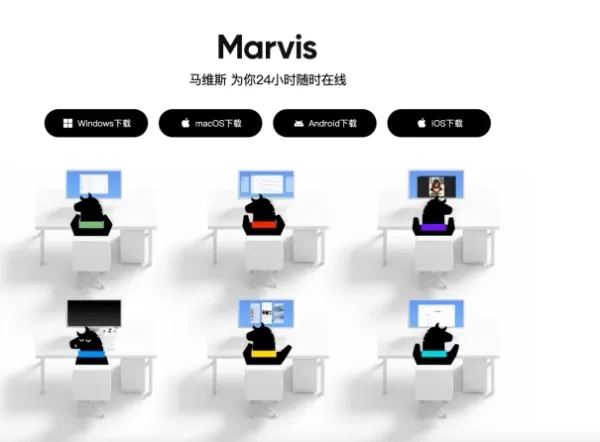
On June 23, the iOS version of Marvis, Tencent's operating-system-level AI assistant, officially launched on the Apple App Store. This marks full coverage across mobile and PC platforms, following the release of Android, Windows, and macOS versions on May 20. Users can now summon this 24/7 online AI assistant anytime, anywhere, and seamlessly switch between phone and computer, embedding AI into every aspect of daily work and life.
The iOS interface continues Marvis' consistent design language: upon entering the app, the main screen shows the conversation entry "Hello, what would you like to do today?" and preloads high-frequency quick commands such as "Bangkok Travel Guide Webpage," "Stock Information Inquiry on Tonghuashun," and "Personal File Organization," lowering the initial learning curve for users.
iOS Version Features: A Portable Desktop Terminal on Mobile
The iOS launch focuses on enhancing the collaborative experience between mobile and desktop devices. Through "multi-device account synchronization," users can connect and control multiple devices with just one phone—whether an Android phone connecting to a Mac or an iOS phone connecting to a Windows computer. Using the "cross-device remote control" capability, even when away from the computer, users can pull out their phone and remotely control the computer desktop in real time via Marvis to complete complex tasks previously only possible on a PC, while also viewing the computer screen in real time, achieving true "desktop-level visual remote control" rather than traditional command-based remote control.
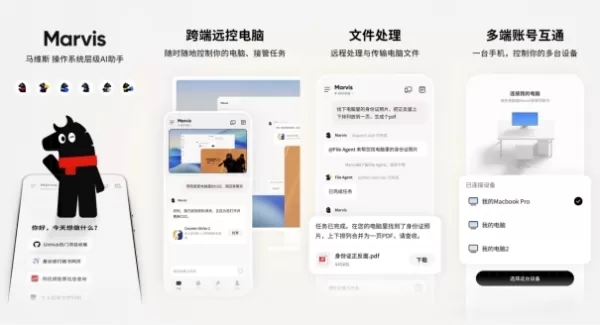
For example, in a daily work scenario, if a user needs to supplement a document while commuting home, they can simply ask Marvis to send the meeting minutes from the computer desktop to the mobile app, and Marvis automatically handles cross-device positioning and transmission. When abroad and needing urgent historical documents, they can also remotely retrieve, export, and send them to their email. For users who need to maintain computers for their elders, they can remotely take over the home computer via their phone to complete software installation and configuration adjustments, and see the actual computer screen, avoiding the hassle of describing the problem over the phone.
Additionally, even when the computer is locked, users can still use their phone to remotely enter the password and perform subsequent operations. For time-consuming tasks like game updates or large file downloads, users can check progress and issue follow-up instructions anytime via their phone. Even when the computer is offline, the iOS version of Marvis can switch to a pure cloud mode, independently completing tasks such as information retrieval and file processing.
Local + Cloud Dual Mode: Exploring a New Form of Operating System-Level AI
Unlike most AI assistants that run on the "application layer," Tencent's Marvis adopts a "system-level" technical approach and bets on a "local mode + hybrid architecture of end and cloud." The product offers two options: "Efficiency Mode," which balances speed and accuracy through end-cloud collaboration, and "Local Mode," which runs based on the local large model on the device, ensuring files never need to be uploaded to the cloud, maximizing user data privacy protection.
This choice addresses current industry pain points for AI agents: mainstream AI agents generally rely on pure cloud operation, leading to four major bottlenecks—high costs, privacy concerns, response delays, and unavailability when offline. Each call consumes cloud computing power and tokens, sensitive files must be uploaded to the cloud, network fluctuations slow down responses, and offline means "no resources available."
Marvis' solution involves deep strategic cooperation at the chip and system levels, allowing local and cloud to each play their roles. On the technical collaboration front, Marvis has optimized chips with Intel based on OpenVINO, and the team has completed extensive device compatibility work, providing hardware-level support for smooth and stable local model operation. At the system level, Marvis has achieved system-level file and setting operation permissions with Microsoft. This path—from bottom-up capability accumulation to system-level ecosystem collaboration—forms the core competitiveness of Marvis, distinguishing it from general cloud-based agents.
On the other hand, unlike other AI products that require uploading to the cloud for processing, Marvis comes with a small on-device model that can run locally, performing indexing and preliminary analysis on the user's computer. Even in efficiency mode, after the user authorizes the selection range, all recognition, organization, and search of documents and images in the local knowledge base are completed locally on the device, without leaving the computer, ensuring both privacy security and significantly reducing cloud token consumption.
Currently, Marvis is still in a period of rapid capability iteration. Since its launch on May 20, 2026, Marvis has maintained a high frequency of updates, delivering 21 versions within just one month—averaging one version every 1-2 days. These include features such as session management, voice input, connecting to Mac for remote control on the phone, user profile management, and low-resource mode. The team stated that in the future, they will gradually introduce new features such as the Mac local mode, global knowledge base, and custom agents, continuously improving the product experience while involving users in the growth process of Marvis.
Related article
 Indian Tech Tycoon Invests $30M in AI Rival to Microsoft Office
Serial entrepreneur Bhavin Turakhia is investing $30 million of his own capital, betting that the enterprise AI sector still has room for new players. His latest startup, Neo, operates on a core belief: legacy workplace software cannot simply be patc
Former OpenAI Chief Scientist Ilya’s SSI Unveils First Model
AI has achieved another major milestone. Following his departure from OpenAI, former chief scientist Ilya Sutskever established Safe Superintelligence Inc. (SSI), which has recently unveiled details regarding its inaugural model. Reports from oversea
Lovable Leads Atech's Seed Round as AI Ambient Coding Officially Enters the Hardware Field
On May 14, 2026, AI application development platform Lovable announced its participation in the $800,000 seed funding round for Danish hardware startup Atech. Led by Lovable, the round attracted top-tier venture capital firms including the a16z Scout
Related Special Topic Recommendations
chatbot
Indian Tech Tycoon Invests $30M in AI Rival to Microsoft Office
Serial entrepreneur Bhavin Turakhia is investing $30 million of his own capital, betting that the enterprise AI sector still has room for new players. His latest startup, Neo, operates on a core belief: legacy workplace software cannot simply be patc
Former OpenAI Chief Scientist Ilya’s SSI Unveils First Model
AI has achieved another major milestone. Following his departure from OpenAI, former chief scientist Ilya Sutskever established Safe Superintelligence Inc. (SSI), which has recently unveiled details regarding its inaugural model. Reports from oversea
Lovable Leads Atech's Seed Round as AI Ambient Coding Officially Enters the Hardware Field
On May 14, 2026, AI application development platform Lovable announced its participation in the $800,000 seed funding round for Danish hardware startup Atech. Led by Lovable, the round attracted top-tier venture capital firms including the a16z Scout
Related Special Topic Recommendations
chatbot
 Best AI Conversation Trainer Tools for Interview Practice
2026 Latest Best Top-rated AI Conversation Trainer Tools for Interview Practice are here on XIX.AI! This curated collection features powerful, game-changing tools that go through rigorous real-world tests to deliver accurate feedback. You’ll find a free vs paid comparison and detailed rankings to help you choose the must-try option that boosts your confidence and skills. Explore now to Discover your perfect tool for interview success!
 12 tools
 xix.ai
Design & Art
Best AI Style Transfer Tools for Creative Experiments
xix.ai
Design & Art
Best AI Style Transfer Tools for Creative Experiments
2026 Latest Best Top-rated AI Style Transfer Tools for Creative Experiments! XIX.AI has curated a powerful, game-changing collection of must-try tools that deliver exceptional results through real-world tests and rigorous rankings. These top solutions help creatives boost productivity significantly by accelerating content creation and unlocking endless creative possibilities. Explore now to discover your perfect tool and start creating today!
9 tools
xix.ai
Comic Creation
Best AI Dialogue Bubble Tools for Visual Storytelling
2026 Latest Best Top-Rated AI Dialogue Bubble Tools for Visual Storytelling are here on XIX.AI! This curated collection features powerful, game-changing tools that help creators boost productivity and overcome creative bottlenecks. Get a free vs paid comparison, see real-world tests, and check the latest rankings to find the must-try solutions perfect for crafting engaging visual narratives. Explore now to discover your ideal tool!
10 tools
xix.ai
Meeting Assistant
Top AI Meeting Summary Tools: Track Decisions and Follow-Ups Clearly
2026 Latest Top-Rated Best AI Meeting Summary Tools for Clear Decision Tracking and Effortless Follow-Ups. This curated list showcases powerful, game-changing solutions that boost productivity dramatically by automating meeting notes, identifying key action items, and streamlining team coordination across all projects. Get a free vs paid comparison along with real-world tests and weekly updated rankings to help you find the perfect tool. Explore now to unlock your AI edge!
9 tools
xix.ai
Data Analysis
Best AI Data Cleaning Tools: Fix Missing Values and Duplicates Fast
2026 Latest Best Top-rated AI Data Cleaning Tools for quick fixing of missing values and duplicates. This curated list showcases powerful, game-changing solutions that boost productivity significantly. Each option has undergone rigorous real-world tests to ensure reliability. Get a free vs paid comparison and discover the must-try tool that fits your needs best. Explore now at XIX.AI to Unlock your AI edge.
11 tools
xix.ai
Design & Art
Best AI Creative Ideation Tools for Artists: Break Through Visual Blocks
2026 Latest Best Top-Rated AI Creative Ideation Tools for Artists are curated by XIX.AI to help creators break through visual blocks and boost creativity instantly. These powerful game-changing tools offer real-world tests, detailed free vs paid comparison, and weekly updated rankings. Discover your perfect tool to accelerate content creation and unlock your AI edge today. Explore now!
14 tools
xix.ai

 Comments (0)
0/500
Comments (0)
0/500
On June 23, the iOS version of Marvis, Tencent's operating-system-level AI assistant, officially launched on the Apple App Store. This marks full coverage across mobile and PC platforms, following the release of Android, Windows, and macOS versions on May 20. Users can now summon this 24/7 online AI assistant anytime, anywhere, and seamlessly switch between phone and computer, embedding AI into every aspect of daily work and life.
The iOS interface continues Marvis' consistent design language: upon entering the app, the main screen shows the conversation entry "Hello, what would you like to do today?" and preloads high-frequency quick commands such as "Bangkok Travel Guide Webpage," "Stock Information Inquiry on Tonghuashun," and "Personal File Organization," lowering the initial learning curve for users.
iOS Version Features: A Portable Desktop Terminal on Mobile
The iOS launch focuses on enhancing the collaborative experience between mobile and desktop devices. Through "multi-device account synchronization," users can connect and control multiple devices with just one phone—whether an Android phone connecting to a Mac or an iOS phone connecting to a Windows computer. Using the "cross-device remote control" capability, even when away from the computer, users can pull out their phone and remotely control the computer desktop in real time via Marvis to complete complex tasks previously only possible on a PC, while also viewing the computer screen in real time, achieving true "desktop-level visual remote control" rather than traditional command-based remote control.
For example, in a daily work scenario, if a user needs to supplement a document while commuting home, they can simply ask Marvis to send the meeting minutes from the computer desktop to the mobile app, and Marvis automatically handles cross-device positioning and transmission. When abroad and needing urgent historical documents, they can also remotely retrieve, export, and send them to their email. For users who need to maintain computers for their elders, they can remotely take over the home computer via their phone to complete software installation and configuration adjustments, and see the actual computer screen, avoiding the hassle of describing the problem over the phone.
Additionally, even when the computer is locked, users can still use their phone to remotely enter the password and perform subsequent operations. For time-consuming tasks like game updates or large file downloads, users can check progress and issue follow-up instructions anytime via their phone. Even when the computer is offline, the iOS version of Marvis can switch to a pure cloud mode, independently completing tasks such as information retrieval and file processing.
Local + Cloud Dual Mode: Exploring a New Form of Operating System-Level AI
Unlike most AI assistants that run on the "application layer," Tencent's Marvis adopts a "system-level" technical approach and bets on a "local mode + hybrid architecture of end and cloud." The product offers two options: "Efficiency Mode," which balances speed and accuracy through end-cloud collaboration, and "Local Mode," which runs based on the local large model on the device, ensuring files never need to be uploaded to the cloud, maximizing user data privacy protection.
This choice addresses current industry pain points for AI agents: mainstream AI agents generally rely on pure cloud operation, leading to four major bottlenecks—high costs, privacy concerns, response delays, and unavailability when offline. Each call consumes cloud computing power and tokens, sensitive files must be uploaded to the cloud, network fluctuations slow down responses, and offline means "no resources available."
Marvis' solution involves deep strategic cooperation at the chip and system levels, allowing local and cloud to each play their roles. On the technical collaboration front, Marvis has optimized chips with Intel based on OpenVINO, and the team has completed extensive device compatibility work, providing hardware-level support for smooth and stable local model operation. At the system level, Marvis has achieved system-level file and setting operation permissions with Microsoft. This path—from bottom-up capability accumulation to system-level ecosystem collaboration—forms the core competitiveness of Marvis, distinguishing it from general cloud-based agents.
On the other hand, unlike other AI products that require uploading to the cloud for processing, Marvis comes with a small on-device model that can run locally, performing indexing and preliminary analysis on the user's computer. Even in efficiency mode, after the user authorizes the selection range, all recognition, organization, and search of documents and images in the local knowledge base are completed locally on the device, without leaving the computer, ensuring both privacy security and significantly reducing cloud token consumption.
Currently, Marvis is still in a period of rapid capability iteration. Since its launch on May 20, 2026, Marvis has maintained a high frequency of updates, delivering 21 versions within just one month—averaging one version every 1-2 days. These include features such as session management, voice input, connecting to Mac for remote control on the phone, user profile management, and low-resource mode. The team stated that in the future, they will gradually introduce new features such as the Mac local mode, global knowledge base, and custom agents, continuously improving the product experience while involving users in the growth process of Marvis.








 Indian Tech Tycoon Invests $30M in AI Rival to Microsoft Office
Serial entrepreneur Bhavin Turakhia is investing $30 million of his own capital, betting that the enterprise AI sector still has room for new players. His latest startup, Neo, operates on a core belief: legacy workplace software cannot simply be patc
Indian Tech Tycoon Invests $30M in AI Rival to Microsoft Office
Serial entrepreneur Bhavin Turakhia is investing $30 million of his own capital, betting that the enterprise AI sector still has room for new players. His latest startup, Neo, operates on a core belief: legacy workplace software cannot simply be patc
 Former OpenAI Chief Scientist Ilya’s SSI Unveils First Model
AI has achieved another major milestone. Following his departure from OpenAI, former chief scientist Ilya Sutskever established Safe Superintelligence Inc. (SSI), which has recently unveiled details regarding its inaugural model. Reports from oversea
Former OpenAI Chief Scientist Ilya’s SSI Unveils First Model
AI has achieved another major milestone. Following his departure from OpenAI, former chief scientist Ilya Sutskever established Safe Superintelligence Inc. (SSI), which has recently unveiled details regarding its inaugural model. Reports from oversea
 Lovable Leads Atech's Seed Round as AI Ambient Coding Officially Enters the Hardware Field
On May 14, 2026, AI application development platform Lovable announced its participation in the $800,000 seed funding round for Danish hardware startup Atech. Led by Lovable, the round attracted top-tier venture capital firms including the a16z Scout
Lovable Leads Atech's Seed Round as AI Ambient Coding Officially Enters the Hardware Field
On May 14, 2026, AI application development platform Lovable announced its participation in the $800,000 seed funding round for Danish hardware startup Atech. Led by Lovable, the round attracted top-tier venture capital firms including the a16z Scout

2026 Latest Best Top-rated AI Conversation Trainer Tools for Interview Practice are here on XIX.AI! This curated collection features powerful, game-changing tools that go through rigorous real-world tests to deliver accurate feedback. You’ll find a free vs paid comparison and detailed rankings to help you choose the must-try option that boosts your confidence and skills. Explore now to Discover your perfect tool for interview success!
12 tools
xix.ai

2026 Latest Best Top-rated AI Style Transfer Tools for Creative Experiments! XIX.AI has curated a powerful, game-changing collection of must-try tools that deliver exceptional results through real-world tests and rigorous rankings. These top solutions help creatives boost productivity significantly by accelerating content creation and unlocking endless creative possibilities. Explore now to discover your perfect tool and start creating today!
9 tools
xix.ai

2026 Latest Best Top-Rated AI Dialogue Bubble Tools for Visual Storytelling are here on XIX.AI! This curated collection features powerful, game-changing tools that help creators boost productivity and overcome creative bottlenecks. Get a free vs paid comparison, see real-world tests, and check the latest rankings to find the must-try solutions perfect for crafting engaging visual narratives. Explore now to discover your ideal tool!
10 tools
xix.ai

2026 Latest Top-Rated Best AI Meeting Summary Tools for Clear Decision Tracking and Effortless Follow-Ups. This curated list showcases powerful, game-changing solutions that boost productivity dramatically by automating meeting notes, identifying key action items, and streamlining team coordination across all projects. Get a free vs paid comparison along with real-world tests and weekly updated rankings to help you find the perfect tool. Explore now to unlock your AI edge!
9 tools
xix.ai

2026 Latest Best Top-rated AI Data Cleaning Tools for quick fixing of missing values and duplicates. This curated list showcases powerful, game-changing solutions that boost productivity significantly. Each option has undergone rigorous real-world tests to ensure reliability. Get a free vs paid comparison and discover the must-try tool that fits your needs best. Explore now at XIX.AI to Unlock your AI edge.
11 tools
xix.ai

2026 Latest Best Top-Rated AI Creative Ideation Tools for Artists are curated by XIX.AI to help creators break through visual blocks and boost creativity instantly. These powerful game-changing tools offer real-world tests, detailed free vs paid comparison, and weekly updated rankings. Discover your perfect tool to accelerate content creation and unlock your AI edge today. Explore now!
14 tools
xix.ai












