


 Home
Home
Tencent Carbon Quest Program Phase II Finalists Announced: 16 Teams to Address Global Issues via Global Solutions
On June 24, during London Climate Week, Tencent partnered with TED to host an event unveiling the final shortlist for phase two of its Carbon Quest Plan. Selected teams presented their technologies and discussed global climate initiatives with climate experts, policymakers, investors, and industry partners.
After 18 months of selection and evaluation, 10 cutting-edge low-carbon technologies were chosen from over 660 applications worldwide, receiving roughly 170 million yuan in pilot funding from Tencent’s Carbon Quest Plan. Another six innovations secured a total of around 10 million yuan through carbon credit pre-purchases, MRV support, or green premium subsidies.
The final 16 projects include four teams from China—Nanjing University, the Shanghai Institute of Advanced Technology of the Chinese Academy of Sciences, Peking University, and Sipeng Technology—alongside teams from Kenya, Belgium, Canada, the United States, the United Kingdom, Germany, and other countries. Since phase two of the Carbon Quest Plan launched in December 2024, it attracted applications from 54 countries and regions, with the global top 50 announced in October 2025. This final list reflects the plan’s core mission: solving global problems with global solutions.
Putting cutting-edge technology to work on real-world climate challenges
Xiao Wangjun, an assistant professor at Nanjing University’s School of Energy and Resources, leads one of the shortlisted projects in phase two of the Carbon Quest Plan: “High-Efficiency Charged Biochar Air Capture Technology Driven by Geothermal-PV Integration.” The project uses a low-cost charged biochar to capture carbon dioxide directly from the air through DAC technology. Beyond high capture capacity and low-temperature desorption, the approach taps into Kenya’s abundant geothermal and solar resources, significantly reducing energy use during carbon capture while balancing material stability with overall efficiency.
Kenya, as Xiao Wangjun noted, is one of the demonstration sites for phase two. Unlike theoretical evaluations, the Carbon Quest Plan focuses on tackling climate issues in real-world settings. Phase two spans four tracks: Carbon Removal (CDR), steel industry CCUS, manufacturing CCU, and Long-Duration Energy Storage (LDES). Except for the manufacturing CCU track, each has dedicated demonstration sites that require teams to tailor solutions to local conditions.
Kenya was chosen for the CDR track because of its abundant renewable energy and favorable geological storage conditions in the central and southern rift regions. For steel industry CCUS, demonstration sites are in Handan, China, and Serbia, where partnerships with two traditional long-process steel mills enable thousand-ton-scale full-cycle trials. The Maldives, heavily affected by the climate crisis, provides a critical test bed for LDES, as managing grid stability with renewable power is a key challenge. Professor Zhu Jia of Nanjing University said: “The Carbon Quest Plan doesn’t just fund cutting-edge low-carbon technologies—it connects them with real-world scenarios, helping them move out of the lab.”
At London Climate Week, Xu Hao, Tencent’s Vice President of Sustainable Social Value and Director of the Carbon Neutrality Innovation Center, noted that many promising climate technologies fail to scale due to a lack of funding and real-world testing environments. The Carbon Quest Plan identified this challenge and, by collaborating with industry, investment, and ecosystem partners, provides capital, connects technologies with real scenarios, and helps viable low-carbon solutions cross the “valley of death” from lab to deployment—seeking more answers to the global climate crisis.

Xu Hao, Tencent’s Vice President of Sustainable Social Value, speaks at London Climate Week
Diversified support opens new collaboration paths for low-carbon technologies
Beyond direct funding and resource backing for 10 pioneering technologies, phase two of the Carbon Quest Plan supports additional climate innovations through carbon credit pre-purchases, MRV assistance, or green premium subsidies.
Huang Xinwo, Tencent’s Senior Director of Strategy Development and head of the Carbon Quest Plan, noted that phase two attracted many promising low-carbon innovations, but each team’s needs vary considerably. By diversifying support, the program tailors assistance to projects at different technical stages and along various development paths.
The team led by Zhang Zishuai of Peking University, selected for MRV support, focuses on ocean-based CDR. Their approach couples low-pressure electroadsorption with seawater desalination to efficiently convert seawater inorganic carbon into calcium carbonate—essentially building an “artificial coral carbon capture factory” for carbon removal. While the project earned recognition from global judges, MRV and cost remain major barriers to large-scale ocean carbon removal. To address the lack of MRV standards for this route, phase two of the Carbon Quest Plan provided MRV support and funding to advance MRV technology and standardized methods.
Tencent will also sign thousand-ton carbon credit purchase agreements with select teams. For technologies with long-term commercial potential that face near-term green premium challenges, the Carbon Quest Plan offers product green subsidies to accelerate downstream industry adoption.
Professor Jiang Peixue of Tsinghua University’s Department of Energy and Power Engineering, co-chair of the Carbon Quest Plan’s Expert Committee, considers the program’s global collaboration platform highly forward-looking. By connecting diverse stakeholders and supporting climate innovators through multiple channels, it reflects Tencent’s thoughtful engagement with climate issues as a technology company—benefiting industry partnerships, academic exchange, and project investment.
Group photo of phase two shortlisted teams for the Carbon Quest Plan
Huang Xinwo added that since its launch, the Carbon Quest Plan has drawn broad industry attention, with results from phase one increasingly visible. Phase two’s selected technologies will soon be demonstrated worldwide. Going forward, the plan will further leverage Tencent’s technological and ecological strengths to explore fresh climate solutions. Preparations for phase three are already underway, he revealed.
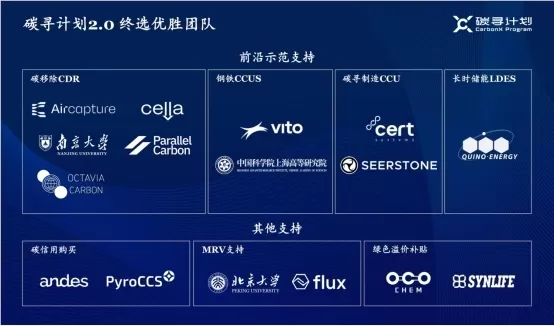
Phase two shortlisted projects of the Carbon Quest Plan
Related article
 Alibaba Integrates Organizational Structure and Establishes Token Foundry Division
As the AI race enters its second half, Alibaba is rapidly restructuring. On June 8, the company announced a major strategic upgrade: merging the Tongyi Large Model Business Unit with the Future Life Lab to create the new Token Foundry Business Unit.
OpenAI Teams With Grab to Embed ChatGPT Training for 300,000 Users
OpenAI has brought AI education directly to the streets and alleys of Southeast Asia. This Wednesday, it launched a collaboration with Grab, a Singapore-based transportation and food delivery platform, to offer an artificial intelligence training pro
Kuaishou Q2 Revenue Hits 35.5 Billion Yuan; Kuaichuan AI Sales Surge Over 200%
Kuaishou Technology’s Q2 2026 financial results reveal total revenue of 35.5 billion yuan, driven by a 7.4% year-over-year increase in core commercial revenue. The company reported an adjusted net profit of 3.9 billion yuan, reflecting an 11% net pro
Related Special Topic Recommendations
writing
Alibaba Integrates Organizational Structure and Establishes Token Foundry Division
As the AI race enters its second half, Alibaba is rapidly restructuring. On June 8, the company announced a major strategic upgrade: merging the Tongyi Large Model Business Unit with the Future Life Lab to create the new Token Foundry Business Unit.
OpenAI Teams With Grab to Embed ChatGPT Training for 300,000 Users
OpenAI has brought AI education directly to the streets and alleys of Southeast Asia. This Wednesday, it launched a collaboration with Grab, a Singapore-based transportation and food delivery platform, to offer an artificial intelligence training pro
Kuaishou Q2 Revenue Hits 35.5 Billion Yuan; Kuaichuan AI Sales Surge Over 200%
Kuaishou Technology’s Q2 2026 financial results reveal total revenue of 35.5 billion yuan, driven by a 7.4% year-over-year increase in core commercial revenue. The company reported an adjusted net profit of 3.9 billion yuan, reflecting an 11% net pro
Related Special Topic Recommendations
writing
 Best AI Rewrite Tools for Faster Content Refresh
2026 Latest Best Top-Rated AI Rewrite Tools for Faster Content Refresh are here on XIX.AI! This curated list features powerful game-changing solutions that boost writing efficiency significantly through real-world tests and detailed rankings. You’ll find a free vs paid comparison to help you choose the perfect option. Explore now to Unlock your AI edge!
 9 tools
 xix.ai
Meeting Assistant
Best AI Action Item Tools for Project Follow Up
xix.ai
Meeting Assistant
Best AI Action Item Tools for Project Follow Up
2026 Latest Best Top-rated AI Action Item Tools for Project Follow Up! XIX.AI has curated a powerful, game-changing collection of must-try tools that deliver accurate task tracking, real-time updates, and streamlined workflow management. Every entry undergoes rigorous weekly updated real-world tests to ensure top performance across all use cases. Get a free vs paid comparison to find the perfect fit for boosting your productivity. Explore now to Unlock your AI edge!
10 tools
xix.ai
automation
AI Agent Builder Tools for Business Process Automation
2026 Latest Best Top-rated AI Agent Builder Tools for Business Process Automation! XIX.AI has curated a powerful, game-changing collection of must-try options that go through rigorous real-world tests. You’ll find detailed free vs paid comparison insights and updated weekly rankings to help you spot the perfect tool for boosting productivity across work tasks. Explore now to Unlock your AI edge!
12 tools
xix.ai
SEO
AI Content Optimization Tools for On-Page SEO
2026 Latest Best Top-Rated AI Content Optimization Tools for On-Page SEO are here on XIX.AI! This curated list features powerful, game-changing solutions that help boost writing efficiency and deliver high-quality content. We conduct real-world tests and provide a free vs paid comparison along with weekly updated rankings to help you find the must-try tool perfect for your needs. Explore now to unlock your AI edge!
9 tools
xix.ai
Social Media
Best AI Hashtag Tools for Instagram and TikTok Growth
2026 Latest Best AI Hashtag Tools for Instagram and TikTok Growth! XIX.AI has curated a top-rated list of must-try powerful tools that deliver game-changing results through real-world tests. You’ll find detailed rankings, free vs paid comparison info, and insights to help you boost content reach efficiently. Explore now to discover your perfect tool and unlock your AI edge!
8 tools
xix.ai
Finance
AI Financial Analysis Tools for Small Businesses
2026 Latest Best Top-Rated AI Financial Analysis Tools for Small Businesses! XIX.AI has curated a powerful, game-changing collection of must-try solutions designed to streamline financial tasks, boost productivity, and help you make smarter business decisions. Each tool goes through rigorous real-world tests, with weekly updated rankings and a detailed free vs paid comparison to help you find the perfect fit. Explore now to unlock your AI edge!
15 tools
xix.ai

 Comments (0)
0/500
Comments (0)
0/500
On June 24, during London Climate Week, Tencent partnered with TED to host an event unveiling the final shortlist for phase two of its Carbon Quest Plan. Selected teams presented their technologies and discussed global climate initiatives with climate experts, policymakers, investors, and industry partners.
After 18 months of selection and evaluation, 10 cutting-edge low-carbon technologies were chosen from over 660 applications worldwide, receiving roughly 170 million yuan in pilot funding from Tencent’s Carbon Quest Plan. Another six innovations secured a total of around 10 million yuan through carbon credit pre-purchases, MRV support, or green premium subsidies.
The final 16 projects include four teams from China—Nanjing University, the Shanghai Institute of Advanced Technology of the Chinese Academy of Sciences, Peking University, and Sipeng Technology—alongside teams from Kenya, Belgium, Canada, the United States, the United Kingdom, Germany, and other countries. Since phase two of the Carbon Quest Plan launched in December 2024, it attracted applications from 54 countries and regions, with the global top 50 announced in October 2025. This final list reflects the plan’s core mission: solving global problems with global solutions.
Putting cutting-edge technology to work on real-world climate challenges
Xiao Wangjun, an assistant professor at Nanjing University’s School of Energy and Resources, leads one of the shortlisted projects in phase two of the Carbon Quest Plan: “High-Efficiency Charged Biochar Air Capture Technology Driven by Geothermal-PV Integration.” The project uses a low-cost charged biochar to capture carbon dioxide directly from the air through DAC technology. Beyond high capture capacity and low-temperature desorption, the approach taps into Kenya’s abundant geothermal and solar resources, significantly reducing energy use during carbon capture while balancing material stability with overall efficiency.
Kenya, as Xiao Wangjun noted, is one of the demonstration sites for phase two. Unlike theoretical evaluations, the Carbon Quest Plan focuses on tackling climate issues in real-world settings. Phase two spans four tracks: Carbon Removal (CDR), steel industry CCUS, manufacturing CCU, and Long-Duration Energy Storage (LDES). Except for the manufacturing CCU track, each has dedicated demonstration sites that require teams to tailor solutions to local conditions.
Kenya was chosen for the CDR track because of its abundant renewable energy and favorable geological storage conditions in the central and southern rift regions. For steel industry CCUS, demonstration sites are in Handan, China, and Serbia, where partnerships with two traditional long-process steel mills enable thousand-ton-scale full-cycle trials. The Maldives, heavily affected by the climate crisis, provides a critical test bed for LDES, as managing grid stability with renewable power is a key challenge. Professor Zhu Jia of Nanjing University said: “The Carbon Quest Plan doesn’t just fund cutting-edge low-carbon technologies—it connects them with real-world scenarios, helping them move out of the lab.”
At London Climate Week, Xu Hao, Tencent’s Vice President of Sustainable Social Value and Director of the Carbon Neutrality Innovation Center, noted that many promising climate technologies fail to scale due to a lack of funding and real-world testing environments. The Carbon Quest Plan identified this challenge and, by collaborating with industry, investment, and ecosystem partners, provides capital, connects technologies with real scenarios, and helps viable low-carbon solutions cross the “valley of death” from lab to deployment—seeking more answers to the global climate crisis.
Xu Hao, Tencent’s Vice President of Sustainable Social Value, speaks at London Climate Week
Diversified support opens new collaboration paths for low-carbon technologies
Beyond direct funding and resource backing for 10 pioneering technologies, phase two of the Carbon Quest Plan supports additional climate innovations through carbon credit pre-purchases, MRV assistance, or green premium subsidies.
Huang Xinwo, Tencent’s Senior Director of Strategy Development and head of the Carbon Quest Plan, noted that phase two attracted many promising low-carbon innovations, but each team’s needs vary considerably. By diversifying support, the program tailors assistance to projects at different technical stages and along various development paths.
The team led by Zhang Zishuai of Peking University, selected for MRV support, focuses on ocean-based CDR. Their approach couples low-pressure electroadsorption with seawater desalination to efficiently convert seawater inorganic carbon into calcium carbonate—essentially building an “artificial coral carbon capture factory” for carbon removal. While the project earned recognition from global judges, MRV and cost remain major barriers to large-scale ocean carbon removal. To address the lack of MRV standards for this route, phase two of the Carbon Quest Plan provided MRV support and funding to advance MRV technology and standardized methods.
Tencent will also sign thousand-ton carbon credit purchase agreements with select teams. For technologies with long-term commercial potential that face near-term green premium challenges, the Carbon Quest Plan offers product green subsidies to accelerate downstream industry adoption.
Professor Jiang Peixue of Tsinghua University’s Department of Energy and Power Engineering, co-chair of the Carbon Quest Plan’s Expert Committee, considers the program’s global collaboration platform highly forward-looking. By connecting diverse stakeholders and supporting climate innovators through multiple channels, it reflects Tencent’s thoughtful engagement with climate issues as a technology company—benefiting industry partnerships, academic exchange, and project investment.
Group photo of phase two shortlisted teams for the Carbon Quest Plan
Huang Xinwo added that since its launch, the Carbon Quest Plan has drawn broad industry attention, with results from phase one increasingly visible. Phase two’s selected technologies will soon be demonstrated worldwide. Going forward, the plan will further leverage Tencent’s technological and ecological strengths to explore fresh climate solutions. Preparations for phase three are already underway, he revealed.
Phase two shortlisted projects of the Carbon Quest Plan








 Alibaba Integrates Organizational Structure and Establishes Token Foundry Division
As the AI race enters its second half, Alibaba is rapidly restructuring. On June 8, the company announced a major strategic upgrade: merging the Tongyi Large Model Business Unit with the Future Life Lab to create the new Token Foundry Business Unit.
Alibaba Integrates Organizational Structure and Establishes Token Foundry Division
As the AI race enters its second half, Alibaba is rapidly restructuring. On June 8, the company announced a major strategic upgrade: merging the Tongyi Large Model Business Unit with the Future Life Lab to create the new Token Foundry Business Unit.
 OpenAI Teams With Grab to Embed ChatGPT Training for 300,000 Users
OpenAI has brought AI education directly to the streets and alleys of Southeast Asia. This Wednesday, it launched a collaboration with Grab, a Singapore-based transportation and food delivery platform, to offer an artificial intelligence training pro
OpenAI Teams With Grab to Embed ChatGPT Training for 300,000 Users
OpenAI has brought AI education directly to the streets and alleys of Southeast Asia. This Wednesday, it launched a collaboration with Grab, a Singapore-based transportation and food delivery platform, to offer an artificial intelligence training pro
 Kuaishou Q2 Revenue Hits 35.5 Billion Yuan; Kuaichuan AI Sales Surge Over 200%
Kuaishou Technology’s Q2 2026 financial results reveal total revenue of 35.5 billion yuan, driven by a 7.4% year-over-year increase in core commercial revenue. The company reported an adjusted net profit of 3.9 billion yuan, reflecting an 11% net pro
Kuaishou Q2 Revenue Hits 35.5 Billion Yuan; Kuaichuan AI Sales Surge Over 200%
Kuaishou Technology’s Q2 2026 financial results reveal total revenue of 35.5 billion yuan, driven by a 7.4% year-over-year increase in core commercial revenue. The company reported an adjusted net profit of 3.9 billion yuan, reflecting an 11% net pro

2026 Latest Best Top-Rated AI Rewrite Tools for Faster Content Refresh are here on XIX.AI! This curated list features powerful game-changing solutions that boost writing efficiency significantly through real-world tests and detailed rankings. You’ll find a free vs paid comparison to help you choose the perfect option. Explore now to Unlock your AI edge!
9 tools
xix.ai

2026 Latest Best Top-rated AI Action Item Tools for Project Follow Up! XIX.AI has curated a powerful, game-changing collection of must-try tools that deliver accurate task tracking, real-time updates, and streamlined workflow management. Every entry undergoes rigorous weekly updated real-world tests to ensure top performance across all use cases. Get a free vs paid comparison to find the perfect fit for boosting your productivity. Explore now to Unlock your AI edge!
10 tools
xix.ai

2026 Latest Best Top-rated AI Agent Builder Tools for Business Process Automation! XIX.AI has curated a powerful, game-changing collection of must-try options that go through rigorous real-world tests. You’ll find detailed free vs paid comparison insights and updated weekly rankings to help you spot the perfect tool for boosting productivity across work tasks. Explore now to Unlock your AI edge!
12 tools
xix.ai

2026 Latest Best Top-Rated AI Content Optimization Tools for On-Page SEO are here on XIX.AI! This curated list features powerful, game-changing solutions that help boost writing efficiency and deliver high-quality content. We conduct real-world tests and provide a free vs paid comparison along with weekly updated rankings to help you find the must-try tool perfect for your needs. Explore now to unlock your AI edge!
9 tools
xix.ai

2026 Latest Best AI Hashtag Tools for Instagram and TikTok Growth! XIX.AI has curated a top-rated list of must-try powerful tools that deliver game-changing results through real-world tests. You’ll find detailed rankings, free vs paid comparison info, and insights to help you boost content reach efficiently. Explore now to discover your perfect tool and unlock your AI edge!
8 tools
xix.ai

2026 Latest Best Top-Rated AI Financial Analysis Tools for Small Businesses! XIX.AI has curated a powerful, game-changing collection of must-try solutions designed to streamline financial tasks, boost productivity, and help you make smarter business decisions. Each tool goes through rigorous real-world tests, with weekly updated rankings and a detailed free vs paid comparison to help you find the perfect fit. Explore now to unlock your AI edge!
15 tools
xix.ai












