


 Home
HomeSmart Glasses Empower Low-Vision Users with AI Assistance
Accessibility technology company Envision has teamed up with eyewear maker Solos to introduce new smart glasses tailored for blind and low-vision individuals. According to Envision, the camera-equipped Ally Solos Glasses can read and translate text, describe environments, perform web searches, and identify people, objects, and signage. Information is delivered to the wearer through open-ear speakers integrated into the arms of the frames.
The Ally Solos Glasses are now available for pre-order at $399, a promotional launch price reduced from the standard $699. The frames come in two sizes—regular and large—and three color choices: black, gray, and brown. Pre-ordered units are scheduled to ship in October 2025.
These glasses are based on the existing AirGo Vision model launched by Solos in December, which offered visual recognition powered by OpenAI's GPT-4o. Envision's version replaces GPT-4o with the company's own "Ally" AI assistant. As detailed on the Ally website, this assistant utilizes a blend of foundational AI models including Meta's Llama, OpenAI's ChatGPT, Google's Gemini, and Perplexity.
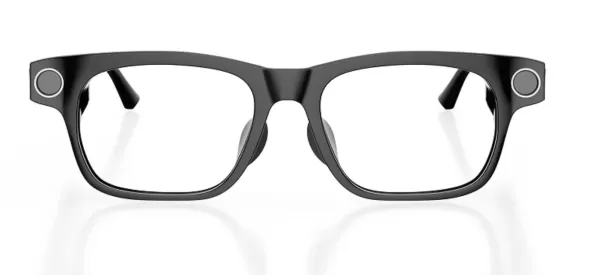
The front view of the Ally Solos glasses highlights the dual cameras positioned on either side of the frame. Image: EnvisionThe AI functions operate by connecting to the Ally app for iOS or Android via Bluetooth. The glasses boast a robust IP67 rating for dust and water resistance. According to the pre-order details, the USB-C rechargeable arms offer up to 16 hours of active use per charge. A full charge takes approximately 90 minutes, while a 15-minute fast charge provides roughly three hours of battery life.
Accessibility features are already a key advantage in other smart glasses. Envision, for instance, previously developed assistive eyewear using the discontinued Google Glass hardware. Similarly, AI-powered vision capabilities in Ray-Ban Meta smart glasses have gained popularity within the low-vision community. How the Ally Solos Glasses stack up against more affordable options remains to be seen, as their $699 price point is significantly higher than the $299 AirGo Vision and Ray-Ban Meta models.
Related article
 Andreessen-backed Vals Targets AI Benchmarking Leadership
Benchmarking has become the industry standard for how AI companies validate their models’ capabilities, leverage favorable metrics to differentiate from competitors, and market their superiority. In short, strong benchmark results almost always trans
Apple Exec John Ternus Calls iPhone Best AI Device
Apple’s incoming CEO John Ternus clarified the company’s AI strategy during Wednesday’s Surprise and Shine event, asserting that the iPhone is already the premier AI device and prioritizing user data privacy over competitors.As Ternus succeeds Tim Co
Claude’s Cowork feature now recalls your past chat instructions
Anthropic’s update to Claude’s memory system removes a major friction point in using AI agents: the repetitive need to re-explain context that the AI already retains. By merging the memory architectures of standard chat and Claude Cowork, Claude now
Related Special Topic Recommendations
Design & Art
Andreessen-backed Vals Targets AI Benchmarking Leadership
Benchmarking has become the industry standard for how AI companies validate their models’ capabilities, leverage favorable metrics to differentiate from competitors, and market their superiority. In short, strong benchmark results almost always trans
Apple Exec John Ternus Calls iPhone Best AI Device
Apple’s incoming CEO John Ternus clarified the company’s AI strategy during Wednesday’s Surprise and Shine event, asserting that the iPhone is already the premier AI device and prioritizing user data privacy over competitors.As Ternus succeeds Tim Co
Claude’s Cowork feature now recalls your past chat instructions
Anthropic’s update to Claude’s memory system removes a major friction point in using AI agents: the repetitive need to re-explain context that the AI already retains. By merging the memory architectures of standard chat and Claude Cowork, Claude now
Related Special Topic Recommendations
Design & Art
 Top AI Illustration Tools: Create Editorial Scenes and Cover Art Faster
2026 Latest Top-rated AI Illustration Tools: Our curated list features the best powerfully designed tools for creating stunning editorial scenes and eye-catching cover art quickly. Each option has gone through rigorous real-world tests, offering a free vs paid comparison to help you find the perfect match for your workflow. Try these must-try solutions today to unlock your AI edge and boost your creative productivity. Explore now at XIX.AI.
 10 tools
 xix.ai
Education and Learning
Top AI Tutors for Exam Prep: Practice Math, Science, and English
xix.ai
Education and Learning
Top AI Tutors for Exam Prep: Practice Math, Science, and English
2026 Latest Top-Rated Best AI Tutors for Exam Prep are here on XIX.AI! Our curated list features powerful game-changing tools that offer free vs paid comparison, real-world tests, and weekly updated rankings. They help boost your writing efficiency, simplify complex topic learning, and unlock your academic potential. Explore now to Discover your perfect exam prep tool and Start creating today to Unlock your AI edge!
10 tools
xix.ai
Finance
AI Budget Planning Tools for Personal Money Management
2026 Latest Best Top-Rated AI Budget Planning Tools for Personal Money Management are here on XIX.AI! This curated collection features powerful, game-changing solutions that help you conduct real-world tests, understand spending habits, and create personalized plans to boost productivity. Enjoy a free vs paid comparison along with detailed rankings. Must-try tools designed to simplify money management and unlock your AI edge. Explore now!
11 tools
xix.ai
Health & Wellness
AI Sleep Tracking Assistants: Improve Recovery with Better Bedtime Habits
2026 Latest Best Top-Rated AI Sleep Tracking Assistants curated for ultimate recovery. This fully updated weekly guide features powerful tools that deliver real-world tests, free vs paid comparison, and detailed rankings to help you find the must-try solution that boosts sleep quality and supports better bedtime habits. Explore now at XIX.AI to Unlock your AI edge.
10 tools
xix.ai
Data Analysis
AI SQL Copilots for Product and Revenue Analytics
2026 Latest Best Top-Rated AI SQL Copilots for Product and Revenue Analytics! XIX.AI has curated a powerful, game-changing collection of must-try tools that undergo real-world tests through weekly updated rankings. These tools help users boost productivity significantly by accelerating data analysis, streamlining complex queries, and generating accurate insights to drive smarter business decisions. Explore now to Discover your perfect tool for unlocking your AI edge!
14 tools
xix.ai
Education and Learning
Best AI Homework Helpers That Teach: Learn Concepts, Not Just Answers
2026 Latest Best Top-Rated AI Homework Helpers That Teach Core Concepts Not Just Answers Powerful Tools for Students Must-Try Curated List Weekly Updated Free vs Paid Comparison Real-World Tests Accurate Rankings to Help You Unlock Your Full Learning Potential Explore now to Discover your perfect tool for smarter studying.
10 tools
xix.ai

 Comments (2)
0/500
Comments (2)
0/500
![ThomasBaker]()
This is such a cool step forward! I've been following assistive AI for a while, and seeing it integrated into something as everyday as glasses is brilliant. Makes me wonder what other 'invisible' tech could help people navigate the world more independently. The translation feature is a huge plus too. 🕶️
![DanielAllen]()
Endlich mal ein Produkt, das nicht nur für Nerds ist! Die Brille liest Texte vor – praktisch für den Alltag. Aber ich frage mich, ob die Kamera-Daten sicher sind. Datenschutz bleibt bei solchen Gadgets oft ein Nachteil. Trotzdem, ein Schritt in die richtige Richtung für mehr Inklusion! 👓
Accessibility technology company Envision has teamed up with eyewear maker Solos to introduce new smart glasses tailored for blind and low-vision individuals. According to Envision, the camera-equipped Ally Solos Glasses can read and translate text, describe environments, perform web searches, and identify people, objects, and signage. Information is delivered to the wearer through open-ear speakers integrated into the arms of the frames.
The Ally Solos Glasses are now available for pre-order at $399, a promotional launch price reduced from the standard $699. The frames come in two sizes—regular and large—and three color choices: black, gray, and brown. Pre-ordered units are scheduled to ship in October 2025.
These glasses are based on the existing AirGo Vision model launched by Solos in December, which offered visual recognition powered by OpenAI's GPT-4o. Envision's version replaces GPT-4o with the company's own "Ally" AI assistant. As detailed on the Ally website, this assistant utilizes a blend of foundational AI models including Meta's Llama, OpenAI's ChatGPT, Google's Gemini, and Perplexity.
The AI functions operate by connecting to the Ally app for iOS or Android via Bluetooth. The glasses boast a robust IP67 rating for dust and water resistance. According to the pre-order details, the USB-C rechargeable arms offer up to 16 hours of active use per charge. A full charge takes approximately 90 minutes, while a 15-minute fast charge provides roughly three hours of battery life.
Accessibility features are already a key advantage in other smart glasses. Envision, for instance, previously developed assistive eyewear using the discontinued Google Glass hardware. Similarly, AI-powered vision capabilities in Ray-Ban Meta smart glasses have gained popularity within the low-vision community. How the Ally Solos Glasses stack up against more affordable options remains to be seen, as their $699 price point is significantly higher than the $299 AirGo Vision and Ray-Ban Meta models.








 Andreessen-backed Vals Targets AI Benchmarking Leadership
Benchmarking has become the industry standard for how AI companies validate their models’ capabilities, leverage favorable metrics to differentiate from competitors, and market their superiority. In short, strong benchmark results almost always trans
Andreessen-backed Vals Targets AI Benchmarking Leadership
Benchmarking has become the industry standard for how AI companies validate their models’ capabilities, leverage favorable metrics to differentiate from competitors, and market their superiority. In short, strong benchmark results almost always trans
 Apple Exec John Ternus Calls iPhone Best AI Device
Apple’s incoming CEO John Ternus clarified the company’s AI strategy during Wednesday’s Surprise and Shine event, asserting that the iPhone is already the premier AI device and prioritizing user data privacy over competitors.As Ternus succeeds Tim Co
Apple Exec John Ternus Calls iPhone Best AI Device
Apple’s incoming CEO John Ternus clarified the company’s AI strategy during Wednesday’s Surprise and Shine event, asserting that the iPhone is already the premier AI device and prioritizing user data privacy over competitors.As Ternus succeeds Tim Co
 Claude’s Cowork feature now recalls your past chat instructions
Anthropic’s update to Claude’s memory system removes a major friction point in using AI agents: the repetitive need to re-explain context that the AI already retains. By merging the memory architectures of standard chat and Claude Cowork, Claude now
Claude’s Cowork feature now recalls your past chat instructions
Anthropic’s update to Claude’s memory system removes a major friction point in using AI agents: the repetitive need to re-explain context that the AI already retains. By merging the memory architectures of standard chat and Claude Cowork, Claude now

2026 Latest Top-rated AI Illustration Tools: Our curated list features the best powerfully designed tools for creating stunning editorial scenes and eye-catching cover art quickly. Each option has gone through rigorous real-world tests, offering a free vs paid comparison to help you find the perfect match for your workflow. Try these must-try solutions today to unlock your AI edge and boost your creative productivity. Explore now at XIX.AI.
10 tools
xix.ai

2026 Latest Top-Rated Best AI Tutors for Exam Prep are here on XIX.AI! Our curated list features powerful game-changing tools that offer free vs paid comparison, real-world tests, and weekly updated rankings. They help boost your writing efficiency, simplify complex topic learning, and unlock your academic potential. Explore now to Discover your perfect exam prep tool and Start creating today to Unlock your AI edge!
10 tools
xix.ai

2026 Latest Best Top-Rated AI Budget Planning Tools for Personal Money Management are here on XIX.AI! This curated collection features powerful, game-changing solutions that help you conduct real-world tests, understand spending habits, and create personalized plans to boost productivity. Enjoy a free vs paid comparison along with detailed rankings. Must-try tools designed to simplify money management and unlock your AI edge. Explore now!
11 tools
xix.ai

2026 Latest Best Top-Rated AI Sleep Tracking Assistants curated for ultimate recovery. This fully updated weekly guide features powerful tools that deliver real-world tests, free vs paid comparison, and detailed rankings to help you find the must-try solution that boosts sleep quality and supports better bedtime habits. Explore now at XIX.AI to Unlock your AI edge.
10 tools
xix.ai

2026 Latest Best Top-Rated AI SQL Copilots for Product and Revenue Analytics! XIX.AI has curated a powerful, game-changing collection of must-try tools that undergo real-world tests through weekly updated rankings. These tools help users boost productivity significantly by accelerating data analysis, streamlining complex queries, and generating accurate insights to drive smarter business decisions. Explore now to Discover your perfect tool for unlocking your AI edge!
14 tools
xix.ai

2026 Latest Best Top-Rated AI Homework Helpers That Teach Core Concepts Not Just Answers Powerful Tools for Students Must-Try Curated List Weekly Updated Free vs Paid Comparison Real-World Tests Accurate Rankings to Help You Unlock Your Full Learning Potential Explore now to Discover your perfect tool for smarter studying.
10 tools
xix.ai

This is such a cool step forward! I've been following assistive AI for a while, and seeing it integrated into something as everyday as glasses is brilliant. Makes me wonder what other 'invisible' tech could help people navigate the world more independently. The translation feature is a huge plus too. 🕶️
Endlich mal ein Produkt, das nicht nur für Nerds ist! Die Brille liest Texte vor – praktisch für den Alltag. Aber ich frage mich, ob die Kamera-Daten sicher sind. Datenschutz bleibt bei solchen Gadgets oft ein Nachteil. Trotzdem, ein Schritt in die richtige Richtung für mehr Inklusion! 👓












