


 Home
HomeClaude’s Cowork feature now recalls your past chat instructions
Anthropic’s update to Claude’s memory system removes a major friction point in using AI agents: the repetitive need to re-explain context that the AI already retains. By merging the memory architectures of standard chat and Claude Cowork, Claude now maintains continuity across all interactions, remembering insights from one session even when switching to another.
Users can now view, edit, or delete any information stored in Claude’s memory, ensuring full transparency and control over what the AI retains.

Image Credits:Anthropic
This enhancement streamlines the workflow between research and execution, allowing users to transition seamlessly from brainstorming to action without losing context.
Previously, users might have developed project ideas through casual chats with Claude, only to face the frustration of restarting from scratch when switching to Cowork to implement those ideas. This update resolves that disconnect, making Claude feel like a single, cohesive assistant rather than disjointed tools.
For example, if you are drafting a manager update or a conference agenda, Cowork now leverages past conversations to automatically understand relevant context. It retains key details like headcount, location, and speaker lists, eliminating the need to re-enter this information manually.
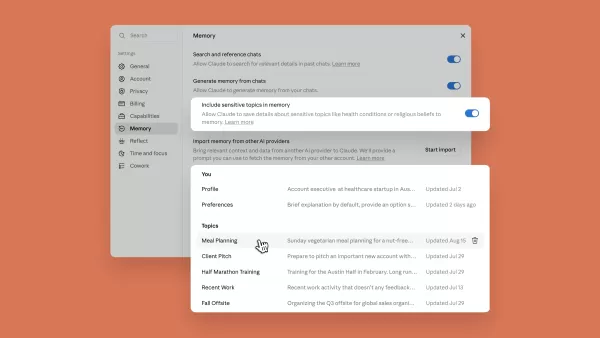
Image Credits:Anthropic
Claude now updates its memory in real-time as you chat, rather than waiting for a conversation to end. This ensures that new insights are instantly shared between chat and Cowork, facilitating smoother transitions even during active discussions.
By default, Claude excludes sensitive personal data from memory, such as health records, race, ethnicity, religious beliefs, political views, and gender identity. Users can opt to include these topics by enabling the “include sensitive topics in memory” setting, and the app will notify them whenever such data is stored.
Strictly prohibited from being saved are government-issued IDs, Social Security numbers, criminal history, immigration status, and any other information violating Anthropic’s acceptable use policy.
This memory feature is enabled by default for Free, Pro, and Max subscribers on web, desktop, and mobile platforms. iOS and Android users must update their apps to the latest version to access these improvements.
Related article
 Gemini faces branding challenges, as does the wider AI industry
Google’s Wednesday announcement regarding new Gemini Live voice features makes a valid point: “You shouldn’t have to guess whether a task requires Spark, a Daily Brief, or a quick inbox search.” While Google presents this as a commitment to handling
Apple Watch’s New AI Features Normalize Always-Listening Tech
Apple is pushing consumers to embrace a new norm: your devices are constantly listening.During Wednesday’s “Surprise and Shine” iPhone launch, which unveiled the latest hardware, the true revelation wasn’t the rumored foldable iPhone, but rather how
Deezer reports over half of daily music uploads are AI-generated
Deezer, a major music streaming service, has monitored the surge in AI-generated uploads since last year, with figures climbing steadily. The platform now reports that AI-produced content accounts for over half of all downloads.According to Deezer, A
Related Special Topic Recommendations
Design & Art
Gemini faces branding challenges, as does the wider AI industry
Google’s Wednesday announcement regarding new Gemini Live voice features makes a valid point: “You shouldn’t have to guess whether a task requires Spark, a Daily Brief, or a quick inbox search.” While Google presents this as a commitment to handling
Apple Watch’s New AI Features Normalize Always-Listening Tech
Apple is pushing consumers to embrace a new norm: your devices are constantly listening.During Wednesday’s “Surprise and Shine” iPhone launch, which unveiled the latest hardware, the true revelation wasn’t the rumored foldable iPhone, but rather how
Deezer reports over half of daily music uploads are AI-generated
Deezer, a major music streaming service, has monitored the surge in AI-generated uploads since last year, with figures climbing steadily. The platform now reports that AI-produced content accounts for over half of all downloads.According to Deezer, A
Related Special Topic Recommendations
Design & Art
 Top AI Illustration Tools: Create Editorial Scenes and Cover Art Faster
2026 Latest Top-rated AI Illustration Tools: Our curated list features the best powerfully designed tools for creating stunning editorial scenes and eye-catching cover art quickly. Each option has gone through rigorous real-world tests, offering a free vs paid comparison to help you find the perfect match for your workflow. Try these must-try solutions today to unlock your AI edge and boost your creative productivity. Explore now at XIX.AI.
 10 tools
 xix.ai
Education and Learning
Top AI Tutors for Exam Prep: Practice Math, Science, and English
xix.ai
Education and Learning
Top AI Tutors for Exam Prep: Practice Math, Science, and English
2026 Latest Top-Rated Best AI Tutors for Exam Prep are here on XIX.AI! Our curated list features powerful game-changing tools that offer free vs paid comparison, real-world tests, and weekly updated rankings. They help boost your writing efficiency, simplify complex topic learning, and unlock your academic potential. Explore now to Discover your perfect exam prep tool and Start creating today to Unlock your AI edge!
10 tools
xix.ai
Finance
AI Budget Planning Tools for Personal Money Management
2026 Latest Best Top-Rated AI Budget Planning Tools for Personal Money Management are here on XIX.AI! This curated collection features powerful, game-changing solutions that help you conduct real-world tests, understand spending habits, and create personalized plans to boost productivity. Enjoy a free vs paid comparison along with detailed rankings. Must-try tools designed to simplify money management and unlock your AI edge. Explore now!
11 tools
xix.ai
Health & Wellness
AI Sleep Tracking Assistants: Improve Recovery with Better Bedtime Habits
2026 Latest Best Top-Rated AI Sleep Tracking Assistants curated for ultimate recovery. This fully updated weekly guide features powerful tools that deliver real-world tests, free vs paid comparison, and detailed rankings to help you find the must-try solution that boosts sleep quality and supports better bedtime habits. Explore now at XIX.AI to Unlock your AI edge.
10 tools
xix.ai
Data Analysis
AI SQL Copilots for Product and Revenue Analytics
2026 Latest Best Top-Rated AI SQL Copilots for Product and Revenue Analytics! XIX.AI has curated a powerful, game-changing collection of must-try tools that undergo real-world tests through weekly updated rankings. These tools help users boost productivity significantly by accelerating data analysis, streamlining complex queries, and generating accurate insights to drive smarter business decisions. Explore now to Discover your perfect tool for unlocking your AI edge!
14 tools
xix.ai
Education and Learning
Best AI Homework Helpers That Teach: Learn Concepts, Not Just Answers
2026 Latest Best Top-Rated AI Homework Helpers That Teach Core Concepts Not Just Answers Powerful Tools for Students Must-Try Curated List Weekly Updated Free vs Paid Comparison Real-World Tests Accurate Rankings to Help You Unlock Your Full Learning Potential Explore now to Discover your perfect tool for smarter studying.
10 tools
xix.ai

 Comments (0)
0/500
Comments (0)
0/500
Anthropic’s update to Claude’s memory system removes a major friction point in using AI agents: the repetitive need to re-explain context that the AI already retains. By merging the memory architectures of standard chat and Claude Cowork, Claude now maintains continuity across all interactions, remembering insights from one session even when switching to another.
Users can now view, edit, or delete any information stored in Claude’s memory, ensuring full transparency and control over what the AI retains.
Image Credits:Anthropic
This enhancement streamlines the workflow between research and execution, allowing users to transition seamlessly from brainstorming to action without losing context.
Previously, users might have developed project ideas through casual chats with Claude, only to face the frustration of restarting from scratch when switching to Cowork to implement those ideas. This update resolves that disconnect, making Claude feel like a single, cohesive assistant rather than disjointed tools.
For example, if you are drafting a manager update or a conference agenda, Cowork now leverages past conversations to automatically understand relevant context. It retains key details like headcount, location, and speaker lists, eliminating the need to re-enter this information manually.
Image Credits:Anthropic
Claude now updates its memory in real-time as you chat, rather than waiting for a conversation to end. This ensures that new insights are instantly shared between chat and Cowork, facilitating smoother transitions even during active discussions.
By default, Claude excludes sensitive personal data from memory, such as health records, race, ethnicity, religious beliefs, political views, and gender identity. Users can opt to include these topics by enabling the “include sensitive topics in memory” setting, and the app will notify them whenever such data is stored.
Strictly prohibited from being saved are government-issued IDs, Social Security numbers, criminal history, immigration status, and any other information violating Anthropic’s acceptable use policy.
This memory feature is enabled by default for Free, Pro, and Max subscribers on web, desktop, and mobile platforms. iOS and Android users must update their apps to the latest version to access these improvements.








 Gemini faces branding challenges, as does the wider AI industry
Google’s Wednesday announcement regarding new Gemini Live voice features makes a valid point: “You shouldn’t have to guess whether a task requires Spark, a Daily Brief, or a quick inbox search.” While Google presents this as a commitment to handling
Gemini faces branding challenges, as does the wider AI industry
Google’s Wednesday announcement regarding new Gemini Live voice features makes a valid point: “You shouldn’t have to guess whether a task requires Spark, a Daily Brief, or a quick inbox search.” While Google presents this as a commitment to handling
 Apple Watch’s New AI Features Normalize Always-Listening Tech
Apple is pushing consumers to embrace a new norm: your devices are constantly listening.During Wednesday’s “Surprise and Shine” iPhone launch, which unveiled the latest hardware, the true revelation wasn’t the rumored foldable iPhone, but rather how
Apple Watch’s New AI Features Normalize Always-Listening Tech
Apple is pushing consumers to embrace a new norm: your devices are constantly listening.During Wednesday’s “Surprise and Shine” iPhone launch, which unveiled the latest hardware, the true revelation wasn’t the rumored foldable iPhone, but rather how
 Deezer reports over half of daily music uploads are AI-generated
Deezer, a major music streaming service, has monitored the surge in AI-generated uploads since last year, with figures climbing steadily. The platform now reports that AI-produced content accounts for over half of all downloads.According to Deezer, A
Deezer reports over half of daily music uploads are AI-generated
Deezer, a major music streaming service, has monitored the surge in AI-generated uploads since last year, with figures climbing steadily. The platform now reports that AI-produced content accounts for over half of all downloads.According to Deezer, A

2026 Latest Top-rated AI Illustration Tools: Our curated list features the best powerfully designed tools for creating stunning editorial scenes and eye-catching cover art quickly. Each option has gone through rigorous real-world tests, offering a free vs paid comparison to help you find the perfect match for your workflow. Try these must-try solutions today to unlock your AI edge and boost your creative productivity. Explore now at XIX.AI.
10 tools
xix.ai

2026 Latest Top-Rated Best AI Tutors for Exam Prep are here on XIX.AI! Our curated list features powerful game-changing tools that offer free vs paid comparison, real-world tests, and weekly updated rankings. They help boost your writing efficiency, simplify complex topic learning, and unlock your academic potential. Explore now to Discover your perfect exam prep tool and Start creating today to Unlock your AI edge!
10 tools
xix.ai

2026 Latest Best Top-Rated AI Budget Planning Tools for Personal Money Management are here on XIX.AI! This curated collection features powerful, game-changing solutions that help you conduct real-world tests, understand spending habits, and create personalized plans to boost productivity. Enjoy a free vs paid comparison along with detailed rankings. Must-try tools designed to simplify money management and unlock your AI edge. Explore now!
11 tools
xix.ai

2026 Latest Best Top-Rated AI Sleep Tracking Assistants curated for ultimate recovery. This fully updated weekly guide features powerful tools that deliver real-world tests, free vs paid comparison, and detailed rankings to help you find the must-try solution that boosts sleep quality and supports better bedtime habits. Explore now at XIX.AI to Unlock your AI edge.
10 tools
xix.ai

2026 Latest Best Top-Rated AI SQL Copilots for Product and Revenue Analytics! XIX.AI has curated a powerful, game-changing collection of must-try tools that undergo real-world tests through weekly updated rankings. These tools help users boost productivity significantly by accelerating data analysis, streamlining complex queries, and generating accurate insights to drive smarter business decisions. Explore now to Discover your perfect tool for unlocking your AI edge!
14 tools
xix.ai

2026 Latest Best Top-Rated AI Homework Helpers That Teach Core Concepts Not Just Answers Powerful Tools for Students Must-Try Curated List Weekly Updated Free vs Paid Comparison Real-World Tests Accurate Rankings to Help You Unlock Your Full Learning Potential Explore now to Discover your perfect tool for smarter studying.
10 tools
xix.ai












