


 Home
HomeSequen raises $16M to deliver TikTok-style personalization to consumer brands
Zoë Weil drove a billion-dollar surge in gross merchandise volume at Etsy in one year by optimizing AI ranking systems. Now, with Sequen, she and her co-founders are applying their extensive AI research and product expertise to empower consumer businesses.
Having secured $16 million in Series A funding, Sequen provides real-time personalization and ranking infrastructure. This technology, previously accessible only to tech giants due to their massive datasets, is now available to other large consumer enterprises.
While the general public may not grasp the technical details, anyone who has used apps like TikTok, Instagram, or YouTube has experienced these systems firsthand.
Sequen CEO Zoë Weil explains, “Modern tech no longer just recommends content; it subtly shapes your desires over time. The algorithms are so advanced that many users suspect platforms are eavesdropping on their conversations,” she notes.
Weil attributes this capability to Large Event Models. Unlike Large Language Models (LLMs) that process text, Large Event Models analyze streams of events and human behavior, offering applications beyond mere algorithmic improvement.

Image Credits:Sequen
Weil envisions Sequen eventually replacing cookies—a tracking method that raises privacy concerns and faces regulation—by offering a more ethical alternative for personalizing web experiences.
“Our large event models learn from live user actions, including hovers and conversations within a session, rather than relying on static profiles or third-party cookies,” Weil states. “This enables real-time personalization even with sparse data. We’re not just unlocking TikTok’s algorithms for Fortune 500 companies lacking the infrastructure; we’re advancing the technology further,” she adds.
Sequen clients integrate with the RankTune platform via APIs, accessing frontier and real-time ranking models. Since most customers already use in-house APIs for relevance, they simply swap them for Sequen’s solution.
Unlike cookies, Sequen’s technology is less privacy-invasive because it relies on real-time data without needing user identity. It also delivers sub-20 millisecond decision-making speeds.
“Our large event models generalize real-time event streams regardless of who performs them,” Weil explains. “They understand and interpret events without relying on user identity, making personalization completely identity-agnostic.”
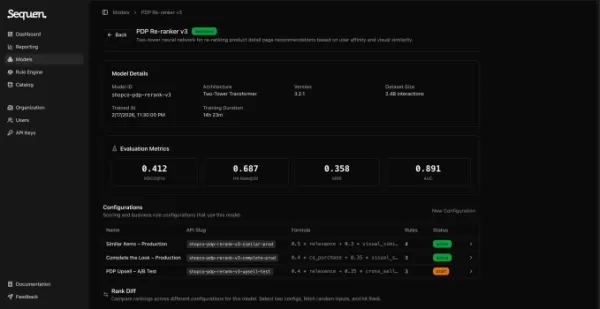
Image Credits:Sequen
Despite its privacy-forward design, Sequen delivers significant revenue growth. Weil highlights a large furniture company that saw a 7% revenue lift after switching, compared to a typical 0.4% gain. Fetch Rewards achieved a 20% net revenue increase in under 11 days. The startup is also partnering with a streaming media firm and an online travel agency.
Pricing is based on requests per second (RPS), with tiers offering up to 500 or 1,000 RPS and volume discounts. Initial contracts with the first five customers are valued in the seven figures.
“Customers consistently choose the highest tier because, once they see results in one area, they want to deploy us across their entire platform,” Weil observes.
Weil began her career in research but shifted to product development, helping companies build ranking systems to generate business value. This experience paved the way for founding Sequen.
In less than 18 months, Sequen has processed approximately 10 billion monthly requests and secured contracts with several Fortune 500 companies. The company offers proprietary technology, including large event models, ranking algorithms, and more.
Weil is joined by Ethan Benjamin, a former Etsy colleague, and co-founders Mo Afsharr and Alexander Thom. Raphael Louca, formerly of Meta, recently joined as Chief Product Officer. The 14-person New York-based team includes talent from DeepMind, Meta, and Anthropic.
Sequen’s Series A was co-led by White Star Capital and Threshold Ventures, with participation from prior investors like Greycroft, which led the seed round. Total funding to date stands at $22 million.
Related article
 How Cloudflare Tools Secure Autonomous AI Payments
Cloudflare Tools secure autonomous AI payments to tackle what PSE Consulting’s Andrew O’Connor calls one of the biggest barriers to market adoptionSafeguarding web infrastructure is transforming as organisations search for reliable frameworks to depl
Cohere’s Joëlle Pineau on Sovereign AI and Enterprise Security
IDC research commissioned by Cohere explores sovereign AI, with Chief AI Officer Joëlle Pineau outlining essential strategies for enterprise cloud security and data governance.According to IDC’s report, The State of Sovereign AI Adoption in 2026, com
How AI and Robotics Are Transforming bp’s Oil Production
Digital twin technology enables bp to simulate energy asset operations, identifying improvement opportunities and predicting failures before they occur. Credit: bpRicky Burns, Transformation & Technology Manager at bp, explains how digital tools help
Related Special Topic Recommendations
writing
How Cloudflare Tools Secure Autonomous AI Payments
Cloudflare Tools secure autonomous AI payments to tackle what PSE Consulting’s Andrew O’Connor calls one of the biggest barriers to market adoptionSafeguarding web infrastructure is transforming as organisations search for reliable frameworks to depl
Cohere’s Joëlle Pineau on Sovereign AI and Enterprise Security
IDC research commissioned by Cohere explores sovereign AI, with Chief AI Officer Joëlle Pineau outlining essential strategies for enterprise cloud security and data governance.According to IDC’s report, The State of Sovereign AI Adoption in 2026, com
How AI and Robotics Are Transforming bp’s Oil Production
Digital twin technology enables bp to simulate energy asset operations, identifying improvement opportunities and predicting failures before they occur. Credit: bpRicky Burns, Transformation & Technology Manager at bp, explains how digital tools help
Related Special Topic Recommendations
writing
 Best AI Writing Assistants for Long Articles: Outline and Draft Faster
2026 Latest Best AI Writing Assistants for Long Articles: Outline and Draft Faster. XIX.AI curates the top-rated, must-try tools that offer powerful, game-changing support to boost writing efficiency significantly. You’ll find detailed free vs paid comparison, real-world tests, and updated rankings weekly. Explore now to Discover your perfect tool and Start creating today to Unlock your AI edge.
 8 tools
 xix.ai
Education and Learning
ChatGPT Study Tools for Exam Revision, Flashcards, and Homework Explanations
xix.ai
Education and Learning
ChatGPT Study Tools for Exam Revision, Flashcards, and Homework Explanations
2026 Latest Best ChatGPT Study Tools for Exam Revision, Flashcards, and Homework Explanations! XIX.AI has curated a top-rated list of powerful game-changing tools designed to boost your productivity. These must-try solutions offer free vs paid comparison, real-world tests, and detailed rankings to help you find the perfect option for efficient exam preparation and homework support. Explore now to unlock your AI edge!
10 tools
xix.ai
Education and Learning
AI Study Planner Tools for Exam Preparation
2026 Latest Best Top-Rated AI Study Planner Tools for Exam Preparation are here on XIX.AI! This curated collection features powerful, game-changing tools that help you streamline your review process, boost focus, and create personalized study schedules. We conduct real-world tests to determine the top options, offering a free vs paid comparison along with weekly updated rankings. Must-try solutions designed to maximize your productivity and help you ace every exam. Explore now to find your perfect tool!
14 tools
xix.ai
SEO
Best AI Keyword Gap Tools for Organic Growth
2026 Latest Best Top-rated AI Keyword Gap Tools for Organic Growth! XIX.AI has carefully curated a powerful, game-changing collection of the best tools available, featuring weekly updated rankings and real-world tests. You can find a detailed free vs paid comparison to help you choose the perfect option that boosts your content creation efficiency and unlocks your AI edge. Explore now!
8 tools
xix.ai
SEO
AI Internal Link Tools for Better Site Structure
2026 Latest Best Top-Rated AI Internal Link Tools for Better Site Structure are here on XIX.AI! This curated collection features powerful, game-changing solutions that go through real-world tests to deliver superior results. Get a free vs paid comparison, see rankings, and discover must-try options to boost your site’s SEO performance and streamline content organization. Explore now to unlock your AI edge!
11 tools
xix.ai
Productivity
Best AI Note Organizing Tools for Daily Work
2026 Latest Best Top-rated AI Note Organizing Tools for Daily Work are here on XIX.AI! This curated list features powerful, game-changing solutions that help boost productivity significantly through real-world tests and rigorous rankings. You’ll find a detailed free vs paid comparison to help you choose the perfect fit for your needs. Explore now to Discover your perfect tool and Unlock your AI edge in daily tasks!
11 tools
xix.ai

 Comments (0)
0/500
Comments (0)
0/500
Zoë Weil drove a billion-dollar surge in gross merchandise volume at Etsy in one year by optimizing AI ranking systems. Now, with Sequen, she and her co-founders are applying their extensive AI research and product expertise to empower consumer businesses.
Having secured $16 million in Series A funding, Sequen provides real-time personalization and ranking infrastructure. This technology, previously accessible only to tech giants due to their massive datasets, is now available to other large consumer enterprises.
While the general public may not grasp the technical details, anyone who has used apps like TikTok, Instagram, or YouTube has experienced these systems firsthand.
Sequen CEO Zoë Weil explains, “Modern tech no longer just recommends content; it subtly shapes your desires over time. The algorithms are so advanced that many users suspect platforms are eavesdropping on their conversations,” she notes.
Weil attributes this capability to Large Event Models. Unlike Large Language Models (LLMs) that process text, Large Event Models analyze streams of events and human behavior, offering applications beyond mere algorithmic improvement.
Image Credits:Sequen
Weil envisions Sequen eventually replacing cookies—a tracking method that raises privacy concerns and faces regulation—by offering a more ethical alternative for personalizing web experiences.
“Our large event models learn from live user actions, including hovers and conversations within a session, rather than relying on static profiles or third-party cookies,” Weil states. “This enables real-time personalization even with sparse data. We’re not just unlocking TikTok’s algorithms for Fortune 500 companies lacking the infrastructure; we’re advancing the technology further,” she adds.
Sequen clients integrate with the RankTune platform via APIs, accessing frontier and real-time ranking models. Since most customers already use in-house APIs for relevance, they simply swap them for Sequen’s solution.
Unlike cookies, Sequen’s technology is less privacy-invasive because it relies on real-time data without needing user identity. It also delivers sub-20 millisecond decision-making speeds.
“Our large event models generalize real-time event streams regardless of who performs them,” Weil explains. “They understand and interpret events without relying on user identity, making personalization completely identity-agnostic.”
Image Credits:Sequen
Despite its privacy-forward design, Sequen delivers significant revenue growth. Weil highlights a large furniture company that saw a 7% revenue lift after switching, compared to a typical 0.4% gain. Fetch Rewards achieved a 20% net revenue increase in under 11 days. The startup is also partnering with a streaming media firm and an online travel agency.
Pricing is based on requests per second (RPS), with tiers offering up to 500 or 1,000 RPS and volume discounts. Initial contracts with the first five customers are valued in the seven figures.
“Customers consistently choose the highest tier because, once they see results in one area, they want to deploy us across their entire platform,” Weil observes.
Weil began her career in research but shifted to product development, helping companies build ranking systems to generate business value. This experience paved the way for founding Sequen.
In less than 18 months, Sequen has processed approximately 10 billion monthly requests and secured contracts with several Fortune 500 companies. The company offers proprietary technology, including large event models, ranking algorithms, and more.
Weil is joined by Ethan Benjamin, a former Etsy colleague, and co-founders Mo Afsharr and Alexander Thom. Raphael Louca, formerly of Meta, recently joined as Chief Product Officer. The 14-person New York-based team includes talent from DeepMind, Meta, and Anthropic.
Sequen’s Series A was co-led by White Star Capital and Threshold Ventures, with participation from prior investors like Greycroft, which led the seed round. Total funding to date stands at $22 million.








 How Cloudflare Tools Secure Autonomous AI Payments
Cloudflare Tools secure autonomous AI payments to tackle what PSE Consulting’s Andrew O’Connor calls one of the biggest barriers to market adoptionSafeguarding web infrastructure is transforming as organisations search for reliable frameworks to depl
How Cloudflare Tools Secure Autonomous AI Payments
Cloudflare Tools secure autonomous AI payments to tackle what PSE Consulting’s Andrew O’Connor calls one of the biggest barriers to market adoptionSafeguarding web infrastructure is transforming as organisations search for reliable frameworks to depl
 Cohere’s Joëlle Pineau on Sovereign AI and Enterprise Security
IDC research commissioned by Cohere explores sovereign AI, with Chief AI Officer Joëlle Pineau outlining essential strategies for enterprise cloud security and data governance.According to IDC’s report, The State of Sovereign AI Adoption in 2026, com
Cohere’s Joëlle Pineau on Sovereign AI and Enterprise Security
IDC research commissioned by Cohere explores sovereign AI, with Chief AI Officer Joëlle Pineau outlining essential strategies for enterprise cloud security and data governance.According to IDC’s report, The State of Sovereign AI Adoption in 2026, com
 How AI and Robotics Are Transforming bp’s Oil Production
Digital twin technology enables bp to simulate energy asset operations, identifying improvement opportunities and predicting failures before they occur. Credit: bpRicky Burns, Transformation & Technology Manager at bp, explains how digital tools help
How AI and Robotics Are Transforming bp’s Oil Production
Digital twin technology enables bp to simulate energy asset operations, identifying improvement opportunities and predicting failures before they occur. Credit: bpRicky Burns, Transformation & Technology Manager at bp, explains how digital tools help

2026 Latest Best AI Writing Assistants for Long Articles: Outline and Draft Faster. XIX.AI curates the top-rated, must-try tools that offer powerful, game-changing support to boost writing efficiency significantly. You’ll find detailed free vs paid comparison, real-world tests, and updated rankings weekly. Explore now to Discover your perfect tool and Start creating today to Unlock your AI edge.
8 tools
xix.ai

2026 Latest Best ChatGPT Study Tools for Exam Revision, Flashcards, and Homework Explanations! XIX.AI has curated a top-rated list of powerful game-changing tools designed to boost your productivity. These must-try solutions offer free vs paid comparison, real-world tests, and detailed rankings to help you find the perfect option for efficient exam preparation and homework support. Explore now to unlock your AI edge!
10 tools
xix.ai

2026 Latest Best Top-Rated AI Study Planner Tools for Exam Preparation are here on XIX.AI! This curated collection features powerful, game-changing tools that help you streamline your review process, boost focus, and create personalized study schedules. We conduct real-world tests to determine the top options, offering a free vs paid comparison along with weekly updated rankings. Must-try solutions designed to maximize your productivity and help you ace every exam. Explore now to find your perfect tool!
14 tools
xix.ai

2026 Latest Best Top-rated AI Keyword Gap Tools for Organic Growth! XIX.AI has carefully curated a powerful, game-changing collection of the best tools available, featuring weekly updated rankings and real-world tests. You can find a detailed free vs paid comparison to help you choose the perfect option that boosts your content creation efficiency and unlocks your AI edge. Explore now!
8 tools
xix.ai

2026 Latest Best Top-Rated AI Internal Link Tools for Better Site Structure are here on XIX.AI! This curated collection features powerful, game-changing solutions that go through real-world tests to deliver superior results. Get a free vs paid comparison, see rankings, and discover must-try options to boost your site’s SEO performance and streamline content organization. Explore now to unlock your AI edge!
11 tools
xix.ai

2026 Latest Best Top-rated AI Note Organizing Tools for Daily Work are here on XIX.AI! This curated list features powerful, game-changing solutions that help boost productivity significantly through real-world tests and rigorous rankings. You’ll find a detailed free vs paid comparison to help you choose the perfect fit for your needs. Explore now to Discover your perfect tool and Unlock your AI edge in daily tasks!
11 tools
xix.ai












