


 Home
HomePerplexity Unveils Freemium 'Deep Research' Feature in New Product Launch
Perplexity has joined the race of AI-powered research tools with the launch of its new feature on Friday.
Google introduced a comparable capability for its Gemini AI platform back in December, followed by OpenAI's research agent earlier this month. Interestingly, all three companies have branded their offerings under the same name: Deep Research.
These tools aim to deliver thoroughly researched answers with proper citations for professional applications, moving beyond typical consumer chatbot responses. In its announcement, Perplexity highlighted that Deep Research "handles advanced tasks across fields like finance, marketing, and product research with expert precision."
Perplexity Deep Research is currently accessible via the web, with plans to extend it to Mac, iOS, and Android apps soon. To activate it, users simply choose "Deep Research" from a drop-down menu when entering a query. The tool then compiles a comprehensive report, which can be exported as a PDF or shared as a Perplexity Page.
According to Perplexity, Deep Research works by "iteratively searching, reviewing documents, and refining its research strategy as it gathers more information"—a process designed to mimic human research behavior.
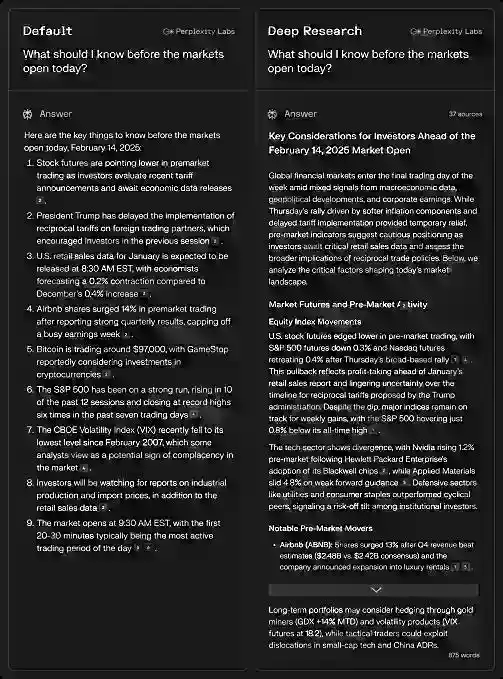
Image: PerplexityImage Credits: Perplexity The company also emphasized its performance on Humanity’s Last Exam, a challenging AI benchmark that tests expertise across various academic disciplines. Perplexity's Deep Research scored 21.1%, significantly outperforming models like Gemini Thinking (6.2%), Grok-2 (3.8%), and GPT-4o (3.3%), though it fell short of OpenAI’s Deep Research, which scored 26.6%.
While OpenAI currently limits its Deep Research feature to Pro subscribers at $200 per month, Perplexity offers its version for free—non-subscribers get a limited number of daily queries, while paying users enjoy unlimited access.
Perplexity's tool also operates faster, typically completing tasks in under three minutes, compared to OpenAI’s version which can take anywhere from 5 to 30 minutes.
When asked to compare the different deep research offerings, Perplexity provided an analysis covering technology, pricing, and performance across various use cases and subjects, referencing articles about each tool. It summarized the distinctions as follows:
- Perplexity AI stands out for speed and ease of use, ideal for casual researchers
- OpenAI leads in analytical rigor, making it suitable for enterprise applications
- Google offers the most seamless integration with existing productivity tools
It remains to be seen how these tools will reshape everyday and professional research as adoption grows. However, The Economist recently pointed out potential drawbacks in OpenAI’s Deep Research that may also apply here: limitations in creative data interpretation, reliance on readily available sources, and the broader concern that over-reliance on AI research assistants could stifle human innovation and breakthrough thinking.
Related article
 Stripe to Acquire OpenRouter as AI Model Routing Gains Momentum
Stripe has agreed to acquire OpenRouter, an AI model-routing platform that gives developers access to hundreds of models through a single interface. The deal adds model selection and routing to Stripe’s existing work around AI usage and token-based b
Former OpenAI Researcher Barrett Zoph Returns to Google to Support Gemini Development
Barret Zoph, who previously abruptly left and joined OpenAI due to a disagreement with Thinking Machines Lab CEO Miriam Mularati, has once again changed employers. Alphabet's Google announced that Zoph will return as Vice President of Research, bring
How Recursive Intelligence Raised $335M at $4B Valuation in 4 Months
The co-founders of startup Ricursive Intelligence seemed destined to be co-founders.Anna Goldie, CEO, and Azalia Mirhoseini, CTO, are so well-known in the AI community that they were among those AI engineers who “got those weird emails from Zuckerber
Related Special Topic Recommendations
Design & Art
Stripe to Acquire OpenRouter as AI Model Routing Gains Momentum
Stripe has agreed to acquire OpenRouter, an AI model-routing platform that gives developers access to hundreds of models through a single interface. The deal adds model selection and routing to Stripe’s existing work around AI usage and token-based b
Former OpenAI Researcher Barrett Zoph Returns to Google to Support Gemini Development
Barret Zoph, who previously abruptly left and joined OpenAI due to a disagreement with Thinking Machines Lab CEO Miriam Mularati, has once again changed employers. Alphabet's Google announced that Zoph will return as Vice President of Research, bring
How Recursive Intelligence Raised $335M at $4B Valuation in 4 Months
The co-founders of startup Ricursive Intelligence seemed destined to be co-founders.Anna Goldie, CEO, and Azalia Mirhoseini, CTO, are so well-known in the AI community that they were among those AI engineers who “got those weird emails from Zuckerber
Related Special Topic Recommendations
Design & Art
 Top AI Illustration Tools: Create Editorial Scenes and Cover Art Faster
2026 Latest Top-rated AI Illustration Tools: Our curated list features the best powerfully designed tools for creating stunning editorial scenes and eye-catching cover art quickly. Each option has gone through rigorous real-world tests, offering a free vs paid comparison to help you find the perfect match for your workflow. Try these must-try solutions today to unlock your AI edge and boost your creative productivity. Explore now at XIX.AI.
 10 tools
 xix.ai
Education and Learning
Top AI Tutors for Exam Prep: Practice Math, Science, and English
xix.ai
Education and Learning
Top AI Tutors for Exam Prep: Practice Math, Science, and English
2026 Latest Top-Rated Best AI Tutors for Exam Prep are here on XIX.AI! Our curated list features powerful game-changing tools that offer free vs paid comparison, real-world tests, and weekly updated rankings. They help boost your writing efficiency, simplify complex topic learning, and unlock your academic potential. Explore now to Discover your perfect exam prep tool and Start creating today to Unlock your AI edge!
10 tools
xix.ai
Finance
AI Budget Planning Tools for Personal Money Management
2026 Latest Best Top-Rated AI Budget Planning Tools for Personal Money Management are here on XIX.AI! This curated collection features powerful, game-changing solutions that help you conduct real-world tests, understand spending habits, and create personalized plans to boost productivity. Enjoy a free vs paid comparison along with detailed rankings. Must-try tools designed to simplify money management and unlock your AI edge. Explore now!
11 tools
xix.ai
Health & Wellness
AI Sleep Tracking Assistants: Improve Recovery with Better Bedtime Habits
2026 Latest Best Top-Rated AI Sleep Tracking Assistants curated for ultimate recovery. This fully updated weekly guide features powerful tools that deliver real-world tests, free vs paid comparison, and detailed rankings to help you find the must-try solution that boosts sleep quality and supports better bedtime habits. Explore now at XIX.AI to Unlock your AI edge.
10 tools
xix.ai
Data Analysis
AI SQL Copilots for Product and Revenue Analytics
2026 Latest Best Top-Rated AI SQL Copilots for Product and Revenue Analytics! XIX.AI has curated a powerful, game-changing collection of must-try tools that undergo real-world tests through weekly updated rankings. These tools help users boost productivity significantly by accelerating data analysis, streamlining complex queries, and generating accurate insights to drive smarter business decisions. Explore now to Discover your perfect tool for unlocking your AI edge!
14 tools
xix.ai
Education and Learning
Best AI Homework Helpers That Teach: Learn Concepts, Not Just Answers
2026 Latest Best Top-Rated AI Homework Helpers That Teach Core Concepts Not Just Answers Powerful Tools for Students Must-Try Curated List Weekly Updated Free vs Paid Comparison Real-World Tests Accurate Rankings to Help You Unlock Your Full Learning Potential Explore now to Discover your perfect tool for smarter studying.
10 tools
xix.ai

 Comments (1)
0/500
Comments (1)
0/500
![WillieClark]()
又来了个‘深度研究’,各家AI工具卷得飞起,但免费版能有多深?别又是挂羊头卖狗肉吧😂 上次Google的Gemini吹得天花乱坠,结果用起来也就那样。Perplexity这波操作,怕不是想靠免费吸引流量,然后偷偷塞付费墙🤔 不过有竞争总是好事,至少逼着OpenAI也赶紧迭代吧。
Perplexity has joined the race of AI-powered research tools with the launch of its new feature on Friday.
Google introduced a comparable capability for its Gemini AI platform back in December, followed by OpenAI's research agent earlier this month. Interestingly, all three companies have branded their offerings under the same name: Deep Research.
These tools aim to deliver thoroughly researched answers with proper citations for professional applications, moving beyond typical consumer chatbot responses. In its announcement, Perplexity highlighted that Deep Research "handles advanced tasks across fields like finance, marketing, and product research with expert precision."
Perplexity Deep Research is currently accessible via the web, with plans to extend it to Mac, iOS, and Android apps soon. To activate it, users simply choose "Deep Research" from a drop-down menu when entering a query. The tool then compiles a comprehensive report, which can be exported as a PDF or shared as a Perplexity Page.
According to Perplexity, Deep Research works by "iteratively searching, reviewing documents, and refining its research strategy as it gathers more information"—a process designed to mimic human research behavior.
The company also emphasized its performance on Humanity’s Last Exam, a challenging AI benchmark that tests expertise across various academic disciplines. Perplexity's Deep Research scored 21.1%, significantly outperforming models like Gemini Thinking (6.2%), Grok-2 (3.8%), and GPT-4o (3.3%), though it fell short of OpenAI’s Deep Research, which scored 26.6%.
While OpenAI currently limits its Deep Research feature to Pro subscribers at $200 per month, Perplexity offers its version for free—non-subscribers get a limited number of daily queries, while paying users enjoy unlimited access.
Perplexity's tool also operates faster, typically completing tasks in under three minutes, compared to OpenAI’s version which can take anywhere from 5 to 30 minutes.
When asked to compare the different deep research offerings, Perplexity provided an analysis covering technology, pricing, and performance across various use cases and subjects, referencing articles about each tool. It summarized the distinctions as follows:
- Perplexity AI stands out for speed and ease of use, ideal for casual researchers
- OpenAI leads in analytical rigor, making it suitable for enterprise applications
- Google offers the most seamless integration with existing productivity tools
It remains to be seen how these tools will reshape everyday and professional research as adoption grows. However, The Economist recently pointed out potential drawbacks in OpenAI’s Deep Research that may also apply here: limitations in creative data interpretation, reliance on readily available sources, and the broader concern that over-reliance on AI research assistants could stifle human innovation and breakthrough thinking.








 Stripe to Acquire OpenRouter as AI Model Routing Gains Momentum
Stripe has agreed to acquire OpenRouter, an AI model-routing platform that gives developers access to hundreds of models through a single interface. The deal adds model selection and routing to Stripe’s existing work around AI usage and token-based b
Stripe to Acquire OpenRouter as AI Model Routing Gains Momentum
Stripe has agreed to acquire OpenRouter, an AI model-routing platform that gives developers access to hundreds of models through a single interface. The deal adds model selection and routing to Stripe’s existing work around AI usage and token-based b
 Former OpenAI Researcher Barrett Zoph Returns to Google to Support Gemini Development
Barret Zoph, who previously abruptly left and joined OpenAI due to a disagreement with Thinking Machines Lab CEO Miriam Mularati, has once again changed employers. Alphabet's Google announced that Zoph will return as Vice President of Research, bring
Former OpenAI Researcher Barrett Zoph Returns to Google to Support Gemini Development
Barret Zoph, who previously abruptly left and joined OpenAI due to a disagreement with Thinking Machines Lab CEO Miriam Mularati, has once again changed employers. Alphabet's Google announced that Zoph will return as Vice President of Research, bring
 How Recursive Intelligence Raised $335M at $4B Valuation in 4 Months
The co-founders of startup Ricursive Intelligence seemed destined to be co-founders.Anna Goldie, CEO, and Azalia Mirhoseini, CTO, are so well-known in the AI community that they were among those AI engineers who “got those weird emails from Zuckerber
How Recursive Intelligence Raised $335M at $4B Valuation in 4 Months
The co-founders of startup Ricursive Intelligence seemed destined to be co-founders.Anna Goldie, CEO, and Azalia Mirhoseini, CTO, are so well-known in the AI community that they were among those AI engineers who “got those weird emails from Zuckerber

2026 Latest Top-rated AI Illustration Tools: Our curated list features the best powerfully designed tools for creating stunning editorial scenes and eye-catching cover art quickly. Each option has gone through rigorous real-world tests, offering a free vs paid comparison to help you find the perfect match for your workflow. Try these must-try solutions today to unlock your AI edge and boost your creative productivity. Explore now at XIX.AI.
10 tools
xix.ai

2026 Latest Top-Rated Best AI Tutors for Exam Prep are here on XIX.AI! Our curated list features powerful game-changing tools that offer free vs paid comparison, real-world tests, and weekly updated rankings. They help boost your writing efficiency, simplify complex topic learning, and unlock your academic potential. Explore now to Discover your perfect exam prep tool and Start creating today to Unlock your AI edge!
10 tools
xix.ai

2026 Latest Best Top-Rated AI Budget Planning Tools for Personal Money Management are here on XIX.AI! This curated collection features powerful, game-changing solutions that help you conduct real-world tests, understand spending habits, and create personalized plans to boost productivity. Enjoy a free vs paid comparison along with detailed rankings. Must-try tools designed to simplify money management and unlock your AI edge. Explore now!
11 tools
xix.ai

2026 Latest Best Top-Rated AI Sleep Tracking Assistants curated for ultimate recovery. This fully updated weekly guide features powerful tools that deliver real-world tests, free vs paid comparison, and detailed rankings to help you find the must-try solution that boosts sleep quality and supports better bedtime habits. Explore now at XIX.AI to Unlock your AI edge.
10 tools
xix.ai

2026 Latest Best Top-Rated AI SQL Copilots for Product and Revenue Analytics! XIX.AI has curated a powerful, game-changing collection of must-try tools that undergo real-world tests through weekly updated rankings. These tools help users boost productivity significantly by accelerating data analysis, streamlining complex queries, and generating accurate insights to drive smarter business decisions. Explore now to Discover your perfect tool for unlocking your AI edge!
14 tools
xix.ai

2026 Latest Best Top-Rated AI Homework Helpers That Teach Core Concepts Not Just Answers Powerful Tools for Students Must-Try Curated List Weekly Updated Free vs Paid Comparison Real-World Tests Accurate Rankings to Help You Unlock Your Full Learning Potential Explore now to Discover your perfect tool for smarter studying.
10 tools
xix.ai

又来了个‘深度研究’,各家AI工具卷得飞起,但免费版能有多深?别又是挂羊头卖狗肉吧😂 上次Google的Gemini吹得天花乱坠,结果用起来也就那样。Perplexity这波操作,怕不是想靠免费吸引流量,然后偷偷塞付费墙🤔 不过有竞争总是好事,至少逼着OpenAI也赶紧迭代吧。












