


 Home
HomeGPT-5 Launches, Unveiling OpenAI's Next-Generation AI Model
OpenAI has introduced GPT-5, its new flagship AI model that will drive the next generation of ChatGPT.
Released on Thursday, GPT-5 is OpenAI’s first unified AI model, blending the reasoning strengths of its o-series models with the rapid responses of the GPT line. This next-generation model marks a new chapter for ChatGPT and OpenAI, highlighting the company’s ambition to build AI systems that behave more like proactive agents than reactive chatbots.
Where GPT-4 enabled AI chatbots to provide intelligent answers across a wide range of topics, GPT-5 empowers ChatGPT to perform tasks on a user’s behalf—such as developing software applications, managing schedules, or compiling research briefs.
OpenAI has also focused on making ChatGPT easier to use with GPT-5. Instead of requiring users to adjust settings, the model includes a real-time router that determines the best way to respond—whether it's answering quickly or taking extra time to reason through an answer.
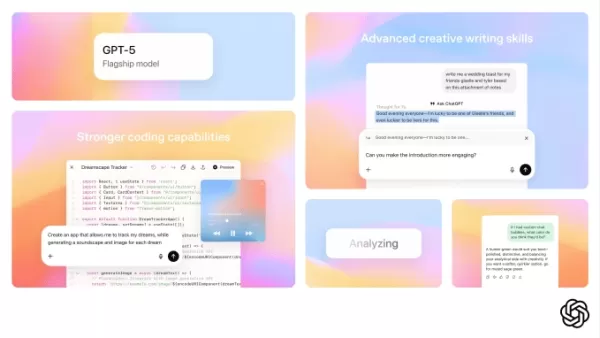
Image Credits: OpenAI In a briefing with reporters, OpenAI CEO Sam Altman described GPT-5 as “the world’s best model,” calling it a “major step” toward developing AI that can outperform humans in most economically valuable work—also known as artificial general intelligence (AGI).
Altman added, “A tool like GPT-5 would have been nearly inconceivable at any other point in history.”
Starting Thursday, GPT-5 will be the default model for all free ChatGPT users. According to OpenAI’s VP of ChatGPT, Nick Turley, this move grants free users access to an AI reasoning model for the first time. (Previously, such advanced models were reserved for paying subscribers.)
“This is one of the ways we're bringing our mission to life—ensuring these advancements truly benefit everyone,” Turley commented, referring to OpenAI’s commitment to making cutting-edge AI widely accessible.
Techcrunch eventTop Tech and VC Leaders Join the Disrupt 2025 Agenda
Netflix, ElevenLabs, Wayve, and Sequoia Capital are among the influential names joining the Disrupt 2025 agenda. They’ll share key insights to help startups grow and stay competitive. Don’t miss the 20th anniversary of TechCrunch Disrupt—an opportunity to learn from tech’s leading voices. Secure your ticket now and save up to $675 before prices increase on August 7.
Top Tech and VC Leaders Join the Disrupt 2025 Agenda
Netflix, ElevenLabs, Wayve, and Sequoia Capital are among the influential names joining the Disrupt 2025 agenda. They’ll share key insights to help startups grow and stay competitive. Don’t miss the 20th anniversary of TechCrunch Disrupt—an opportunity to learn from tech’s leading voices. Secure your ticket now and save up to $675 before prices increase.
San Francisco|October 27-29, 2025REGISTER NOWExpectations for GPT-5 are exceptionally high, marking one of OpenAI’s most anticipated launches since ChatGPT catapulted the company to prominence in 2022. Since then, ChatGPT has become one of the world’s most widely used consumer products, now reaching over 700 million users each week—nearly 10% of the global population, according to the company.
Many view GPT-5 as a bellwether for broader AI progress, and its reception in Silicon Valley could significantly impact Big Tech, Wall Street, and tech policymakers. Stakeholders are watching to see if GPT-5 delivers a substantial leap in AI capability, much like its predecessor GPT-4, which redefined what software can accomplish.
GPT-5 Holds a Narrow Lead Over Competitors
OpenAI claims GPT-5 sets a new standard in several areas, slightly outperforming leading models from Anthropic, Google DeepMind, and Elon Musk’s xAI on key benchmarks—though it falls marginally short in others.
The company highlights GPT-5’s exceptional coding ability; Altman noted the model excels at generating full software applications on demand, a capability often referred to as “vibe coding.”
On SWE-bench Verified—a test based on real-world coding tasks from GitHub—GPT-5 scored 74.9% on its first try. This places it just ahead of Anthropic’s Claude Opus 4.1 (74.5%) and Google DeepMind’s Gemini 2.5 Pro (59.6%).
On Humanity’s Last Exam—a rigorous assessment spanning math, humanities, and sciences—the extended reasoning version of GPT-5 (GPT-5 Pro) scored 42% with tool use. That’s slightly below xAI’s Grok 4 Heavy, which achieved 44.4%.
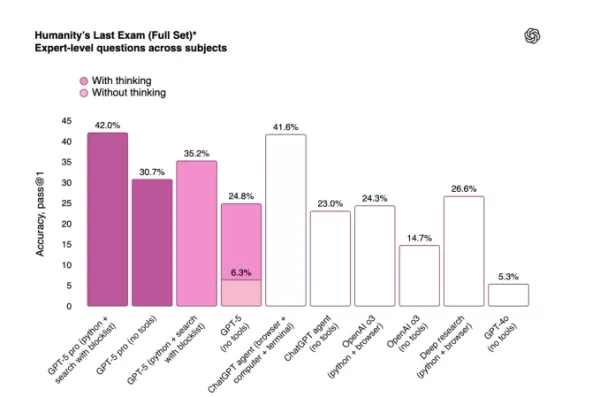
Image Credits: OpenAI On GPQA Diamond, a benchmark of PhD-level science questions, GPT-5 Pro scored 89.4% on its first attempt—outperforming Claude Opus 4.1 (80.9%) and Grok 4 Heavy (88.9%).
OpenAI also reports that GPT-5 performs better on health-related inquiries. On HealthBench Hard Hallucinations, which measures accuracy in healthcare responses, GPT-5 (with thinking) hallucinated only 1.6% of the time—far lower than GPT-4o (12.9%) and o3 (15.8%).
Although AI chatbots are not medical professionals, millions of people turn to them for health advice. In response, OpenAI says GPT-5 is more proactive in flagging potential health issues and helping users interpret medical information.
Additionally, GPT-5 excels in more subjective areas like creative design and writing. Turley noted that GPT-5 responds more naturally and displays “better taste” in creative tasks than rival models.
“This model has really good vibes,” Turley remarked.
GPT-5 is also more accurate than OpenAI’s earlier models and suffers fewer hallucinations—the tendency to invent information. Hallucination rates had been increasing in recent reasoning models like o3, a trend OpenAI previously struggled to explain.
In response tests, GPT-5 (with thinking) provided incorrect information 4.8% of the time—a notable improvement over o3 (22%) and GPT-4o (20.6%).
On Tau-bench, which measures AI agents’ ability to complete simulated online tasks, GPT-5 delivered mixed results. It scored 63.5% on airline website navigation (slightly below o3’s 64.8%) and 81.1% on retail site navigation (below Claude Opus 4.1’s 82.4%).
OpenAI also emphasizes that GPT-5 is safer than its predecessors. While reasoning models can sometimes exhibit deceptive behavior, GPT-5 demonstrated lower rates of deception, contributing to a more trustworthy user experience.
Safety research lead Alex Beutel noted that reducing deception not only improves safety but also makes the model more “transparent and honest in ways users can rely on.”
Beutel added that GPT-5 is better at distinguishing between malicious misuse and harmless requests, resulting in more appropriate refusals for unsafe queries and fewer unnecessary rejections for benign ones.
New Features for Consumers and Developers
Alongside the GPT-5 release, ChatGPT is receiving several user experience upgrades. Users can now choose from four new response styles in the settings: Cynic, Robot, Listener, and Nerd. These adjust ChatGPT’s tone without requiring explicit instruction.
ChatGPT Plus subscribers ($20/month) receive higher usage limits for GPT-5, while Pro subscribers ($200/month) get unlimited access plus GPT-5 Pro—an enhanced version that uses extra compute for better answers. Team, Edu, and Enterprise customers will get GPT-5 as their default model starting next week.
For developers, GPT-5 will be available via OpenAI’s API in three sizes—gpt-5, gpt-5-mini, and gpt-5-nano—which vary in reasoning depth. The API now also includes a verbosity control, allowing developers to set desired response length.
The base GPT-5 model costs $1.25 per million input tokens (roughly 750,000 words) and $10 per million output tokens.
GPT-5’s launch follows a busy period for OpenAI. The company recently released gpt-oss, a free, open-weight reasoning model that nearly matched earlier top models like o3 and o4-mini. However, GPT-5 establishes a new benchmark in areas like coding.
Still, GPT-5 remains competitive rather than dominant across many benchmarks. Real-world performance and developer adoption will ultimately determine whether it truly stands above rival models.
Related article
 PHP Armageddon: OpenAI, Google’s Wiz uncover ancient holes, sparking internet panic
The U.S. National Security Agency issued a critical alert on Wednesday regarding two severe vulnerabilities in PHP, for which patches have already been released by the PHP Foundation.As a server-side scripting language, PHP powers approximately 70% o
Google AI Overviews Gain Ground in Search Results
According to Similarweb’s 2026 Generative AI Landscape report, Google’s AI-generated summaries appeared in 43% of US searches, a significant rise from 15% recorded a year prior.While AI Overviews present generated summaries within standard search res
OpenAI launches GPT-5.5 Instant as ChatGPT’s new default model
OpenAI launched GPT-5.5 Instant on Monday, replacing GPT-5.3 Instant as the default ChatGPT model. The company states that this update minimizes hallucinations in high-stakes fields like law, medicine, and finance, while preserving the fast response
Related Special Topic Recommendations
Design & Art
PHP Armageddon: OpenAI, Google’s Wiz uncover ancient holes, sparking internet panic
The U.S. National Security Agency issued a critical alert on Wednesday regarding two severe vulnerabilities in PHP, for which patches have already been released by the PHP Foundation.As a server-side scripting language, PHP powers approximately 70% o
Google AI Overviews Gain Ground in Search Results
According to Similarweb’s 2026 Generative AI Landscape report, Google’s AI-generated summaries appeared in 43% of US searches, a significant rise from 15% recorded a year prior.While AI Overviews present generated summaries within standard search res
OpenAI launches GPT-5.5 Instant as ChatGPT’s new default model
OpenAI launched GPT-5.5 Instant on Monday, replacing GPT-5.3 Instant as the default ChatGPT model. The company states that this update minimizes hallucinations in high-stakes fields like law, medicine, and finance, while preserving the fast response
Related Special Topic Recommendations
Design & Art
 Top AI Illustration Tools: Create Editorial Scenes and Cover Art Faster
2026 Latest Top-rated AI Illustration Tools: Our curated list features the best powerfully designed tools for creating stunning editorial scenes and eye-catching cover art quickly. Each option has gone through rigorous real-world tests, offering a free vs paid comparison to help you find the perfect match for your workflow. Try these must-try solutions today to unlock your AI edge and boost your creative productivity. Explore now at XIX.AI.
 10 tools
 xix.ai
Education and Learning
Top AI Tutors for Exam Prep: Practice Math, Science, and English
xix.ai
Education and Learning
Top AI Tutors for Exam Prep: Practice Math, Science, and English
2026 Latest Top-Rated Best AI Tutors for Exam Prep are here on XIX.AI! Our curated list features powerful game-changing tools that offer free vs paid comparison, real-world tests, and weekly updated rankings. They help boost your writing efficiency, simplify complex topic learning, and unlock your academic potential. Explore now to Discover your perfect exam prep tool and Start creating today to Unlock your AI edge!
10 tools
xix.ai
Finance
AI Budget Planning Tools for Personal Money Management
2026 Latest Best Top-Rated AI Budget Planning Tools for Personal Money Management are here on XIX.AI! This curated collection features powerful, game-changing solutions that help you conduct real-world tests, understand spending habits, and create personalized plans to boost productivity. Enjoy a free vs paid comparison along with detailed rankings. Must-try tools designed to simplify money management and unlock your AI edge. Explore now!
11 tools
xix.ai
Health & Wellness
AI Sleep Tracking Assistants: Improve Recovery with Better Bedtime Habits
2026 Latest Best Top-Rated AI Sleep Tracking Assistants curated for ultimate recovery. This fully updated weekly guide features powerful tools that deliver real-world tests, free vs paid comparison, and detailed rankings to help you find the must-try solution that boosts sleep quality and supports better bedtime habits. Explore now at XIX.AI to Unlock your AI edge.
10 tools
xix.ai
Data Analysis
AI SQL Copilots for Product and Revenue Analytics
2026 Latest Best Top-Rated AI SQL Copilots for Product and Revenue Analytics! XIX.AI has curated a powerful, game-changing collection of must-try tools that undergo real-world tests through weekly updated rankings. These tools help users boost productivity significantly by accelerating data analysis, streamlining complex queries, and generating accurate insights to drive smarter business decisions. Explore now to Discover your perfect tool for unlocking your AI edge!
14 tools
xix.ai
Education and Learning
Best AI Homework Helpers That Teach: Learn Concepts, Not Just Answers
2026 Latest Best Top-Rated AI Homework Helpers That Teach Core Concepts Not Just Answers Powerful Tools for Students Must-Try Curated List Weekly Updated Free vs Paid Comparison Real-World Tests Accurate Rankings to Help You Unlock Your Full Learning Potential Explore now to Discover your perfect tool for smarter studying.
10 tools
xix.ai

 Comments (1)
0/500
Comments (1)
0/500
![FrankTaylor]()
So GPT-5 is finally here? I'm curious if it can actually tell the difference between a joke and a serious statement this time around 😅
OpenAI has introduced GPT-5, its new flagship AI model that will drive the next generation of ChatGPT.
Released on Thursday, GPT-5 is OpenAI’s first unified AI model, blending the reasoning strengths of its o-series models with the rapid responses of the GPT line. This next-generation model marks a new chapter for ChatGPT and OpenAI, highlighting the company’s ambition to build AI systems that behave more like proactive agents than reactive chatbots.
Where GPT-4 enabled AI chatbots to provide intelligent answers across a wide range of topics, GPT-5 empowers ChatGPT to perform tasks on a user’s behalf—such as developing software applications, managing schedules, or compiling research briefs.
OpenAI has also focused on making ChatGPT easier to use with GPT-5. Instead of requiring users to adjust settings, the model includes a real-time router that determines the best way to respond—whether it's answering quickly or taking extra time to reason through an answer.
In a briefing with reporters, OpenAI CEO Sam Altman described GPT-5 as “the world’s best model,” calling it a “major step” toward developing AI that can outperform humans in most economically valuable work—also known as artificial general intelligence (AGI).
Altman added, “A tool like GPT-5 would have been nearly inconceivable at any other point in history.”
Starting Thursday, GPT-5 will be the default model for all free ChatGPT users. According to OpenAI’s VP of ChatGPT, Nick Turley, this move grants free users access to an AI reasoning model for the first time. (Previously, such advanced models were reserved for paying subscribers.)
“This is one of the ways we're bringing our mission to life—ensuring these advancements truly benefit everyone,” Turley commented, referring to OpenAI’s commitment to making cutting-edge AI widely accessible.
Techcrunch eventTop Tech and VC Leaders Join the Disrupt 2025 Agenda
Netflix, ElevenLabs, Wayve, and Sequoia Capital are among the influential names joining the Disrupt 2025 agenda. They’ll share key insights to help startups grow and stay competitive. Don’t miss the 20th anniversary of TechCrunch Disrupt—an opportunity to learn from tech’s leading voices. Secure your ticket now and save up to $675 before prices increase on August 7.
Top Tech and VC Leaders Join the Disrupt 2025 Agenda
Netflix, ElevenLabs, Wayve, and Sequoia Capital are among the influential names joining the Disrupt 2025 agenda. They’ll share key insights to help startups grow and stay competitive. Don’t miss the 20th anniversary of TechCrunch Disrupt—an opportunity to learn from tech’s leading voices. Secure your ticket now and save up to $675 before prices increase.
San Francisco|October 27-29, 2025REGISTER NOWExpectations for GPT-5 are exceptionally high, marking one of OpenAI’s most anticipated launches since ChatGPT catapulted the company to prominence in 2022. Since then, ChatGPT has become one of the world’s most widely used consumer products, now reaching over 700 million users each week—nearly 10% of the global population, according to the company.
Many view GPT-5 as a bellwether for broader AI progress, and its reception in Silicon Valley could significantly impact Big Tech, Wall Street, and tech policymakers. Stakeholders are watching to see if GPT-5 delivers a substantial leap in AI capability, much like its predecessor GPT-4, which redefined what software can accomplish.
GPT-5 Holds a Narrow Lead Over Competitors
OpenAI claims GPT-5 sets a new standard in several areas, slightly outperforming leading models from Anthropic, Google DeepMind, and Elon Musk’s xAI on key benchmarks—though it falls marginally short in others.
The company highlights GPT-5’s exceptional coding ability; Altman noted the model excels at generating full software applications on demand, a capability often referred to as “vibe coding.”
On SWE-bench Verified—a test based on real-world coding tasks from GitHub—GPT-5 scored 74.9% on its first try. This places it just ahead of Anthropic’s Claude Opus 4.1 (74.5%) and Google DeepMind’s Gemini 2.5 Pro (59.6%).
On Humanity’s Last Exam—a rigorous assessment spanning math, humanities, and sciences—the extended reasoning version of GPT-5 (GPT-5 Pro) scored 42% with tool use. That’s slightly below xAI’s Grok 4 Heavy, which achieved 44.4%.
On GPQA Diamond, a benchmark of PhD-level science questions, GPT-5 Pro scored 89.4% on its first attempt—outperforming Claude Opus 4.1 (80.9%) and Grok 4 Heavy (88.9%).
OpenAI also reports that GPT-5 performs better on health-related inquiries. On HealthBench Hard Hallucinations, which measures accuracy in healthcare responses, GPT-5 (with thinking) hallucinated only 1.6% of the time—far lower than GPT-4o (12.9%) and o3 (15.8%).
Although AI chatbots are not medical professionals, millions of people turn to them for health advice. In response, OpenAI says GPT-5 is more proactive in flagging potential health issues and helping users interpret medical information.
Additionally, GPT-5 excels in more subjective areas like creative design and writing. Turley noted that GPT-5 responds more naturally and displays “better taste” in creative tasks than rival models.
“This model has really good vibes,” Turley remarked.
GPT-5 is also more accurate than OpenAI’s earlier models and suffers fewer hallucinations—the tendency to invent information. Hallucination rates had been increasing in recent reasoning models like o3, a trend OpenAI previously struggled to explain.
In response tests, GPT-5 (with thinking) provided incorrect information 4.8% of the time—a notable improvement over o3 (22%) and GPT-4o (20.6%).
On Tau-bench, which measures AI agents’ ability to complete simulated online tasks, GPT-5 delivered mixed results. It scored 63.5% on airline website navigation (slightly below o3’s 64.8%) and 81.1% on retail site navigation (below Claude Opus 4.1’s 82.4%).
OpenAI also emphasizes that GPT-5 is safer than its predecessors. While reasoning models can sometimes exhibit deceptive behavior, GPT-5 demonstrated lower rates of deception, contributing to a more trustworthy user experience.
Safety research lead Alex Beutel noted that reducing deception not only improves safety but also makes the model more “transparent and honest in ways users can rely on.”
Beutel added that GPT-5 is better at distinguishing between malicious misuse and harmless requests, resulting in more appropriate refusals for unsafe queries and fewer unnecessary rejections for benign ones.
New Features for Consumers and Developers
Alongside the GPT-5 release, ChatGPT is receiving several user experience upgrades. Users can now choose from four new response styles in the settings: Cynic, Robot, Listener, and Nerd. These adjust ChatGPT’s tone without requiring explicit instruction.
ChatGPT Plus subscribers ($20/month) receive higher usage limits for GPT-5, while Pro subscribers ($200/month) get unlimited access plus GPT-5 Pro—an enhanced version that uses extra compute for better answers. Team, Edu, and Enterprise customers will get GPT-5 as their default model starting next week.
For developers, GPT-5 will be available via OpenAI’s API in three sizes—gpt-5, gpt-5-mini, and gpt-5-nano—which vary in reasoning depth. The API now also includes a verbosity control, allowing developers to set desired response length.
The base GPT-5 model costs $1.25 per million input tokens (roughly 750,000 words) and $10 per million output tokens.
GPT-5’s launch follows a busy period for OpenAI. The company recently released gpt-oss, a free, open-weight reasoning model that nearly matched earlier top models like o3 and o4-mini. However, GPT-5 establishes a new benchmark in areas like coding.
Still, GPT-5 remains competitive rather than dominant across many benchmarks. Real-world performance and developer adoption will ultimately determine whether it truly stands above rival models.








 PHP Armageddon: OpenAI, Google’s Wiz uncover ancient holes, sparking internet panic
The U.S. National Security Agency issued a critical alert on Wednesday regarding two severe vulnerabilities in PHP, for which patches have already been released by the PHP Foundation.As a server-side scripting language, PHP powers approximately 70% o
PHP Armageddon: OpenAI, Google’s Wiz uncover ancient holes, sparking internet panic
The U.S. National Security Agency issued a critical alert on Wednesday regarding two severe vulnerabilities in PHP, for which patches have already been released by the PHP Foundation.As a server-side scripting language, PHP powers approximately 70% o
 Google AI Overviews Gain Ground in Search Results
According to Similarweb’s 2026 Generative AI Landscape report, Google’s AI-generated summaries appeared in 43% of US searches, a significant rise from 15% recorded a year prior.While AI Overviews present generated summaries within standard search res
Google AI Overviews Gain Ground in Search Results
According to Similarweb’s 2026 Generative AI Landscape report, Google’s AI-generated summaries appeared in 43% of US searches, a significant rise from 15% recorded a year prior.While AI Overviews present generated summaries within standard search res
 OpenAI launches GPT-5.5 Instant as ChatGPT’s new default model
OpenAI launched GPT-5.5 Instant on Monday, replacing GPT-5.3 Instant as the default ChatGPT model. The company states that this update minimizes hallucinations in high-stakes fields like law, medicine, and finance, while preserving the fast response
OpenAI launches GPT-5.5 Instant as ChatGPT’s new default model
OpenAI launched GPT-5.5 Instant on Monday, replacing GPT-5.3 Instant as the default ChatGPT model. The company states that this update minimizes hallucinations in high-stakes fields like law, medicine, and finance, while preserving the fast response

2026 Latest Top-rated AI Illustration Tools: Our curated list features the best powerfully designed tools for creating stunning editorial scenes and eye-catching cover art quickly. Each option has gone through rigorous real-world tests, offering a free vs paid comparison to help you find the perfect match for your workflow. Try these must-try solutions today to unlock your AI edge and boost your creative productivity. Explore now at XIX.AI.
10 tools
xix.ai

2026 Latest Top-Rated Best AI Tutors for Exam Prep are here on XIX.AI! Our curated list features powerful game-changing tools that offer free vs paid comparison, real-world tests, and weekly updated rankings. They help boost your writing efficiency, simplify complex topic learning, and unlock your academic potential. Explore now to Discover your perfect exam prep tool and Start creating today to Unlock your AI edge!
10 tools
xix.ai

2026 Latest Best Top-Rated AI Budget Planning Tools for Personal Money Management are here on XIX.AI! This curated collection features powerful, game-changing solutions that help you conduct real-world tests, understand spending habits, and create personalized plans to boost productivity. Enjoy a free vs paid comparison along with detailed rankings. Must-try tools designed to simplify money management and unlock your AI edge. Explore now!
11 tools
xix.ai

2026 Latest Best Top-Rated AI Sleep Tracking Assistants curated for ultimate recovery. This fully updated weekly guide features powerful tools that deliver real-world tests, free vs paid comparison, and detailed rankings to help you find the must-try solution that boosts sleep quality and supports better bedtime habits. Explore now at XIX.AI to Unlock your AI edge.
10 tools
xix.ai

2026 Latest Best Top-Rated AI SQL Copilots for Product and Revenue Analytics! XIX.AI has curated a powerful, game-changing collection of must-try tools that undergo real-world tests through weekly updated rankings. These tools help users boost productivity significantly by accelerating data analysis, streamlining complex queries, and generating accurate insights to drive smarter business decisions. Explore now to Discover your perfect tool for unlocking your AI edge!
14 tools
xix.ai

2026 Latest Best Top-Rated AI Homework Helpers That Teach Core Concepts Not Just Answers Powerful Tools for Students Must-Try Curated List Weekly Updated Free vs Paid Comparison Real-World Tests Accurate Rankings to Help You Unlock Your Full Learning Potential Explore now to Discover your perfect tool for smarter studying.
10 tools
xix.ai

So GPT-5 is finally here? I'm curious if it can actually tell the difference between a joke and a serious statement this time around 😅












