


 Home
HomeOpenAI upgrades Codex AI assistant with six new role plugins
Artificial intelligence applications worldwide are accelerating their expansion from software development into nearly every industry. OpenAI, the AI leader, has officially announced a major update to its core AI agent assistant, Codex, introducing six new job-specific plugins at once. This upgrade encompasses 62 commonly used applications and 110 professional skills in depth, marking a disruptive broadening of the tool's use cases.
As OpenAI's most representative agent product, Codex originally focused mainly on helping programmers with coding tasks. Now, its ecosystem has experienced explosive growth, with weekly active users surpassing 5 million. Notably, non-developer users now account for roughly 20% of the total user base, and their growth rate is more than three times faster than that of traditional developers. These rapidly emerging new users come from diverse fields such as data analysis, marketing, operations, design, research, investment banking, and investing. To meet this trend, OpenAI has precisely launched exclusive plugin packs tailored to six mainstream job roles: data analysis, creative production, sales, product design, public stock investment, and investment banking. These packs bundle job-specific applications, skills, and workflows into one-click solutions.
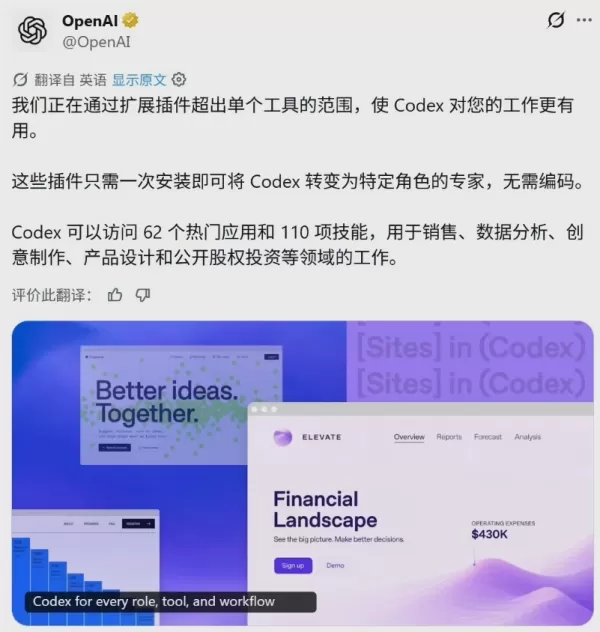
In terms of specific features, the new plugins deliver productivity-level improvements for different job roles. For example, the data analysis plugin integrates seamlessly with mainstream databases and industry tools like Snowflake, Databricks Genie, Hex, and Tableau, enabling teams to query business data directly, interpret metric changes, and generate visual dashboards with one click. The creative production plugin is designed specifically for marketing teams, quickly turning dry briefs into diverse ad variations, campaign boards, product promotional images, or lifestyle illustrations. Additionally, the system offers preview capabilities for building interactive websites and applications aimed at commercial and enterprise users. Team members can simply access a unique URL to view project boards or lightweight tool progress in a shared virtual workspace, provide real-time feedback, and make decisions.
To make AI intervention more precise, Codex has also expanded its refined "annotation editing" feature for documents, spreadsheets, and presentations. Whether in navigation bars of interactive websites, core statements in investment arguments, or complex chart labels in slides, users can directly select specific text, allowing Codex to "edit where it points." This enables micro-adjustments only at designated spots, completely eliminating the inefficient mode of large-scale rewriting. These underlying restructures will undoubtedly further accelerate the widespread adoption of enterprise-level AI productivity tools.
Related article
 DeepMind CEO Hassabis: I sleep six hours a day, usually feel energetic around 1 a.m.
Fortune recently featured an interview with Demis Hassabis, CEO of Google DeepMind, revealing his unconventional approach to rest and productivity. Hassabis disclosed that he sleeps very little, structuring his waking hours into two distinct work blo
OpenAI, Anthropic Vie for Market Share Despite Revenue Shortfalls
Despite recent reports suggesting OpenAI missed revenue targets, creating pressure on tech stocks this Tuesday, private AI lab investors remain resilient. Seasoned backers have confirmed they will not reduce investment despite negative media coverage
California AV Compliance: A New Era of Tickets, Geofences, and 1M Miles
Guident operates an AuveTech shuttle in South Florida, managing a four-mile route in West Palm Beach and a one-mile route in Boca Raton using its remote monitoring technology. | Credit: GuidentCalifornia is redefining the regulatory landscape for dri
Related Special Topic Recommendations
Video creation
DeepMind CEO Hassabis: I sleep six hours a day, usually feel energetic around 1 a.m.
Fortune recently featured an interview with Demis Hassabis, CEO of Google DeepMind, revealing his unconventional approach to rest and productivity. Hassabis disclosed that he sleeps very little, structuring his waking hours into two distinct work blo
OpenAI, Anthropic Vie for Market Share Despite Revenue Shortfalls
Despite recent reports suggesting OpenAI missed revenue targets, creating pressure on tech stocks this Tuesday, private AI lab investors remain resilient. Seasoned backers have confirmed they will not reduce investment despite negative media coverage
California AV Compliance: A New Era of Tickets, Geofences, and 1M Miles
Guident operates an AuveTech shuttle in South Florida, managing a four-mile route in West Palm Beach and a one-mile route in Boca Raton using its remote monitoring technology. | Credit: GuidentCalifornia is redefining the regulatory landscape for dri
Related Special Topic Recommendations
Video creation
 AI Short-Form Video Hook Generators for Reels, Shorts, and Product Launch Campaigns
2026 Latest Best AI Short-Form Video Hook Generators for Reels Shorts and Product Launch Campaigns! XIX.AI curates top-rated powerful game-changing tools that deliver must-try results through real-world tests. This weekly updated page offers free vs paid comparison rankings to help you find the perfect solution for boosting content creativity and productivity. Explore now to Unlock your AI edge!
 11 tools
 xix.ai
writing
AI Article Outline Tools for Long Form Writing
xix.ai
writing
AI Article Outline Tools for Long Form Writing
2026 Latest Best Top-Rated AI Article Outline Tools for Long Form Writing! This curated collection features powerful, game-changing tools that deliver accurate, structured outlines with real-world tests to boost writing efficiency significantly. XIX.AI is part of this elite selection. Get a free vs paid comparison to help you choose the perfect tool. Explore now and Unlock your AI edge!
9 tools
xix.ai
chatbot
Best AI Roleplay Chat Apps for Language Practice, Interview Prep, and Daily Fluency
2026 Latest Best Top-rated AI Roleplay Chat Apps for Language Practice, Interview Prep, and Daily Fluency! XIX.AI curates a powerful game-changing collection that offers free vs paid comparison, real-world tests, and updated rankings weekly. These must-try tools help you boost writing skills, overcome fluency challenges, and improve communication efficiency across all daily scenarios. Explore now to discover your perfect tool for language growth!
10 tools
xix.ai
Music composition
AI Stem Separation Tools for Remix Production, Sampling Prep, and Karaoke Masters
2026 Latest Best Top-rated AI Stem Separation Tools Curated for Remix Production, Sampling Prep, and Karaoke Masters. These powerful game-changing tools offer real-world tests to deliver precise audio isolation, boosting productivity significantly. XIX.AI provides a weekly updated free vs paid comparison guide to help you find the must-try solution that suits your needs. Explore now to unlock your AI edge.
8 tools
xix.ai
Data Analysis
AI SQL Copilots for Revenue Dashboards, Funnel Analysis, and Product Metrics
2026 Latest Best AI SQL Copilots Ranked Top-Rated! XIX.AI curates a powerful game-changing collection for weekly updated real-world tests. These must-try tools help you generate accurate revenue dashboards, analyze sales funnels, and track product metrics swiftly, boosting productivity massively. Explore now to Discover your perfect tool for data-driven decision making! 238 characters
9 tools
xix.ai
Music composition
Best AI Melody Writing Tools for Song Drafts
2026 Latest Best Top-Rated AI Melody Writing Tools for Song Drafts! XIX.AI has curated a highly powerful game-changing collection that goes through rigorous real-world tests to deliver the best writing experience. You can find detailed free vs paid comparisons, accurate rankings, and must-try options designed to help you create stunning song drafts effortlessly and boost your creative productivity significantly. Explore now to discover your perfect tool!
8 tools
xix.ai

 Comments (0)
0/500
Comments (0)
0/500
Artificial intelligence applications worldwide are accelerating their expansion from software development into nearly every industry. OpenAI, the AI leader, has officially announced a major update to its core AI agent assistant, Codex, introducing six new job-specific plugins at once. This upgrade encompasses 62 commonly used applications and 110 professional skills in depth, marking a disruptive broadening of the tool's use cases.
As OpenAI's most representative agent product, Codex originally focused mainly on helping programmers with coding tasks. Now, its ecosystem has experienced explosive growth, with weekly active users surpassing 5 million. Notably, non-developer users now account for roughly 20% of the total user base, and their growth rate is more than three times faster than that of traditional developers. These rapidly emerging new users come from diverse fields such as data analysis, marketing, operations, design, research, investment banking, and investing. To meet this trend, OpenAI has precisely launched exclusive plugin packs tailored to six mainstream job roles: data analysis, creative production, sales, product design, public stock investment, and investment banking. These packs bundle job-specific applications, skills, and workflows into one-click solutions.
In terms of specific features, the new plugins deliver productivity-level improvements for different job roles. For example, the data analysis plugin integrates seamlessly with mainstream databases and industry tools like Snowflake, Databricks Genie, Hex, and Tableau, enabling teams to query business data directly, interpret metric changes, and generate visual dashboards with one click. The creative production plugin is designed specifically for marketing teams, quickly turning dry briefs into diverse ad variations, campaign boards, product promotional images, or lifestyle illustrations. Additionally, the system offers preview capabilities for building interactive websites and applications aimed at commercial and enterprise users. Team members can simply access a unique URL to view project boards or lightweight tool progress in a shared virtual workspace, provide real-time feedback, and make decisions.
To make AI intervention more precise, Codex has also expanded its refined "annotation editing" feature for documents, spreadsheets, and presentations. Whether in navigation bars of interactive websites, core statements in investment arguments, or complex chart labels in slides, users can directly select specific text, allowing Codex to "edit where it points." This enables micro-adjustments only at designated spots, completely eliminating the inefficient mode of large-scale rewriting. These underlying restructures will undoubtedly further accelerate the widespread adoption of enterprise-level AI productivity tools.








 DeepMind CEO Hassabis: I sleep six hours a day, usually feel energetic around 1 a.m.
Fortune recently featured an interview with Demis Hassabis, CEO of Google DeepMind, revealing his unconventional approach to rest and productivity. Hassabis disclosed that he sleeps very little, structuring his waking hours into two distinct work blo
DeepMind CEO Hassabis: I sleep six hours a day, usually feel energetic around 1 a.m.
Fortune recently featured an interview with Demis Hassabis, CEO of Google DeepMind, revealing his unconventional approach to rest and productivity. Hassabis disclosed that he sleeps very little, structuring his waking hours into two distinct work blo
 OpenAI, Anthropic Vie for Market Share Despite Revenue Shortfalls
Despite recent reports suggesting OpenAI missed revenue targets, creating pressure on tech stocks this Tuesday, private AI lab investors remain resilient. Seasoned backers have confirmed they will not reduce investment despite negative media coverage
California AV Compliance: A New Era of Tickets, Geofences, and 1M Miles
Guident operates an AuveTech shuttle in South Florida, managing a four-mile route in West Palm Beach and a one-mile route in Boca Raton using its remote monitoring technology. | Credit: GuidentCalifornia is redefining the regulatory landscape for dri
OpenAI, Anthropic Vie for Market Share Despite Revenue Shortfalls
Despite recent reports suggesting OpenAI missed revenue targets, creating pressure on tech stocks this Tuesday, private AI lab investors remain resilient. Seasoned backers have confirmed they will not reduce investment despite negative media coverage
California AV Compliance: A New Era of Tickets, Geofences, and 1M Miles
Guident operates an AuveTech shuttle in South Florida, managing a four-mile route in West Palm Beach and a one-mile route in Boca Raton using its remote monitoring technology. | Credit: GuidentCalifornia is redefining the regulatory landscape for dri

2026 Latest Best AI Short-Form Video Hook Generators for Reels Shorts and Product Launch Campaigns! XIX.AI curates top-rated powerful game-changing tools that deliver must-try results through real-world tests. This weekly updated page offers free vs paid comparison rankings to help you find the perfect solution for boosting content creativity and productivity. Explore now to Unlock your AI edge!
11 tools
xix.ai

2026 Latest Best Top-Rated AI Article Outline Tools for Long Form Writing! This curated collection features powerful, game-changing tools that deliver accurate, structured outlines with real-world tests to boost writing efficiency significantly. XIX.AI is part of this elite selection. Get a free vs paid comparison to help you choose the perfect tool. Explore now and Unlock your AI edge!
9 tools
xix.ai

2026 Latest Best Top-rated AI Roleplay Chat Apps for Language Practice, Interview Prep, and Daily Fluency! XIX.AI curates a powerful game-changing collection that offers free vs paid comparison, real-world tests, and updated rankings weekly. These must-try tools help you boost writing skills, overcome fluency challenges, and improve communication efficiency across all daily scenarios. Explore now to discover your perfect tool for language growth!
10 tools
xix.ai
2026 Latest Best Top-rated AI Stem Separation Tools Curated for Remix Production, Sampling Prep, and Karaoke Masters. These powerful game-changing tools offer real-world tests to deliver precise audio isolation, boosting productivity significantly. XIX.AI provides a weekly updated free vs paid comparison guide to help you find the must-try solution that suits your needs. Explore now to unlock your AI edge.
8 tools
xix.ai

2026 Latest Best AI SQL Copilots Ranked Top-Rated! XIX.AI curates a powerful game-changing collection for weekly updated real-world tests. These must-try tools help you generate accurate revenue dashboards, analyze sales funnels, and track product metrics swiftly, boosting productivity massively. Explore now to Discover your perfect tool for data-driven decision making! 238 characters
9 tools
xix.ai

2026 Latest Best Top-Rated AI Melody Writing Tools for Song Drafts! XIX.AI has curated a highly powerful game-changing collection that goes through rigorous real-world tests to deliver the best writing experience. You can find detailed free vs paid comparisons, accurate rankings, and must-try options designed to help you create stunning song drafts effortlessly and boost your creative productivity significantly. Explore now to discover your perfect tool!
8 tools
xix.ai












