


 Home
Home
OpenAI Launches Math and AI Advisory Group; Mysterious Model Solves 100 World-Class Problems in 24 Days

On September 22, OpenAI announced the formation of an "Advisory Group on Mathematics and Artificial Intelligence." Headquartered at the Institute for Advanced Study in Princeton, this independent body comprises nine mathematicians who operate separately from OpenAI.
More notably, OpenAI revealed that a mysterious model, training since August 28, has successfully resolved over 100 longstanding open problems across various mathematical disciplines, including the controversial Navier-Stokes Millennium Prize Problem.
Mathematicians express astonishment at the rapid progress, sparking internal debate on academic disclosure
OpenAI noted that the model's mathematical advancements have surprised its internal team, prompting discussions on the most appropriate method for informing the broader academic community.
Recognizing mathematics as a foundational science, OpenAI acknowledged that AI-driven discoveries could have widespread applications. Consequently, the company is adopting a cautious approach to developing and deploying these capabilities, currently exploring broader implementation strategies.
This follows an open letter by prominent mathematicians Terence Tao, Yu Deng, Peter Scholze, and others, who raised concerns about using the solution of open mathematical problems as a benchmark for new AI systems. OpenAI stated that these perspectives highlight the need for more thorough engagement with the mathematical community.
Advisory group features three Fields Medal winners and operates without compensation from OpenAI
OpenAI clarified that the advisory group functions independently, retaining the right to offer unsolicited advice, publicly comment on OpenAI's impact on mathematics, and independently adjust its membership. Members are unpaid, though the group does not influence the pace of OpenAI's internal mathematical research.
The founding members include François Charles (École Normale Supérieure, ENS-PSL), Camillo De Lellis (Institute for Advanced Study, Gran Sasso Science Institute), Timothy Gowers (Collège de France, University of Cambridge), Martin Hairer (École Polytechnique Fédérale de Lausanne, Imperial College London), Nikhil Srivastava (Berkeley, Simons Institute), Ulrike Tillmann (University of Oxford, INI), Ravi Vakil (Stanford University), Edward Witten (IAS), and Melanie Matchett Wood (Harvard University). Among them, Gowers, Hairer, and Witten are Fields Medalists; Camillo De Lellis is also a signatory of the aforementioned open letter.
The advisory group will advise on the review and dissemination of emerging results, assist OpenAI in assessing the significance of findings, and provide opinions on academic standards in mathematical research. Additionally, it will recommend how OpenAI's tools can better support mathematical research and education.
Related article
 Anthropic Confirms Claude Account Hacked After Users Lose Access
Multiple Claude users have recently reported on social media that their account quotas were being depleted rapidly without any active usage. Anthropic’s investigation revealed that hackers gained unauthorized access to user accounts by stealing login
Senspeech X2.5 Twin Stars: First Million-Token Context on the Edge, Fully Trained with Domestic Computing Power
On September 1st, iFLYTEK’s wholly-owned subsidiary, Ciyuan Xinghuo, officially launched and open-sourced two edge-side general large models: Xinghuo X2.5-4B and Xinghuo X2.5-1.7B. These models are the first of their kind to natively support a contex
Meitun LongCat Launches LoHoSearch as BrowseComp Scores Drop Below 30%
Search agent capabilities have been largely defined by BrowseComp over the last year. Yet, this benchmark is losing its relevance — it drove model performance from 30% to 90% in just ten months, and its value is rapidly diminishing. On July 17, Meitu
Related Special Topic Recommendations
writing
Anthropic Confirms Claude Account Hacked After Users Lose Access
Multiple Claude users have recently reported on social media that their account quotas were being depleted rapidly without any active usage. Anthropic’s investigation revealed that hackers gained unauthorized access to user accounts by stealing login
Senspeech X2.5 Twin Stars: First Million-Token Context on the Edge, Fully Trained with Domestic Computing Power
On September 1st, iFLYTEK’s wholly-owned subsidiary, Ciyuan Xinghuo, officially launched and open-sourced two edge-side general large models: Xinghuo X2.5-4B and Xinghuo X2.5-1.7B. These models are the first of their kind to natively support a contex
Meitun LongCat Launches LoHoSearch as BrowseComp Scores Drop Below 30%
Search agent capabilities have been largely defined by BrowseComp over the last year. Yet, this benchmark is losing its relevance — it drove model performance from 30% to 90% in just ten months, and its value is rapidly diminishing. On July 17, Meitu
Related Special Topic Recommendations
writing
 AI Rewrite Tools for Business Writing: Make Dense Copy Clearer
2026 Latest Best Top-rated AI Rewrite Tools for Business Writing are here on XIX.AI! This curated list features powerful, game-changing tools that undergo real-world tests to make dense copy clearer and boost writing efficiency. Get a free vs paid comparison and see which option suits your needs. Explore now to discover your perfect tool and unlock your AI edge in business communication.
 13 tools
 xix.ai
Music composition
AI Songwriting Tools for Lyrics and Melody Ideas
xix.ai
Music composition
AI Songwriting Tools for Lyrics and Melody Ideas
2026 Latest Best Top-Rated AI Songwriting Tools for Lyrics and Melody Ideas are here on XIX.AI! This curated collection features powerful, game-changing options that go through rigorous real-world tests to deliver accurate lyric and melody suggestions. Get a free vs paid comparison, see detailed rankings, and discover must-try tools that can boost your creative workflow significantly. Explore now to find the perfect fit for your needs!
8 tools
xix.ai
Health & Wellness
ChatGPT Meal Planning Apps for Macro Tracking, Grocery Lists, and Weekly Prep
2026 Latest Best ChatGPT Meal Planning Apps Top-rated must-try curated powerful game-changing tools for macro tracking grocery lists and weekly prep. XIX.AI delivers weekly updated rankings based on real-world tests, including free vs paid comparison details. Discover your perfect tool to boost productivity and unlock your AI edge today. Explore now!
9 tools
xix.ai
Video creation
AI Video Script Tools for Short Form Content
2026 Latest Best Top-Rated AI Video Script Tools for Short Form Content! XIX.AI has curated a powerful, game-changing collection of must-try tools that go through rigorous real-world tests. You’ll find detailed weekly updated rankings, free vs paid comparison info, and insights to help you boost productivity and unlock your AI edge in creating high-quality short form content. Explore now to discover your perfect tool!
10 tools
xix.ai
Comic Creation
AI Comic Panel Tools for Storyboard Style Narratives
2026 Latest Best AI Comic Panel Tools for Storyboard Style Narratives! This curated top-rated collection features powerful game-changing solutions that help creators boost writing efficiency and overcome creation bottlenecks. You’ll find detailed free vs paid comparison, real-world tests, and official rankings to guide your pick. XIX.AI offers expert insights too. Explore now to Discover your perfect tool for bringing vivid stories to life! 238 characters
9 tools
xix.ai
Video creation
Best AI Video Generation Tools for Short Content
2026 Latest Best Top-rated AI Video Generation Tools for Short Content are here on XIX.AI’s curated collection. These powerful game-changing tools have undergone rigorous real-world tests, featuring a comprehensive free vs paid comparison and detailed rankings to help you find the perfect option. Whether you need to create high-quality short videos fast or boost your productivity across various tasks, these must-try solutions deliver outstanding results. Explore now to discover your ideal tool and unlock your AI edge.
9 tools
xix.ai

 Comments (0)
0/500
Comments (0)
0/500
On September 22, OpenAI announced the formation of an "Advisory Group on Mathematics and Artificial Intelligence." Headquartered at the Institute for Advanced Study in Princeton, this independent body comprises nine mathematicians who operate separately from OpenAI.
More notably, OpenAI revealed that a mysterious model, training since August 28, has successfully resolved over 100 longstanding open problems across various mathematical disciplines, including the controversial Navier-Stokes Millennium Prize Problem.
Mathematicians express astonishment at the rapid progress, sparking internal debate on academic disclosure
OpenAI noted that the model's mathematical advancements have surprised its internal team, prompting discussions on the most appropriate method for informing the broader academic community.
Recognizing mathematics as a foundational science, OpenAI acknowledged that AI-driven discoveries could have widespread applications. Consequently, the company is adopting a cautious approach to developing and deploying these capabilities, currently exploring broader implementation strategies.
This follows an open letter by prominent mathematicians Terence Tao, Yu Deng, Peter Scholze, and others, who raised concerns about using the solution of open mathematical problems as a benchmark for new AI systems. OpenAI stated that these perspectives highlight the need for more thorough engagement with the mathematical community.
Advisory group features three Fields Medal winners and operates without compensation from OpenAI
OpenAI clarified that the advisory group functions independently, retaining the right to offer unsolicited advice, publicly comment on OpenAI's impact on mathematics, and independently adjust its membership. Members are unpaid, though the group does not influence the pace of OpenAI's internal mathematical research.
The founding members include François Charles (École Normale Supérieure, ENS-PSL), Camillo De Lellis (Institute for Advanced Study, Gran Sasso Science Institute), Timothy Gowers (Collège de France, University of Cambridge), Martin Hairer (École Polytechnique Fédérale de Lausanne, Imperial College London), Nikhil Srivastava (Berkeley, Simons Institute), Ulrike Tillmann (University of Oxford, INI), Ravi Vakil (Stanford University), Edward Witten (IAS), and Melanie Matchett Wood (Harvard University). Among them, Gowers, Hairer, and Witten are Fields Medalists; Camillo De Lellis is also a signatory of the aforementioned open letter.
The advisory group will advise on the review and dissemination of emerging results, assist OpenAI in assessing the significance of findings, and provide opinions on academic standards in mathematical research. Additionally, it will recommend how OpenAI's tools can better support mathematical research and education.








 Anthropic Confirms Claude Account Hacked After Users Lose Access
Multiple Claude users have recently reported on social media that their account quotas were being depleted rapidly without any active usage. Anthropic’s investigation revealed that hackers gained unauthorized access to user accounts by stealing login
Anthropic Confirms Claude Account Hacked After Users Lose Access
Multiple Claude users have recently reported on social media that their account quotas were being depleted rapidly without any active usage. Anthropic’s investigation revealed that hackers gained unauthorized access to user accounts by stealing login
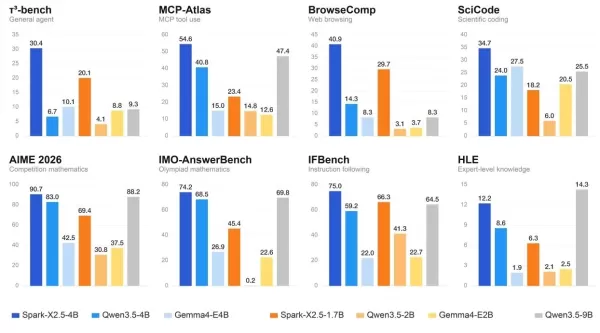 Senspeech X2.5 Twin Stars: First Million-Token Context on the Edge, Fully Trained with Domestic Computing Power
On September 1st, iFLYTEK’s wholly-owned subsidiary, Ciyuan Xinghuo, officially launched and open-sourced two edge-side general large models: Xinghuo X2.5-4B and Xinghuo X2.5-1.7B. These models are the first of their kind to natively support a contex
Senspeech X2.5 Twin Stars: First Million-Token Context on the Edge, Fully Trained with Domestic Computing Power
On September 1st, iFLYTEK’s wholly-owned subsidiary, Ciyuan Xinghuo, officially launched and open-sourced two edge-side general large models: Xinghuo X2.5-4B and Xinghuo X2.5-1.7B. These models are the first of their kind to natively support a contex
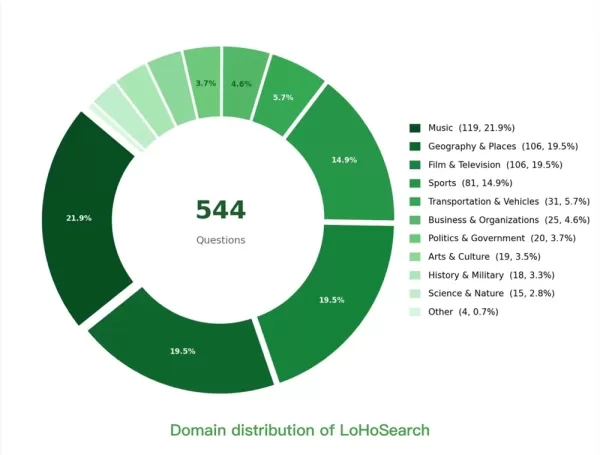 Meitun LongCat Launches LoHoSearch as BrowseComp Scores Drop Below 30%
Search agent capabilities have been largely defined by BrowseComp over the last year. Yet, this benchmark is losing its relevance — it drove model performance from 30% to 90% in just ten months, and its value is rapidly diminishing. On July 17, Meitu
Meitun LongCat Launches LoHoSearch as BrowseComp Scores Drop Below 30%
Search agent capabilities have been largely defined by BrowseComp over the last year. Yet, this benchmark is losing its relevance — it drove model performance from 30% to 90% in just ten months, and its value is rapidly diminishing. On July 17, Meitu

2026 Latest Best Top-rated AI Rewrite Tools for Business Writing are here on XIX.AI! This curated list features powerful, game-changing tools that undergo real-world tests to make dense copy clearer and boost writing efficiency. Get a free vs paid comparison and see which option suits your needs. Explore now to discover your perfect tool and unlock your AI edge in business communication.
13 tools
xix.ai

2026 Latest Best Top-Rated AI Songwriting Tools for Lyrics and Melody Ideas are here on XIX.AI! This curated collection features powerful, game-changing options that go through rigorous real-world tests to deliver accurate lyric and melody suggestions. Get a free vs paid comparison, see detailed rankings, and discover must-try tools that can boost your creative workflow significantly. Explore now to find the perfect fit for your needs!
8 tools
xix.ai

2026 Latest Best ChatGPT Meal Planning Apps Top-rated must-try curated powerful game-changing tools for macro tracking grocery lists and weekly prep. XIX.AI delivers weekly updated rankings based on real-world tests, including free vs paid comparison details. Discover your perfect tool to boost productivity and unlock your AI edge today. Explore now!
9 tools
xix.ai

2026 Latest Best Top-Rated AI Video Script Tools for Short Form Content! XIX.AI has curated a powerful, game-changing collection of must-try tools that go through rigorous real-world tests. You’ll find detailed weekly updated rankings, free vs paid comparison info, and insights to help you boost productivity and unlock your AI edge in creating high-quality short form content. Explore now to discover your perfect tool!
10 tools
xix.ai

2026 Latest Best AI Comic Panel Tools for Storyboard Style Narratives! This curated top-rated collection features powerful game-changing solutions that help creators boost writing efficiency and overcome creation bottlenecks. You’ll find detailed free vs paid comparison, real-world tests, and official rankings to guide your pick. XIX.AI offers expert insights too. Explore now to Discover your perfect tool for bringing vivid stories to life! 238 characters
9 tools
xix.ai

2026 Latest Best Top-rated AI Video Generation Tools for Short Content are here on XIX.AI’s curated collection. These powerful game-changing tools have undergone rigorous real-world tests, featuring a comprehensive free vs paid comparison and detailed rankings to help you find the perfect option. Whether you need to create high-quality short videos fast or boost your productivity across various tasks, these must-try solutions deliver outstanding results. Explore now to discover your ideal tool and unlock your AI edge.
9 tools
xix.ai












