


 Home
HomeNVIDIA Unveils Lyra 2.0, Creating Expansive 3D Scenes from Single Images
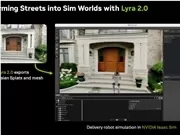
On April 16, 2026, NVIDIA's research team officially launched Lyra2.0, a 3D scene generation system. This technology constructs expansive, highly coherent virtual environments from a single photograph, effectively solving the problem of image distortion over long camera paths. With the growing demand for embodied AI training, Lyra2.0 represents a significant breakthrough in AI's ability to understand 3D space and simulate environments in real time.
Technically, Lyra2.0 can generate 3D environments extending up to 90 meters from a single image. To combat the spatial distortion and error accumulation caused by "forgetting" in traditional video models, researchers implemented two key innovations. The system stores 3D geometry data for each frame in real time, ensuring environmental consistency when the camera revisits previous locations. It also trains on defective output data, enabling the model to learn self-correction. Benchmark tests show Lyra2.0 outperforms six competing models, including GEN3C and Yume-1.5, in image quality and camera control, while its fast version boosts generation efficiency by 13 times.
Lyra2.0 now integrates seamlessly with physics engines like Nvidia Isaac Sim, allowing generated 3D scenes to be exported directly as mesh models. This closed-loop workflow enables robots to conduct efficient simulation training within AI-generated environments, drastically reducing the need for large-scale real-world 3D data collection. Although currently limited to static scenes, Lyra2.0's advancements in generation scale and stability provide a more robust and imaginative infrastructure for advancing physical perception in autonomous driving and general-purpose robots (AGI).
Related article
 Indian Tech Tycoon Invests $30M in AI Rival to Microsoft Office
Serial entrepreneur Bhavin Turakhia is investing $30 million of his own capital, betting that the enterprise AI sector still has room for new players. His latest startup, Neo, operates on a core belief: legacy workplace software cannot simply be patc
Former OpenAI Chief Scientist Ilya’s SSI Unveils First Model
AI has achieved another major milestone. Following his departure from OpenAI, former chief scientist Ilya Sutskever established Safe Superintelligence Inc. (SSI), which has recently unveiled details regarding its inaugural model. Reports from oversea
Lovable Leads Atech's Seed Round as AI Ambient Coding Officially Enters the Hardware Field
On May 14, 2026, AI application development platform Lovable announced its participation in the $800,000 seed funding round for Danish hardware startup Atech. Led by Lovable, the round attracted top-tier venture capital firms including the a16z Scout
Related Special Topic Recommendations
chatbot
Indian Tech Tycoon Invests $30M in AI Rival to Microsoft Office
Serial entrepreneur Bhavin Turakhia is investing $30 million of his own capital, betting that the enterprise AI sector still has room for new players. His latest startup, Neo, operates on a core belief: legacy workplace software cannot simply be patc
Former OpenAI Chief Scientist Ilya’s SSI Unveils First Model
AI has achieved another major milestone. Following his departure from OpenAI, former chief scientist Ilya Sutskever established Safe Superintelligence Inc. (SSI), which has recently unveiled details regarding its inaugural model. Reports from oversea
Lovable Leads Atech's Seed Round as AI Ambient Coding Officially Enters the Hardware Field
On May 14, 2026, AI application development platform Lovable announced its participation in the $800,000 seed funding round for Danish hardware startup Atech. Led by Lovable, the round attracted top-tier venture capital firms including the a16z Scout
Related Special Topic Recommendations
chatbot
 Best AI Conversation Trainer Tools for Interview Practice
2026 Latest Best Top-rated AI Conversation Trainer Tools for Interview Practice are here on XIX.AI! This curated collection features powerful, game-changing tools that go through rigorous real-world tests to deliver accurate feedback. You’ll find a free vs paid comparison and detailed rankings to help you choose the must-try option that boosts your confidence and skills. Explore now to Discover your perfect tool for interview success!
 12 tools
 xix.ai
Design & Art
Best AI Style Transfer Tools for Creative Experiments
xix.ai
Design & Art
Best AI Style Transfer Tools for Creative Experiments
2026 Latest Best Top-rated AI Style Transfer Tools for Creative Experiments! XIX.AI has curated a powerful, game-changing collection of must-try tools that deliver exceptional results through real-world tests and rigorous rankings. These top solutions help creatives boost productivity significantly by accelerating content creation and unlocking endless creative possibilities. Explore now to discover your perfect tool and start creating today!
9 tools
xix.ai
Comic Creation
Best AI Dialogue Bubble Tools for Visual Storytelling
2026 Latest Best Top-Rated AI Dialogue Bubble Tools for Visual Storytelling are here on XIX.AI! This curated collection features powerful, game-changing tools that help creators boost productivity and overcome creative bottlenecks. Get a free vs paid comparison, see real-world tests, and check the latest rankings to find the must-try solutions perfect for crafting engaging visual narratives. Explore now to discover your ideal tool!
10 tools
xix.ai
Meeting Assistant
Top AI Meeting Summary Tools: Track Decisions and Follow-Ups Clearly
2026 Latest Top-Rated Best AI Meeting Summary Tools for Clear Decision Tracking and Effortless Follow-Ups. This curated list showcases powerful, game-changing solutions that boost productivity dramatically by automating meeting notes, identifying key action items, and streamlining team coordination across all projects. Get a free vs paid comparison along with real-world tests and weekly updated rankings to help you find the perfect tool. Explore now to unlock your AI edge!
9 tools
xix.ai
Data Analysis
Best AI Data Cleaning Tools: Fix Missing Values and Duplicates Fast
2026 Latest Best Top-rated AI Data Cleaning Tools for quick fixing of missing values and duplicates. This curated list showcases powerful, game-changing solutions that boost productivity significantly. Each option has undergone rigorous real-world tests to ensure reliability. Get a free vs paid comparison and discover the must-try tool that fits your needs best. Explore now at XIX.AI to Unlock your AI edge.
11 tools
xix.ai
Design & Art
Best AI Creative Ideation Tools for Artists: Break Through Visual Blocks
2026 Latest Best Top-Rated AI Creative Ideation Tools for Artists are curated by XIX.AI to help creators break through visual blocks and boost creativity instantly. These powerful game-changing tools offer real-world tests, detailed free vs paid comparison, and weekly updated rankings. Discover your perfect tool to accelerate content creation and unlock your AI edge today. Explore now!
14 tools
xix.ai

 Comments (0)
0/500
Comments (0)
0/500
On April 16, 2026, NVIDIA's research team officially launched Lyra2.0, a 3D scene generation system. This technology constructs expansive, highly coherent virtual environments from a single photograph, effectively solving the problem of image distortion over long camera paths. With the growing demand for embodied AI training, Lyra2.0 represents a significant breakthrough in AI's ability to understand 3D space and simulate environments in real time.
Technically, Lyra2.0 can generate 3D environments extending up to 90 meters from a single image. To combat the spatial distortion and error accumulation caused by "forgetting" in traditional video models, researchers implemented two key innovations. The system stores 3D geometry data for each frame in real time, ensuring environmental consistency when the camera revisits previous locations. It also trains on defective output data, enabling the model to learn self-correction. Benchmark tests show Lyra2.0 outperforms six competing models, including GEN3C and Yume-1.5, in image quality and camera control, while its fast version boosts generation efficiency by 13 times.
Lyra2.0 now integrates seamlessly with physics engines like Nvidia Isaac Sim, allowing generated 3D scenes to be exported directly as mesh models. This closed-loop workflow enables robots to conduct efficient simulation training within AI-generated environments, drastically reducing the need for large-scale real-world 3D data collection. Although currently limited to static scenes, Lyra2.0's advancements in generation scale and stability provide a more robust and imaginative infrastructure for advancing physical perception in autonomous driving and general-purpose robots (AGI).








 Indian Tech Tycoon Invests $30M in AI Rival to Microsoft Office
Serial entrepreneur Bhavin Turakhia is investing $30 million of his own capital, betting that the enterprise AI sector still has room for new players. His latest startup, Neo, operates on a core belief: legacy workplace software cannot simply be patc
Indian Tech Tycoon Invests $30M in AI Rival to Microsoft Office
Serial entrepreneur Bhavin Turakhia is investing $30 million of his own capital, betting that the enterprise AI sector still has room for new players. His latest startup, Neo, operates on a core belief: legacy workplace software cannot simply be patc
 Former OpenAI Chief Scientist Ilya’s SSI Unveils First Model
AI has achieved another major milestone. Following his departure from OpenAI, former chief scientist Ilya Sutskever established Safe Superintelligence Inc. (SSI), which has recently unveiled details regarding its inaugural model. Reports from oversea
Former OpenAI Chief Scientist Ilya’s SSI Unveils First Model
AI has achieved another major milestone. Following his departure from OpenAI, former chief scientist Ilya Sutskever established Safe Superintelligence Inc. (SSI), which has recently unveiled details regarding its inaugural model. Reports from oversea
 Lovable Leads Atech's Seed Round as AI Ambient Coding Officially Enters the Hardware Field
On May 14, 2026, AI application development platform Lovable announced its participation in the $800,000 seed funding round for Danish hardware startup Atech. Led by Lovable, the round attracted top-tier venture capital firms including the a16z Scout
Lovable Leads Atech's Seed Round as AI Ambient Coding Officially Enters the Hardware Field
On May 14, 2026, AI application development platform Lovable announced its participation in the $800,000 seed funding round for Danish hardware startup Atech. Led by Lovable, the round attracted top-tier venture capital firms including the a16z Scout

2026 Latest Best Top-rated AI Conversation Trainer Tools for Interview Practice are here on XIX.AI! This curated collection features powerful, game-changing tools that go through rigorous real-world tests to deliver accurate feedback. You’ll find a free vs paid comparison and detailed rankings to help you choose the must-try option that boosts your confidence and skills. Explore now to Discover your perfect tool for interview success!
12 tools
xix.ai

2026 Latest Best Top-rated AI Style Transfer Tools for Creative Experiments! XIX.AI has curated a powerful, game-changing collection of must-try tools that deliver exceptional results through real-world tests and rigorous rankings. These top solutions help creatives boost productivity significantly by accelerating content creation and unlocking endless creative possibilities. Explore now to discover your perfect tool and start creating today!
9 tools
xix.ai

2026 Latest Best Top-Rated AI Dialogue Bubble Tools for Visual Storytelling are here on XIX.AI! This curated collection features powerful, game-changing tools that help creators boost productivity and overcome creative bottlenecks. Get a free vs paid comparison, see real-world tests, and check the latest rankings to find the must-try solutions perfect for crafting engaging visual narratives. Explore now to discover your ideal tool!
10 tools
xix.ai

2026 Latest Top-Rated Best AI Meeting Summary Tools for Clear Decision Tracking and Effortless Follow-Ups. This curated list showcases powerful, game-changing solutions that boost productivity dramatically by automating meeting notes, identifying key action items, and streamlining team coordination across all projects. Get a free vs paid comparison along with real-world tests and weekly updated rankings to help you find the perfect tool. Explore now to unlock your AI edge!
9 tools
xix.ai

2026 Latest Best Top-rated AI Data Cleaning Tools for quick fixing of missing values and duplicates. This curated list showcases powerful, game-changing solutions that boost productivity significantly. Each option has undergone rigorous real-world tests to ensure reliability. Get a free vs paid comparison and discover the must-try tool that fits your needs best. Explore now at XIX.AI to Unlock your AI edge.
11 tools
xix.ai

2026 Latest Best Top-Rated AI Creative Ideation Tools for Artists are curated by XIX.AI to help creators break through visual blocks and boost creativity instantly. These powerful game-changing tools offer real-world tests, detailed free vs paid comparison, and weekly updated rankings. Discover your perfect tool to accelerate content creation and unlock your AI edge today. Explore now!
14 tools
xix.ai












