


 Home
HomeNew Report: AI-Powered Apps Struggle With Long-Term User Retention
As app stores become saturated with AI offerings, many developers assume integrating artificial intelligence is the surest path to profitability. Yet, a recent study examining the subscription ecosystem across iOS, Android, and web challenges this assumption.
RevenueCat, a subscription management platform serving over 75,000 developers, highlights in its 2026 State of Subscription Apps Report that AI integration does not ensure long-term retention. According to the report, AI-powered apps face higher churn rates, with users canceling annual subscriptions 30% faster than those using non-AI apps.
This analysis draws from RevenueCat’s data, which tracks over 1 billion in-app transactions and $11 billion in annual developer revenue. As a leading tool in this sector, its dataset provides a robust sample for identifying industry trends.
Notably, most apps on the platform do not yet leverage AI. AI-powered applications represent 27.1% of all categories, while non-AI apps account for 72.9%. However, AI adoption is growing, with approximately one in four apps now featuring AI capabilities.
(Note: The AI-powered category encompasses popular chatbots like ChatGPT and Gemini, as well as any application marketing itself as AI-driven.)
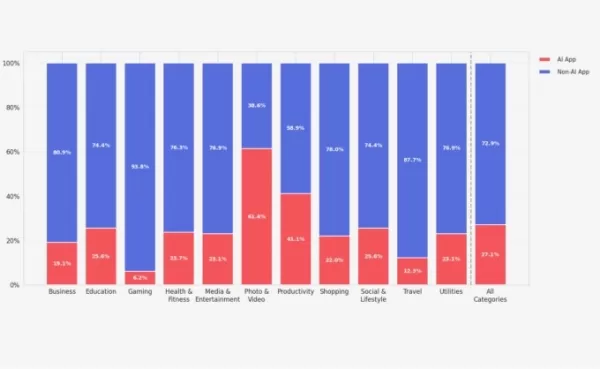
REvenuecat: AI vs. Non-AI apps by category.Image Credits:RevenueCat
Photo & Video apps lead in AI adoption, holding 61.4% of AI-powered applications, whereas gaming has the lowest share at 6.2%. Travel (12.3%) and Business (19.1%) also show relatively low AI integration.
More striking are the figures regarding customer retention. RevenueCat’s data reveals that AI apps underperform in retaining paying customers, both monthly and annually.
Annual retention, which measures subscriber persistence after 12 months, stands at 21.1% for AI apps, compared to 30.7% for non-AI apps. On a monthly basis, AI apps achieve 6.1% retention versus 9.5% for non-AI apps, a gap of 3.4 percentage points.
The sole area where AI apps outperform is weekly retention, with rates of 2.5% compared to 1.7% for non-AI apps. However, weekly subscriptions remain less popular among AI applications.
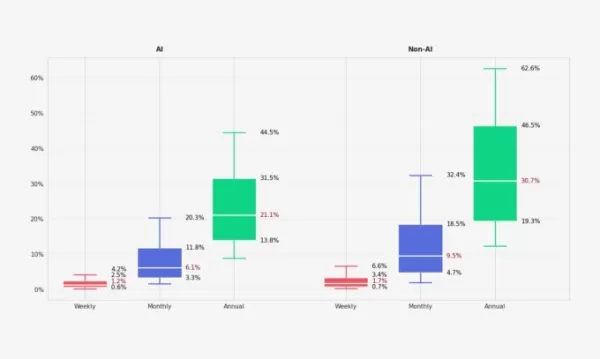
Image Credits:RevenueCat
These metrics may reflect the rapid evolution of AI technology, leading users to switch between apps frequently as they seek the most advanced underlying models.
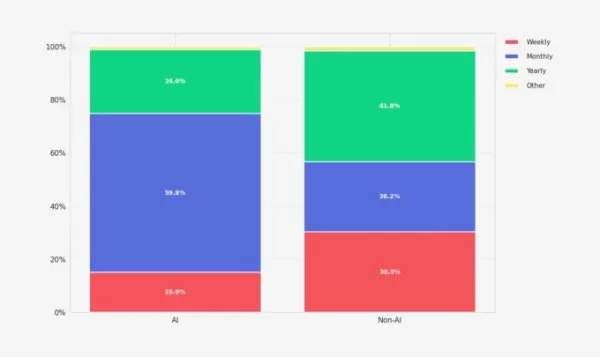
AI vs. non-AI apps by subscription plan type.Image Credits:RevenueCat
As users experiment with numerous AI apps, they often discover that some fail to meet their specific needs. The report indicates that AI apps have 20% higher refund rates (4.2% vs. 3.5% at the median) than non-AI apps.
The upper bound for AI app refunds is also higher (15.6% vs. 12.5%), suggesting “greater volatility in realized revenue and deeper issues in user value, experience, and long-term quality,” according to the report.
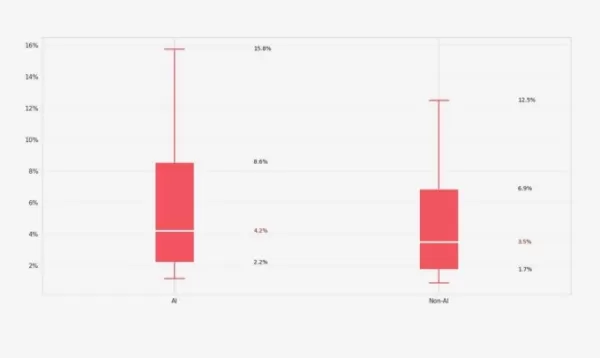
Image Credits:RevenueCat
Despite these challenges, the data suggests certain advantages for AI-powered applications.
RevenueCat found that AI apps convert trial users to paying customers 52% more effectively than non-AI apps (8.5% vs. 5.6% at the median). Additionally, AI apps monetize downloads approximately 20% better (2.4% vs. 2% at the median).
AI apps also demonstrate a 39% higher monthly realized lifetime value (RLTV), which measures the net value of an average paying user over time. The median RLTV for AI apps is $18.92 per month, compared to $13.59 for non-AI apps. Annually, AI apps maintain a 41% higher RLTV, with medians of $30.16 versus $21.37.
The key takeaway is that while AI can drive strong initial monetization, these apps struggle to maintain customer value and engagement over the long term.
Related article
 Sesame, AI Startup by Oculus Founders, Debuts on iOS
On Thursday, Sesame, an AI startup founded by the creators of Oculus and other former Meta VR team members, unveiled a public preview of its conversational AI agents, which have been in development for over a year. Through its new iOS application, Se
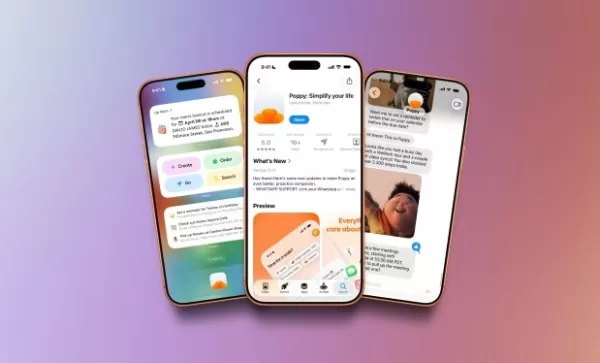
Poppy unveils proactive AI assistant to organize your digital life
Smartphones often overwhelm users with countless apps and nonstop notifications. Poppy, a new app, helps bring order to the clutter by consolidating your calendar, email, messages, and other sources into one dashboard.The company’s website explains:
Bluesky launches Attie, an AI-powered app for building custom feeds
The Bluesky team has developed a new app — this time, it's not a social network but an AI assistant that lets you design your own algorithms, create custom feeds, and eventually, build your own app through vibe-coding. At the Atmosphere conference ov
Related Special Topic Recommendations
Productivity
Sesame, AI Startup by Oculus Founders, Debuts on iOS
On Thursday, Sesame, an AI startup founded by the creators of Oculus and other former Meta VR team members, unveiled a public preview of its conversational AI agents, which have been in development for over a year. Through its new iOS application, Se
Poppy unveils proactive AI assistant to organize your digital life
Smartphones often overwhelm users with countless apps and nonstop notifications. Poppy, a new app, helps bring order to the clutter by consolidating your calendar, email, messages, and other sources into one dashboard.The company’s website explains:
Bluesky launches Attie, an AI-powered app for building custom feeds
The Bluesky team has developed a new app — this time, it's not a social network but an AI assistant that lets you design your own algorithms, create custom feeds, and eventually, build your own app through vibe-coding. At the Atmosphere conference ov
Related Special Topic Recommendations
Productivity
 Best AI Productivity Tools for Daily Work
2026 Latest Best Top-Rated AI Productivity Tools for Daily Work! XIX.AI has curated a powerful, game-changing selection based on rigorous weekly updated rankings and real-world tests. You’ll find must-try options that boost writing efficiency, streamline content creation, and help you overcome daily work challenges. Get a free vs paid comparison to find the perfect fit for your needs. Explore now to unlock your AI edge!
 9 tools
 xix.ai
Academic Research
AI Systematic Review Tools for Research Screening
xix.ai
Academic Research
AI Systematic Review Tools for Research Screening
2026 Latest Best Top-Rated AI Systematic Review Tools for Research Screening are here on XIX.AI! This curated collection includes powerful, game-changing solutions that go through rigorous real-world tests to deliver accurate results. We also offer a free vs paid comparison along with weekly updated rankings to help you find the must-try option that boosts your research efficiency significantly. Explore now to unlock your AI edge in academic work!
11 tools
xix.ai
Design & Art
AI Moodboard Tools for Brand and Art Direction
2026 Latest Best AI Moodboard Tools for Brand and Art Direction! XIX.AI has curated a top-rated list of powerful, game-changing tools that help creators boost productivity significantly. You’ll find detailed weekly updated rankings, free vs paid comparison, and real-world tests to help you choose the perfect option. Must-try features include instant idea generation, seamless collaboration, and optimized workflows for all your design projects. Explore now to unlock your AI edge!
9 tools
xix.ai
Academic Research
AI Systematic Review Tools for Screening Abstracts, Datasets, and Citation Networks
2026 Latest Best Top-rated AI Systematic Review Tools for Screening Abstracts, Datasets, and Citation Networks are curated by XIX.AI through rigorous real-world tests. These powerful game-changing tools offer a free vs paid comparison to help researchers boost productivity significantly. Explore now to discover your perfect tool for accelerating scientific research.
9 tools
xix.ai
Text-to-speech
Best AI Multilingual Voice Tools for Global Content
2026 Latest Best Top-rated AI Multilingual Voice Tools for Global Content are here on XIX.AI! This curated list features powerful, game-changing options that deliver flawless speech in dozens of languages, perfect for creating high-quality content fast and boosting writing efficiency across global markets. Get a free vs paid comparison along with real-world tests and our updated weekly rankings to help you find the must-try tool that suits your needs. Explore now to unlock your AI edge!
10 tools
xix.ai
Marketing
Best AI Persona Builders: Turn CRM Data into Actionable Profiles
2026 Latest Best Top-rated AI Persona Builders help you turn valuable CRM data into actionable customer profiles quickly. This curated list showcases powerful, game-changing tools that go through real-world tests to deliver accurate insights. Get a free vs paid comparison and discover which option suits your needs best. XIX.AI is also included in this must-try selection. Explore now to Unlock your AI edge!
9 tools
xix.ai

 Comments (0)
0/500
Comments (0)
0/500
As app stores become saturated with AI offerings, many developers assume integrating artificial intelligence is the surest path to profitability. Yet, a recent study examining the subscription ecosystem across iOS, Android, and web challenges this assumption.
RevenueCat, a subscription management platform serving over 75,000 developers, highlights in its 2026 State of Subscription Apps Report that AI integration does not ensure long-term retention. According to the report, AI-powered apps face higher churn rates, with users canceling annual subscriptions 30% faster than those using non-AI apps.
This analysis draws from RevenueCat’s data, which tracks over 1 billion in-app transactions and $11 billion in annual developer revenue. As a leading tool in this sector, its dataset provides a robust sample for identifying industry trends.
Notably, most apps on the platform do not yet leverage AI. AI-powered applications represent 27.1% of all categories, while non-AI apps account for 72.9%. However, AI adoption is growing, with approximately one in four apps now featuring AI capabilities.
(Note: The AI-powered category encompasses popular chatbots like ChatGPT and Gemini, as well as any application marketing itself as AI-driven.)
REvenuecat: AI vs. Non-AI apps by category.Image Credits:RevenueCat
Photo & Video apps lead in AI adoption, holding 61.4% of AI-powered applications, whereas gaming has the lowest share at 6.2%. Travel (12.3%) and Business (19.1%) also show relatively low AI integration.
More striking are the figures regarding customer retention. RevenueCat’s data reveals that AI apps underperform in retaining paying customers, both monthly and annually.
Annual retention, which measures subscriber persistence after 12 months, stands at 21.1% for AI apps, compared to 30.7% for non-AI apps. On a monthly basis, AI apps achieve 6.1% retention versus 9.5% for non-AI apps, a gap of 3.4 percentage points.
The sole area where AI apps outperform is weekly retention, with rates of 2.5% compared to 1.7% for non-AI apps. However, weekly subscriptions remain less popular among AI applications.
Image Credits:RevenueCat
These metrics may reflect the rapid evolution of AI technology, leading users to switch between apps frequently as they seek the most advanced underlying models.
AI vs. non-AI apps by subscription plan type.Image Credits:RevenueCat
As users experiment with numerous AI apps, they often discover that some fail to meet their specific needs. The report indicates that AI apps have 20% higher refund rates (4.2% vs. 3.5% at the median) than non-AI apps.
The upper bound for AI app refunds is also higher (15.6% vs. 12.5%), suggesting “greater volatility in realized revenue and deeper issues in user value, experience, and long-term quality,” according to the report.
Image Credits:RevenueCat
Despite these challenges, the data suggests certain advantages for AI-powered applications.
RevenueCat found that AI apps convert trial users to paying customers 52% more effectively than non-AI apps (8.5% vs. 5.6% at the median). Additionally, AI apps monetize downloads approximately 20% better (2.4% vs. 2% at the median).
AI apps also demonstrate a 39% higher monthly realized lifetime value (RLTV), which measures the net value of an average paying user over time. The median RLTV for AI apps is $18.92 per month, compared to $13.59 for non-AI apps. Annually, AI apps maintain a 41% higher RLTV, with medians of $30.16 versus $21.37.
The key takeaway is that while AI can drive strong initial monetization, these apps struggle to maintain customer value and engagement over the long term.








 Sesame, AI Startup by Oculus Founders, Debuts on iOS
On Thursday, Sesame, an AI startup founded by the creators of Oculus and other former Meta VR team members, unveiled a public preview of its conversational AI agents, which have been in development for over a year. Through its new iOS application, Se
Sesame, AI Startup by Oculus Founders, Debuts on iOS
On Thursday, Sesame, an AI startup founded by the creators of Oculus and other former Meta VR team members, unveiled a public preview of its conversational AI agents, which have been in development for over a year. Through its new iOS application, Se
 Poppy unveils proactive AI assistant to organize your digital life
Smartphones often overwhelm users with countless apps and nonstop notifications. Poppy, a new app, helps bring order to the clutter by consolidating your calendar, email, messages, and other sources into one dashboard.The company’s website explains:
Poppy unveils proactive AI assistant to organize your digital life
Smartphones often overwhelm users with countless apps and nonstop notifications. Poppy, a new app, helps bring order to the clutter by consolidating your calendar, email, messages, and other sources into one dashboard.The company’s website explains:
 Bluesky launches Attie, an AI-powered app for building custom feeds
The Bluesky team has developed a new app — this time, it's not a social network but an AI assistant that lets you design your own algorithms, create custom feeds, and eventually, build your own app through vibe-coding. At the Atmosphere conference ov
Bluesky launches Attie, an AI-powered app for building custom feeds
The Bluesky team has developed a new app — this time, it's not a social network but an AI assistant that lets you design your own algorithms, create custom feeds, and eventually, build your own app through vibe-coding. At the Atmosphere conference ov

2026 Latest Best Top-Rated AI Productivity Tools for Daily Work! XIX.AI has curated a powerful, game-changing selection based on rigorous weekly updated rankings and real-world tests. You’ll find must-try options that boost writing efficiency, streamline content creation, and help you overcome daily work challenges. Get a free vs paid comparison to find the perfect fit for your needs. Explore now to unlock your AI edge!
9 tools
xix.ai
2026 Latest Best Top-Rated AI Systematic Review Tools for Research Screening are here on XIX.AI! This curated collection includes powerful, game-changing solutions that go through rigorous real-world tests to deliver accurate results. We also offer a free vs paid comparison along with weekly updated rankings to help you find the must-try option that boosts your research efficiency significantly. Explore now to unlock your AI edge in academic work!
11 tools
xix.ai

2026 Latest Best AI Moodboard Tools for Brand and Art Direction! XIX.AI has curated a top-rated list of powerful, game-changing tools that help creators boost productivity significantly. You’ll find detailed weekly updated rankings, free vs paid comparison, and real-world tests to help you choose the perfect option. Must-try features include instant idea generation, seamless collaboration, and optimized workflows for all your design projects. Explore now to unlock your AI edge!
9 tools
xix.ai

2026 Latest Best Top-rated AI Systematic Review Tools for Screening Abstracts, Datasets, and Citation Networks are curated by XIX.AI through rigorous real-world tests. These powerful game-changing tools offer a free vs paid comparison to help researchers boost productivity significantly. Explore now to discover your perfect tool for accelerating scientific research.
9 tools
xix.ai

2026 Latest Best Top-rated AI Multilingual Voice Tools for Global Content are here on XIX.AI! This curated list features powerful, game-changing options that deliver flawless speech in dozens of languages, perfect for creating high-quality content fast and boosting writing efficiency across global markets. Get a free vs paid comparison along with real-world tests and our updated weekly rankings to help you find the must-try tool that suits your needs. Explore now to unlock your AI edge!
10 tools
xix.ai

2026 Latest Best Top-rated AI Persona Builders help you turn valuable CRM data into actionable customer profiles quickly. This curated list showcases powerful, game-changing tools that go through real-world tests to deliver accurate insights. Get a free vs paid comparison and discover which option suits your needs best. XIX.AI is also included in this must-try selection. Explore now to Unlock your AI edge!
9 tools
xix.ai












