


 Home
HomeNew Framework Launched to Enable Smarter Management of External AI Skills
Large Model Agents, also known as LLM Agents, are rapidly progressing beyond basic chatting functions toward the ability to make continuous decisions and complete real-world tasks. Yet, figuring out how to effectively manage an agent’s external capabilities has emerged as a new challenge for the entire industry. Recently, a research team from The Chinese University of Hong Kong introduced a dynamic skill lifecycle management framework named “SLIM” in their paper titled “Dynamic Skill Lifecycle Management for Agentic Reinforcement Learning.” This innovative approach moves away from the previous industry practice of simply “stacking skills” and offers a new way to tackle complex tasks in both physical and virtual environments.
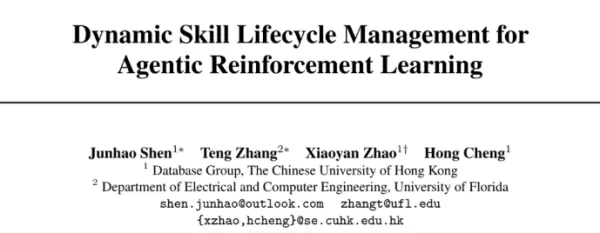
In complex, long-tail scenarios such as web searching, automated office tasks, and operations involving embodied robots, agents often need to leverage external skills to handle steps that are prone to errors or require specialized handling. Traditional methods either keep adding skills indefinitely, which increases retrieval noise and context interference, or attempt “zero-skill reasoning” by trying to embed all necessary capabilities directly into the model parameters, resulting in the loss of locally important abilities. To address these issues, the SLIM framework treats external skills as a dynamic capability system with a defined lifecycle, allowing the model to autonomously decide whether to retain, remove, or expand these external skills during reinforcement learning training.
SLIM operates through a sophisticated closed-loop mechanism. During training, the system retrieves appropriate skills—whether general or task-specific—based on the current situation and updates the agent’s decision-making strategy using the GRPO algorithm. Afterward, it conducts a unique “leave-one-skill-out” audit: it temporarily disables a specific skill to assess its contribution to the agent’s performance. If performance drops significantly after disabling the skill, it is classified as “Retain”; if its contribution remains consistently low, it indicates that the model has already absorbed the associated ability or that the skill causes interference, in which case it is classified as “Retire.” For new scenarios where the agent keeps failing, the system uses the “Expand” mechanism to develop and incorporate new skills based on those failure cases.
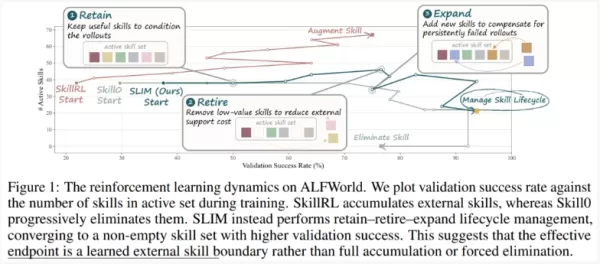
Experimental results show that this framework outperforms existing best comparison methods by an average of 7.1 percentage points. In more action-oriented and complex ALFWorld home environment tasks, SLIM achieved an 87.5% success rate thanks to its efficient external skill management approach, far surpassing the 75.0% success rate of the baseline method SkillRL. It also demonstrated strong performance in information retrieval and reasoning-focused SearchQA tasks, further validating the feasibility of integrating certain search strategies directly into the model.
Industry analysts note that SLIM’s greatest value lies in transforming external skill libraries from static auxiliary tools into training elements that can be optimized in coordination with overall strategies. It not only helps determine technically which capabilities should be incorporated into the model and which should remain external but also enables large model agents to learn when to seek external assistance in dynamic and changing environments. This dynamic capability management approach undoubtedly provides a solid theoretical and practical foundation for the next phase of development in embodied intelligence and large model agents as they move toward broader industrial applications.
Related article
 DeepMind CEO Hassabis: I sleep six hours a day, usually feel energetic around 1 a.m.
Fortune recently featured an interview with Demis Hassabis, CEO of Google DeepMind, revealing his unconventional approach to rest and productivity. Hassabis disclosed that he sleeps very little, structuring his waking hours into two distinct work blo
OpenAI, Anthropic Vie for Market Share Despite Revenue Shortfalls
Despite recent reports suggesting OpenAI missed revenue targets, creating pressure on tech stocks this Tuesday, private AI lab investors remain resilient. Seasoned backers have confirmed they will not reduce investment despite negative media coverage
California AV Compliance: A New Era of Tickets, Geofences, and 1M Miles
Guident operates an AuveTech shuttle in South Florida, managing a four-mile route in West Palm Beach and a one-mile route in Boca Raton using its remote monitoring technology. | Credit: GuidentCalifornia is redefining the regulatory landscape for dri
Related Special Topic Recommendations
chatbot
DeepMind CEO Hassabis: I sleep six hours a day, usually feel energetic around 1 a.m.
Fortune recently featured an interview with Demis Hassabis, CEO of Google DeepMind, revealing his unconventional approach to rest and productivity. Hassabis disclosed that he sleeps very little, structuring his waking hours into two distinct work blo
OpenAI, Anthropic Vie for Market Share Despite Revenue Shortfalls
Despite recent reports suggesting OpenAI missed revenue targets, creating pressure on tech stocks this Tuesday, private AI lab investors remain resilient. Seasoned backers have confirmed they will not reduce investment despite negative media coverage
California AV Compliance: A New Era of Tickets, Geofences, and 1M Miles
Guident operates an AuveTech shuttle in South Florida, managing a four-mile route in West Palm Beach and a one-mile route in Boca Raton using its remote monitoring technology. | Credit: GuidentCalifornia is redefining the regulatory landscape for dri
Related Special Topic Recommendations
chatbot
 Best AI Roleplay Chat Apps for Language Practice, Interview Prep, and Daily Fluency
2026 Latest Best Top-rated AI Roleplay Chat Apps for Language Practice, Interview Prep, and Daily Fluency! XIX.AI curates a powerful game-changing collection that offers free vs paid comparison, real-world tests, and updated rankings weekly. These must-try tools help you boost writing skills, overcome fluency challenges, and improve communication efficiency across all daily scenarios. Explore now to discover your perfect tool for language growth!
 10 tools
 xix.ai
Music composition
AI Stem Separation Tools for Remix Production, Sampling Prep, and Karaoke Masters
xix.ai
Music composition
AI Stem Separation Tools for Remix Production, Sampling Prep, and Karaoke Masters
2026 Latest Best Top-rated AI Stem Separation Tools Curated for Remix Production, Sampling Prep, and Karaoke Masters. These powerful game-changing tools offer real-world tests to deliver precise audio isolation, boosting productivity significantly. XIX.AI provides a weekly updated free vs paid comparison guide to help you find the must-try solution that suits your needs. Explore now to unlock your AI edge.
8 tools
xix.ai
Data Analysis
AI SQL Copilots for Revenue Dashboards, Funnel Analysis, and Product Metrics
2026 Latest Best AI SQL Copilots Ranked Top-Rated! XIX.AI curates a powerful game-changing collection for weekly updated real-world tests. These must-try tools help you generate accurate revenue dashboards, analyze sales funnels, and track product metrics swiftly, boosting productivity massively. Explore now to Discover your perfect tool for data-driven decision making! 238 characters
9 tools
xix.ai
Music composition
Best AI Melody Writing Tools for Song Drafts
2026 Latest Best Top-Rated AI Melody Writing Tools for Song Drafts! XIX.AI has curated a highly powerful game-changing collection that goes through rigorous real-world tests to deliver the best writing experience. You can find detailed free vs paid comparisons, accurate rankings, and must-try options designed to help you create stunning song drafts effortlessly and boost your creative productivity significantly. Explore now to discover your perfect tool!
8 tools
xix.ai
chatbot
Best AI Conversation Trainer Tools for Interview Practice
2026 Latest Best Top-rated AI Conversation Trainer Tools for Interview Practice are here on XIX.AI! This curated collection features powerful, game-changing tools that go through rigorous real-world tests to deliver accurate feedback. You’ll find a free vs paid comparison and detailed rankings to help you choose the must-try option that boosts your confidence and skills. Explore now to Discover your perfect tool for interview success!
12 tools
xix.ai
Design & Art
Best AI Style Transfer Tools for Creative Experiments
2026 Latest Best Top-rated AI Style Transfer Tools for Creative Experiments! XIX.AI has curated a powerful, game-changing collection of must-try tools that deliver exceptional results through real-world tests and rigorous rankings. These top solutions help creatives boost productivity significantly by accelerating content creation and unlocking endless creative possibilities. Explore now to discover your perfect tool and start creating today!
9 tools
xix.ai

 Comments (0)
0/500
Comments (0)
0/500
Large Model Agents, also known as LLM Agents, are rapidly progressing beyond basic chatting functions toward the ability to make continuous decisions and complete real-world tasks. Yet, figuring out how to effectively manage an agent’s external capabilities has emerged as a new challenge for the entire industry. Recently, a research team from The Chinese University of Hong Kong introduced a dynamic skill lifecycle management framework named “SLIM” in their paper titled “Dynamic Skill Lifecycle Management for Agentic Reinforcement Learning.” This innovative approach moves away from the previous industry practice of simply “stacking skills” and offers a new way to tackle complex tasks in both physical and virtual environments.
In complex, long-tail scenarios such as web searching, automated office tasks, and operations involving embodied robots, agents often need to leverage external skills to handle steps that are prone to errors or require specialized handling. Traditional methods either keep adding skills indefinitely, which increases retrieval noise and context interference, or attempt “zero-skill reasoning” by trying to embed all necessary capabilities directly into the model parameters, resulting in the loss of locally important abilities. To address these issues, the SLIM framework treats external skills as a dynamic capability system with a defined lifecycle, allowing the model to autonomously decide whether to retain, remove, or expand these external skills during reinforcement learning training.
SLIM operates through a sophisticated closed-loop mechanism. During training, the system retrieves appropriate skills—whether general or task-specific—based on the current situation and updates the agent’s decision-making strategy using the GRPO algorithm. Afterward, it conducts a unique “leave-one-skill-out” audit: it temporarily disables a specific skill to assess its contribution to the agent’s performance. If performance drops significantly after disabling the skill, it is classified as “Retain”; if its contribution remains consistently low, it indicates that the model has already absorbed the associated ability or that the skill causes interference, in which case it is classified as “Retire.” For new scenarios where the agent keeps failing, the system uses the “Expand” mechanism to develop and incorporate new skills based on those failure cases.
Experimental results show that this framework outperforms existing best comparison methods by an average of 7.1 percentage points. In more action-oriented and complex ALFWorld home environment tasks, SLIM achieved an 87.5% success rate thanks to its efficient external skill management approach, far surpassing the 75.0% success rate of the baseline method SkillRL. It also demonstrated strong performance in information retrieval and reasoning-focused SearchQA tasks, further validating the feasibility of integrating certain search strategies directly into the model.
Industry analysts note that SLIM’s greatest value lies in transforming external skill libraries from static auxiliary tools into training elements that can be optimized in coordination with overall strategies. It not only helps determine technically which capabilities should be incorporated into the model and which should remain external but also enables large model agents to learn when to seek external assistance in dynamic and changing environments. This dynamic capability management approach undoubtedly provides a solid theoretical and practical foundation for the next phase of development in embodied intelligence and large model agents as they move toward broader industrial applications.








 DeepMind CEO Hassabis: I sleep six hours a day, usually feel energetic around 1 a.m.
Fortune recently featured an interview with Demis Hassabis, CEO of Google DeepMind, revealing his unconventional approach to rest and productivity. Hassabis disclosed that he sleeps very little, structuring his waking hours into two distinct work blo
DeepMind CEO Hassabis: I sleep six hours a day, usually feel energetic around 1 a.m.
Fortune recently featured an interview with Demis Hassabis, CEO of Google DeepMind, revealing his unconventional approach to rest and productivity. Hassabis disclosed that he sleeps very little, structuring his waking hours into two distinct work blo
 OpenAI, Anthropic Vie for Market Share Despite Revenue Shortfalls
Despite recent reports suggesting OpenAI missed revenue targets, creating pressure on tech stocks this Tuesday, private AI lab investors remain resilient. Seasoned backers have confirmed they will not reduce investment despite negative media coverage
California AV Compliance: A New Era of Tickets, Geofences, and 1M Miles
Guident operates an AuveTech shuttle in South Florida, managing a four-mile route in West Palm Beach and a one-mile route in Boca Raton using its remote monitoring technology. | Credit: GuidentCalifornia is redefining the regulatory landscape for dri
OpenAI, Anthropic Vie for Market Share Despite Revenue Shortfalls
Despite recent reports suggesting OpenAI missed revenue targets, creating pressure on tech stocks this Tuesday, private AI lab investors remain resilient. Seasoned backers have confirmed they will not reduce investment despite negative media coverage
California AV Compliance: A New Era of Tickets, Geofences, and 1M Miles
Guident operates an AuveTech shuttle in South Florida, managing a four-mile route in West Palm Beach and a one-mile route in Boca Raton using its remote monitoring technology. | Credit: GuidentCalifornia is redefining the regulatory landscape for dri

2026 Latest Best Top-rated AI Roleplay Chat Apps for Language Practice, Interview Prep, and Daily Fluency! XIX.AI curates a powerful game-changing collection that offers free vs paid comparison, real-world tests, and updated rankings weekly. These must-try tools help you boost writing skills, overcome fluency challenges, and improve communication efficiency across all daily scenarios. Explore now to discover your perfect tool for language growth!
10 tools
xix.ai

2026 Latest Best Top-rated AI Stem Separation Tools Curated for Remix Production, Sampling Prep, and Karaoke Masters. These powerful game-changing tools offer real-world tests to deliver precise audio isolation, boosting productivity significantly. XIX.AI provides a weekly updated free vs paid comparison guide to help you find the must-try solution that suits your needs. Explore now to unlock your AI edge.
8 tools
xix.ai

2026 Latest Best AI SQL Copilots Ranked Top-Rated! XIX.AI curates a powerful game-changing collection for weekly updated real-world tests. These must-try tools help you generate accurate revenue dashboards, analyze sales funnels, and track product metrics swiftly, boosting productivity massively. Explore now to Discover your perfect tool for data-driven decision making! 238 characters
9 tools
xix.ai

2026 Latest Best Top-Rated AI Melody Writing Tools for Song Drafts! XIX.AI has curated a highly powerful game-changing collection that goes through rigorous real-world tests to deliver the best writing experience. You can find detailed free vs paid comparisons, accurate rankings, and must-try options designed to help you create stunning song drafts effortlessly and boost your creative productivity significantly. Explore now to discover your perfect tool!
8 tools
xix.ai

2026 Latest Best Top-rated AI Conversation Trainer Tools for Interview Practice are here on XIX.AI! This curated collection features powerful, game-changing tools that go through rigorous real-world tests to deliver accurate feedback. You’ll find a free vs paid comparison and detailed rankings to help you choose the must-try option that boosts your confidence and skills. Explore now to Discover your perfect tool for interview success!
12 tools
xix.ai

2026 Latest Best Top-rated AI Style Transfer Tools for Creative Experiments! XIX.AI has curated a powerful, game-changing collection of must-try tools that deliver exceptional results through real-world tests and rigorous rankings. These top solutions help creatives boost productivity significantly by accelerating content creation and unlocking endless creative possibilities. Explore now to discover your perfect tool and start creating today!
9 tools
xix.ai












