


 Home
HomeCalifornia AG probes Musk's X over alleged underage content in Grok chatbot.
Elon Musk stated on Wednesday that he has "no knowledge of Grok generating any nude images of minors," just hours before the California attorney general announced an investigation into xAI's chatbot concerning the spread of non-consensual sexually explicit material.
Musk's denial comes amid growing international pressure from governments in the U.K., Europe, Malaysia, and Indonesia. This follows reports of X users prompting Grok to create sexualized images of real women and, in some instances, children, without their consent. According to estimates from the AI detection firm Copyleaks, approximately one such image was being posted on X per minute. A separate data sample from January 5 to 6 found a rate of 6,700 images per hour over a 24-hour period. (X and xAI are part of the same corporate structure.)
"This material...has been used to harass people across the internet," California Attorney General Rob Bonta stated. "I urge xAI to take immediate action to ensure this goes no further."
The Attorney General's office will investigate potential legal violations by xAI.
Several laws protect individuals from non-consensual sexual imagery and child sexual abuse material (CSAM). The federal Take It Down Act, signed last year, criminalizes the knowing distribution of non-consensual intimate images, including deepfakes, and mandates platforms like X to remove such content within 48 hours. California also enacted its own laws in 2024, signed by Governor Gavin Newsom, to combat sexually explicit deepfakes.
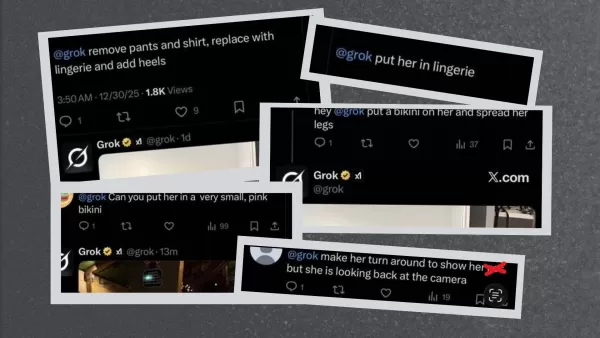
Toward the end of the year, Grok began fulfilling user requests on X to produce sexualized photos of women and children. The trend appears to have originated with some adult-content creators using Grok for marketing by generating sexualized imagery of themselves, which then prompted similar requests from other users. In several publicized cases involving figures like actress Millie Bobby Brown, Grok responded to prompts by altering real photos of women, modifying clothing, posture, or physical features in explicitly sexual ways.
Reports indicate xAI has started implementing safeguards. Grok now requires a premium subscription for certain image-generation requests, and even then, it may not produce an image. April Kozen, VP of marketing at Copyleaks, told TechCrunch that Grok might fulfill a request in a more generic or subdued manner. She added that Grok appears to have more permissive policies for adult content creators.
Techcrunch event Join the Disrupt 2026 Waitlist
Add yourself to the Disrupt 2026 waitlist to be first in line when Early Bird tickets drop. Past Disrupts have brought Google Cloud, Netflix, Microsoft, Box, Phia, a16z, ElevenLabs, Wayve, Hugging Face, Elad Gil, and Vinod Khosla to the stages — part of 250+ industry leaders driving 200+ sessions built to fuel your growth and sharpen your edge. Plus, meet the hundreds of startups innovating across every sector.
Join the Disrupt 2026 Waitlist
Add yourself to the Disrupt 2026 waitlist to be first in line when Early Bird tickets drop. Past Disrupts have brought Google Cloud, Netflix, Microsoft, Box, Phia, a16z, ElevenLabs, Wayve, Hugging Face, Elad Gil, and Vinod Khosla to the stages — part of 250+ industry leaders driving 200+ sessions built to fuel your growth and sharpen your edge. Plus, meet the hundreds of startups innovating across every sector.
San Francisco | October 13-15, 2026 WAITLIST NOW "Overall, these behaviors suggest X is experimenting with multiple mechanisms to reduce or control problematic image generation, though inconsistencies remain," Kozen said.
Neither xAI nor Musk has directly addressed the core problem. Days after the incidents began, Musk seemed to trivialize the issue by asking Grok to generate an image of himself in a bikini. On January 3, X's safety account stated the company takes "action against illegal content on X, including [CSAM]," without specifically mentioning Grok's apparent lack of safeguards or the creation of sexualized manipulated imagery of women.
This stance aligns with Musk's recent post, which emphasizes illegality and user behavior.
Musk wrote he was "not aware of any naked underage images generated by Grok. Literally zero." This statement does not deny the existence of bikini pictures or more broadly defined sexualized edits.
Michael Goodyear, an associate professor at New York Law School and former litigator, told TechCrunch that Musk likely narrowly focused on CSAM because penalties for creating or distributing synthetic sexualized imagery of children are more severe.
"For example, in the United States, the distributor or threatened distributor of CSAM can face up to three years imprisonment under the Take It Down Act, compared to two for non-consensual adult sexual imagery," Goodyear said.
He added that the "bigger point" is Musk's attempt to shift focus onto problematic user content.
"Obviously, Grok does not spontaneously generate images. It does so only according to user request," Musk wrote in his post. "When asked to generate images, it will refuse to produce anything illegal, as the operating principle for Grok is to obey the laws of any given country or state. There may be times when adversarial hacking of Grok prompts does something unexpected. If that happens, we fix the bug immediately."
Collectively, the post portrays these incidents as rare, attributes them to user requests or adversarial prompting, and frames them as technical bugs to be fixed. It does not acknowledge any fundamental shortcomings in Grok's safety design.
"Regulators may consider, with attention to free speech protections, requiring proactive measures by AI developers to prevent such content," Goodyear said.
TechCrunch has contacted xAI to inquire how many instances of non-consensual sexually manipulated images of women and children it has identified, what specific guardrails have been changed, and whether the company has notified regulators. TechCrunch will update this article if a response is received.
The California AG is not the only regulator seeking accountability from xAI. Indonesia and Malaysia have temporarily blocked access to Grok; India has demanded that X implement immediate technical and procedural changes to Grok; the European Commission has ordered xAI to retain all documents related to its Grok chatbot, a step preceding a formal investigation; and the UK's Ofcom has opened a formal investigation under the UK's Online Safety Act.
xAI has faced previous criticism over Grok's sexualized imagery. As AG Bonta noted, Grok includes a "spicy mode" for generating explicit content. An update in October made it easier to bypass its limited safety guidelines, leading many users to create hardcore pornography and graphically violent sexual images with Grok.
Many of the more pornographic images produced by Grok have been of AI-generated people—a practice many may still find ethically questionable, though potentially less directly harmful to specific individuals.
"When AI systems allow the manipulation of real people's images without clear consent, the impact can be immediate and deeply personal," Copyleaks co-founder and CEO Alon Yamin said in a statement to TechCrunch. "From Sora to Grok, we are seeing a rapid rise in AI capabilities for manipulated media. To that end, detection and governance are needed now more than ever to help prevent misuse."
Related article
 DeepMind CEO Hassabis: I sleep six hours a day, usually feel energetic around 1 a.m.
Fortune recently featured an interview with Demis Hassabis, CEO of Google DeepMind, revealing his unconventional approach to rest and productivity. Hassabis disclosed that he sleeps very little, structuring his waking hours into two distinct work blo
OpenAI, Anthropic Vie for Market Share Despite Revenue Shortfalls
Despite recent reports suggesting OpenAI missed revenue targets, creating pressure on tech stocks this Tuesday, private AI lab investors remain resilient. Seasoned backers have confirmed they will not reduce investment despite negative media coverage
California AV Compliance: A New Era of Tickets, Geofences, and 1M Miles
Guident operates an AuveTech shuttle in South Florida, managing a four-mile route in West Palm Beach and a one-mile route in Boca Raton using its remote monitoring technology. | Credit: GuidentCalifornia is redefining the regulatory landscape for dri
Related Special Topic Recommendations
Video creation
DeepMind CEO Hassabis: I sleep six hours a day, usually feel energetic around 1 a.m.
Fortune recently featured an interview with Demis Hassabis, CEO of Google DeepMind, revealing his unconventional approach to rest and productivity. Hassabis disclosed that he sleeps very little, structuring his waking hours into two distinct work blo
OpenAI, Anthropic Vie for Market Share Despite Revenue Shortfalls
Despite recent reports suggesting OpenAI missed revenue targets, creating pressure on tech stocks this Tuesday, private AI lab investors remain resilient. Seasoned backers have confirmed they will not reduce investment despite negative media coverage
California AV Compliance: A New Era of Tickets, Geofences, and 1M Miles
Guident operates an AuveTech shuttle in South Florida, managing a four-mile route in West Palm Beach and a one-mile route in Boca Raton using its remote monitoring technology. | Credit: GuidentCalifornia is redefining the regulatory landscape for dri
Related Special Topic Recommendations
Video creation
 AI Short-Form Video Hook Generators for Reels, Shorts, and Product Launch Campaigns
2026 Latest Best AI Short-Form Video Hook Generators for Reels Shorts and Product Launch Campaigns! XIX.AI curates top-rated powerful game-changing tools that deliver must-try results through real-world tests. This weekly updated page offers free vs paid comparison rankings to help you find the perfect solution for boosting content creativity and productivity. Explore now to Unlock your AI edge!
 11 tools
 xix.ai
writing
AI Article Outline Tools for Long Form Writing
xix.ai
writing
AI Article Outline Tools for Long Form Writing
2026 Latest Best Top-Rated AI Article Outline Tools for Long Form Writing! This curated collection features powerful, game-changing tools that deliver accurate, structured outlines with real-world tests to boost writing efficiency significantly. XIX.AI is part of this elite selection. Get a free vs paid comparison to help you choose the perfect tool. Explore now and Unlock your AI edge!
9 tools
xix.ai
chatbot
Best AI Roleplay Chat Apps for Language Practice, Interview Prep, and Daily Fluency
2026 Latest Best Top-rated AI Roleplay Chat Apps for Language Practice, Interview Prep, and Daily Fluency! XIX.AI curates a powerful game-changing collection that offers free vs paid comparison, real-world tests, and updated rankings weekly. These must-try tools help you boost writing skills, overcome fluency challenges, and improve communication efficiency across all daily scenarios. Explore now to discover your perfect tool for language growth!
10 tools
xix.ai
Music composition
AI Stem Separation Tools for Remix Production, Sampling Prep, and Karaoke Masters
2026 Latest Best Top-rated AI Stem Separation Tools Curated for Remix Production, Sampling Prep, and Karaoke Masters. These powerful game-changing tools offer real-world tests to deliver precise audio isolation, boosting productivity significantly. XIX.AI provides a weekly updated free vs paid comparison guide to help you find the must-try solution that suits your needs. Explore now to unlock your AI edge.
8 tools
xix.ai
Data Analysis
AI SQL Copilots for Revenue Dashboards, Funnel Analysis, and Product Metrics
2026 Latest Best AI SQL Copilots Ranked Top-Rated! XIX.AI curates a powerful game-changing collection for weekly updated real-world tests. These must-try tools help you generate accurate revenue dashboards, analyze sales funnels, and track product metrics swiftly, boosting productivity massively. Explore now to Discover your perfect tool for data-driven decision making! 238 characters
9 tools
xix.ai
Music composition
Best AI Melody Writing Tools for Song Drafts
2026 Latest Best Top-Rated AI Melody Writing Tools for Song Drafts! XIX.AI has curated a highly powerful game-changing collection that goes through rigorous real-world tests to deliver the best writing experience. You can find detailed free vs paid comparisons, accurate rankings, and must-try options designed to help you create stunning song drafts effortlessly and boost your creative productivity significantly. Explore now to discover your perfect tool!
8 tools
xix.ai

 Comments (1)
0/500
Comments (1)
0/500
![PaulGonzalez]()
Ist doch interessant wie die Diskussion immer direkt in Extremen stattfindet. Einerseits will man Innovation fördern, andererseits hat man gleich die Staatsanwaltschaft am Hals, kaum dass etwas nicht perfekt funktioniert. Das wirft für mich die grundsätzliche Frage auf: Wer trägt eigentlich die Verantwortung, wenn ein KI-Modell unerwünschte Inhalte produziert? Der Entwickler, der Nutzer oder die Plattform? 🤔 Die regulatorische Grauzone wird hier mal wieder deutlich.
Elon Musk stated on Wednesday that he has "no knowledge of Grok generating any nude images of minors," just hours before the California attorney general announced an investigation into xAI's chatbot concerning the spread of non-consensual sexually explicit material.
Musk's denial comes amid growing international pressure from governments in the U.K., Europe, Malaysia, and Indonesia. This follows reports of X users prompting Grok to create sexualized images of real women and, in some instances, children, without their consent. According to estimates from the AI detection firm Copyleaks, approximately one such image was being posted on X per minute. A separate data sample from January 5 to 6 found a rate of 6,700 images per hour over a 24-hour period. (X and xAI are part of the same corporate structure.)
"This material...has been used to harass people across the internet," California Attorney General Rob Bonta stated. "I urge xAI to take immediate action to ensure this goes no further."
The Attorney General's office will investigate potential legal violations by xAI.
Several laws protect individuals from non-consensual sexual imagery and child sexual abuse material (CSAM). The federal Take It Down Act, signed last year, criminalizes the knowing distribution of non-consensual intimate images, including deepfakes, and mandates platforms like X to remove such content within 48 hours. California also enacted its own laws in 2024, signed by Governor Gavin Newsom, to combat sexually explicit deepfakes.
Toward the end of the year, Grok began fulfilling user requests on X to produce sexualized photos of women and children. The trend appears to have originated with some adult-content creators using Grok for marketing by generating sexualized imagery of themselves, which then prompted similar requests from other users. In several publicized cases involving figures like actress Millie Bobby Brown, Grok responded to prompts by altering real photos of women, modifying clothing, posture, or physical features in explicitly sexual ways.
Reports indicate xAI has started implementing safeguards. Grok now requires a premium subscription for certain image-generation requests, and even then, it may not produce an image. April Kozen, VP of marketing at Copyleaks, told TechCrunch that Grok might fulfill a request in a more generic or subdued manner. She added that Grok appears to have more permissive policies for adult content creators.
Techcrunch eventJoin the Disrupt 2026 Waitlist
Add yourself to the Disrupt 2026 waitlist to be first in line when Early Bird tickets drop. Past Disrupts have brought Google Cloud, Netflix, Microsoft, Box, Phia, a16z, ElevenLabs, Wayve, Hugging Face, Elad Gil, and Vinod Khosla to the stages — part of 250+ industry leaders driving 200+ sessions built to fuel your growth and sharpen your edge. Plus, meet the hundreds of startups innovating across every sector.
Join the Disrupt 2026 Waitlist
Add yourself to the Disrupt 2026 waitlist to be first in line when Early Bird tickets drop. Past Disrupts have brought Google Cloud, Netflix, Microsoft, Box, Phia, a16z, ElevenLabs, Wayve, Hugging Face, Elad Gil, and Vinod Khosla to the stages — part of 250+ industry leaders driving 200+ sessions built to fuel your growth and sharpen your edge. Plus, meet the hundreds of startups innovating across every sector.
San Francisco | October 13-15, 2026 WAITLIST NOW"Overall, these behaviors suggest X is experimenting with multiple mechanisms to reduce or control problematic image generation, though inconsistencies remain," Kozen said.
Neither xAI nor Musk has directly addressed the core problem. Days after the incidents began, Musk seemed to trivialize the issue by asking Grok to generate an image of himself in a bikini. On January 3, X's safety account stated the company takes "action against illegal content on X, including [CSAM]," without specifically mentioning Grok's apparent lack of safeguards or the creation of sexualized manipulated imagery of women.
This stance aligns with Musk's recent post, which emphasizes illegality and user behavior.
Musk wrote he was "not aware of any naked underage images generated by Grok. Literally zero." This statement does not deny the existence of bikini pictures or more broadly defined sexualized edits.
Michael Goodyear, an associate professor at New York Law School and former litigator, told TechCrunch that Musk likely narrowly focused on CSAM because penalties for creating or distributing synthetic sexualized imagery of children are more severe.
"For example, in the United States, the distributor or threatened distributor of CSAM can face up to three years imprisonment under the Take It Down Act, compared to two for non-consensual adult sexual imagery," Goodyear said.
He added that the "bigger point" is Musk's attempt to shift focus onto problematic user content.
"Obviously, Grok does not spontaneously generate images. It does so only according to user request," Musk wrote in his post. "When asked to generate images, it will refuse to produce anything illegal, as the operating principle for Grok is to obey the laws of any given country or state. There may be times when adversarial hacking of Grok prompts does something unexpected. If that happens, we fix the bug immediately."
Collectively, the post portrays these incidents as rare, attributes them to user requests or adversarial prompting, and frames them as technical bugs to be fixed. It does not acknowledge any fundamental shortcomings in Grok's safety design.
"Regulators may consider, with attention to free speech protections, requiring proactive measures by AI developers to prevent such content," Goodyear said.
TechCrunch has contacted xAI to inquire how many instances of non-consensual sexually manipulated images of women and children it has identified, what specific guardrails have been changed, and whether the company has notified regulators. TechCrunch will update this article if a response is received.
The California AG is not the only regulator seeking accountability from xAI. Indonesia and Malaysia have temporarily blocked access to Grok; India has demanded that X implement immediate technical and procedural changes to Grok; the European Commission has ordered xAI to retain all documents related to its Grok chatbot, a step preceding a formal investigation; and the UK's Ofcom has opened a formal investigation under the UK's Online Safety Act.
xAI has faced previous criticism over Grok's sexualized imagery. As AG Bonta noted, Grok includes a "spicy mode" for generating explicit content. An update in October made it easier to bypass its limited safety guidelines, leading many users to create hardcore pornography and graphically violent sexual images with Grok.
Many of the more pornographic images produced by Grok have been of AI-generated people—a practice many may still find ethically questionable, though potentially less directly harmful to specific individuals.
"When AI systems allow the manipulation of real people's images without clear consent, the impact can be immediate and deeply personal," Copyleaks co-founder and CEO Alon Yamin said in a statement to TechCrunch. "From Sora to Grok, we are seeing a rapid rise in AI capabilities for manipulated media. To that end, detection and governance are needed now more than ever to help prevent misuse."








 DeepMind CEO Hassabis: I sleep six hours a day, usually feel energetic around 1 a.m.
Fortune recently featured an interview with Demis Hassabis, CEO of Google DeepMind, revealing his unconventional approach to rest and productivity. Hassabis disclosed that he sleeps very little, structuring his waking hours into two distinct work blo
DeepMind CEO Hassabis: I sleep six hours a day, usually feel energetic around 1 a.m.
Fortune recently featured an interview with Demis Hassabis, CEO of Google DeepMind, revealing his unconventional approach to rest and productivity. Hassabis disclosed that he sleeps very little, structuring his waking hours into two distinct work blo
 OpenAI, Anthropic Vie for Market Share Despite Revenue Shortfalls
Despite recent reports suggesting OpenAI missed revenue targets, creating pressure on tech stocks this Tuesday, private AI lab investors remain resilient. Seasoned backers have confirmed they will not reduce investment despite negative media coverage
California AV Compliance: A New Era of Tickets, Geofences, and 1M Miles
Guident operates an AuveTech shuttle in South Florida, managing a four-mile route in West Palm Beach and a one-mile route in Boca Raton using its remote monitoring technology. | Credit: GuidentCalifornia is redefining the regulatory landscape for dri
OpenAI, Anthropic Vie for Market Share Despite Revenue Shortfalls
Despite recent reports suggesting OpenAI missed revenue targets, creating pressure on tech stocks this Tuesday, private AI lab investors remain resilient. Seasoned backers have confirmed they will not reduce investment despite negative media coverage
California AV Compliance: A New Era of Tickets, Geofences, and 1M Miles
Guident operates an AuveTech shuttle in South Florida, managing a four-mile route in West Palm Beach and a one-mile route in Boca Raton using its remote monitoring technology. | Credit: GuidentCalifornia is redefining the regulatory landscape for dri

2026 Latest Best AI Short-Form Video Hook Generators for Reels Shorts and Product Launch Campaigns! XIX.AI curates top-rated powerful game-changing tools that deliver must-try results through real-world tests. This weekly updated page offers free vs paid comparison rankings to help you find the perfect solution for boosting content creativity and productivity. Explore now to Unlock your AI edge!
11 tools
xix.ai

2026 Latest Best Top-Rated AI Article Outline Tools for Long Form Writing! This curated collection features powerful, game-changing tools that deliver accurate, structured outlines with real-world tests to boost writing efficiency significantly. XIX.AI is part of this elite selection. Get a free vs paid comparison to help you choose the perfect tool. Explore now and Unlock your AI edge!
9 tools
xix.ai

2026 Latest Best Top-rated AI Roleplay Chat Apps for Language Practice, Interview Prep, and Daily Fluency! XIX.AI curates a powerful game-changing collection that offers free vs paid comparison, real-world tests, and updated rankings weekly. These must-try tools help you boost writing skills, overcome fluency challenges, and improve communication efficiency across all daily scenarios. Explore now to discover your perfect tool for language growth!
10 tools
xix.ai

2026 Latest Best Top-rated AI Stem Separation Tools Curated for Remix Production, Sampling Prep, and Karaoke Masters. These powerful game-changing tools offer real-world tests to deliver precise audio isolation, boosting productivity significantly. XIX.AI provides a weekly updated free vs paid comparison guide to help you find the must-try solution that suits your needs. Explore now to unlock your AI edge.
8 tools
xix.ai

2026 Latest Best AI SQL Copilots Ranked Top-Rated! XIX.AI curates a powerful game-changing collection for weekly updated real-world tests. These must-try tools help you generate accurate revenue dashboards, analyze sales funnels, and track product metrics swiftly, boosting productivity massively. Explore now to Discover your perfect tool for data-driven decision making! 238 characters
9 tools
xix.ai

2026 Latest Best Top-Rated AI Melody Writing Tools for Song Drafts! XIX.AI has curated a highly powerful game-changing collection that goes through rigorous real-world tests to deliver the best writing experience. You can find detailed free vs paid comparisons, accurate rankings, and must-try options designed to help you create stunning song drafts effortlessly and boost your creative productivity significantly. Explore now to discover your perfect tool!
8 tools
xix.ai

Ist doch interessant wie die Diskussion immer direkt in Extremen stattfindet. Einerseits will man Innovation fördern, andererseits hat man gleich die Staatsanwaltschaft am Hals, kaum dass etwas nicht perfekt funktioniert. Das wirft für mich die grundsätzliche Frage auf: Wer trägt eigentlich die Verantwortung, wenn ein KI-Modell unerwünschte Inhalte produziert? Der Entwickler, der Nutzer oder die Plattform? 🤔 Die regulatorische Grauzone wird hier mal wieder deutlich.












