


 Home
HomeMiniMax M2.5 Goes Open Source, Ushering in Era of Affordable AI Agents
MiniMax has launched the M2.5 model, the third iteration in its M2 series, released within just 108 days. The open-source model weights are now accessible on ModelScope, marking significant progress in performance, efficiency, and affordability. It excels in programming, search, and workplace applications. Additionally, it offers a seamless access path—from no-code usage to private deployment—along with a comprehensive guide for tool calling and inference parameter tuning, ushering in an era of low-cost AI agents.
Core Capabilities Deliver Multidimensional Breakthroughs
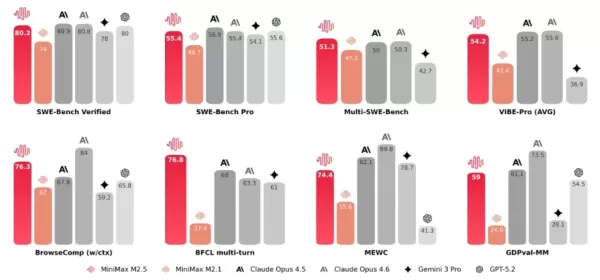
M2.5 has achieved outstanding results across multiple authoritative benchmarks. It reached 80.2% on SWE-Bench Verified, surpassing GPT-5.2 and nearing Claude Opus4.5. On Multi-SWE-Bench, it scored 51.3%, ranking first in multilingual programming performance. BrowseComp performance hit 76.3%, reflecting strong advantages in search and tool-calling tasks. In programming, the model demonstrates architectural-level planning, covering the full software development lifecycle and enabling cross-platform, full-stack development with better framework generalization than Claude Opus4.6. In search, it reduces the number of interaction rounds by 20%, excelling in expert-level search tasks. For office scenarios, it integrates domain knowledge from finance and law, delivering advanced productivity capabilities and achieving a 59.0% win rate against mainstream models in internal evaluations. At the same time, M2.5 is 37% faster than M2.1, matching Claude Opus4.6 in response time while costing only one-tenth as much.
Rapid Iteration Enabled by Technological Innovation
The swift evolution of M2.5 is driven by three core technological advances: first, the Forge native Agent RL framework, which delivers roughly 40x training acceleration; second, the CISPO algorithm, which ensures stability in large-scale training and resolves the long-context credit assignment problem; and third, an innovative Reward design that balances model performance and response speed. Thanks to these technologies, M2.5 now handles 30% of daily tasks and 80% of new code submissions within MiniMax. Over 108 days, the M2 series’ SWE-Bench Verified score rose from 69.4% to 80.2%, with an iteration pace that leads mainstream industry models.
Multiple Deployment Options to Suit Various Scenarios
M2.5 provides three access methods: no-code, API calls, and local deployment, catering to diverse user needs. Non-technical users can get started immediately using the MiniMax Agent web interface, where over 10,000 reusable “Expert” agents have been created by the community. Developers can utilize the free API on ModelScope or the official API. Two official API versions are available—Lightning and Standard—with costs ranging from 1/10 to 1/20 of comparable models. For local deployment, four solutions are supported: SGLang, vLLM, Transformers, and MLX, each tailored for high-concurrency production, small-to-medium scale deployment, quick validation, or Mac-based local development, complete with hardware requirements and operational instructions.
Dedicated Support for Tool Calls and Parameter Optimization
M2.5 natively supports structured tool calls, enabling parallel invocation of multiple tools. When deployed with vLLM or SGLang, you can directly use the OpenAI SDK format; other frameworks require manual parsing of XML-formatted outputs. A complete workflow and best practices are provided for feeding tool results back into the model. For inference, the recommended parameter settings are temperature=1.0, top_p=0.95, and top_k=40, with flexibility to optimize for specific use cases. Programming prompts can leverage the model’s architectural reasoning, and the model adapts well to over 10 programming languages and various scaffolding tools.
Related article
 Stripe to Acquire OpenRouter as AI Model Routing Gains Momentum
Stripe has agreed to acquire OpenRouter, an AI model-routing platform that gives developers access to hundreds of models through a single interface. The deal adds model selection and routing to Stripe’s existing work around AI usage and token-based b
Former OpenAI Researcher Barrett Zoph Returns to Google to Support Gemini Development
Barret Zoph, who previously abruptly left and joined OpenAI due to a disagreement with Thinking Machines Lab CEO Miriam Mularati, has once again changed employers. Alphabet's Google announced that Zoph will return as Vice President of Research, bring
How Recursive Intelligence Raised $335M at $4B Valuation in 4 Months
The co-founders of startup Ricursive Intelligence seemed destined to be co-founders.Anna Goldie, CEO, and Azalia Mirhoseini, CTO, are so well-known in the AI community that they were among those AI engineers who “got those weird emails from Zuckerber
Related Special Topic Recommendations
Design & Art
Stripe to Acquire OpenRouter as AI Model Routing Gains Momentum
Stripe has agreed to acquire OpenRouter, an AI model-routing platform that gives developers access to hundreds of models through a single interface. The deal adds model selection and routing to Stripe’s existing work around AI usage and token-based b
Former OpenAI Researcher Barrett Zoph Returns to Google to Support Gemini Development
Barret Zoph, who previously abruptly left and joined OpenAI due to a disagreement with Thinking Machines Lab CEO Miriam Mularati, has once again changed employers. Alphabet's Google announced that Zoph will return as Vice President of Research, bring
How Recursive Intelligence Raised $335M at $4B Valuation in 4 Months
The co-founders of startup Ricursive Intelligence seemed destined to be co-founders.Anna Goldie, CEO, and Azalia Mirhoseini, CTO, are so well-known in the AI community that they were among those AI engineers who “got those weird emails from Zuckerber
Related Special Topic Recommendations
Design & Art
 Top AI Illustration Tools: Create Editorial Scenes and Cover Art Faster
2026 Latest Top-rated AI Illustration Tools: Our curated list features the best powerfully designed tools for creating stunning editorial scenes and eye-catching cover art quickly. Each option has gone through rigorous real-world tests, offering a free vs paid comparison to help you find the perfect match for your workflow. Try these must-try solutions today to unlock your AI edge and boost your creative productivity. Explore now at XIX.AI.
 10 tools
 xix.ai
Education and Learning
Top AI Tutors for Exam Prep: Practice Math, Science, and English
xix.ai
Education and Learning
Top AI Tutors for Exam Prep: Practice Math, Science, and English
2026 Latest Top-Rated Best AI Tutors for Exam Prep are here on XIX.AI! Our curated list features powerful game-changing tools that offer free vs paid comparison, real-world tests, and weekly updated rankings. They help boost your writing efficiency, simplify complex topic learning, and unlock your academic potential. Explore now to Discover your perfect exam prep tool and Start creating today to Unlock your AI edge!
10 tools
xix.ai
Finance
AI Budget Planning Tools for Personal Money Management
2026 Latest Best Top-Rated AI Budget Planning Tools for Personal Money Management are here on XIX.AI! This curated collection features powerful, game-changing solutions that help you conduct real-world tests, understand spending habits, and create personalized plans to boost productivity. Enjoy a free vs paid comparison along with detailed rankings. Must-try tools designed to simplify money management and unlock your AI edge. Explore now!
11 tools
xix.ai
Health & Wellness
AI Sleep Tracking Assistants: Improve Recovery with Better Bedtime Habits
2026 Latest Best Top-Rated AI Sleep Tracking Assistants curated for ultimate recovery. This fully updated weekly guide features powerful tools that deliver real-world tests, free vs paid comparison, and detailed rankings to help you find the must-try solution that boosts sleep quality and supports better bedtime habits. Explore now at XIX.AI to Unlock your AI edge.
10 tools
xix.ai
Data Analysis
AI SQL Copilots for Product and Revenue Analytics
2026 Latest Best Top-Rated AI SQL Copilots for Product and Revenue Analytics! XIX.AI has curated a powerful, game-changing collection of must-try tools that undergo real-world tests through weekly updated rankings. These tools help users boost productivity significantly by accelerating data analysis, streamlining complex queries, and generating accurate insights to drive smarter business decisions. Explore now to Discover your perfect tool for unlocking your AI edge!
14 tools
xix.ai
Education and Learning
Best AI Homework Helpers That Teach: Learn Concepts, Not Just Answers
2026 Latest Best Top-Rated AI Homework Helpers That Teach Core Concepts Not Just Answers Powerful Tools for Students Must-Try Curated List Weekly Updated Free vs Paid Comparison Real-World Tests Accurate Rankings to Help You Unlock Your Full Learning Potential Explore now to Discover your perfect tool for smarter studying.
10 tools
xix.ai

 Comments (2)
0/500
Comments (2)
0/500
![FrankLewis]()
Finally, MiniMax decided to open-source M2.5? About time! Though I'm a bit skeptical about the whole "affordable AI agents" hype – reminds me of those "free" trials that end up costing an arm and a leg. Let's see if the weights actually run on my laptop without melting it 🔥🤷
![AnthonyPerez]()
¡Esto es enorme! Que MiniMax abra su modelo M2.5 como código abierto en un tiempo récord realmente puede cambiar el juego 🚀. Hace que los agentes de IA avanzados sean mucho más accesibles para desarrolladores individuales y pequeñas empresas. Solo espero que esto presione a otros grandes actores y acelere el ritmo de la innovación en IA. Sin embargo, siempre me preocupa un poco la seguridad y los sesgos con los modelos open-source tan rápidamente disponibles. ¿Cómo se manejará eso?
MiniMax has launched the M2.5 model, the third iteration in its M2 series, released within just 108 days. The open-source model weights are now accessible on ModelScope, marking significant progress in performance, efficiency, and affordability. It excels in programming, search, and workplace applications. Additionally, it offers a seamless access path—from no-code usage to private deployment—along with a comprehensive guide for tool calling and inference parameter tuning, ushering in an era of low-cost AI agents.
Core Capabilities Deliver Multidimensional Breakthroughs
M2.5 has achieved outstanding results across multiple authoritative benchmarks. It reached 80.2% on SWE-Bench Verified, surpassing GPT-5.2 and nearing Claude Opus4.5. On Multi-SWE-Bench, it scored 51.3%, ranking first in multilingual programming performance. BrowseComp performance hit 76.3%, reflecting strong advantages in search and tool-calling tasks. In programming, the model demonstrates architectural-level planning, covering the full software development lifecycle and enabling cross-platform, full-stack development with better framework generalization than Claude Opus4.6. In search, it reduces the number of interaction rounds by 20%, excelling in expert-level search tasks. For office scenarios, it integrates domain knowledge from finance and law, delivering advanced productivity capabilities and achieving a 59.0% win rate against mainstream models in internal evaluations. At the same time, M2.5 is 37% faster than M2.1, matching Claude Opus4.6 in response time while costing only one-tenth as much.
Rapid Iteration Enabled by Technological Innovation
The swift evolution of M2.5 is driven by three core technological advances: first, the Forge native Agent RL framework, which delivers roughly 40x training acceleration; second, the CISPO algorithm, which ensures stability in large-scale training and resolves the long-context credit assignment problem; and third, an innovative Reward design that balances model performance and response speed. Thanks to these technologies, M2.5 now handles 30% of daily tasks and 80% of new code submissions within MiniMax. Over 108 days, the M2 series’ SWE-Bench Verified score rose from 69.4% to 80.2%, with an iteration pace that leads mainstream industry models.
Multiple Deployment Options to Suit Various Scenarios
M2.5 provides three access methods: no-code, API calls, and local deployment, catering to diverse user needs. Non-technical users can get started immediately using the MiniMax Agent web interface, where over 10,000 reusable “Expert” agents have been created by the community. Developers can utilize the free API on ModelScope or the official API. Two official API versions are available—Lightning and Standard—with costs ranging from 1/10 to 1/20 of comparable models. For local deployment, four solutions are supported: SGLang, vLLM, Transformers, and MLX, each tailored for high-concurrency production, small-to-medium scale deployment, quick validation, or Mac-based local development, complete with hardware requirements and operational instructions.
Dedicated Support for Tool Calls and Parameter Optimization
M2.5 natively supports structured tool calls, enabling parallel invocation of multiple tools. When deployed with vLLM or SGLang, you can directly use the OpenAI SDK format; other frameworks require manual parsing of XML-formatted outputs. A complete workflow and best practices are provided for feeding tool results back into the model. For inference, the recommended parameter settings are temperature=1.0, top_p=0.95, and top_k=40, with flexibility to optimize for specific use cases. Programming prompts can leverage the model’s architectural reasoning, and the model adapts well to over 10 programming languages and various scaffolding tools.








 Stripe to Acquire OpenRouter as AI Model Routing Gains Momentum
Stripe has agreed to acquire OpenRouter, an AI model-routing platform that gives developers access to hundreds of models through a single interface. The deal adds model selection and routing to Stripe’s existing work around AI usage and token-based b
Stripe to Acquire OpenRouter as AI Model Routing Gains Momentum
Stripe has agreed to acquire OpenRouter, an AI model-routing platform that gives developers access to hundreds of models through a single interface. The deal adds model selection and routing to Stripe’s existing work around AI usage and token-based b
 Former OpenAI Researcher Barrett Zoph Returns to Google to Support Gemini Development
Barret Zoph, who previously abruptly left and joined OpenAI due to a disagreement with Thinking Machines Lab CEO Miriam Mularati, has once again changed employers. Alphabet's Google announced that Zoph will return as Vice President of Research, bring
Former OpenAI Researcher Barrett Zoph Returns to Google to Support Gemini Development
Barret Zoph, who previously abruptly left and joined OpenAI due to a disagreement with Thinking Machines Lab CEO Miriam Mularati, has once again changed employers. Alphabet's Google announced that Zoph will return as Vice President of Research, bring
 How Recursive Intelligence Raised $335M at $4B Valuation in 4 Months
The co-founders of startup Ricursive Intelligence seemed destined to be co-founders.Anna Goldie, CEO, and Azalia Mirhoseini, CTO, are so well-known in the AI community that they were among those AI engineers who “got those weird emails from Zuckerber
How Recursive Intelligence Raised $335M at $4B Valuation in 4 Months
The co-founders of startup Ricursive Intelligence seemed destined to be co-founders.Anna Goldie, CEO, and Azalia Mirhoseini, CTO, are so well-known in the AI community that they were among those AI engineers who “got those weird emails from Zuckerber

2026 Latest Top-rated AI Illustration Tools: Our curated list features the best powerfully designed tools for creating stunning editorial scenes and eye-catching cover art quickly. Each option has gone through rigorous real-world tests, offering a free vs paid comparison to help you find the perfect match for your workflow. Try these must-try solutions today to unlock your AI edge and boost your creative productivity. Explore now at XIX.AI.
10 tools
xix.ai

2026 Latest Top-Rated Best AI Tutors for Exam Prep are here on XIX.AI! Our curated list features powerful game-changing tools that offer free vs paid comparison, real-world tests, and weekly updated rankings. They help boost your writing efficiency, simplify complex topic learning, and unlock your academic potential. Explore now to Discover your perfect exam prep tool and Start creating today to Unlock your AI edge!
10 tools
xix.ai

2026 Latest Best Top-Rated AI Budget Planning Tools for Personal Money Management are here on XIX.AI! This curated collection features powerful, game-changing solutions that help you conduct real-world tests, understand spending habits, and create personalized plans to boost productivity. Enjoy a free vs paid comparison along with detailed rankings. Must-try tools designed to simplify money management and unlock your AI edge. Explore now!
11 tools
xix.ai

2026 Latest Best Top-Rated AI Sleep Tracking Assistants curated for ultimate recovery. This fully updated weekly guide features powerful tools that deliver real-world tests, free vs paid comparison, and detailed rankings to help you find the must-try solution that boosts sleep quality and supports better bedtime habits. Explore now at XIX.AI to Unlock your AI edge.
10 tools
xix.ai

2026 Latest Best Top-Rated AI SQL Copilots for Product and Revenue Analytics! XIX.AI has curated a powerful, game-changing collection of must-try tools that undergo real-world tests through weekly updated rankings. These tools help users boost productivity significantly by accelerating data analysis, streamlining complex queries, and generating accurate insights to drive smarter business decisions. Explore now to Discover your perfect tool for unlocking your AI edge!
14 tools
xix.ai

2026 Latest Best Top-Rated AI Homework Helpers That Teach Core Concepts Not Just Answers Powerful Tools for Students Must-Try Curated List Weekly Updated Free vs Paid Comparison Real-World Tests Accurate Rankings to Help You Unlock Your Full Learning Potential Explore now to Discover your perfect tool for smarter studying.
10 tools
xix.ai

Finally, MiniMax decided to open-source M2.5? About time! Though I'm a bit skeptical about the whole "affordable AI agents" hype – reminds me of those "free" trials that end up costing an arm and a leg. Let's see if the weights actually run on my laptop without melting it 🔥🤷
¡Esto es enorme! Que MiniMax abra su modelo M2.5 como código abierto en un tiempo récord realmente puede cambiar el juego 🚀. Hace que los agentes de IA avanzados sean mucho más accesibles para desarrolladores individuales y pequeñas empresas. Solo espero que esto presione a otros grandes actores y acelere el ritmo de la innovación en IA. Sin embargo, siempre me preocupa un poco la seguridad y los sesgos con los modelos open-source tan rápidamente disponibles. ¿Cómo se manejará eso?












