


 Home
HomeMicrosoft Open-Sources Phi-4-Vision, a Lightweight Multimodal AI Model
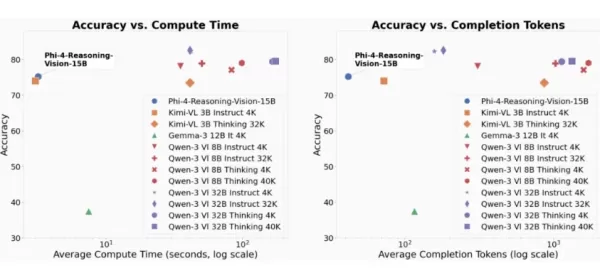
Microsoft has officially open-sourced its latest multi-modal reasoning model, Phi-4-reasoning-vision-15B. With 15 billion parameters, this model strikes an ideal balance between high performance and low cost. Its lightweight architecture makes it a compelling new option for tackling complex visual tasks in resource-limited environments.
A "Compact Powerhouse" Fueled by Refined Data
Unlike typical industry models trained on trillions of tokens, Phi-4-reasoning-vision was developed using only 200 billion multi-modal tokens. The team prioritized data quality through rigorous cleaning of open-source data, generating targeted synthetic data, and carefully calibrating domain-specific data ratios—such as increasing mathematical content to boost computational reasoning. This approach enables excellent performance in scientific reasoning and on-screen element localization tasks.
Innovative Hybrid Reasoning Strategy
A key innovation of this model is its "hybrid reasoning pathway" design:
Perception Tasks: For straightforward tasks like image captioning or OCR, the model defaults to a direct answer mode, optimizing for speed and lower latency.
Reasoning Tasks: When confronted with complex logic, such as interpreting mathematical formulas or scientific charts, it automatically engages a structured chain-of-thought (CoT) process to ensure answer accuracy.
Users can also manually switch between these two modes using specific trigger phrases, adapting the model's behavior to different application needs.
By integrating the SigLIP-2 dynamic resolution encoder, the model excels at perceiving fine details within high-resolution screenshots. This capability positions it as an ideal foundation for developing Computer Usage Agents (CUAs), which can accurately identify and interact with buttons, fields, and other elements on digital interfaces.
Phi-4-reasoning-vision-15B is now available on major open-source platforms. Microsoft envisions that this compact model will demonstrate how "smaller and faster" can also mean "more capable" in the multi-modal domain, helping to advance the adoption of spatial intelligence and real-time interactive technologies.
Related article
 Tencent Unveils AI-Native Cloud Storage to Disrupt Big Tech Dominance
Tencent Cloud Drive has officially launched without prior announcement, with its homepage currently displaying a prominent "COMING SOON" message. Despite the absence of an official statement or specific launch date, this development has already spark
King Charles Speaks Out on AI Safety Concerns
Left to right: King Charles with Alphabet Chief Scientist and Google DeepMind Founder Demis Hassabis, alongside NVIDIA CEO Jensen Huang. Photo credit: NVIDIA/LinkedInKing Charles convened leaders from NVIDIA, Google DeepMind, and Anthropic to discuss
MIIT: OpenHarmony Surpasses 1.35 Billion Devices as Downloads Hit 10 Billion
China’s open-source ecosystem took center stage during a recent State Council Information Office briefing, highlighting the nation's growing influence in technology. Held on July 20 at 10:00 a.m., the event featured key officials from the Ministry of
Related Special Topic Recommendations
Software Development
Tencent Unveils AI-Native Cloud Storage to Disrupt Big Tech Dominance
Tencent Cloud Drive has officially launched without prior announcement, with its homepage currently displaying a prominent "COMING SOON" message. Despite the absence of an official statement or specific launch date, this development has already spark
King Charles Speaks Out on AI Safety Concerns
Left to right: King Charles with Alphabet Chief Scientist and Google DeepMind Founder Demis Hassabis, alongside NVIDIA CEO Jensen Huang. Photo credit: NVIDIA/LinkedInKing Charles convened leaders from NVIDIA, Google DeepMind, and Anthropic to discuss
MIIT: OpenHarmony Surpasses 1.35 Billion Devices as Downloads Hit 10 Billion
China’s open-source ecosystem took center stage during a recent State Council Information Office briefing, highlighting the nation's growing influence in technology. Held on July 20 at 10:00 a.m., the event featured key officials from the Ministry of
Related Special Topic Recommendations
Software Development
 Best AI Release Note Generators for SaaS Engineering Teams
2026 Latest Best Top-rated AI Release Note Generators for SaaS Engineering Teams, carefully curated by XIX.AI. These powerful tools help teams create clear, concise updates fast, boost writing efficiency significantly, and avoid common mistakes. Enjoy a free vs paid comparison along with real-world tests and weekly updated rankings. Discover your perfect tool to unlock your AI edge today. Explore now!
 10 tools
 xix.ai
chatbot
Best AI Chatbot Tools for Customer Support
xix.ai
chatbot
Best AI Chatbot Tools for Customer Support
2026 Latest Best Top-Rated AI Chatbot Tools for Customer Support are here on XIX.AI! This curated list features powerful, game-changing solutions that boost efficiency across all customer service tasks. We conduct real-world tests and provide a weekly updated free vs paid comparison along with detailed rankings to help you find the must-try tool that matches your needs perfectly. Explore now to unlock your AI edge!
13 tools
xix.ai
SEO
AI Topic Cluster Tools for SEO Content Planning
2026 Latest Best Top-Rated AI Topic Cluster Tools for SEO Content Planning! XIX.AI curates a powerful game-changing collection that has undergone rigorous real-world tests and weekly updated rankings. These must-try tools help you plan high-quality content efficiently, boost writing productivity, and overcome creativity bottlenecks. Explore now to discover your perfect tool and unlock your AI edge in SEO work!
8 tools
xix.ai
writing
AI Editing Tools for Business and Academic Writing
2026 Latest Best Top-Rated AI Editing Tools for Business and Academic Writing! XIX.AI has curated a powerful, game-changing collection of must-try tools that go through rigorous real-world tests. You’ll find detailed free vs paid comparison, accurate rankings, and insights to help you boost writing efficiency, produce high-quality content faster, and meet tight deadlines. Explore now to unlock your AI edge!
9 tools
xix.ai
code
AI Debugging Tools for Python and JavaScript Projects
2026 Latest Best Top-Rated AI Debugging Tools for Python and JavaScript Projects, curated by XIX.AI. These powerful game-changing solutions offer real-world tests, weekly updated rankings, and a free vs paid comparison to help you fix coding errors faster, boost productivity, and unlock your AI edge. Explore now!
14 tools
xix.ai
Software Development
AI Code Search Tools for Large Repositories
2026 Latest Best AI Code Search Tools for Large Repositories ranked by expert teams. This curated list showcases top-rated solutions that deliver powerful, game-changing speed when navigating massive codebases. You’ll find a free vs paid comparison along with real-world tests to help you choose the perfect fit. XIX.AI provides exclusive insights to elevate your productivity. Explore now and unlock your AI edge.
9 tools
xix.ai

 Comments (1)
0/500
Comments (1)
0/500
![StevenSanchez]()
So Microsoft just dropped Phi-4-Vision as open source? That's a bold move — 15B params and low cost sounds like a sweet spot for startups who can't afford GPT-4. But I wonder: will this actually drive real multimodal apps or just end up as another benchmark-chasing experiment?
Microsoft has officially open-sourced its latest multi-modal reasoning model, Phi-4-reasoning-vision-15B. With 15 billion parameters, this model strikes an ideal balance between high performance and low cost. Its lightweight architecture makes it a compelling new option for tackling complex visual tasks in resource-limited environments.
A "Compact Powerhouse" Fueled by Refined Data
Unlike typical industry models trained on trillions of tokens, Phi-4-reasoning-vision was developed using only 200 billion multi-modal tokens. The team prioritized data quality through rigorous cleaning of open-source data, generating targeted synthetic data, and carefully calibrating domain-specific data ratios—such as increasing mathematical content to boost computational reasoning. This approach enables excellent performance in scientific reasoning and on-screen element localization tasks.
Innovative Hybrid Reasoning Strategy
A key innovation of this model is its "hybrid reasoning pathway" design:
Perception Tasks: For straightforward tasks like image captioning or OCR, the model defaults to a direct answer mode, optimizing for speed and lower latency.
Reasoning Tasks: When confronted with complex logic, such as interpreting mathematical formulas or scientific charts, it automatically engages a structured chain-of-thought (CoT) process to ensure answer accuracy.
Users can also manually switch between these two modes using specific trigger phrases, adapting the model's behavior to different application needs.
By integrating the SigLIP-2 dynamic resolution encoder, the model excels at perceiving fine details within high-resolution screenshots. This capability positions it as an ideal foundation for developing Computer Usage Agents (CUAs), which can accurately identify and interact with buttons, fields, and other elements on digital interfaces.
Phi-4-reasoning-vision-15B is now available on major open-source platforms. Microsoft envisions that this compact model will demonstrate how "smaller and faster" can also mean "more capable" in the multi-modal domain, helping to advance the adoption of spatial intelligence and real-time interactive technologies.








 Tencent Unveils AI-Native Cloud Storage to Disrupt Big Tech Dominance
Tencent Cloud Drive has officially launched without prior announcement, with its homepage currently displaying a prominent "COMING SOON" message. Despite the absence of an official statement or specific launch date, this development has already spark
Tencent Unveils AI-Native Cloud Storage to Disrupt Big Tech Dominance
Tencent Cloud Drive has officially launched without prior announcement, with its homepage currently displaying a prominent "COMING SOON" message. Despite the absence of an official statement or specific launch date, this development has already spark
 King Charles Speaks Out on AI Safety Concerns
Left to right: King Charles with Alphabet Chief Scientist and Google DeepMind Founder Demis Hassabis, alongside NVIDIA CEO Jensen Huang. Photo credit: NVIDIA/LinkedInKing Charles convened leaders from NVIDIA, Google DeepMind, and Anthropic to discuss
King Charles Speaks Out on AI Safety Concerns
Left to right: King Charles with Alphabet Chief Scientist and Google DeepMind Founder Demis Hassabis, alongside NVIDIA CEO Jensen Huang. Photo credit: NVIDIA/LinkedInKing Charles convened leaders from NVIDIA, Google DeepMind, and Anthropic to discuss
 MIIT: OpenHarmony Surpasses 1.35 Billion Devices as Downloads Hit 10 Billion
China’s open-source ecosystem took center stage during a recent State Council Information Office briefing, highlighting the nation's growing influence in technology. Held on July 20 at 10:00 a.m., the event featured key officials from the Ministry of
MIIT: OpenHarmony Surpasses 1.35 Billion Devices as Downloads Hit 10 Billion
China’s open-source ecosystem took center stage during a recent State Council Information Office briefing, highlighting the nation's growing influence in technology. Held on July 20 at 10:00 a.m., the event featured key officials from the Ministry of
2026 Latest Best Top-rated AI Release Note Generators for SaaS Engineering Teams, carefully curated by XIX.AI. These powerful tools help teams create clear, concise updates fast, boost writing efficiency significantly, and avoid common mistakes. Enjoy a free vs paid comparison along with real-world tests and weekly updated rankings. Discover your perfect tool to unlock your AI edge today. Explore now!
10 tools
xix.ai

2026 Latest Best Top-Rated AI Chatbot Tools for Customer Support are here on XIX.AI! This curated list features powerful, game-changing solutions that boost efficiency across all customer service tasks. We conduct real-world tests and provide a weekly updated free vs paid comparison along with detailed rankings to help you find the must-try tool that matches your needs perfectly. Explore now to unlock your AI edge!
13 tools
xix.ai

2026 Latest Best Top-Rated AI Topic Cluster Tools for SEO Content Planning! XIX.AI curates a powerful game-changing collection that has undergone rigorous real-world tests and weekly updated rankings. These must-try tools help you plan high-quality content efficiently, boost writing productivity, and overcome creativity bottlenecks. Explore now to discover your perfect tool and unlock your AI edge in SEO work!
8 tools
xix.ai
2026 Latest Best Top-Rated AI Editing Tools for Business and Academic Writing! XIX.AI has curated a powerful, game-changing collection of must-try tools that go through rigorous real-world tests. You’ll find detailed free vs paid comparison, accurate rankings, and insights to help you boost writing efficiency, produce high-quality content faster, and meet tight deadlines. Explore now to unlock your AI edge!
9 tools
xix.ai

2026 Latest Best Top-Rated AI Debugging Tools for Python and JavaScript Projects, curated by XIX.AI. These powerful game-changing solutions offer real-world tests, weekly updated rankings, and a free vs paid comparison to help you fix coding errors faster, boost productivity, and unlock your AI edge. Explore now!
14 tools
xix.ai

2026 Latest Best AI Code Search Tools for Large Repositories ranked by expert teams. This curated list showcases top-rated solutions that deliver powerful, game-changing speed when navigating massive codebases. You’ll find a free vs paid comparison along with real-world tests to help you choose the perfect fit. XIX.AI provides exclusive insights to elevate your productivity. Explore now and unlock your AI edge.
9 tools
xix.ai

So Microsoft just dropped Phi-4-Vision as open source? That's a bold move — 15B params and low cost sounds like a sweet spot for startups who can't afford GPT-4. But I wonder: will this actually drive real multimodal apps or just end up as another benchmark-chasing experiment?












