


 Home
HomeMIIT: OpenHarmony Surpasses 1.35 Billion Devices as Downloads Hit 10 Billion
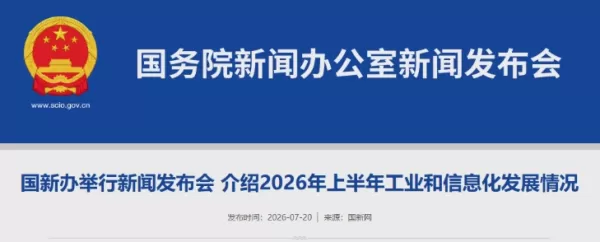
China’s open-source ecosystem took center stage during a recent State Council Information Office briefing, highlighting the nation's growing influence in technology. Held on July 20 at 10:00 a.m., the event featured key officials from the Ministry of Industry and Information Technology, including Wang Weiming, Tao Qing, and Xie Cun, who presented the industry’s performance for the first half of 2026 and addressed media inquiries. The data shared by Tao Qing provided a clear snapshot of the progress made in basic software, industrial applications, and the broader open-source community.
Stability remains the cornerstone of this growth. Between January and May, China’s software sector generated over 6.2 trillion yuan in revenue, marking a 10.3% year-on-year increase and sustaining a steady upward trajectory. This robust financial foundation has enabled the industry to exhibit four distinct developmental trends this year.
First, basic software is accelerating its development. Operating systems and databases are achieving significant breakthroughs, with continuous innovation driving progress. The open-source HarmonyOS has expanded its reach to cover smartphones, computers, vehicles, and smart home devices, supporting more than 1.35 billion connected units. Additionally, over 100 industry-specific distributions based on open-source HarmonyOS, such as E-Hong and Yi-Hong, have been released. What began as a domestic initiative from scratch has evolved into a massive ecosystem powering hundreds of millions of devices.
Second, industrial software is seeing widespread adoption. A comprehensive product suite now covers critical sectors, with rapid deployment and iterative improvements driving digital transformation across industries. By the end of June, the adoption rate of digital R&D design tools in key industrial enterprises reached 86.3%, while the digitalization rate of core processes hit 69.5%, both figures reflecting high levels of integration.
Third, artificial intelligence is providing comprehensive empowerment. The government has encouraged software firms to leverage AI-driven transformations, speeding up the integration of code large models and intelligent programming tools. These advancements have boosted R&D and production efficiency, resulting in richer product features, more intuitive user interactions, and faster content creation. Innovative applications, including intelligent testing and operations, are also being implemented at an accelerating pace.
Fourth, and most notably highlighted at this briefing, is the rapid expansion of the open-source ecosystem. National-level open-source foundations are currently incubating more than 50 projects. The national AI open-source community has attracted over 11 million users and hosts more than 70,000 models. Comprehensive open-source solutions spanning basic software, large models, and applications are being built rapidly. Most strikingly, global cumulative downloads of China’s AI open-source large models have surpassed 10 billion. This transition from lines of code to billions of pulls by developers worldwide underscores the tangible global impact of China’s AI advancements.
Related article
 King Charles Speaks Out on AI Safety Concerns
Left to right: King Charles with Alphabet Chief Scientist and Google DeepMind Founder Demis Hassabis, alongside NVIDIA CEO Jensen Huang. Photo credit: NVIDIA/LinkedInKing Charles convened leaders from NVIDIA, Google DeepMind, and Anthropic to discuss
Deep Code Now Supports DeepSeek-V4 as AI Programming Enters Deep Thinking Era
In the rapidly evolving arena of AI coding assistants, Deep Code, a newly emerged open-source terminal tool, has captured significant attention from the developer community. Its standout feature is its seamless integration with the DeepSeek-V4 series
How to fix Core Web Vitals for SEO ranking
Most AI audio tools still force creators through a fragmented workflow: one product for voice, another for music, a third for sound effects, and a DAW to stitch everything together.Seed Audio 1.0(seedaudio1.0) takes a different approach — it treats y
Related Special Topic Recommendations
Software Development
King Charles Speaks Out on AI Safety Concerns
Left to right: King Charles with Alphabet Chief Scientist and Google DeepMind Founder Demis Hassabis, alongside NVIDIA CEO Jensen Huang. Photo credit: NVIDIA/LinkedInKing Charles convened leaders from NVIDIA, Google DeepMind, and Anthropic to discuss
Deep Code Now Supports DeepSeek-V4 as AI Programming Enters Deep Thinking Era
In the rapidly evolving arena of AI coding assistants, Deep Code, a newly emerged open-source terminal tool, has captured significant attention from the developer community. Its standout feature is its seamless integration with the DeepSeek-V4 series
How to fix Core Web Vitals for SEO ranking
Most AI audio tools still force creators through a fragmented workflow: one product for voice, another for music, a third for sound effects, and a DAW to stitch everything together.Seed Audio 1.0(seedaudio1.0) takes a different approach — it treats y
Related Special Topic Recommendations
Software Development
 Best AI Release Note Generators for SaaS Engineering Teams
2026 Latest Best Top-rated AI Release Note Generators for SaaS Engineering Teams, carefully curated by XIX.AI. These powerful tools help teams create clear, concise updates fast, boost writing efficiency significantly, and avoid common mistakes. Enjoy a free vs paid comparison along with real-world tests and weekly updated rankings. Discover your perfect tool to unlock your AI edge today. Explore now!
 10 tools
 xix.ai
chatbot
Best AI Chatbot Tools for Customer Support
xix.ai
chatbot
Best AI Chatbot Tools for Customer Support
2026 Latest Best Top-Rated AI Chatbot Tools for Customer Support are here on XIX.AI! This curated list features powerful, game-changing solutions that boost efficiency across all customer service tasks. We conduct real-world tests and provide a weekly updated free vs paid comparison along with detailed rankings to help you find the must-try tool that matches your needs perfectly. Explore now to unlock your AI edge!
13 tools
xix.ai
SEO
AI Topic Cluster Tools for SEO Content Planning
2026 Latest Best Top-Rated AI Topic Cluster Tools for SEO Content Planning! XIX.AI curates a powerful game-changing collection that has undergone rigorous real-world tests and weekly updated rankings. These must-try tools help you plan high-quality content efficiently, boost writing productivity, and overcome creativity bottlenecks. Explore now to discover your perfect tool and unlock your AI edge in SEO work!
8 tools
xix.ai
writing
AI Editing Tools for Business and Academic Writing
2026 Latest Best Top-Rated AI Editing Tools for Business and Academic Writing! XIX.AI has curated a powerful, game-changing collection of must-try tools that go through rigorous real-world tests. You’ll find detailed free vs paid comparison, accurate rankings, and insights to help you boost writing efficiency, produce high-quality content faster, and meet tight deadlines. Explore now to unlock your AI edge!
9 tools
xix.ai
code
AI Debugging Tools for Python and JavaScript Projects
2026 Latest Best Top-Rated AI Debugging Tools for Python and JavaScript Projects, curated by XIX.AI. These powerful game-changing solutions offer real-world tests, weekly updated rankings, and a free vs paid comparison to help you fix coding errors faster, boost productivity, and unlock your AI edge. Explore now!
14 tools
xix.ai
Software Development
AI Code Search Tools for Large Repositories
2026 Latest Best AI Code Search Tools for Large Repositories ranked by expert teams. This curated list showcases top-rated solutions that deliver powerful, game-changing speed when navigating massive codebases. You’ll find a free vs paid comparison along with real-world tests to help you choose the perfect fit. XIX.AI provides exclusive insights to elevate your productivity. Explore now and unlock your AI edge.
9 tools
xix.ai

 Comments (0)
0/500
Comments (0)
0/500
China’s open-source ecosystem took center stage during a recent State Council Information Office briefing, highlighting the nation's growing influence in technology. Held on July 20 at 10:00 a.m., the event featured key officials from the Ministry of Industry and Information Technology, including Wang Weiming, Tao Qing, and Xie Cun, who presented the industry’s performance for the first half of 2026 and addressed media inquiries. The data shared by Tao Qing provided a clear snapshot of the progress made in basic software, industrial applications, and the broader open-source community.
Stability remains the cornerstone of this growth. Between January and May, China’s software sector generated over 6.2 trillion yuan in revenue, marking a 10.3% year-on-year increase and sustaining a steady upward trajectory. This robust financial foundation has enabled the industry to exhibit four distinct developmental trends this year.
First, basic software is accelerating its development. Operating systems and databases are achieving significant breakthroughs, with continuous innovation driving progress. The open-source HarmonyOS has expanded its reach to cover smartphones, computers, vehicles, and smart home devices, supporting more than 1.35 billion connected units. Additionally, over 100 industry-specific distributions based on open-source HarmonyOS, such as E-Hong and Yi-Hong, have been released. What began as a domestic initiative from scratch has evolved into a massive ecosystem powering hundreds of millions of devices.
Second, industrial software is seeing widespread adoption. A comprehensive product suite now covers critical sectors, with rapid deployment and iterative improvements driving digital transformation across industries. By the end of June, the adoption rate of digital R&D design tools in key industrial enterprises reached 86.3%, while the digitalization rate of core processes hit 69.5%, both figures reflecting high levels of integration.
Third, artificial intelligence is providing comprehensive empowerment. The government has encouraged software firms to leverage AI-driven transformations, speeding up the integration of code large models and intelligent programming tools. These advancements have boosted R&D and production efficiency, resulting in richer product features, more intuitive user interactions, and faster content creation. Innovative applications, including intelligent testing and operations, are also being implemented at an accelerating pace.
Fourth, and most notably highlighted at this briefing, is the rapid expansion of the open-source ecosystem. National-level open-source foundations are currently incubating more than 50 projects. The national AI open-source community has attracted over 11 million users and hosts more than 70,000 models. Comprehensive open-source solutions spanning basic software, large models, and applications are being built rapidly. Most strikingly, global cumulative downloads of China’s AI open-source large models have surpassed 10 billion. This transition from lines of code to billions of pulls by developers worldwide underscores the tangible global impact of China’s AI advancements.








 King Charles Speaks Out on AI Safety Concerns
Left to right: King Charles with Alphabet Chief Scientist and Google DeepMind Founder Demis Hassabis, alongside NVIDIA CEO Jensen Huang. Photo credit: NVIDIA/LinkedInKing Charles convened leaders from NVIDIA, Google DeepMind, and Anthropic to discuss
King Charles Speaks Out on AI Safety Concerns
Left to right: King Charles with Alphabet Chief Scientist and Google DeepMind Founder Demis Hassabis, alongside NVIDIA CEO Jensen Huang. Photo credit: NVIDIA/LinkedInKing Charles convened leaders from NVIDIA, Google DeepMind, and Anthropic to discuss
 Deep Code Now Supports DeepSeek-V4 as AI Programming Enters Deep Thinking Era
In the rapidly evolving arena of AI coding assistants, Deep Code, a newly emerged open-source terminal tool, has captured significant attention from the developer community. Its standout feature is its seamless integration with the DeepSeek-V4 series
How to fix Core Web Vitals for SEO ranking
Most AI audio tools still force creators through a fragmented workflow: one product for voice, another for music, a third for sound effects, and a DAW to stitch everything together.Seed Audio 1.0(seedaudio1.0) takes a different approach — it treats y
Deep Code Now Supports DeepSeek-V4 as AI Programming Enters Deep Thinking Era
In the rapidly evolving arena of AI coding assistants, Deep Code, a newly emerged open-source terminal tool, has captured significant attention from the developer community. Its standout feature is its seamless integration with the DeepSeek-V4 series
How to fix Core Web Vitals for SEO ranking
Most AI audio tools still force creators through a fragmented workflow: one product for voice, another for music, a third for sound effects, and a DAW to stitch everything together.Seed Audio 1.0(seedaudio1.0) takes a different approach — it treats y
2026 Latest Best Top-rated AI Release Note Generators for SaaS Engineering Teams, carefully curated by XIX.AI. These powerful tools help teams create clear, concise updates fast, boost writing efficiency significantly, and avoid common mistakes. Enjoy a free vs paid comparison along with real-world tests and weekly updated rankings. Discover your perfect tool to unlock your AI edge today. Explore now!
10 tools
xix.ai

2026 Latest Best Top-Rated AI Chatbot Tools for Customer Support are here on XIX.AI! This curated list features powerful, game-changing solutions that boost efficiency across all customer service tasks. We conduct real-world tests and provide a weekly updated free vs paid comparison along with detailed rankings to help you find the must-try tool that matches your needs perfectly. Explore now to unlock your AI edge!
13 tools
xix.ai

2026 Latest Best Top-Rated AI Topic Cluster Tools for SEO Content Planning! XIX.AI curates a powerful game-changing collection that has undergone rigorous real-world tests and weekly updated rankings. These must-try tools help you plan high-quality content efficiently, boost writing productivity, and overcome creativity bottlenecks. Explore now to discover your perfect tool and unlock your AI edge in SEO work!
8 tools
xix.ai

2026 Latest Best Top-Rated AI Editing Tools for Business and Academic Writing! XIX.AI has curated a powerful, game-changing collection of must-try tools that go through rigorous real-world tests. You’ll find detailed free vs paid comparison, accurate rankings, and insights to help you boost writing efficiency, produce high-quality content faster, and meet tight deadlines. Explore now to unlock your AI edge!
9 tools
xix.ai

2026 Latest Best Top-Rated AI Debugging Tools for Python and JavaScript Projects, curated by XIX.AI. These powerful game-changing solutions offer real-world tests, weekly updated rankings, and a free vs paid comparison to help you fix coding errors faster, boost productivity, and unlock your AI edge. Explore now!
14 tools
xix.ai

2026 Latest Best AI Code Search Tools for Large Repositories ranked by expert teams. This curated list showcases top-rated solutions that deliver powerful, game-changing speed when navigating massive codebases. You’ll find a free vs paid comparison along with real-world tests to help you choose the perfect fit. XIX.AI provides exclusive insights to elevate your productivity. Explore now and unlock your AI edge.
9 tools
xix.ai












