


 Home
HomeMicrosoft Classic Outlook to Integrate Copilot AI for Email Drafting on Windows 10 and 11
Windows Latest reports that Microsoft intends to bring the Copilot update to the classic Outlook for Windows 10 and 11 by late 2026, introducing an "email drafting" feature. This strategy signals Microsoft's push to extend AI tools from the new Outlook to legacy users, accelerating Copilot's integration into everyday office workflows.

Classic Outlook users to receive AI drafting tools
Microsoft plans to roll out the "draft email" feature to Microsoft 365 Copilot license holders this year. Once enabled, users can activate Copilot within the compose window to generate or refine emails, cutting down on writing time. Previously exclusive to the new Outlook app, this feature's expansion to the classic version highlights Microsoft's effort to broaden Copilot access and encourage user migration.
However, Windows Latest notes potential friction. With development prioritizing the new Outlook, adding AI to the classic version might confuse users, leaving them unsure whether Microsoft aims to support legacy users or hasten their transition to the new platform.
SpaceX orbital AI costs projected below NVIDIA ground solutions, per Morgan Stanley
A July 23 report from Morgan Stanley indicates SpaceX's orbital computing costs could fall to $6.5 per watt annually by 2031 (approx. 44.1 RMB), undercutting the $6.8 per watt annual cost of ground-based NVIDIA Blackwell GPU data centers. This marks the first time mainstream investment banks view orbital computing as commercially viable.
AI1 satellite design unveiled, highlighting space computing benefits
SpaceX has shared details of its first dedicated AI satellite, the "AI1." Capable of handling up to 150kW of peak computing load, it features liquid cooling, micrometeoroid shielding, centralized computing modules, and deployable solar arrays. Manufactured at SpaceX's Gigasat facility in Texas, the company has requested FCC approval to launch up to 1 million such satellites.
Orbital data centers offer distinct advantages over ground-based alternatives. The vacuum environment facilitates radiative cooling, while continuous solar exposure ensures reliable power. Strategic orbital positioning allows for massive scalability. Morgan Stanley projects orbital computing costs could drop to $1.7 per watt annually by 2040. At that point, a 1GW orbital data center would cost $1.7 billion annually to operate, compared to roughly $100 billion in upfront construction costs for an equivalent ground facility today. Bridging this cost gap could fundamentally transform the global AI infrastructure landscape.
Related article
 Volcano Engine's Seedance AI shifts focus from copyright protection to IP commercialization
Yule Capital reports that ByteDance’s Huoshan Engine has invited several copyright holders to beta test its new “AI Copyright Management Platform.” This tool enables brand owners and short-form drama producers to commercially leverage legally license
Huang Renxun Praises OpenClaw for Record-Breaking Adoption, Completing Linux's 30-Year Journey in Weeks
NVIDIA CEO Jensen Huang delivered a keynote address at the recent Morgan Stanley conference, declaring that agentic AI has reached a pivotal historical milestone and offering high praise for the open-source project OpenClaw.Huang described OpenClaw a
Friend, the Lonely AI Wearable, Returns With a New Voice and a Much Bigger Price Tag
Two years ago, tech entrepreneur Avi Schiffmann introduced Friend, an AI-powered wearable device designed for conversation and daily text updates. The core concept was to leverage artificial intelligence to alleviate feelings of isolation. This week,
Related Special Topic Recommendations
Health & Wellness
Volcano Engine's Seedance AI shifts focus from copyright protection to IP commercialization
Yule Capital reports that ByteDance’s Huoshan Engine has invited several copyright holders to beta test its new “AI Copyright Management Platform.” This tool enables brand owners and short-form drama producers to commercially leverage legally license
Huang Renxun Praises OpenClaw for Record-Breaking Adoption, Completing Linux's 30-Year Journey in Weeks
NVIDIA CEO Jensen Huang delivered a keynote address at the recent Morgan Stanley conference, declaring that agentic AI has reached a pivotal historical milestone and offering high praise for the open-source project OpenClaw.Huang described OpenClaw a
Friend, the Lonely AI Wearable, Returns With a New Voice and a Much Bigger Price Tag
Two years ago, tech entrepreneur Avi Schiffmann introduced Friend, an AI-powered wearable device designed for conversation and daily text updates. The core concept was to leverage artificial intelligence to alleviate feelings of isolation. This week,
Related Special Topic Recommendations
Health & Wellness
 Best AI Wellness Companions: Reduce Stress with Daily Mindfulness Support
2026 Latest Best Top-Rated AI Wellness Companions Ranked by Experts. This curated list features powerful game-changing tools that offer daily mindfulness support to help users reduce stress, boost focus, and improve overall well-being through real-world tests. Get a free vs paid comparison to find your perfect match. Explore now at XIX.AI to unlock your AI edge.
 9 tools
 xix.ai
Text-to-speech
AI Speech Styling Tools for Natural Voice Output
xix.ai
Text-to-speech
AI Speech Styling Tools for Natural Voice Output
2026 Latest Best Top-Rated AI Speech Styling Tools for Natural Voice Output are here on XIX.AI. This curated collection features powerful, game-changing tools that deliver highly customizable voice tones, perfect for boosting writing efficiency and creating engaging content. We conduct real-world tests to provide accurate weekly updated rankings, along with a free vs paid comparison to help you choose the best fit for your needs. Explore now to Discover your perfect tool and Unlock your AI edge.
20 tools
xix.ai
SEO
AI Rank Tracking Tools for Google, AI Overviews, and Answer Engine Visibility
2026 Latest Best Top-rated AI Rank Tracking Tools for Google, AI Overviews, and Answer Engine Visibility are here on XIX.AI. This curated list features powerful game-changing tools that go through rigorous real-world tests to deliver accurate rankings data. Get a free vs paid comparison, see top performers, and discover must-try options to boost your content’s visibility across search engines. Explore now to find the perfect tool for your needs.
10 tools
xix.ai
Productivity
Best AI Second-Brain Organizers for Notes and Tasks
2026 Latest Best Top-Rated AI Second-Brain Organizers for Notes and Tasks! XIX.AI has curated a highly powerful game-changing collection, featuring weekly updated rankings, free vs paid comparison, and real-world tests to help you find the perfect tool that boosts productivity dramatically. Explore now to unlock your AI edge!
11 tools
xix.ai
Prompt
AI Prompt Testing Platforms for ChatGPT and Claude Workflows
2026 Latest Best Top-Rated AI Prompt Testing Platforms for ChatGPT and Claude Workflows! XIX.AI curates a powerful game-changing collection, featuring weekly updated rankings, free vs paid comparison, real-world tests, and detailed feature breakdowns to help you identify the must-try tools that boost productivity and deliver flawless outputs. Explore now to discover your perfect solution and unlock your AI edge. (249 characters)
9 tools
xix.ai
Marketing
AI Landing Page Copy Tools for SaaS A/B Tests, Pricing Pages, and Demo Conversion
2026 Latest Best AI Landing Page Copy Tools for SaaS A/B Tests, Pricing Pages, and Demo Conversion are here on XIX.AI. This curated list of top-rated tools offers powerful game-changing solutions to boost content quality, improve writing efficiency, and enhance overall productivity. We conduct real-world tests and provide a free vs paid comparison along with weekly updated rankings. Must-try options help you break through creation bottlenecks. Explore now to discover your perfect tool and unlock your AI edge!
8 tools
xix.ai

 Comments (0)
0/500
Comments (0)
0/500
Windows Latest reports that Microsoft intends to bring the Copilot update to the classic Outlook for Windows 10 and 11 by late 2026, introducing an "email drafting" feature. This strategy signals Microsoft's push to extend AI tools from the new Outlook to legacy users, accelerating Copilot's integration into everyday office workflows.
Classic Outlook users to receive AI drafting tools
Microsoft plans to roll out the "draft email" feature to Microsoft 365 Copilot license holders this year. Once enabled, users can activate Copilot within the compose window to generate or refine emails, cutting down on writing time. Previously exclusive to the new Outlook app, this feature's expansion to the classic version highlights Microsoft's effort to broaden Copilot access and encourage user migration.
However, Windows Latest notes potential friction. With development prioritizing the new Outlook, adding AI to the classic version might confuse users, leaving them unsure whether Microsoft aims to support legacy users or hasten their transition to the new platform.
SpaceX orbital AI costs projected below NVIDIA ground solutions, per Morgan Stanley
A July 23 report from Morgan Stanley indicates SpaceX's orbital computing costs could fall to $6.5 per watt annually by 2031 (approx. 44.1 RMB), undercutting the $6.8 per watt annual cost of ground-based NVIDIA Blackwell GPU data centers. This marks the first time mainstream investment banks view orbital computing as commercially viable.
AI1 satellite design unveiled, highlighting space computing benefits
SpaceX has shared details of its first dedicated AI satellite, the "AI1." Capable of handling up to 150kW of peak computing load, it features liquid cooling, micrometeoroid shielding, centralized computing modules, and deployable solar arrays. Manufactured at SpaceX's Gigasat facility in Texas, the company has requested FCC approval to launch up to 1 million such satellites.
Orbital data centers offer distinct advantages over ground-based alternatives. The vacuum environment facilitates radiative cooling, while continuous solar exposure ensures reliable power. Strategic orbital positioning allows for massive scalability. Morgan Stanley projects orbital computing costs could drop to $1.7 per watt annually by 2040. At that point, a 1GW orbital data center would cost $1.7 billion annually to operate, compared to roughly $100 billion in upfront construction costs for an equivalent ground facility today. Bridging this cost gap could fundamentally transform the global AI infrastructure landscape.








 Volcano Engine's Seedance AI shifts focus from copyright protection to IP commercialization
Yule Capital reports that ByteDance’s Huoshan Engine has invited several copyright holders to beta test its new “AI Copyright Management Platform.” This tool enables brand owners and short-form drama producers to commercially leverage legally license
Volcano Engine's Seedance AI shifts focus from copyright protection to IP commercialization
Yule Capital reports that ByteDance’s Huoshan Engine has invited several copyright holders to beta test its new “AI Copyright Management Platform.” This tool enables brand owners and short-form drama producers to commercially leverage legally license
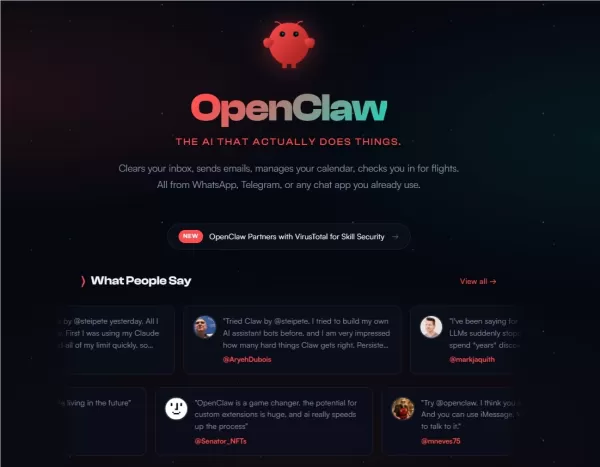 Huang Renxun Praises OpenClaw for Record-Breaking Adoption, Completing Linux's 30-Year Journey in Weeks
NVIDIA CEO Jensen Huang delivered a keynote address at the recent Morgan Stanley conference, declaring that agentic AI has reached a pivotal historical milestone and offering high praise for the open-source project OpenClaw.Huang described OpenClaw a
Huang Renxun Praises OpenClaw for Record-Breaking Adoption, Completing Linux's 30-Year Journey in Weeks
NVIDIA CEO Jensen Huang delivered a keynote address at the recent Morgan Stanley conference, declaring that agentic AI has reached a pivotal historical milestone and offering high praise for the open-source project OpenClaw.Huang described OpenClaw a
 Friend, the Lonely AI Wearable, Returns With a New Voice and a Much Bigger Price Tag
Two years ago, tech entrepreneur Avi Schiffmann introduced Friend, an AI-powered wearable device designed for conversation and daily text updates. The core concept was to leverage artificial intelligence to alleviate feelings of isolation. This week,
Friend, the Lonely AI Wearable, Returns With a New Voice and a Much Bigger Price Tag
Two years ago, tech entrepreneur Avi Schiffmann introduced Friend, an AI-powered wearable device designed for conversation and daily text updates. The core concept was to leverage artificial intelligence to alleviate feelings of isolation. This week,

2026 Latest Best Top-Rated AI Wellness Companions Ranked by Experts. This curated list features powerful game-changing tools that offer daily mindfulness support to help users reduce stress, boost focus, and improve overall well-being through real-world tests. Get a free vs paid comparison to find your perfect match. Explore now at XIX.AI to unlock your AI edge.
9 tools
xix.ai
2026 Latest Best Top-Rated AI Speech Styling Tools for Natural Voice Output are here on XIX.AI. This curated collection features powerful, game-changing tools that deliver highly customizable voice tones, perfect for boosting writing efficiency and creating engaging content. We conduct real-world tests to provide accurate weekly updated rankings, along with a free vs paid comparison to help you choose the best fit for your needs. Explore now to Discover your perfect tool and Unlock your AI edge.
20 tools
xix.ai
2026 Latest Best Top-rated AI Rank Tracking Tools for Google, AI Overviews, and Answer Engine Visibility are here on XIX.AI. This curated list features powerful game-changing tools that go through rigorous real-world tests to deliver accurate rankings data. Get a free vs paid comparison, see top performers, and discover must-try options to boost your content’s visibility across search engines. Explore now to find the perfect tool for your needs.
10 tools
xix.ai
2026 Latest Best Top-Rated AI Second-Brain Organizers for Notes and Tasks! XIX.AI has curated a highly powerful game-changing collection, featuring weekly updated rankings, free vs paid comparison, and real-world tests to help you find the perfect tool that boosts productivity dramatically. Explore now to unlock your AI edge!
11 tools
xix.ai

2026 Latest Best Top-Rated AI Prompt Testing Platforms for ChatGPT and Claude Workflows! XIX.AI curates a powerful game-changing collection, featuring weekly updated rankings, free vs paid comparison, real-world tests, and detailed feature breakdowns to help you identify the must-try tools that boost productivity and deliver flawless outputs. Explore now to discover your perfect solution and unlock your AI edge. (249 characters)
9 tools
xix.ai

2026 Latest Best AI Landing Page Copy Tools for SaaS A/B Tests, Pricing Pages, and Demo Conversion are here on XIX.AI. This curated list of top-rated tools offers powerful game-changing solutions to boost content quality, improve writing efficiency, and enhance overall productivity. We conduct real-world tests and provide a free vs paid comparison along with weekly updated rankings. Must-try options help you break through creation bottlenecks. Explore now to discover your perfect tool and unlock your AI edge!
8 tools
xix.ai












