


 Home
HomeMicrosoft AI CEO Mustafa Suleiman: AI to automate white-collar jobs in 18 months

In a recent interview, Microsoft's Chief AI Officer Mustafa Suleyman made a striking prediction: AI will achieve human-level performance in most professional tasks within the next 12 to 18 months, fully automating white-collar office work. This statement quickly sparked widespread debate among the global tech community and professionals.
The Era of "Office-Based" AI Is Arriving
Suleyman noted that jobs requiring people to sit in front of a computer — such as accounting, law, marketing, and project management — will largely be taken over by AI. "I think we will reach human-level performance in most (if not all) professional tasks," he said. This prediction strikes at the heart of traditional knowledge-based work, signaling a rapid shift of AI from a supporting tool to an independent performer.
Related reports suggest this timeline points to around mid-2027. Suleyman believes that with exponential growth in computing power and continuous iteration of AI models, the automation wave will fundamentally reshape workplace structures.
Building "Superintelligence": The Barriers to AI Development Will Drop Dramatically
Suleyman further revealed that his mission is to build "superintelligence." He is optimistic that creating new AI models will one day be as simple as producing a podcast or writing a blog. This perspective underscores the democratization and popularization of AI technology, implying that ordinary developers and companies may soon be able to deploy powerful AI systems with ease.
Opportunities and Challenges in Workplace Transformation
AIbase Analysis: Suleyman's prediction, while forward-looking, has ignited intense debate about the job market, skills transformation, and social adaptation. On one hand, AI automation can dramatically boost productivity and free up human talent for higher-value work. On the other hand, professionals in accounting, law, marketing, and similar fields must quickly develop AI collaboration skills to thrive in the new workplace.
Currently, the precise impact of AI on employment remains under scrutiny, but executive predictions from tech giants frequently signal major shifts in industry investment and strategic direction. Companies like Microsoft are actively investing in AI infrastructure to seize this historic opportunity.
AIbase Perspective
Related article
 OpenAI Unveils Codex Referral Program to Boost Usage Quotas
As AI tools become more common, quota limits often block productivity. OpenAI recently announced a new Codex promotion on social media, offering tangible benefits to users.Running for two weeks, this campaign rewards users who invite friends to join
Meta launches AI optimism ad set to song about human extinction
Meta’s latest ad opens with a stark black-and-white close-up of an eye, capturing the anxiety of scrolling through alarming headlines about AI stealing jobs, isolating society, and triggering a global crisis.“Some people will have you believe AI is g
Mistral AI’s Open-Source Math Proof Tool Uses 119B Parameters, Activating Just 6B, Cuts Costs to 1% of Rivals
Mistral AI, a European artificial intelligence firm, has officially released Leanstral 1.5, a specialized model for formal mathematical proof. Built specifically for the Lean4 programming language, this 119B-parameter model activates only 6B paramete
Related Special Topic Recommendations
Meeting Assistant
OpenAI Unveils Codex Referral Program to Boost Usage Quotas
As AI tools become more common, quota limits often block productivity. OpenAI recently announced a new Codex promotion on social media, offering tangible benefits to users.Running for two weeks, this campaign rewards users who invite friends to join
Meta launches AI optimism ad set to song about human extinction
Meta’s latest ad opens with a stark black-and-white close-up of an eye, capturing the anxiety of scrolling through alarming headlines about AI stealing jobs, isolating society, and triggering a global crisis.“Some people will have you believe AI is g
Mistral AI’s Open-Source Math Proof Tool Uses 119B Parameters, Activating Just 6B, Cuts Costs to 1% of Rivals
Mistral AI, a European artificial intelligence firm, has officially released Leanstral 1.5, a specialized model for formal mathematical proof. Built specifically for the Lean4 programming language, this 119B-parameter model activates only 6B paramete
Related Special Topic Recommendations
Meeting Assistant
 Best AI Transcript Tools for Client Call Notes
2026 Latest Best Top-Rated AI Transcript Tools for Client Call Notes! XIX.AI has curated a powerful, game-changing collection of must-try tools that go through real-world tests to deliver accurate, detailed notes. You can compare free and paid options side by side and see how they boost your productivity. Explore now to discover your perfect tool and unlock your AI edge in client communication!
 10 tools
 xix.ai
Text-to-speech
Best AI Dubbing Platforms for Multilingual Shorts, Tutorials, and Product Walkthroughs
xix.ai
Text-to-speech
Best AI Dubbing Platforms for Multilingual Shorts, Tutorials, and Product Walkthroughs
2026 Latest Best Top-rated AI Dubbing Platforms for Multilingual Shorts, Tutorials, and Product Walkthroughs! XIX.AI curates a powerful game-changing collection after rigorous real-world tests and weekly updated rankings. You’ll find must-try options that boost productivity significantly, helping you create high-quality content faster without wasting time. Explore now to discover your perfect tool and unlock your AI edge.
9 tools
xix.ai
Productivity
ChatGPT Meeting Follow-Up Tools for Action Items, Owners, and Deadline Tracking
2026 Latest Best ChatGPT Meeting Follow-Up Tools Ranked! XIX.AI has curated a top-rated collection of powerful tools that help you quickly turn meeting notes into actionable items, track owners and deadlines effortlessly, and stay organized throughout your projects. Every tool goes through rigorous real-world tests to ensure reliability. Check out the free vs paid comparison and rankings to discover your perfect solution for boosting productivity. Explore now!
9 tools
xix.ai
Meeting Assistant
Best AI Agenda Builders: Plan Better Weekly Syncs in Minutes
2026 Latest Best AI Agenda Builders page features a curated list of top-rated tools that make planning weekly team syncs effortless. These powerful solutions help you create organized, efficient agendas in just minutes, saving valuable time and boosting productivity. XIX.AI ensures all entries go through rigorous real-world tests before inclusion. Get a free vs paid comparison and discover the must-try options that deliver game-changing results. Explore now to find your perfect tool for smoother workflows!
15 tools
xix.ai
Business
Best AI Business Plan Tools for Startups
2026 Latest Best Top-Rated AI Business Plan Tools for Startups! XIX.AI curates a powerful, game-changing collection of must-try tools that go through real-world tests and rigorous weekly updated rankings. These top solutions help startups draft flawless plans, boost productivity, and unlock their full AI edge. Explore now to discover your perfect tool!
9 tools
xix.ai
Marketing
Best AI Persona Builder Tools for Audience Research
2026 Latest Best Top-rated AI Persona Builder Tools for Audience Research are here on XIX.AI! This curated list features powerful, game-changing tools that help you conduct real-world tests and create accurate audience profiles through detailed free vs paid comparison. You’ll discover the must-try options that boost writing efficiency and unlock your AI edge in marketing strategies. Explore now to find your perfect tool!
9 tools
xix.ai

 Comments (1)
0/500
Comments (1)
0/500
![ChristopherHarris]()
Mustafa Suleiman’s prediction is bold, isn’t it? 18 months for white-collar automation feels incredibly tight. I’m curious if this includes creative roles or just routine data processing. As a regular user, I’d love to see AI handle my inbox, but I worry about the human touch in customer service. Will we see mass layoffs or just role shifts? Either way, it’s a fascinating time to watch tech evolve. 🤖💼
In a recent interview, Microsoft's Chief AI Officer Mustafa Suleyman made a striking prediction: AI will achieve human-level performance in most professional tasks within the next 12 to 18 months, fully automating white-collar office work. This statement quickly sparked widespread debate among the global tech community and professionals.
The Era of "Office-Based" AI Is Arriving
Suleyman noted that jobs requiring people to sit in front of a computer — such as accounting, law, marketing, and project management — will largely be taken over by AI. "I think we will reach human-level performance in most (if not all) professional tasks," he said. This prediction strikes at the heart of traditional knowledge-based work, signaling a rapid shift of AI from a supporting tool to an independent performer.
Related reports suggest this timeline points to around mid-2027. Suleyman believes that with exponential growth in computing power and continuous iteration of AI models, the automation wave will fundamentally reshape workplace structures.
Building "Superintelligence": The Barriers to AI Development Will Drop Dramatically
Suleyman further revealed that his mission is to build "superintelligence." He is optimistic that creating new AI models will one day be as simple as producing a podcast or writing a blog. This perspective underscores the democratization and popularization of AI technology, implying that ordinary developers and companies may soon be able to deploy powerful AI systems with ease.
Opportunities and Challenges in Workplace Transformation
AIbase Analysis: Suleyman's prediction, while forward-looking, has ignited intense debate about the job market, skills transformation, and social adaptation. On one hand, AI automation can dramatically boost productivity and free up human talent for higher-value work. On the other hand, professionals in accounting, law, marketing, and similar fields must quickly develop AI collaboration skills to thrive in the new workplace.
Currently, the precise impact of AI on employment remains under scrutiny, but executive predictions from tech giants frequently signal major shifts in industry investment and strategic direction. Companies like Microsoft are actively investing in AI infrastructure to seize this historic opportunity.
AIbase Perspective








 OpenAI Unveils Codex Referral Program to Boost Usage Quotas
As AI tools become more common, quota limits often block productivity. OpenAI recently announced a new Codex promotion on social media, offering tangible benefits to users.Running for two weeks, this campaign rewards users who invite friends to join
OpenAI Unveils Codex Referral Program to Boost Usage Quotas
As AI tools become more common, quota limits often block productivity. OpenAI recently announced a new Codex promotion on social media, offering tangible benefits to users.Running for two weeks, this campaign rewards users who invite friends to join
 Meta launches AI optimism ad set to song about human extinction
Meta’s latest ad opens with a stark black-and-white close-up of an eye, capturing the anxiety of scrolling through alarming headlines about AI stealing jobs, isolating society, and triggering a global crisis.“Some people will have you believe AI is g
Meta launches AI optimism ad set to song about human extinction
Meta’s latest ad opens with a stark black-and-white close-up of an eye, capturing the anxiety of scrolling through alarming headlines about AI stealing jobs, isolating society, and triggering a global crisis.“Some people will have you believe AI is g
 Mistral AI’s Open-Source Math Proof Tool Uses 119B Parameters, Activating Just 6B, Cuts Costs to 1% of Rivals
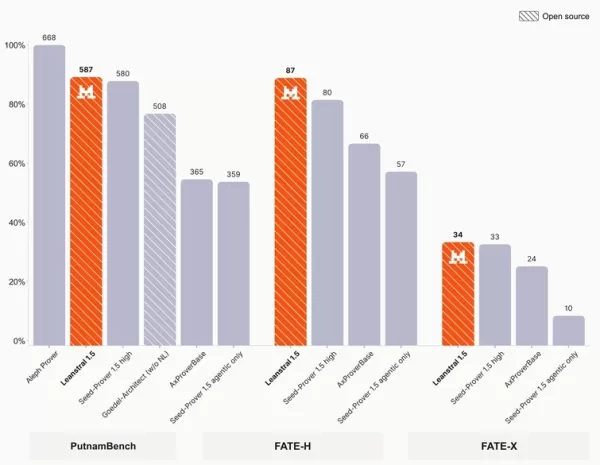
Mistral AI, a European artificial intelligence firm, has officially released Leanstral 1.5, a specialized model for formal mathematical proof. Built specifically for the Lean4 programming language, this 119B-parameter model activates only 6B paramete
Mistral AI’s Open-Source Math Proof Tool Uses 119B Parameters, Activating Just 6B, Cuts Costs to 1% of Rivals
Mistral AI, a European artificial intelligence firm, has officially released Leanstral 1.5, a specialized model for formal mathematical proof. Built specifically for the Lean4 programming language, this 119B-parameter model activates only 6B paramete
2026 Latest Best Top-Rated AI Transcript Tools for Client Call Notes! XIX.AI has curated a powerful, game-changing collection of must-try tools that go through real-world tests to deliver accurate, detailed notes. You can compare free and paid options side by side and see how they boost your productivity. Explore now to discover your perfect tool and unlock your AI edge in client communication!
10 tools
xix.ai

2026 Latest Best Top-rated AI Dubbing Platforms for Multilingual Shorts, Tutorials, and Product Walkthroughs! XIX.AI curates a powerful game-changing collection after rigorous real-world tests and weekly updated rankings. You’ll find must-try options that boost productivity significantly, helping you create high-quality content faster without wasting time. Explore now to discover your perfect tool and unlock your AI edge.
9 tools
xix.ai
2026 Latest Best ChatGPT Meeting Follow-Up Tools Ranked! XIX.AI has curated a top-rated collection of powerful tools that help you quickly turn meeting notes into actionable items, track owners and deadlines effortlessly, and stay organized throughout your projects. Every tool goes through rigorous real-world tests to ensure reliability. Check out the free vs paid comparison and rankings to discover your perfect solution for boosting productivity. Explore now!
9 tools
xix.ai

2026 Latest Best AI Agenda Builders page features a curated list of top-rated tools that make planning weekly team syncs effortless. These powerful solutions help you create organized, efficient agendas in just minutes, saving valuable time and boosting productivity. XIX.AI ensures all entries go through rigorous real-world tests before inclusion. Get a free vs paid comparison and discover the must-try options that deliver game-changing results. Explore now to find your perfect tool for smoother workflows!
15 tools
xix.ai
2026 Latest Best Top-Rated AI Business Plan Tools for Startups! XIX.AI curates a powerful, game-changing collection of must-try tools that go through real-world tests and rigorous weekly updated rankings. These top solutions help startups draft flawless plans, boost productivity, and unlock their full AI edge. Explore now to discover your perfect tool!
9 tools
xix.ai
2026 Latest Best Top-rated AI Persona Builder Tools for Audience Research are here on XIX.AI! This curated list features powerful, game-changing tools that help you conduct real-world tests and create accurate audience profiles through detailed free vs paid comparison. You’ll discover the must-try options that boost writing efficiency and unlock your AI edge in marketing strategies. Explore now to find your perfect tool!
9 tools
xix.ai

Mustafa Suleiman’s prediction is bold, isn’t it? 18 months for white-collar automation feels incredibly tight. I’m curious if this includes creative roles or just routine data processing. As a regular user, I’d love to see AI handle my inbox, but I worry about the human touch in customer service. Will we see mass layoffs or just role shifts? Either way, it’s a fascinating time to watch tech evolve. 🤖💼












