


 Home
HomeMemories AI Develops Visual Memory Layer for Wearables and Robotics
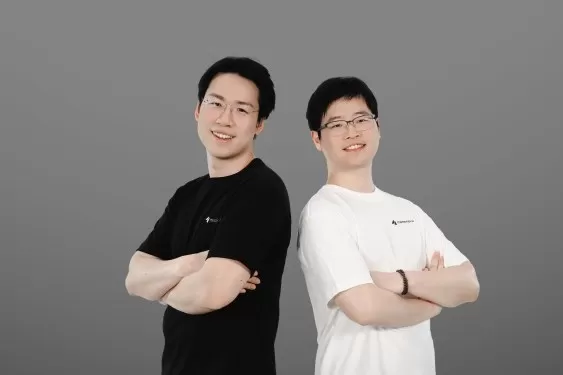
Shawn Shen argues that for AI to truly thrive in the physical world, it must possess the capability to remember what it sees. His company, Memories.ai, is leveraging Nvidia's AI tools to create the underlying infrastructure that will enable wearables and robots to store and retrieve visual memories.
On Monday, at the Nvidia GTC conference, Memories.ai announced a partnership with the semiconductor leader. This collaboration grants Memories.ai access to Nvidia’s Cosmos-Reason 2—a reasoning vision language model—and Nvidia Metropolis, an application for video search and summarization, to advance its visual memory technology.
Shen (pictured left) explained to TechCrunch that the idea for the company emerged while he and his co-founder and CTO, Ben Zhou (pictured right), were developing the AI system for Meta’s Ray-Ban glasses. Their work highlighted a key question: what practical use would such technology have if users couldn't later access and recall the video data they captured?
After searching for, but failing to find, any existing solutions for AI visual memory, they made the decision to leave Meta and build the technology themselves.
“AI has already achieved remarkable success in the digital realm. The next frontier is the physical world,” Shen stated. “AI-powered wearables and robots also need memories... Ultimately, we believe a future where AI has visual memory is inevitable.”
The concept of memory for AI systems is a relatively recent development. OpenAI introduced memory features for ChatGPT in 2024, with refinements in 2025. Similarly, Elon Musk’s xAI and Google Gemini have launched their own memory tools within the last two years.
However, Shen notes that these advancements have primarily concentrated on text-based memory. While text is more structured and easier to index, it’s less applicable for physical AI—like robotics and wearables—that primarily perceive and interact with the world through visual input.
Founded in 2024, Memories.ai has secured $16 million in funding to date. This includes an $8 million seed round in July 2025, followed by an $8 million extension. The investment was led by Susa Ventures, with participation from Seedcamp, Fusion Fund, Crane Venture Partners, and others.
According to Shen, building this visual memory layer presented two core challenges: developing the infrastructure to embed and index video into a storable, retrievable data format, and capturing the necessary training data.
The company debuted its large visual memory model (LVMM) in July 2025. Shen describes it as a more compact counterpart to Google's recently released Gemini Embedding 2, a multimodal indexing and retrieval model.
For data collection, the team created LUCI, a custom hardware device worn by "data collectors" to record training videos. Shen clarified that they have no plans to become a hardware manufacturer or sell these devices. They built LUCI because commercial video recorders, often focused on high-definition formats that drain battery life, were unsuitable for their needs.
Memories.ai has since released the second generation of its LVMM and inked a partnership with Qualcomm. The model is slated to run on Qualcomm’s processors starting later this year.
Shen revealed that the company is already collaborating with several major wearable manufacturers, though he declined to name them. While current demand exists, he foresees even greater future opportunities in the wearable and robotics markets.
“From a commercialization standpoint, our focus is squarely on the model and the infrastructure,” Shen said. “We believe the wearables and robotics market will inevitably arrive, but its full emergence is still on the horizon.”
Related article
 OneRail Leverages Nvidia AI to Optimize Real-Time Last-Mile Delivery
OneRail has introduced an AI-driven delivery platform leveraging Nvidia technology to assist retailers, wholesalers, and distributors in determining the most efficient delivery methods for individual orders.Named OmniSTAR, the system assesses various
Apple's New Hardware Chief John Ternus Steers Vision for Future Products
Loading the player…The Ternus era at Apple has officially begun.Tim Cook stepped down as CEO this week, handing leadership to former hardware chief John Ternus. Ternus’s first memo promised a “huge launch next week,” meaning the next iPhone event lan
Groq raises $350M to fuel its pivot from AI chips to neocloud
AI infrastructure firm Groq has secured $350 million in fresh funding, marking its ongoing transition from a specialized chip developer to a neocloud provider offering robust GPU and AI infrastructure services.Backed by Disruptive Technologies, with
Related Special Topic Recommendations
chatbot
OneRail Leverages Nvidia AI to Optimize Real-Time Last-Mile Delivery
OneRail has introduced an AI-driven delivery platform leveraging Nvidia technology to assist retailers, wholesalers, and distributors in determining the most efficient delivery methods for individual orders.Named OmniSTAR, the system assesses various
Apple's New Hardware Chief John Ternus Steers Vision for Future Products
Loading the player…The Ternus era at Apple has officially begun.Tim Cook stepped down as CEO this week, handing leadership to former hardware chief John Ternus. Ternus’s first memo promised a “huge launch next week,” meaning the next iPhone event lan
Groq raises $350M to fuel its pivot from AI chips to neocloud
AI infrastructure firm Groq has secured $350 million in fresh funding, marking its ongoing transition from a specialized chip developer to a neocloud provider offering robust GPU and AI infrastructure services.Backed by Disruptive Technologies, with
Related Special Topic Recommendations
chatbot
 Best AI Conversation Trainer Tools for Interview Practice
2026 Latest Best Top-rated AI Conversation Trainer Tools for Interview Practice are here on XIX.AI! This curated collection features powerful, game-changing tools that go through rigorous real-world tests to deliver accurate feedback. You’ll find a free vs paid comparison and detailed rankings to help you choose the must-try option that boosts your confidence and skills. Explore now to Discover your perfect tool for interview success!
 12 tools
 xix.ai
Design & Art
Best AI Style Transfer Tools for Creative Experiments
xix.ai
Design & Art
Best AI Style Transfer Tools for Creative Experiments
2026 Latest Best Top-rated AI Style Transfer Tools for Creative Experiments! XIX.AI has curated a powerful, game-changing collection of must-try tools that deliver exceptional results through real-world tests and rigorous rankings. These top solutions help creatives boost productivity significantly by accelerating content creation and unlocking endless creative possibilities. Explore now to discover your perfect tool and start creating today!
9 tools
xix.ai
Comic Creation
Best AI Dialogue Bubble Tools for Visual Storytelling
2026 Latest Best Top-Rated AI Dialogue Bubble Tools for Visual Storytelling are here on XIX.AI! This curated collection features powerful, game-changing tools that help creators boost productivity and overcome creative bottlenecks. Get a free vs paid comparison, see real-world tests, and check the latest rankings to find the must-try solutions perfect for crafting engaging visual narratives. Explore now to discover your ideal tool!
10 tools
xix.ai
Meeting Assistant
Top AI Meeting Summary Tools: Track Decisions and Follow-Ups Clearly
2026 Latest Top-Rated Best AI Meeting Summary Tools for Clear Decision Tracking and Effortless Follow-Ups. This curated list showcases powerful, game-changing solutions that boost productivity dramatically by automating meeting notes, identifying key action items, and streamlining team coordination across all projects. Get a free vs paid comparison along with real-world tests and weekly updated rankings to help you find the perfect tool. Explore now to unlock your AI edge!
9 tools
xix.ai
Data Analysis
Best AI Data Cleaning Tools: Fix Missing Values and Duplicates Fast
2026 Latest Best Top-rated AI Data Cleaning Tools for quick fixing of missing values and duplicates. This curated list showcases powerful, game-changing solutions that boost productivity significantly. Each option has undergone rigorous real-world tests to ensure reliability. Get a free vs paid comparison and discover the must-try tool that fits your needs best. Explore now at XIX.AI to Unlock your AI edge.
11 tools
xix.ai
Design & Art
Best AI Creative Ideation Tools for Artists: Break Through Visual Blocks
2026 Latest Best Top-Rated AI Creative Ideation Tools for Artists are curated by XIX.AI to help creators break through visual blocks and boost creativity instantly. These powerful game-changing tools offer real-world tests, detailed free vs paid comparison, and weekly updated rankings. Discover your perfect tool to accelerate content creation and unlock your AI edge today. Explore now!
14 tools
xix.ai

 Comments (0)
0/500
Comments (0)
0/500
Shawn Shen argues that for AI to truly thrive in the physical world, it must possess the capability to remember what it sees. His company, Memories.ai, is leveraging Nvidia's AI tools to create the underlying infrastructure that will enable wearables and robots to store and retrieve visual memories.
On Monday, at the Nvidia GTC conference, Memories.ai announced a partnership with the semiconductor leader. This collaboration grants Memories.ai access to Nvidia’s Cosmos-Reason 2—a reasoning vision language model—and Nvidia Metropolis, an application for video search and summarization, to advance its visual memory technology.
Shen (pictured left) explained to TechCrunch that the idea for the company emerged while he and his co-founder and CTO, Ben Zhou (pictured right), were developing the AI system for Meta’s Ray-Ban glasses. Their work highlighted a key question: what practical use would such technology have if users couldn't later access and recall the video data they captured?
After searching for, but failing to find, any existing solutions for AI visual memory, they made the decision to leave Meta and build the technology themselves.
“AI has already achieved remarkable success in the digital realm. The next frontier is the physical world,” Shen stated. “AI-powered wearables and robots also need memories... Ultimately, we believe a future where AI has visual memory is inevitable.”
The concept of memory for AI systems is a relatively recent development. OpenAI introduced memory features for ChatGPT in 2024, with refinements in 2025. Similarly, Elon Musk’s xAI and Google Gemini have launched their own memory tools within the last two years.
However, Shen notes that these advancements have primarily concentrated on text-based memory. While text is more structured and easier to index, it’s less applicable for physical AI—like robotics and wearables—that primarily perceive and interact with the world through visual input.
Founded in 2024, Memories.ai has secured $16 million in funding to date. This includes an $8 million seed round in July 2025, followed by an $8 million extension. The investment was led by Susa Ventures, with participation from Seedcamp, Fusion Fund, Crane Venture Partners, and others.
According to Shen, building this visual memory layer presented two core challenges: developing the infrastructure to embed and index video into a storable, retrievable data format, and capturing the necessary training data.
The company debuted its large visual memory model (LVMM) in July 2025. Shen describes it as a more compact counterpart to Google's recently released Gemini Embedding 2, a multimodal indexing and retrieval model.
For data collection, the team created LUCI, a custom hardware device worn by "data collectors" to record training videos. Shen clarified that they have no plans to become a hardware manufacturer or sell these devices. They built LUCI because commercial video recorders, often focused on high-definition formats that drain battery life, were unsuitable for their needs.
Memories.ai has since released the second generation of its LVMM and inked a partnership with Qualcomm. The model is slated to run on Qualcomm’s processors starting later this year.
Shen revealed that the company is already collaborating with several major wearable manufacturers, though he declined to name them. While current demand exists, he foresees even greater future opportunities in the wearable and robotics markets.
“From a commercialization standpoint, our focus is squarely on the model and the infrastructure,” Shen said. “We believe the wearables and robotics market will inevitably arrive, but its full emergence is still on the horizon.”








 OneRail Leverages Nvidia AI to Optimize Real-Time Last-Mile Delivery
OneRail has introduced an AI-driven delivery platform leveraging Nvidia technology to assist retailers, wholesalers, and distributors in determining the most efficient delivery methods for individual orders.Named OmniSTAR, the system assesses various
OneRail Leverages Nvidia AI to Optimize Real-Time Last-Mile Delivery
OneRail has introduced an AI-driven delivery platform leveraging Nvidia technology to assist retailers, wholesalers, and distributors in determining the most efficient delivery methods for individual orders.Named OmniSTAR, the system assesses various
 Apple's New Hardware Chief John Ternus Steers Vision for Future Products
Loading the player…The Ternus era at Apple has officially begun.Tim Cook stepped down as CEO this week, handing leadership to former hardware chief John Ternus. Ternus’s first memo promised a “huge launch next week,” meaning the next iPhone event lan
Apple's New Hardware Chief John Ternus Steers Vision for Future Products
Loading the player…The Ternus era at Apple has officially begun.Tim Cook stepped down as CEO this week, handing leadership to former hardware chief John Ternus. Ternus’s first memo promised a “huge launch next week,” meaning the next iPhone event lan
 Groq raises $350M to fuel its pivot from AI chips to neocloud
AI infrastructure firm Groq has secured $350 million in fresh funding, marking its ongoing transition from a specialized chip developer to a neocloud provider offering robust GPU and AI infrastructure services.Backed by Disruptive Technologies, with
Groq raises $350M to fuel its pivot from AI chips to neocloud
AI infrastructure firm Groq has secured $350 million in fresh funding, marking its ongoing transition from a specialized chip developer to a neocloud provider offering robust GPU and AI infrastructure services.Backed by Disruptive Technologies, with

2026 Latest Best Top-rated AI Conversation Trainer Tools for Interview Practice are here on XIX.AI! This curated collection features powerful, game-changing tools that go through rigorous real-world tests to deliver accurate feedback. You’ll find a free vs paid comparison and detailed rankings to help you choose the must-try option that boosts your confidence and skills. Explore now to Discover your perfect tool for interview success!
12 tools
xix.ai

2026 Latest Best Top-rated AI Style Transfer Tools for Creative Experiments! XIX.AI has curated a powerful, game-changing collection of must-try tools that deliver exceptional results through real-world tests and rigorous rankings. These top solutions help creatives boost productivity significantly by accelerating content creation and unlocking endless creative possibilities. Explore now to discover your perfect tool and start creating today!
9 tools
xix.ai

2026 Latest Best Top-Rated AI Dialogue Bubble Tools for Visual Storytelling are here on XIX.AI! This curated collection features powerful, game-changing tools that help creators boost productivity and overcome creative bottlenecks. Get a free vs paid comparison, see real-world tests, and check the latest rankings to find the must-try solutions perfect for crafting engaging visual narratives. Explore now to discover your ideal tool!
10 tools
xix.ai

2026 Latest Top-Rated Best AI Meeting Summary Tools for Clear Decision Tracking and Effortless Follow-Ups. This curated list showcases powerful, game-changing solutions that boost productivity dramatically by automating meeting notes, identifying key action items, and streamlining team coordination across all projects. Get a free vs paid comparison along with real-world tests and weekly updated rankings to help you find the perfect tool. Explore now to unlock your AI edge!
9 tools
xix.ai

2026 Latest Best Top-rated AI Data Cleaning Tools for quick fixing of missing values and duplicates. This curated list showcases powerful, game-changing solutions that boost productivity significantly. Each option has undergone rigorous real-world tests to ensure reliability. Get a free vs paid comparison and discover the must-try tool that fits your needs best. Explore now at XIX.AI to Unlock your AI edge.
11 tools
xix.ai

2026 Latest Best Top-Rated AI Creative Ideation Tools for Artists are curated by XIX.AI to help creators break through visual blocks and boost creativity instantly. These powerful game-changing tools offer real-world tests, detailed free vs paid comparison, and weekly updated rankings. Discover your perfect tool to accelerate content creation and unlock your AI edge today. Explore now!
14 tools
xix.ai












