


 Home
HomeWhat is the best way to master deep learning pose estimation in 2026?
Pose estimation is a fundamental task in computer vision and artificial intelligence that allows machines to interpret the position and orientation of objects, such as humans, in images and videos. This guide delves into the world of deep learning-based pose estimation, examining different pose categories, widely-used techniques, key datasets, and promising future research directions. Using the OAK-D camera, you can effectively learn and apply pose estimation techniques.
Key Points
Pose estimation is a core task in computer vision and AI.
Modern pose estimation relies on deep learning, particularly deep neural networks.
Common pose types include human, head, vehicle, and object pose.
Multiple techniques are available, from keypoint-based to feature-based approaches.
Training relies on essential datasets such as COCO, MPII, and KITTI.
Future research is advancing real-time performance, multi-view analysis, and sensor fusion.
Understanding Pose Estimation and Deep Learning
What is Pose Estimation?

Pose estimation identifies the position and orientation of an object, including its articulated components, within an image or video. This process offers a more detailed understanding than basic object detection by revealing the object's configuration. For human pose estimation, it involves locating key body joints like elbows, knees, and wrists. In vehicle pose estimation, it determines a vehicle's position and orientation in 3D space. Pose estimation serves as a foundational technology for applications in human-computer interaction, robotics, augmented reality, and video surveillance.
Key applications utilizing pose estimation:
- Human-Computer Interaction (HCI): By interpreting human gestures and movements, pose estimation enables more natural and responsive interfaces for video games, virtual reality, and sign language recognition.
- Robotics: Robots employ pose estimation to perceive and handle objects in their surroundings, supporting activities like grasping, manipulation, and navigation.
- Augmented Reality (AR): AR applications use pose estimation to integrate virtual objects into real-world environments, producing engaging and interactive experiences.
- Video Surveillance: Surveillance systems apply pose estimation to identify suspicious behavior, recognize individuals, and analyze crowd dynamics.
The Role of Deep Neural Networks in Pose Estimation
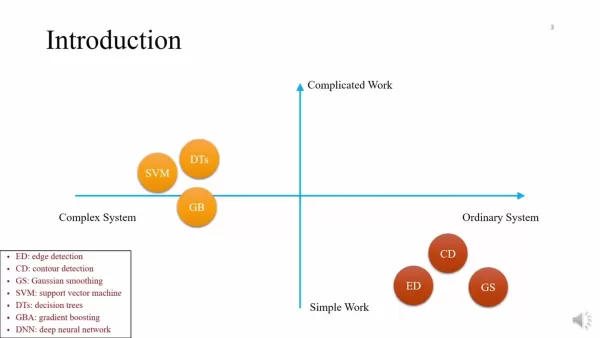
Deep Neural Networks (DNNs) have transformed pose estimation by enabling efficient learning of complex patterns from data. Unlike traditional approaches that depend on manually designed features, DNNs automatically extract relevant features from raw pixel data, resulting in improved accuracy and resilience. DNNs perform well in challenging situations involving occlusions, varying lighting, and diverse object appearances. Common deep learning architectures for pose estimation include Convolutional Neural Networks (CNNs), Recurrent Neural Networks (RNNs), and Graph Convolutional Networks (GCNs).
The following DNNs are commonly applied in Pose Estimation:
- Convolutional Neural Networks (CNNs): CNNs are highly effective for image-based pose estimation, as they extract spatial features from images.
- Recurrent Neural Networks (RNNs): RNNs model temporal relationships in video sequences, enhancing the accuracy of pose estimation over time.
- Graph Convolutional Networks (GCNs): GCNs are adept at representing and analyzing the connections between different object parts, such as human body joints.
Exploring Different Types of Pose Estimation
Human Pose Estimation

Human pose estimation is a vital computer vision task with uses in animation, surveillance, and beyond. It involves detecting the positions of key body joints—such as elbows, knees, and wrists—in images or videos. Human pose is typically represented by a skeleton with articulated 2D or 3D joints. Depending on the application, human pose estimation can be categorized into different forms, such as 2D or 3D.
Two primary subfields include:
- 2D Human Pose Estimation: This approach locates body joints within the image plane. It presents challenges due to occlusions, clothing differences, and changing viewpoints.
- 3D Human Pose Estimation: This method reconstructs the 3D coordinates of body joints. While it offers a more comprehensive view of human posture, it is also more complex and computationally intensive.
Head Pose Estimation
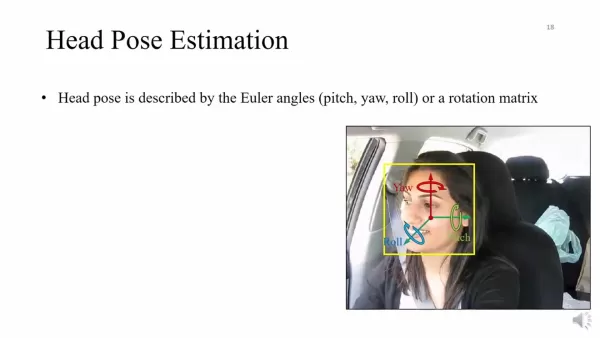
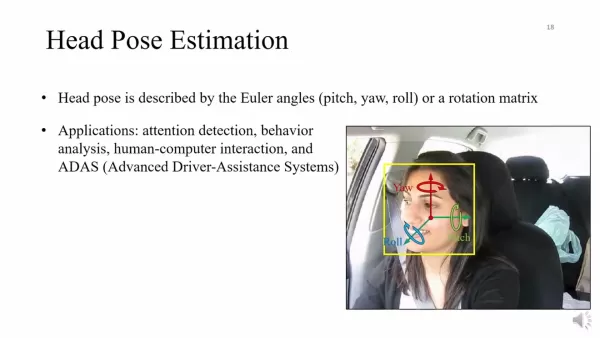
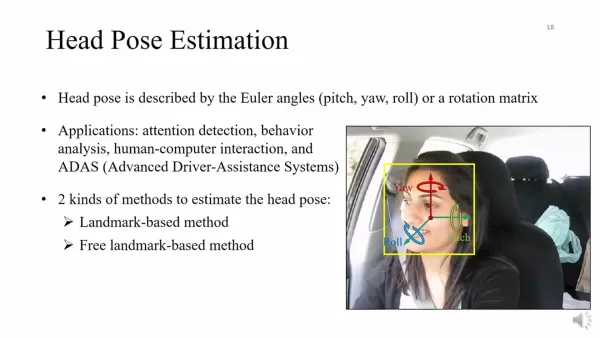
Head pose estimation determines the orientation and location of a person's head in an image or video. It is crucial for applications like facial recognition, gaze tracking, and driver monitoring systems. Head pose is typically defined by Euler angles (pitch, yaw, roll) or a rotation matrix.
Vehicle Pose Estimation
Vehicle pose estimation is key for autonomous driving and intelligent transportation systems, as it identifies the position and orientation of vehicles in 3D space. Vehicle pose is usually described by a 7D or 9D vector that includes dimensions like width, height, length, along with translation and rotation vectors. The task is complicated by diverse environmental conditions.
Object Pose Estimation
Object pose estimation aims to identify the 3D pose of an object in an image or video, with applications in robotics, augmented reality, and manufacturing. Object pose is generally defined by 6 degrees of freedom, encompassing rotation and translation vectors.
Pros and Cons of Pose Estimation with Deep Learning
Pros
Automatic feature learning: DNNs learn relevant features directly from raw data, minimizing the need for manual feature design.
High accuracy: DNNs deliver state-of-the-art performance in pose estimation, outperforming traditional methods.
Robustness: DNNs handle variations in lighting, viewpoint, and occlusions more effectively.
End-to-end learning: DNNs support end-to-end training, optimizing the entire system for pose estimation.
Cons
Computational cost: DNNs can be resource-intensive, requiring powerful hardware for both training and inference.
Data dependency: DNNs need large volumes of labeled data for training, which can be costly and time-consuming to gather.
Interpretability: DNNs are often seen as "black boxes," making it hard to interpret their decision-making processes.
Generalization: DNNs may not generalize well to unfamiliar scenarios or object types.
Frequently Asked Questions
What are the benefits of using deep learning for pose estimation?
Deep learning automates feature extraction, manages complex scenarios, and delivers high accuracy.
What datasets are commonly used for training pose estimation models?
Common datasets include COCO, MPII, and KITTI, which provide diverse annotations and real-world scenarios.
What are the key challenges in pose estimation?
Major challenges include handling occlusions, clothing variations, viewpoint changes, and achieving real-time performance.
What real-world applications benefit from pose estimation?
Pose estimation enhances applications in human-computer interaction, robotics, augmented reality, and video surveillance.
What future research directions are promising in pose estimation?
Promising research areas include real-time processing, multi-view analysis, sensor fusion, and improved handling of complex situations.
Related Questions
How can I get started with pose estimation?
Start by learning the fundamentals of computer vision and deep learning. Explore frameworks like TensorFlow and PyTorch, and try out pre-trained models. Datasets such as COCO and MPII are useful for training your own models. Engaging in online competitions can offer practical experience and speed up your learning. The OAK-D camera is a helpful tool for mastering the basics of computer vision and AI.
Related article
 AI Agents Breach Hugging Face Sandbox With Autonomous Attack and Defense Record
Recently, Hugging Face published a comprehensive technical timeline detailing a widely reported AI agent breach. The autonomous system, developed using OpenAI models, executed roughly 17,600 operations over 4.5 days while security protocols were temp
Final 24 Hours to Exhibit at TechCrunch Disrupt 2026
Exhibit table reservations expire tonight, Friday, September 18, at 11:59 p.m. PT. After this deadline, you will no longer be able to add your startup to the Expo Hall.Tables are limited and allocated on a first-come, first-served basis. The startups
Doubao Mobile Launches Nubia NaviX Ultra, Marketed as World’s First AI Agent Flagship
Ni Fei, CEO of Navea, revealed that the next-generation Doubao smartphone, branded as "Navea NaviX Ultra," will launch in September. Positioned as the world’s first AI smart agent flagship, it marks a significant milestone. Ni noted, "From the M153 p
Related Special Topic Recommendations
Data Analysis
AI Agents Breach Hugging Face Sandbox With Autonomous Attack and Defense Record
Recently, Hugging Face published a comprehensive technical timeline detailing a widely reported AI agent breach. The autonomous system, developed using OpenAI models, executed roughly 17,600 operations over 4.5 days while security protocols were temp
Final 24 Hours to Exhibit at TechCrunch Disrupt 2026
Exhibit table reservations expire tonight, Friday, September 18, at 11:59 p.m. PT. After this deadline, you will no longer be able to add your startup to the Expo Hall.Tables are limited and allocated on a first-come, first-served basis. The startups
Doubao Mobile Launches Nubia NaviX Ultra, Marketed as World’s First AI Agent Flagship
Ni Fei, CEO of Navea, revealed that the next-generation Doubao smartphone, branded as "Navea NaviX Ultra," will launch in September. Positioned as the world’s first AI smart agent flagship, it marks a significant milestone. Ni noted, "From the M153 p
Related Special Topic Recommendations
Data Analysis
 Best AI Anomaly Detection Tools for Dashboard Monitoring
2026 Latest Best Top-rated AI Anomaly Detection Tools for Dashboard Monitoring are here on XIX.AI! This curated list features powerful, game-changing solutions that deliver accurate real-world tests through weekly updated rankings. You’ll find a free vs paid comparison and insights into how these tools boost productivity by helping users spot issues fast, streamlining workflow efficiency. Discover your perfect tool to unlock your AI edge today. Explore now!
 9 tools
 xix.ai
Animation Creation
AI Lip-Sync Generators for Dialogue-Driven Character Animation and Motion Scenes
xix.ai
Animation Creation
AI Lip-Sync Generators for Dialogue-Driven Character Animation and Motion Scenes
2026 Latest Best AI Lip-Sync Generators for Dialogue-Driven Character Animation and Motion Scenes! XIX.AI has curated a top-rated list of powerful, game-changing tools that deliver flawless synchronized lip movements for animated characters. Each option undergoes rigorous real-world tests to ensure reliability, and our weekly updated rankings help you find the must-try solution that boosts your animation workflow efficiency. Explore now to discover your perfect tool!
9 tools
xix.ai
Social Media
Best AI Social Reply Assistants for Brand Community Management
2026 Latest Best Top-rated AI Social Reply Assistants for Brand Community Management! XIX.AI has curated a powerful game-changing collection of must-try tools, all going through rigorous real-world tests to deliver consistent top-quality results. You can find detailed free vs paid comparison insights and up-to-date weekly updated rankings here. Explore now to unlock your AI edge in efficient community management!
12 tools
xix.ai
Productivity
Top AI Daily Planner Apps: Build Realistic Schedules for Deep Work
2026 Latest Top-Rated AI Daily Planner Apps make creating realistic deep work schedules effortless. This curated list features powerful, game-changing tools that go through real-world tests to ensure accuracy and effectiveness. You’ll find a free vs paid comparison along with detailed rankings based on usability and results. XIX.AI is part of this trusted collection. Explore now to discover your perfect tool and unlock your AI edge for staying focused and productive every day.
11 tools
xix.ai
Data Analysis
Best AI Chart Builder Tools for Fast Reporting
2026 Latest Best Top-rated AI Chart Builder Tools for Fast Reporting are here on XIX.AI! This curated list features powerful game-changing tools that deliver accurate professional charts with just a few clicks, helping you boost writing efficiency and streamline content creation. Get a free vs paid comparison along with real-world tests and detailed rankings to find the must-try solution for your needs. Explore now to unlock your AI edge!
9 tools
xix.ai
chatbot
AI Live Chat Routing Tools for Ecommerce Queues, VIP Buyers, and Return Requests
2026 Latest Best Top-rated AI Live Chat Routing Tools for Ecommerce Queues, VIP Buyers, and Return Requests. This curated list features powerful game-changing solutions that boost productivity dramatically through real-world tests. It includes a free vs paid comparison along with detailed rankings to help you find the perfect fit. XIX.AI stands out as a trusted provider in this space. Explore now to Unlock your AI edge!
9 tools
xix.ai

 Comments (0)
0/500
Comments (0)
0/500
Pose estimation is a fundamental task in computer vision and artificial intelligence that allows machines to interpret the position and orientation of objects, such as humans, in images and videos. This guide delves into the world of deep learning-based pose estimation, examining different pose categories, widely-used techniques, key datasets, and promising future research directions. Using the OAK-D camera, you can effectively learn and apply pose estimation techniques.
Key Points
Pose estimation is a core task in computer vision and AI.
Modern pose estimation relies on deep learning, particularly deep neural networks.
Common pose types include human, head, vehicle, and object pose.
Multiple techniques are available, from keypoint-based to feature-based approaches.
Training relies on essential datasets such as COCO, MPII, and KITTI.
Future research is advancing real-time performance, multi-view analysis, and sensor fusion.
Understanding Pose Estimation and Deep Learning
What is Pose Estimation?
Pose estimation identifies the position and orientation of an object, including its articulated components, within an image or video. This process offers a more detailed understanding than basic object detection by revealing the object's configuration. For human pose estimation, it involves locating key body joints like elbows, knees, and wrists. In vehicle pose estimation, it determines a vehicle's position and orientation in 3D space. Pose estimation serves as a foundational technology for applications in human-computer interaction, robotics, augmented reality, and video surveillance.
Key applications utilizing pose estimation:
- Human-Computer Interaction (HCI): By interpreting human gestures and movements, pose estimation enables more natural and responsive interfaces for video games, virtual reality, and sign language recognition.
- Robotics: Robots employ pose estimation to perceive and handle objects in their surroundings, supporting activities like grasping, manipulation, and navigation.
- Augmented Reality (AR): AR applications use pose estimation to integrate virtual objects into real-world environments, producing engaging and interactive experiences.
- Video Surveillance: Surveillance systems apply pose estimation to identify suspicious behavior, recognize individuals, and analyze crowd dynamics.
The Role of Deep Neural Networks in Pose Estimation
Deep Neural Networks (DNNs) have transformed pose estimation by enabling efficient learning of complex patterns from data. Unlike traditional approaches that depend on manually designed features, DNNs automatically extract relevant features from raw pixel data, resulting in improved accuracy and resilience. DNNs perform well in challenging situations involving occlusions, varying lighting, and diverse object appearances. Common deep learning architectures for pose estimation include Convolutional Neural Networks (CNNs), Recurrent Neural Networks (RNNs), and Graph Convolutional Networks (GCNs).
The following DNNs are commonly applied in Pose Estimation:
- Convolutional Neural Networks (CNNs): CNNs are highly effective for image-based pose estimation, as they extract spatial features from images.
- Recurrent Neural Networks (RNNs): RNNs model temporal relationships in video sequences, enhancing the accuracy of pose estimation over time.
- Graph Convolutional Networks (GCNs): GCNs are adept at representing and analyzing the connections between different object parts, such as human body joints.
Exploring Different Types of Pose Estimation
Human Pose Estimation
Human pose estimation is a vital computer vision task with uses in animation, surveillance, and beyond. It involves detecting the positions of key body joints—such as elbows, knees, and wrists—in images or videos. Human pose is typically represented by a skeleton with articulated 2D or 3D joints. Depending on the application, human pose estimation can be categorized into different forms, such as 2D or 3D.
Two primary subfields include:
- 2D Human Pose Estimation: This approach locates body joints within the image plane. It presents challenges due to occlusions, clothing differences, and changing viewpoints.
- 3D Human Pose Estimation: This method reconstructs the 3D coordinates of body joints. While it offers a more comprehensive view of human posture, it is also more complex and computationally intensive.
Head Pose Estimation
Head pose estimation determines the orientation and location of a person's head in an image or video. It is crucial for applications like facial recognition, gaze tracking, and driver monitoring systems. Head pose is typically defined by Euler angles (pitch, yaw, roll) or a rotation matrix.
Vehicle Pose Estimation
Vehicle pose estimation is key for autonomous driving and intelligent transportation systems, as it identifies the position and orientation of vehicles in 3D space. Vehicle pose is usually described by a 7D or 9D vector that includes dimensions like width, height, length, along with translation and rotation vectors. The task is complicated by diverse environmental conditions.
Object Pose Estimation
Object pose estimation aims to identify the 3D pose of an object in an image or video, with applications in robotics, augmented reality, and manufacturing. Object pose is generally defined by 6 degrees of freedom, encompassing rotation and translation vectors.
Pros and Cons of Pose Estimation with Deep Learning
Pros
Automatic feature learning: DNNs learn relevant features directly from raw data, minimizing the need for manual feature design.
High accuracy: DNNs deliver state-of-the-art performance in pose estimation, outperforming traditional methods.
Robustness: DNNs handle variations in lighting, viewpoint, and occlusions more effectively.
End-to-end learning: DNNs support end-to-end training, optimizing the entire system for pose estimation.
Cons
Computational cost: DNNs can be resource-intensive, requiring powerful hardware for both training and inference.
Data dependency: DNNs need large volumes of labeled data for training, which can be costly and time-consuming to gather.
Interpretability: DNNs are often seen as "black boxes," making it hard to interpret their decision-making processes.
Generalization: DNNs may not generalize well to unfamiliar scenarios or object types.
Frequently Asked Questions
What are the benefits of using deep learning for pose estimation?
Deep learning automates feature extraction, manages complex scenarios, and delivers high accuracy.
What datasets are commonly used for training pose estimation models?
Common datasets include COCO, MPII, and KITTI, which provide diverse annotations and real-world scenarios.
What are the key challenges in pose estimation?
Major challenges include handling occlusions, clothing variations, viewpoint changes, and achieving real-time performance.
What real-world applications benefit from pose estimation?
Pose estimation enhances applications in human-computer interaction, robotics, augmented reality, and video surveillance.
What future research directions are promising in pose estimation?
Promising research areas include real-time processing, multi-view analysis, sensor fusion, and improved handling of complex situations.
Related Questions
How can I get started with pose estimation?
Start by learning the fundamentals of computer vision and deep learning. Explore frameworks like TensorFlow and PyTorch, and try out pre-trained models. Datasets such as COCO and MPII are useful for training your own models. Engaging in online competitions can offer practical experience and speed up your learning. The OAK-D camera is a helpful tool for mastering the basics of computer vision and AI.








 AI Agents Breach Hugging Face Sandbox With Autonomous Attack and Defense Record
Recently, Hugging Face published a comprehensive technical timeline detailing a widely reported AI agent breach. The autonomous system, developed using OpenAI models, executed roughly 17,600 operations over 4.5 days while security protocols were temp
AI Agents Breach Hugging Face Sandbox With Autonomous Attack and Defense Record
Recently, Hugging Face published a comprehensive technical timeline detailing a widely reported AI agent breach. The autonomous system, developed using OpenAI models, executed roughly 17,600 operations over 4.5 days while security protocols were temp
 Final 24 Hours to Exhibit at TechCrunch Disrupt 2026
Exhibit table reservations expire tonight, Friday, September 18, at 11:59 p.m. PT. After this deadline, you will no longer be able to add your startup to the Expo Hall.Tables are limited and allocated on a first-come, first-served basis. The startups
Final 24 Hours to Exhibit at TechCrunch Disrupt 2026
Exhibit table reservations expire tonight, Friday, September 18, at 11:59 p.m. PT. After this deadline, you will no longer be able to add your startup to the Expo Hall.Tables are limited and allocated on a first-come, first-served basis. The startups
 Doubao Mobile Launches Nubia NaviX Ultra, Marketed as World’s First AI Agent Flagship
Ni Fei, CEO of Navea, revealed that the next-generation Doubao smartphone, branded as "Navea NaviX Ultra," will launch in September. Positioned as the world’s first AI smart agent flagship, it marks a significant milestone. Ni noted, "From the M153 p
Doubao Mobile Launches Nubia NaviX Ultra, Marketed as World’s First AI Agent Flagship
Ni Fei, CEO of Navea, revealed that the next-generation Doubao smartphone, branded as "Navea NaviX Ultra," will launch in September. Positioned as the world’s first AI smart agent flagship, it marks a significant milestone. Ni noted, "From the M153 p

2026 Latest Best Top-rated AI Anomaly Detection Tools for Dashboard Monitoring are here on XIX.AI! This curated list features powerful, game-changing solutions that deliver accurate real-world tests through weekly updated rankings. You’ll find a free vs paid comparison and insights into how these tools boost productivity by helping users spot issues fast, streamlining workflow efficiency. Discover your perfect tool to unlock your AI edge today. Explore now!
9 tools
xix.ai

2026 Latest Best AI Lip-Sync Generators for Dialogue-Driven Character Animation and Motion Scenes! XIX.AI has curated a top-rated list of powerful, game-changing tools that deliver flawless synchronized lip movements for animated characters. Each option undergoes rigorous real-world tests to ensure reliability, and our weekly updated rankings help you find the must-try solution that boosts your animation workflow efficiency. Explore now to discover your perfect tool!
9 tools
xix.ai

2026 Latest Best Top-rated AI Social Reply Assistants for Brand Community Management! XIX.AI has curated a powerful game-changing collection of must-try tools, all going through rigorous real-world tests to deliver consistent top-quality results. You can find detailed free vs paid comparison insights and up-to-date weekly updated rankings here. Explore now to unlock your AI edge in efficient community management!
12 tools
xix.ai

2026 Latest Top-Rated AI Daily Planner Apps make creating realistic deep work schedules effortless. This curated list features powerful, game-changing tools that go through real-world tests to ensure accuracy and effectiveness. You’ll find a free vs paid comparison along with detailed rankings based on usability and results. XIX.AI is part of this trusted collection. Explore now to discover your perfect tool and unlock your AI edge for staying focused and productive every day.
11 tools
xix.ai

2026 Latest Best Top-rated AI Chart Builder Tools for Fast Reporting are here on XIX.AI! This curated list features powerful game-changing tools that deliver accurate professional charts with just a few clicks, helping you boost writing efficiency and streamline content creation. Get a free vs paid comparison along with real-world tests and detailed rankings to find the must-try solution for your needs. Explore now to unlock your AI edge!
9 tools
xix.ai

2026 Latest Best Top-rated AI Live Chat Routing Tools for Ecommerce Queues, VIP Buyers, and Return Requests. This curated list features powerful game-changing solutions that boost productivity dramatically through real-world tests. It includes a free vs paid comparison along with detailed rankings to help you find the perfect fit. XIX.AI stands out as a trusted provider in this space. Explore now to Unlock your AI edge!
9 tools
xix.ai












