


 Home
HomeHow to master musical instruments in 2026? Multiple choice challenge guide.
Are you a true music lover? Can you tell the difference between a clarinet and an oboe, or a banjo and a mandolin? This article puts your musical knowledge to the test with a multiple-choice quiz designed to challenge your ability to identify instruments. Whether you're an experienced musician or just starting your musical journey, this fun quiz will help you train your ear and discover the incredible variety of instruments used in music.
Key Points
Improve your ability to recognize musical instruments by their sound.
Sharpen your skills in visually identifying instruments from different families.
Learn about both popular and rare musical instruments.
Experience an enjoyable and interactive approach to music education.
Challenge your current understanding of music with thought-provoking questions.
Test Your Musical Instrument Knowledge
Identifying Instruments by Sound
A key aspect of musical expertise is recognizing instruments simply by their unique sound qualities. This ability enhances your listening pleasure and deepens your respect for musical artistry. Our multiple-choice quiz will challenge your hearing, asking you to differentiate between instruments that might sound alike to inexperienced listeners. Get ready to listen carefully and trust your musical intuition!
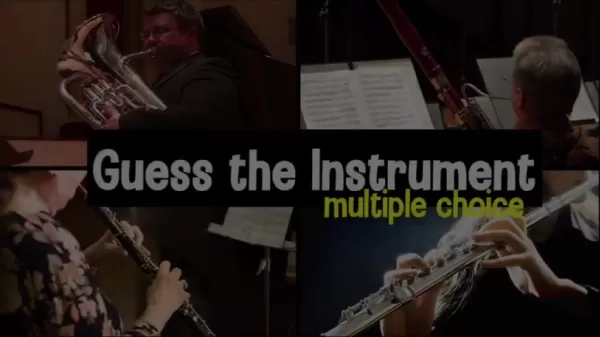
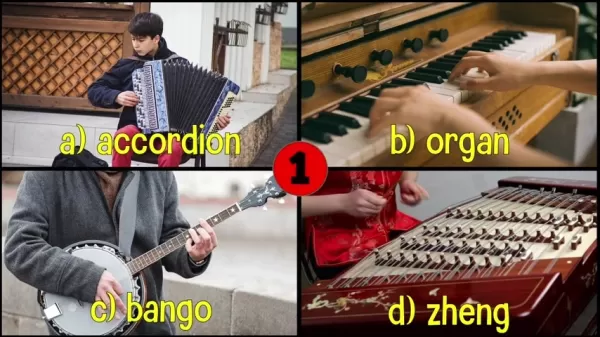
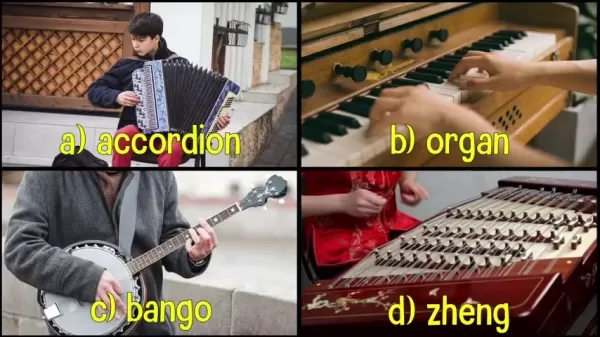
Do you think you can recognize an accordion just by its sound? Let's find out.
Accordion: The accordion creates its distinctive sound through vibrating reeds activated by air from the bellows. The player controls airflow with the bellows while using buttons and keys to play different notes.
Organ: Organs generate sound by directing air through specially tuned pipes. The instrument's numerous pipes enable rich harmonies and dynamic variation, making it suitable for both solo and group performances.
Banjo: The banjo's signature twang comes from its skin head stretched over a circular frame. When strings are plucked, the vibrating head produces a bright, percussive tone commonly heard in folk and bluegrass music.
Zheng: This traditional Chinese instrument features multiple strings stretched across a long wooden soundboard. Musicians use picks to pluck the strings, creating a gentle, resonant sound essential to Chinese classical music.
Woodwind Instruments: Aural Differentiation
The woodwind family includes diverse instruments, each with its own sonic character. From the piercing piccolo to the soulful harmonica, learning to distinguish these instruments is valuable for any music enthusiast. This quiz section will test your ability to identify woodwind instruments based solely on their auditory qualities.
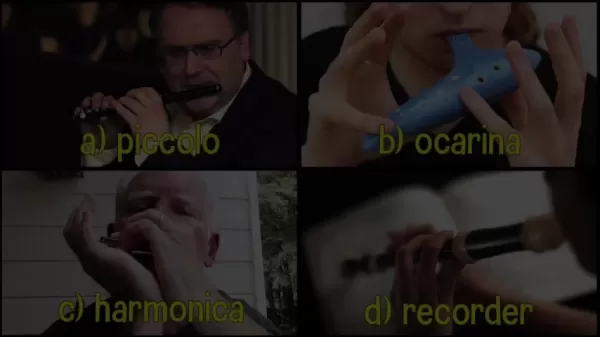
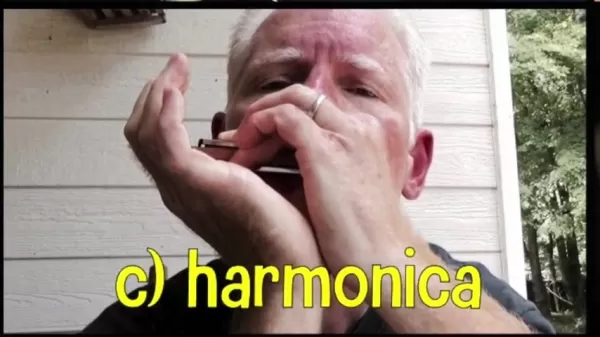
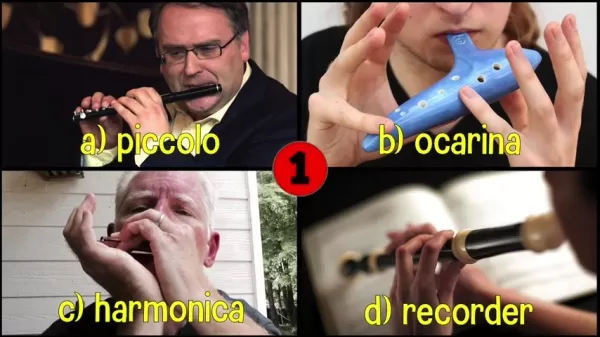
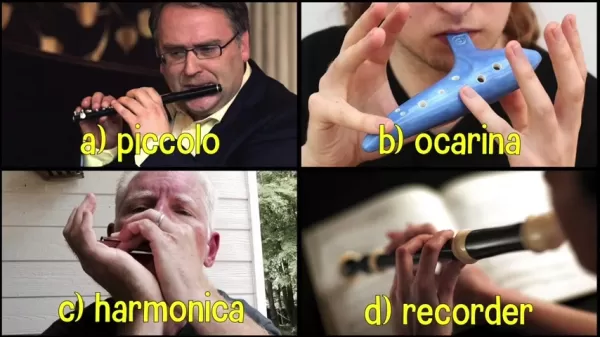
Can you identify the harmonica?
Piccolo: As the smallest member of the flute family, the piccolo produces a brilliant, penetrating sound that stands out in orchestral settings. Its high pitch adds sparkle and intensity to musical arrangements.
Ocarina: This vessel flute creates sound when air moves across a mouthpiece, causing resonance within its chamber. The instrument's pitch depends on the chamber dimensions and finger hole placement.
Harmonica: This free-reed instrument produces sound when players blow or draw air across metal reeds. Different notes sound depending on airflow direction, allowing for versatile musical expression.
Recorder: A type of duct flute, the recorder generates sound when air enters through a mouthpiece, vibrating the air column inside. Players control pitch by covering and uncovering finger holes along the instrument's length.
String Instruments: Identifying the Source
String instruments form the foundation of numerous music styles, from classical compositions to folk tunes and rock anthems. Recognizing different string instruments by ear is crucial for dedicated music fans. This quiz section evaluates your ability to identify string instruments based on their distinctive tonal characteristics. Ready to play along?
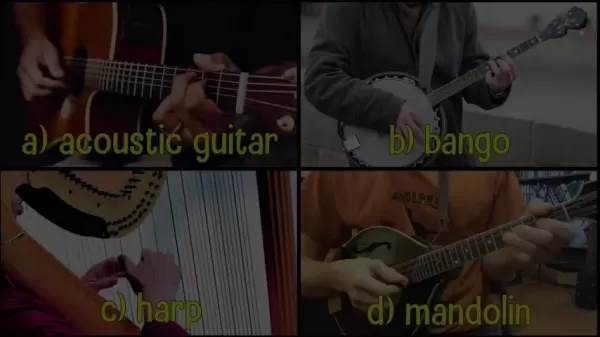
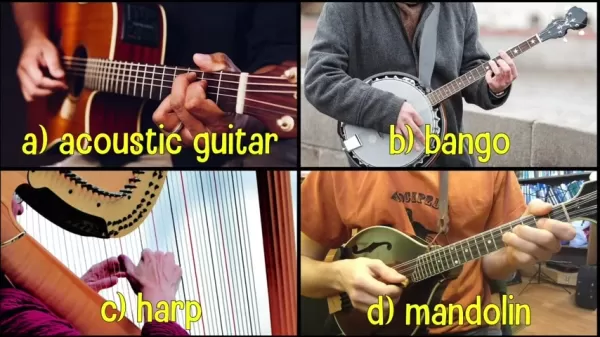
Can you identify what's playing here?
Acoustic Guitar: This instrument produces sound through string vibrations amplified by its hollow body. The guitar's tone depends on wood selection, body construction, and string type.
Banjo: The banjo's bright, twangy tone results from strings vibrating against a skin head mounted on a circular frame. This unique design gives the banjo its immediately recognizable voice.
Harp: As a multi-stringed instrument, the harp creates sound when players pluck or strum its strings. Each string's length and tension determines its pitch, enabling a broad range of notes and harmonies.
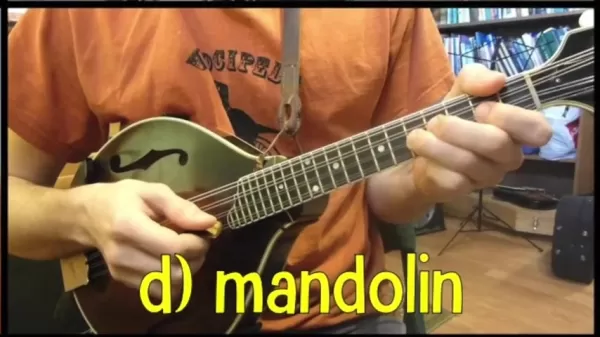
Mandolin: This small lute-like instrument features paired strings played with a pick. The design produces a bright, ringing tone perfect for melodies and decorative musical passages.
Percussion Instruments: Recognizing Rhythms
Percussion instruments provide rhythmic foundation for most musical groups. From the delicate chime of finger cymbals to the powerful resonance of kettle drums, percussion adds texture and energy to music. This quiz section challenges you to identify various percussion instruments by their characteristic sounds.

Which percussion instrument do you hear?
Snare Drum: Identified by wires stretched across its bottom head, the snare drum produces a sharp, rattling sound when struck. The vibrating wires create its distinctive tone.
Bongos: These small open-bottomed drums, played with hands, create bright, resonant tones often featured in Latin American music.
Kettle Drums: Also called timpani, these large bowl-shaped drums can be tuned to specific pitches. They produce deep, resonant sounds that add dramatic impact to orchestral music.
Djembe: Originating from West Africa, this goblet-shaped hand drum produces diverse sounds ranging from deep bass tones to sharp slapping sounds.
Brass Instruments: A Symphony of Sounds
Brass instruments deliver powerful, resonant tones capable of expressing wide emotional ranges. From the smooth cornet to the majestic tuba, these instruments are vital to orchestras, bands, and various ensembles. This quiz section tests your ability to distinguish brass instruments by their unique sound qualities.

Which brass instrument is this?
Cornet: Similar to the trumpet but with a more conical bore, the cornet produces a softer, more rounded tone quality.
Trombone: This brass instrument features a sliding mechanism that enables smooth pitch changes, creating its characteristic gliding sound.
Tuba: As the lowest-pitched brass instrument in orchestras, the tuba provides foundational deep, resonant tones that support the entire ensemble.
French Horn: With its complex valve system and coiled tubing, the French horn produces warm, mellow tones that blend beautifully with other instruments.
Unusual Instruments: Ear Training
The world of musical instruments contains both familiar sounds and more specialized ones. Test your knowledge of less common instruments in this quiz section.
Ukulele: Originating from Hawaii, this small four-stringed instrument produces cheerful, bright tones often associated with tropical music.
Cello: This large bowed string instrument delivers rich, resonant sounds. As a violin family member, it serves as both a solo and ensemble instrument.
Bass Guitar: Providing low-end foundation for rock, pop, and jazz groups, the bass guitar produces deep, powerful tones that anchor the rhythm section.
Banjo: Featuring a skin head stretched over a circular frame, the banjo creates bright, twangy sounds commonly linked with folk and bluegrass music.
Recognizing Similar Instruments
Some musical instruments share similar sounds that can challenge untrained ears. Learning to identify subtle differences in tone quality is an important skill. This section tests your ability to distinguish between similar stringed instruments based on their unique sound characteristics.
Which stringed instrument is playing?
Electric Guitar: Using magnetic pickups to convert string vibrations into electrical signals, the electric guitar can produce everything from clean tones to heavily distorted sounds through amplification.
Acoustic Guitar: This instrument generates sound through string vibrations amplified by its hollow body. The guitar's tone depends on materials, construction, and string type.
Ruan: This traditional Chinese string instrument features a circular body and short neck. Played with a pick, it produces gentle, resonant tones.
Bass Guitar: Providing low-end foundation for numerous music styles, the bass guitar delivers deep, powerful tones that support the rhythm section.
Percussion instruments: Triangle Training
Percussion instruments feature distinct tones that may be easy or difficult to recognize depending on your musical experience. Test your listening skills with these various percussion instruments.
Finger Cymbals: These small handheld cymbals produce shimmering metallic sounds when struck together.
High Hat: Consisting of two cymbals mounted on a stand, the high hat creates various rhythmic patterns when struck with sticks or operated with a foot pedal.
Gong: This large metal disc produces sustained, resonant tones when struck with a mallet.
Triangle: Struck with a metal beater, this small triangular metal bar creates bright, ringing tones.
Differentiating Violins
While string family members share similar structures, each possesses unique tonal qualities. Test your familiarity with different stringed instruments in this quiz.
Viola: Slightly larger than a violin but smaller than a cello, the viola produces warm, mellow tones that blend well with other instruments.
Cello: This large bowed string instrument creates rich, resonant sounds. As a violin family member, it functions as both solo and ensemble instrument.
Violin: The smallest and highest-pitched violin family member, the violin produces bright, clear tones ideal for melodies and decorative passages.
Double Bass: As the orchestra's lowest-pitched string instrument, the double bass provides deep, resonant foundational tones.
Instrument Oddities
Not all instruments are equally familiar, and some might challenge your naming abilities. These instruments each produce distinctive and unusual sounds for listeners.
Stylophone: This miniature electronic keyboard, played with a stylus, generates simple monophonic tones often used in novelty music.
Piano: As hammers strike strings when keys are pressed, this versatile keyboard instrument can play both melodies and harmonies across a wide dynamic range.
Bag Pipes: This wind instrument consists of an air bag filled by player breath and multiple pipes that create drone and melody sounds.
Concertina: Similar to an accordion, this free-reed instrument features buttons on both ends that produce notes when the bellows expand or compress.
Woodwind Instrument Rundown
Woodwind instruments are typically identified by their wooden construction, though some use metal or plastic materials. Regardless of material, these instruments create unique sounds.
Pan Pipes: This ancient instrument consists of multiple length-graded pipes that produce different notes when blown across.
Didgeridoo: Developed by Indigenous Australians, this wind instrument typically consists of a long branch hollowed by termites.
Ocarina: A type of vessel flute, this wind instrument usually features clay or ceramic construction with a distinctive egg-like shape.
Recorder: Held vertically and blown into, this wind instrument produces different notes through finger hole combinations.
Instrument Review
Review various instruments ranging from well-known to more specialized in this final music test section. What have you learned from this comprehensive musical challenge?
Bassoon: As the oboe family's bass member, this large double-reed instrument produces deep, resonant tones.
Bass Clarinet: The clarinet family's bass member, this large single-reed instrument creates rich, mellow sounds.
Cor Anglais: Also called English horn, this double-reed oboe family member produces expressive, mellow tones often used in orchestral music.
Saxophone: Commonly featured in jazz, blues, and popular music, this single-reed instrument delivers bright, powerful tones that can be both lyrical and expressive.
Pros and Cons of Learning About Music Instruments
Pros
Better listening abilities and deeper music appreciation.
Broader understanding of diverse cultures and musical traditions.
Enhanced capacity to recognize and evaluate musical works.
Increased creative potential and musical self-expression.
Greater enjoyment of both live concerts and recorded music.
Cons
Demands time commitment and dedication to study different instruments.
May include encountering unfamiliar or difficult musical styles.
Can feel overwhelming due to the enormous variety of instruments and music genres.
Might require access to recordings, learning materials, or educational resources.
Potential for developing strong preferences about specific instruments or music styles.
Frequently Asked Questions
What is the best way to improve my musical instrument identification skills?
Regular practice and focused listening are essential. Listen to diverse music genres and recordings while consciously attempting to identify the instruments you hear. Consider enrolling in music appreciation classes or using online tools to learn about instrument families and their features. The more you listen and study, the better you'll become at recognizing instruments by sound.
Are there any online resources that can help me learn more about musical instruments?
Yes, numerous online resources can help expand your knowledge of musical instruments. Many websites and applications provide interactive quizzes, audio examples, and detailed instrument information. You can also find educational videos and demonstrations on platforms like YouTube that show different instruments' sounds and playing techniques. Notable resources include: Classic FM: https://www.classicfm.com/discover-music/instruments/Music Instruments Guide: https://www.yamaha.com/en/musical_instrument_guide/Hello Music Theory: https://hellomusictheory.com/learn/instruments/These websites offer excellent information for broadening your musical understanding.
What are some common mistakes people make when trying to identify musical instruments?
A frequent error involves confusing instruments from the same family, like clarinets and oboes, or trumpets and cornets. Another mistake is depending too much on visual identification rather than careful listening. The musical context – including genre, ensemble type, and recording quality – also affects instrument sounds. By considering these factors and practicing listening skills, you can avoid common errors and improve your identification accuracy.
Related Questions
What are the different families of musical instruments?
Musical instruments are generally categorized into five main families: strings, woodwinds, brass, percussion, and keyboards. String instruments create sound through vibrating strings, while woodwinds generate sound when air passes through reeds or openings. Brass instruments rely on lip vibrations in mouthpieces, and percussion instruments produce sound when struck, shaken, or scraped. Keyboard instruments like pianos and organs use keys to activate sound-producing mechanisms. Each family has distinct characteristics and playing methods. The following chart outlines the main instrument families and their members:Instrument FamilyInstrumentsKey characteristicsStringViolin, viola, cello, double bass, guitar, harp, banjo, ukuleleSound created by vibrating stringsWoodwindFlute, piccolo, clarinet, oboe, bassoon, saxophone, recorderSound generated by air moving through reeds or openingsBrassTrumpet, cornet, trombone, French horn, tuba, euphoniumSound produced by lip vibrations in mouthpiecesPercussionSnare drum, bass drum, timpani, cymbals, gong, triangle, xylophone, marimbaSound made when struck, shaken, or scrapedKeyboardPiano, organ, harpsichord, synthesizerSound activated by keys operating sound-producing mechanisms
How do different musical instrument impact music production
Instrument selection profoundly influences music production. Different instruments provide unique tones, sound qualities, and expressive possibilities. The intended musical style often determines instrument choices, as specific instruments can evoke particular emotions, suit certain genres, and shape the overall sound. Genre Definition: Certain instruments become synonymous with specific music styles. For instance, electric guitars define rock and metal, while saxophones characterize jazz. These associations create listener expectations before hearing the music.Emotional Coloring: Each instrument possesses inherent sound qualities that enhance emotional expression. Warm string sections intensify romantic feelings, while solo piano might suggest introspection. Sonic Textures: Synthesizers create modern, futuristic soundscapes, while acoustic instruments evoke organic, human qualities.
Related article
 DeepMind CEO Hassabis: I sleep six hours a day, usually feel energetic around 1 a.m.
Fortune recently featured an interview with Demis Hassabis, CEO of Google DeepMind, revealing his unconventional approach to rest and productivity. Hassabis disclosed that he sleeps very little, structuring his waking hours into two distinct work blo
OpenAI, Anthropic Vie for Market Share Despite Revenue Shortfalls
Despite recent reports suggesting OpenAI missed revenue targets, creating pressure on tech stocks this Tuesday, private AI lab investors remain resilient. Seasoned backers have confirmed they will not reduce investment despite negative media coverage
California AV Compliance: A New Era of Tickets, Geofences, and 1M Miles
Guident operates an AuveTech shuttle in South Florida, managing a four-mile route in West Palm Beach and a one-mile route in Boca Raton using its remote monitoring technology. | Credit: GuidentCalifornia is redefining the regulatory landscape for dri
Related Special Topic Recommendations
Music composition
DeepMind CEO Hassabis: I sleep six hours a day, usually feel energetic around 1 a.m.
Fortune recently featured an interview with Demis Hassabis, CEO of Google DeepMind, revealing his unconventional approach to rest and productivity. Hassabis disclosed that he sleeps very little, structuring his waking hours into two distinct work blo
OpenAI, Anthropic Vie for Market Share Despite Revenue Shortfalls
Despite recent reports suggesting OpenAI missed revenue targets, creating pressure on tech stocks this Tuesday, private AI lab investors remain resilient. Seasoned backers have confirmed they will not reduce investment despite negative media coverage
California AV Compliance: A New Era of Tickets, Geofences, and 1M Miles
Guident operates an AuveTech shuttle in South Florida, managing a four-mile route in West Palm Beach and a one-mile route in Boca Raton using its remote monitoring technology. | Credit: GuidentCalifornia is redefining the regulatory landscape for dri
Related Special Topic Recommendations
Music composition
 AI Stem Separation Tools for Remix Production, Sampling Prep, and Karaoke Masters
2026 Latest Best Top-rated AI Stem Separation Tools Curated for Remix Production, Sampling Prep, and Karaoke Masters. These powerful game-changing tools offer real-world tests to deliver precise audio isolation, boosting productivity significantly. XIX.AI provides a weekly updated free vs paid comparison guide to help you find the must-try solution that suits your needs. Explore now to unlock your AI edge.
 8 tools
 xix.ai
Data Analysis
AI SQL Copilots for Revenue Dashboards, Funnel Analysis, and Product Metrics
xix.ai
Data Analysis
AI SQL Copilots for Revenue Dashboards, Funnel Analysis, and Product Metrics
2026 Latest Best AI SQL Copilots Ranked Top-Rated! XIX.AI curates a powerful game-changing collection for weekly updated real-world tests. These must-try tools help you generate accurate revenue dashboards, analyze sales funnels, and track product metrics swiftly, boosting productivity massively. Explore now to Discover your perfect tool for data-driven decision making! 238 characters
9 tools
xix.ai
Music composition
Best AI Melody Writing Tools for Song Drafts
2026 Latest Best Top-Rated AI Melody Writing Tools for Song Drafts! XIX.AI has curated a highly powerful game-changing collection that goes through rigorous real-world tests to deliver the best writing experience. You can find detailed free vs paid comparisons, accurate rankings, and must-try options designed to help you create stunning song drafts effortlessly and boost your creative productivity significantly. Explore now to discover your perfect tool!
8 tools
xix.ai
chatbot
Best AI Conversation Trainer Tools for Interview Practice
2026 Latest Best Top-rated AI Conversation Trainer Tools for Interview Practice are here on XIX.AI! This curated collection features powerful, game-changing tools that go through rigorous real-world tests to deliver accurate feedback. You’ll find a free vs paid comparison and detailed rankings to help you choose the must-try option that boosts your confidence and skills. Explore now to Discover your perfect tool for interview success!
12 tools
xix.ai
Design & Art
Best AI Style Transfer Tools for Creative Experiments
2026 Latest Best Top-rated AI Style Transfer Tools for Creative Experiments! XIX.AI has curated a powerful, game-changing collection of must-try tools that deliver exceptional results through real-world tests and rigorous rankings. These top solutions help creatives boost productivity significantly by accelerating content creation and unlocking endless creative possibilities. Explore now to discover your perfect tool and start creating today!
9 tools
xix.ai
Comic Creation
Best AI Dialogue Bubble Tools for Visual Storytelling
2026 Latest Best Top-Rated AI Dialogue Bubble Tools for Visual Storytelling are here on XIX.AI! This curated collection features powerful, game-changing tools that help creators boost productivity and overcome creative bottlenecks. Get a free vs paid comparison, see real-world tests, and check the latest rankings to find the must-try solutions perfect for crafting engaging visual narratives. Explore now to discover your ideal tool!
10 tools
xix.ai

 Comments (2)
0/500
Comments (2)
0/500
![FredGreen]()
Haha, this quiz is surprisingly tricky! I thought I knew my instruments, but the banjo vs mandolin got me. Definitely a fun challenge for music nerds. Can't wait to see how many I'll get right by 2026? 🎸
![WillieCarter]()
C'est intéressant comme approche pour apprendre les instruments ! Perso je confonds toujours le saxophone et la clarinette 😅 Est-ce que ce genre de quiz pourrait vraiment aider les débutants à progresser ? J'aimerais bien tester ça avec mes enfants.
Are you a true music lover? Can you tell the difference between a clarinet and an oboe, or a banjo and a mandolin? This article puts your musical knowledge to the test with a multiple-choice quiz designed to challenge your ability to identify instruments. Whether you're an experienced musician or just starting your musical journey, this fun quiz will help you train your ear and discover the incredible variety of instruments used in music.
Key Points
Improve your ability to recognize musical instruments by their sound.
Sharpen your skills in visually identifying instruments from different families.
Learn about both popular and rare musical instruments.
Experience an enjoyable and interactive approach to music education.
Challenge your current understanding of music with thought-provoking questions.
Test Your Musical Instrument Knowledge
Identifying Instruments by Sound
A key aspect of musical expertise is recognizing instruments simply by their unique sound qualities. This ability enhances your listening pleasure and deepens your respect for musical artistry. Our multiple-choice quiz will challenge your hearing, asking you to differentiate between instruments that might sound alike to inexperienced listeners. Get ready to listen carefully and trust your musical intuition!
Do you think you can recognize an accordion just by its sound? Let's find out.
Accordion: The accordion creates its distinctive sound through vibrating reeds activated by air from the bellows. The player controls airflow with the bellows while using buttons and keys to play different notes.
Organ: Organs generate sound by directing air through specially tuned pipes. The instrument's numerous pipes enable rich harmonies and dynamic variation, making it suitable for both solo and group performances.
Banjo: The banjo's signature twang comes from its skin head stretched over a circular frame. When strings are plucked, the vibrating head produces a bright, percussive tone commonly heard in folk and bluegrass music.
Zheng: This traditional Chinese instrument features multiple strings stretched across a long wooden soundboard. Musicians use picks to pluck the strings, creating a gentle, resonant sound essential to Chinese classical music.
Woodwind Instruments: Aural Differentiation
The woodwind family includes diverse instruments, each with its own sonic character. From the piercing piccolo to the soulful harmonica, learning to distinguish these instruments is valuable for any music enthusiast. This quiz section will test your ability to identify woodwind instruments based solely on their auditory qualities.
Can you identify the harmonica?
Piccolo: As the smallest member of the flute family, the piccolo produces a brilliant, penetrating sound that stands out in orchestral settings. Its high pitch adds sparkle and intensity to musical arrangements.
Ocarina: This vessel flute creates sound when air moves across a mouthpiece, causing resonance within its chamber. The instrument's pitch depends on the chamber dimensions and finger hole placement.
Harmonica: This free-reed instrument produces sound when players blow or draw air across metal reeds. Different notes sound depending on airflow direction, allowing for versatile musical expression.
Recorder: A type of duct flute, the recorder generates sound when air enters through a mouthpiece, vibrating the air column inside. Players control pitch by covering and uncovering finger holes along the instrument's length.
String Instruments: Identifying the Source
String instruments form the foundation of numerous music styles, from classical compositions to folk tunes and rock anthems. Recognizing different string instruments by ear is crucial for dedicated music fans. This quiz section evaluates your ability to identify string instruments based on their distinctive tonal characteristics. Ready to play along?
Can you identify what's playing here?
Acoustic Guitar: This instrument produces sound through string vibrations amplified by its hollow body. The guitar's tone depends on wood selection, body construction, and string type.
Banjo: The banjo's bright, twangy tone results from strings vibrating against a skin head mounted on a circular frame. This unique design gives the banjo its immediately recognizable voice.
Harp: As a multi-stringed instrument, the harp creates sound when players pluck or strum its strings. Each string's length and tension determines its pitch, enabling a broad range of notes and harmonies.
Mandolin: This small lute-like instrument features paired strings played with a pick. The design produces a bright, ringing tone perfect for melodies and decorative musical passages.
Percussion Instruments: Recognizing Rhythms
Percussion instruments provide rhythmic foundation for most musical groups. From the delicate chime of finger cymbals to the powerful resonance of kettle drums, percussion adds texture and energy to music. This quiz section challenges you to identify various percussion instruments by their characteristic sounds.
Which percussion instrument do you hear?
Snare Drum: Identified by wires stretched across its bottom head, the snare drum produces a sharp, rattling sound when struck. The vibrating wires create its distinctive tone.
Bongos: These small open-bottomed drums, played with hands, create bright, resonant tones often featured in Latin American music.
Kettle Drums: Also called timpani, these large bowl-shaped drums can be tuned to specific pitches. They produce deep, resonant sounds that add dramatic impact to orchestral music.
Djembe: Originating from West Africa, this goblet-shaped hand drum produces diverse sounds ranging from deep bass tones to sharp slapping sounds.
Brass Instruments: A Symphony of Sounds
Brass instruments deliver powerful, resonant tones capable of expressing wide emotional ranges. From the smooth cornet to the majestic tuba, these instruments are vital to orchestras, bands, and various ensembles. This quiz section tests your ability to distinguish brass instruments by their unique sound qualities.
Which brass instrument is this?
Cornet: Similar to the trumpet but with a more conical bore, the cornet produces a softer, more rounded tone quality.
Trombone: This brass instrument features a sliding mechanism that enables smooth pitch changes, creating its characteristic gliding sound.
Tuba: As the lowest-pitched brass instrument in orchestras, the tuba provides foundational deep, resonant tones that support the entire ensemble.
French Horn: With its complex valve system and coiled tubing, the French horn produces warm, mellow tones that blend beautifully with other instruments.
Unusual Instruments: Ear Training
The world of musical instruments contains both familiar sounds and more specialized ones. Test your knowledge of less common instruments in this quiz section.
Ukulele: Originating from Hawaii, this small four-stringed instrument produces cheerful, bright tones often associated with tropical music.
Cello: This large bowed string instrument delivers rich, resonant sounds. As a violin family member, it serves as both a solo and ensemble instrument.
Bass Guitar: Providing low-end foundation for rock, pop, and jazz groups, the bass guitar produces deep, powerful tones that anchor the rhythm section.
Banjo: Featuring a skin head stretched over a circular frame, the banjo creates bright, twangy sounds commonly linked with folk and bluegrass music.
Recognizing Similar Instruments
Some musical instruments share similar sounds that can challenge untrained ears. Learning to identify subtle differences in tone quality is an important skill. This section tests your ability to distinguish between similar stringed instruments based on their unique sound characteristics.
Which stringed instrument is playing?
Electric Guitar: Using magnetic pickups to convert string vibrations into electrical signals, the electric guitar can produce everything from clean tones to heavily distorted sounds through amplification.
Acoustic Guitar: This instrument generates sound through string vibrations amplified by its hollow body. The guitar's tone depends on materials, construction, and string type.
Ruan: This traditional Chinese string instrument features a circular body and short neck. Played with a pick, it produces gentle, resonant tones.
Bass Guitar: Providing low-end foundation for numerous music styles, the bass guitar delivers deep, powerful tones that support the rhythm section.
Percussion instruments: Triangle Training
Percussion instruments feature distinct tones that may be easy or difficult to recognize depending on your musical experience. Test your listening skills with these various percussion instruments.
Finger Cymbals: These small handheld cymbals produce shimmering metallic sounds when struck together.
High Hat: Consisting of two cymbals mounted on a stand, the high hat creates various rhythmic patterns when struck with sticks or operated with a foot pedal.
Gong: This large metal disc produces sustained, resonant tones when struck with a mallet.
Triangle: Struck with a metal beater, this small triangular metal bar creates bright, ringing tones.
Differentiating Violins
While string family members share similar structures, each possesses unique tonal qualities. Test your familiarity with different stringed instruments in this quiz.
Viola: Slightly larger than a violin but smaller than a cello, the viola produces warm, mellow tones that blend well with other instruments.
Cello: This large bowed string instrument creates rich, resonant sounds. As a violin family member, it functions as both solo and ensemble instrument.
Violin: The smallest and highest-pitched violin family member, the violin produces bright, clear tones ideal for melodies and decorative passages.
Double Bass: As the orchestra's lowest-pitched string instrument, the double bass provides deep, resonant foundational tones.
Instrument Oddities
Not all instruments are equally familiar, and some might challenge your naming abilities. These instruments each produce distinctive and unusual sounds for listeners.
Stylophone: This miniature electronic keyboard, played with a stylus, generates simple monophonic tones often used in novelty music.
Piano: As hammers strike strings when keys are pressed, this versatile keyboard instrument can play both melodies and harmonies across a wide dynamic range.
Bag Pipes: This wind instrument consists of an air bag filled by player breath and multiple pipes that create drone and melody sounds.
Concertina: Similar to an accordion, this free-reed instrument features buttons on both ends that produce notes when the bellows expand or compress.
Woodwind Instrument Rundown
Woodwind instruments are typically identified by their wooden construction, though some use metal or plastic materials. Regardless of material, these instruments create unique sounds.
Pan Pipes: This ancient instrument consists of multiple length-graded pipes that produce different notes when blown across.
Didgeridoo: Developed by Indigenous Australians, this wind instrument typically consists of a long branch hollowed by termites.
Ocarina: A type of vessel flute, this wind instrument usually features clay or ceramic construction with a distinctive egg-like shape.
Recorder: Held vertically and blown into, this wind instrument produces different notes through finger hole combinations.
Instrument Review
Review various instruments ranging from well-known to more specialized in this final music test section. What have you learned from this comprehensive musical challenge?
Bassoon: As the oboe family's bass member, this large double-reed instrument produces deep, resonant tones.
Bass Clarinet: The clarinet family's bass member, this large single-reed instrument creates rich, mellow sounds.
Cor Anglais: Also called English horn, this double-reed oboe family member produces expressive, mellow tones often used in orchestral music.
Saxophone: Commonly featured in jazz, blues, and popular music, this single-reed instrument delivers bright, powerful tones that can be both lyrical and expressive.
Pros and Cons of Learning About Music Instruments
Pros
Better listening abilities and deeper music appreciation.
Broader understanding of diverse cultures and musical traditions.
Enhanced capacity to recognize and evaluate musical works.
Increased creative potential and musical self-expression.
Greater enjoyment of both live concerts and recorded music.
Cons
Demands time commitment and dedication to study different instruments.
May include encountering unfamiliar or difficult musical styles.
Can feel overwhelming due to the enormous variety of instruments and music genres.
Might require access to recordings, learning materials, or educational resources.
Potential for developing strong preferences about specific instruments or music styles.
Frequently Asked Questions
What is the best way to improve my musical instrument identification skills?
Regular practice and focused listening are essential. Listen to diverse music genres and recordings while consciously attempting to identify the instruments you hear. Consider enrolling in music appreciation classes or using online tools to learn about instrument families and their features. The more you listen and study, the better you'll become at recognizing instruments by sound.
Are there any online resources that can help me learn more about musical instruments?
Yes, numerous online resources can help expand your knowledge of musical instruments. Many websites and applications provide interactive quizzes, audio examples, and detailed instrument information. You can also find educational videos and demonstrations on platforms like YouTube that show different instruments' sounds and playing techniques. Notable resources include: Classic FM: https://www.classicfm.com/discover-music/instruments/Music Instruments Guide: https://www.yamaha.com/en/musical_instrument_guide/Hello Music Theory: https://hellomusictheory.com/learn/instruments/These websites offer excellent information for broadening your musical understanding.
What are some common mistakes people make when trying to identify musical instruments?
A frequent error involves confusing instruments from the same family, like clarinets and oboes, or trumpets and cornets. Another mistake is depending too much on visual identification rather than careful listening. The musical context – including genre, ensemble type, and recording quality – also affects instrument sounds. By considering these factors and practicing listening skills, you can avoid common errors and improve your identification accuracy.
Related Questions
What are the different families of musical instruments?
Musical instruments are generally categorized into five main families: strings, woodwinds, brass, percussion, and keyboards. String instruments create sound through vibrating strings, while woodwinds generate sound when air passes through reeds or openings. Brass instruments rely on lip vibrations in mouthpieces, and percussion instruments produce sound when struck, shaken, or scraped. Keyboard instruments like pianos and organs use keys to activate sound-producing mechanisms. Each family has distinct characteristics and playing methods. The following chart outlines the main instrument families and their members:Instrument FamilyInstrumentsKey characteristicsStringViolin, viola, cello, double bass, guitar, harp, banjo, ukuleleSound created by vibrating stringsWoodwindFlute, piccolo, clarinet, oboe, bassoon, saxophone, recorderSound generated by air moving through reeds or openingsBrassTrumpet, cornet, trombone, French horn, tuba, euphoniumSound produced by lip vibrations in mouthpiecesPercussionSnare drum, bass drum, timpani, cymbals, gong, triangle, xylophone, marimbaSound made when struck, shaken, or scrapedKeyboardPiano, organ, harpsichord, synthesizerSound activated by keys operating sound-producing mechanisms
How do different musical instrument impact music production
Instrument selection profoundly influences music production. Different instruments provide unique tones, sound qualities, and expressive possibilities. The intended musical style often determines instrument choices, as specific instruments can evoke particular emotions, suit certain genres, and shape the overall sound. Genre Definition: Certain instruments become synonymous with specific music styles. For instance, electric guitars define rock and metal, while saxophones characterize jazz. These associations create listener expectations before hearing the music.Emotional Coloring: Each instrument possesses inherent sound qualities that enhance emotional expression. Warm string sections intensify romantic feelings, while solo piano might suggest introspection. Sonic Textures: Synthesizers create modern, futuristic soundscapes, while acoustic instruments evoke organic, human qualities.








 DeepMind CEO Hassabis: I sleep six hours a day, usually feel energetic around 1 a.m.
Fortune recently featured an interview with Demis Hassabis, CEO of Google DeepMind, revealing his unconventional approach to rest and productivity. Hassabis disclosed that he sleeps very little, structuring his waking hours into two distinct work blo
DeepMind CEO Hassabis: I sleep six hours a day, usually feel energetic around 1 a.m.
Fortune recently featured an interview with Demis Hassabis, CEO of Google DeepMind, revealing his unconventional approach to rest and productivity. Hassabis disclosed that he sleeps very little, structuring his waking hours into two distinct work blo
 OpenAI, Anthropic Vie for Market Share Despite Revenue Shortfalls
Despite recent reports suggesting OpenAI missed revenue targets, creating pressure on tech stocks this Tuesday, private AI lab investors remain resilient. Seasoned backers have confirmed they will not reduce investment despite negative media coverage
California AV Compliance: A New Era of Tickets, Geofences, and 1M Miles
Guident operates an AuveTech shuttle in South Florida, managing a four-mile route in West Palm Beach and a one-mile route in Boca Raton using its remote monitoring technology. | Credit: GuidentCalifornia is redefining the regulatory landscape for dri
OpenAI, Anthropic Vie for Market Share Despite Revenue Shortfalls
Despite recent reports suggesting OpenAI missed revenue targets, creating pressure on tech stocks this Tuesday, private AI lab investors remain resilient. Seasoned backers have confirmed they will not reduce investment despite negative media coverage
California AV Compliance: A New Era of Tickets, Geofences, and 1M Miles
Guident operates an AuveTech shuttle in South Florida, managing a four-mile route in West Palm Beach and a one-mile route in Boca Raton using its remote monitoring technology. | Credit: GuidentCalifornia is redefining the regulatory landscape for dri

2026 Latest Best Top-rated AI Stem Separation Tools Curated for Remix Production, Sampling Prep, and Karaoke Masters. These powerful game-changing tools offer real-world tests to deliver precise audio isolation, boosting productivity significantly. XIX.AI provides a weekly updated free vs paid comparison guide to help you find the must-try solution that suits your needs. Explore now to unlock your AI edge.
8 tools
xix.ai

2026 Latest Best AI SQL Copilots Ranked Top-Rated! XIX.AI curates a powerful game-changing collection for weekly updated real-world tests. These must-try tools help you generate accurate revenue dashboards, analyze sales funnels, and track product metrics swiftly, boosting productivity massively. Explore now to Discover your perfect tool for data-driven decision making! 238 characters
9 tools
xix.ai

2026 Latest Best Top-Rated AI Melody Writing Tools for Song Drafts! XIX.AI has curated a highly powerful game-changing collection that goes through rigorous real-world tests to deliver the best writing experience. You can find detailed free vs paid comparisons, accurate rankings, and must-try options designed to help you create stunning song drafts effortlessly and boost your creative productivity significantly. Explore now to discover your perfect tool!
8 tools
xix.ai

2026 Latest Best Top-rated AI Conversation Trainer Tools for Interview Practice are here on XIX.AI! This curated collection features powerful, game-changing tools that go through rigorous real-world tests to deliver accurate feedback. You’ll find a free vs paid comparison and detailed rankings to help you choose the must-try option that boosts your confidence and skills. Explore now to Discover your perfect tool for interview success!
12 tools
xix.ai

2026 Latest Best Top-rated AI Style Transfer Tools for Creative Experiments! XIX.AI has curated a powerful, game-changing collection of must-try tools that deliver exceptional results through real-world tests and rigorous rankings. These top solutions help creatives boost productivity significantly by accelerating content creation and unlocking endless creative possibilities. Explore now to discover your perfect tool and start creating today!
9 tools
xix.ai

2026 Latest Best Top-Rated AI Dialogue Bubble Tools for Visual Storytelling are here on XIX.AI! This curated collection features powerful, game-changing tools that help creators boost productivity and overcome creative bottlenecks. Get a free vs paid comparison, see real-world tests, and check the latest rankings to find the must-try solutions perfect for crafting engaging visual narratives. Explore now to discover your ideal tool!
10 tools
xix.ai

Haha, this quiz is surprisingly tricky! I thought I knew my instruments, but the banjo vs mandolin got me. Definitely a fun challenge for music nerds. Can't wait to see how many I'll get right by 2026? 🎸
C'est intéressant comme approche pour apprendre les instruments ! Perso je confonds toujours le saxophone et la clarinette 😅 Est-ce que ce genre de quiz pourrait vraiment aider les débutants à progresser ? J'aimerais bien tester ça avec mes enfants.












