Home
HomeHow to use Liner AI for research with reliable source citations in 2025?
In our information-rich era, the need for reliable data is more critical than ever. While artificial intelligence (AI) has become a powerful research assistant, verifying the accuracy of its responses remains a key challenge. Liner AI emerges as a forward-thinking solution, delivering precise answers backed by verifiable source citations. This article delves into Liner AI's features, benefits, and practical applications, showcasing its potential to transform how we gather and trust information.
Key Points
Liner AI tackles the reliability issue of AI by citing sources for every line of its answers.
It ensures information is accurate and trustworthy, ideal for academic, professional, and personal research.
The platform offers two main modes: General for everyday queries and Scholar for academic work.
Scholar Mode hones in on credible, peer-reviewed documents to support students and researchers.
Getting started is simple: users just type a question to receive a sourced answer.
The Challenge of AI Information Reliability
The Problem with Traditional AI Tools
Many existing AI tools generate responses without revealing their sources, leaving users in the dark about accuracy. This lack of transparency can spread misinformation and compromise research quality. In today's fast-paced digital world, trusting AI output is vital, especially for decisions with real-world impact. Verifying sources becomes non-negotiable for credible information. Liner AI directly addresses this gap by providing clear citations for every piece of information it shares.
Introducing Liner AI: A Solution for Reliable Information
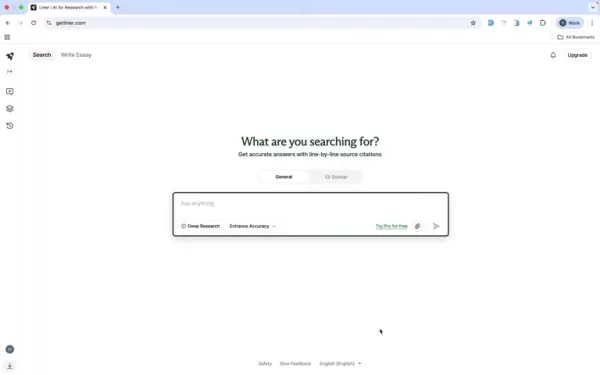
Liner AI solves this problem with its unique line-by-line source citations. This allows users to check the origin of any fact and confirm its validity. Such transparency is foundational for building trust in AI-generated content. Users can confidently use the information for research, work, or learning. Liner AI doesn't just provide answers; it makes them verifiable, reshaping our interaction with AI insights. It supports better decision-making and empowers users to independently assess content credibility.
Exploring Liner AI's Features and Functionality
General and Scholar Modes: Tailoring Research to Your Needs
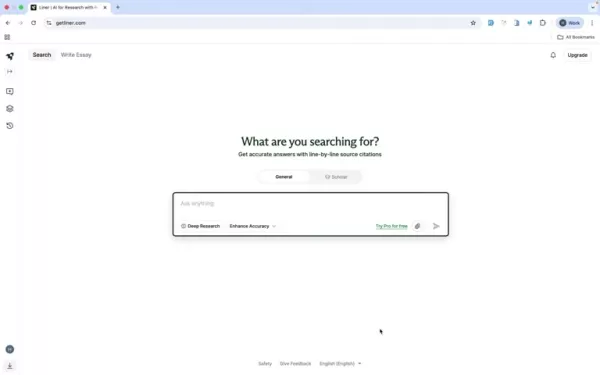
Liner AI features two specialized modes for different research goals. The General mode is perfect for day-to-day questions, pulling from a wide array of online sources. The Scholar mode is tailored for academic work, concentrating on scholarly documents, journals, and peer-reviewed papers.
This focus on academic rigor elevates the quality and dependability of research for students and scholars. Switching between modes lets users customize their experience, accessing the most relevant information for their task. Scholar Mode is built to uphold academic standards and support serious study.
Having both options makes Liner AI an essential tool for anyone seeking evidence-based information. This blend of everyday accessibility and scholarly depth creates a uniquely versatile research assistant.
How Liner AI Provides Source Citations
Liner AI delivers clear, clickable source citations alongside every answer. Each statement is traceable to its original publication, enabling users to evaluate credibility firsthand. This is invaluable for research, where source verification is a core step. Users can click citations to view the original context, ensuring the information is used accurately. This transparency fosters trust and allows for decisions grounded in verifiable data.
The detailed citations empower thorough investigation and ensure findings are solid and reliable. With Liner AI, research becomes more transparent, efficient, and trustworthy, promoting a deeper understanding and upholding integrity. Direct access to source material fundamentally improves the research process and encourages critical analysis.
How to Use Liner AI: A Step-by-Step Guide
Step 1: Accessing Liner AI
To start using Liner AI, visit the official Liner AI website.
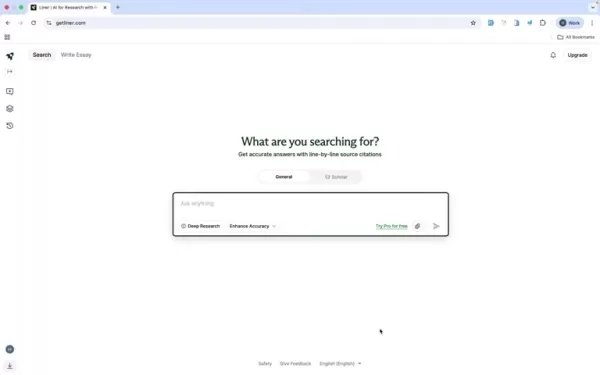
You can find it quickly by searching "Liner AI" on Google or any search engine. The site features a clean, intuitive interface designed for ease of use.
Step 2: Entering Your Question or Prompt
On the homepage, you'll see a prominent text box. Simply type your question or topic here. Liner AI can handle a broad spectrum of queries, from specific factual questions to open-ended research topics.
Step 3: Choosing a Research Mode
Before submitting, select your preferred research mode. Choose General for information from diverse public sources, or select Scholar to focus on academic publications. This choice ensures the results are aligned with your specific needs.
Step 4: Reviewing the Results and Source Citations
After you submit, Liner AI generates a comprehensive answer with inline source citations. Review the response and click on any citation to explore the original source.
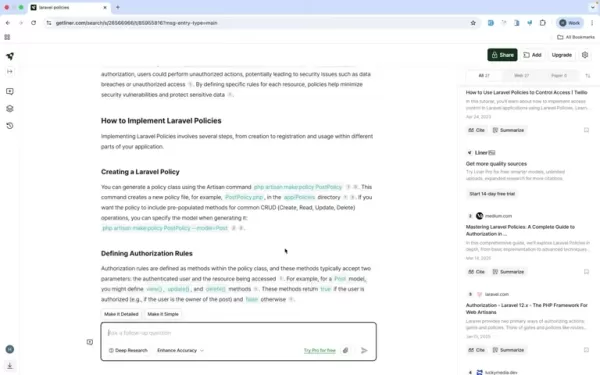
This step is key for verifying the information's accuracy and context. Take time to examine the sources to confirm they meet your research standards.
Advantages and Disadvantages of Liner AI
Pros
Transparent source citations build trust and verify accuracy.
Scholar Mode provides specialized access to academic materials.
The interface is straightforward and user-friendly.
Enhances the overall quality and reliability of research.
Supports making well-informed, evidence-based decisions.
Cons
New users may need a short time to learn the platform fully.
Output quality depends on the availability and credibility of online sources.
Coverage may not be as vast as unrestricted web searches.
Relies on the AI's correct interpretation of source materials.
Access to premium features may require a subscription.
FAQ
What is Liner AI?
Liner AI is an advanced AI platform that delivers accurate answers accompanied by verifiable source citations. It is designed to ensure the reliability of information for all types of research.
How does Liner AI ensure the accuracy of its answers?
Liner AI provides direct citations for every claim, allowing users to check the original sources themselves. This transparency ensures information is reliable and builds user trust in the content.
What are the different research modes available in Liner AI?
Liner AI offers two core modes: General and Scholar. General mode sources information from across the web, while Scholar mode specifically targets academic and peer-reviewed documents for rigorous research.
How do I access the original sources cited by Liner AI?
Each citation in a Liner AI answer is a clickable link. Simply click on the provided citation to be taken directly to the original source document for verification.
Is Liner AI suitable for academic research?
Absolutely. Its dedicated Scholar Mode filters for academic sources, making it an excellent tool for students and researchers who require credible, peer-reviewed information.
Related Questions
What are the key benefits of using Liner AI for research?
Liner AI offers significant advantages for researchers. It elevates accuracy through transparency, allows for independent fact-checking, and makes the research process more efficient and trustworthy. It encourages deeper understanding and critical thinking by linking directly to evidence. Additional benefits include:Higher Quality Research: Ensures your work is grounded in credible sources.Increased Efficiency: Saves time by quickly connecting answers to their origins.Boosted Confidence: Transparent citations increase trust in your findings.Data-Driven Decisions: Empowers you to make choices based on verified information.Academic Rigor: Supports scholarly integrity by prioritizing peer-reviewed content.
How does Liner AI compare to other AI research tools?
Liner AI stands out from other AI research assistants by prioritizing transparency and verification. While many tools offer unsourced answers, Liner AI provides clear citations for every line, setting a higher standard for reliability. Here's a comparison table:FeatureLiner AIOther AI Research ToolsSource CitationsProvided for each lineOften unavailable or vagueResearch ModesGeneral and ScholarTypically a single, broad modeAcademic FocusSpecialized Scholar ModeRarely specializedTransparencyHigh, with visible sourcingGenerally lowAccuracyUsers can verify independentlyDifficult or impossible to verifyUser TrustBuilt through opennessOften limited by opacityIn summary, Liner AI provides a more robust, trustworthy, and transparent research experience.
Related article
 OpenAI Secretly Changes Charter to Make Removing Altman Harder
Following the 2023 coup-like incident, OpenAI has further solidified protections for CEO Sam Altman by updating its corporate bylaws. Recently released court documents reveal that Altman's position is now rock-solid, with substantially higher barrier
Meta AI now responds to buyer messages on Facebook Marketplace
Facebook Marketplace introduces new Meta AI features, including automated replies to buyer inquiries, the company announced Thursday. The platform also leverages AI to accelerate item listings, summarize seller profiles, and now lets sellers offer sh
OpenAI outlines AI economy with public wealth funds, robot taxes, and four-day week
As governments struggle to manage the economic impact of superintelligent machines, OpenAI has released a set of policy proposals outlining how wealth and work could be reshaped in an "intelligence age." The ideas blend traditional left-leaning mecha
Related Special Topic Recommendations
Productivity
OpenAI Secretly Changes Charter to Make Removing Altman Harder
Following the 2023 coup-like incident, OpenAI has further solidified protections for CEO Sam Altman by updating its corporate bylaws. Recently released court documents reveal that Altman's position is now rock-solid, with substantially higher barrier
Meta AI now responds to buyer messages on Facebook Marketplace
Facebook Marketplace introduces new Meta AI features, including automated replies to buyer inquiries, the company announced Thursday. The platform also leverages AI to accelerate item listings, summarize seller profiles, and now lets sellers offer sh
OpenAI outlines AI economy with public wealth funds, robot taxes, and four-day week
As governments struggle to manage the economic impact of superintelligent machines, OpenAI has released a set of policy proposals outlining how wealth and work could be reshaped in an "intelligence age." The ideas blend traditional left-leaning mecha
Related Special Topic Recommendations
Productivity
 AI Personal Wellness & Focus Coaches: Manage Burnout & Boost Mental Energy Levels
Discover the 2026 best AI personal wellness and focus coaches on XIX.AI. Our curated rankings feature top-rated, game-changing tools to manage burnout and boost mental energy. Compare free vs paid options with real-world insights. Unlock your path to peak productivity and well-being today.
 10 tools
 xix.ai
chatbot
Top-Rated AI Romantic Chatbots: Build Long-Term Relationships with Consistent Personalities
xix.ai
chatbot
Top-Rated AI Romantic Chatbots: Build Long-Term Relationships with Consistent Personalities
Discover the 2026 latest top-rated AI romantic chatbots for building genuine, long-term connections. Our curated list features powerful, consistent personalities, free vs paid comparisons, and real-world tests. Find your perfect companion and start building today at XIX.AI.
10 tools
xix.ai
Education and Learning
Best AI Data Science Mentors: Master SQL, Pandas & Machine Learning Workflows
Discover the 2026 best AI data science mentors to master SQL, Pandas & ML workflows. Explore our top-rated, curated selection at XIX.AI for powerful, game-changing guidance. Compare free vs paid options with real-world insights. Unlock your data science mastery today.
10 tools
xix.ai
chatbot
Best AI Flirting & Conversation Trainers: Improve Social Charisma and Confidence in Real-Time
Discover the 2026 best AI flirting and conversation trainers on XIX.AI. Our curated, top-rated selection helps you build social charisma and confidence in real-time. Explore must-try, game-changing tools with free vs paid comparisons and weekly updated rankings. Unlock your social edge today.
10 tools
xix.ai
code
Best AI Tools for Automated Unit Testing: Generate Jest, PyTest & JUnit Test Cases in One Click
Discover the 2026 latest top-rated AI tools for automated unit testing. Our curated selection features powerful, game-changing solutions to generate Jest, PyTest & JUnit test cases instantly. Compare free vs paid options with real-world tests and weekly updated rankings on XIX.AI. Unlock your AI edge and boost development productivity today.
10 tools
xix.ai
Data Analysis
Best AI Data Visualization Tools: Auto-Generate Interactive BI Dashboards from Raw Files
Discover the 2026 best AI data visualization tools at XIX.AI. Our curated, top-rated selection helps you auto-generate powerful, interactive BI dashboards from raw files instantly. Compare free vs paid options with real-world tests and weekly updated rankings. Unlock your data's potential today.
10 tools
xix.ai

 Comments (2)
0/500
Comments (2)
0/500
![WillieJones]()
2025年に信頼できる出典を引用しながらリサーチにLiner AIを使うって、本当に実用段階になるのかな?個人的にはまだAIの回答に完全に頼るのは不安だ😅 特に学術研究では、間違った情報を引用してしまったら大変だし、そもそもAIが提示するソース自体の信頼性をどう検証するのかが気になる。便利そうだけど、使い方次第だね。昔は自分で文献を漁ってたけど、時代は変わったのかも。とはいえ、この手のツールが増えるのは歓迎だけど...倫理的なガイドラインも必要なんじゃないかな。
![WillieRamirez]()
Also das mit den zuverlässigen Quellenangaben klingt ja mal super praktisch! 🧐 Ich frage mich, ob das Tool auch bei deutschen Quellen oder wissenschaftlichen Artikeln gut funktioniert. Die Idee, dass die KI einem quasi die Fußnoten setzt, ist schon ein Gamechanger fürs Studium oder die Arbeit. Hoffentlich wird das nicht zu teuer...
In our information-rich era, the need for reliable data is more critical than ever. While artificial intelligence (AI) has become a powerful research assistant, verifying the accuracy of its responses remains a key challenge. Liner AI emerges as a forward-thinking solution, delivering precise answers backed by verifiable source citations. This article delves into Liner AI's features, benefits, and practical applications, showcasing its potential to transform how we gather and trust information.
Key Points
Liner AI tackles the reliability issue of AI by citing sources for every line of its answers.
It ensures information is accurate and trustworthy, ideal for academic, professional, and personal research.
The platform offers two main modes: General for everyday queries and Scholar for academic work.
Scholar Mode hones in on credible, peer-reviewed documents to support students and researchers.
Getting started is simple: users just type a question to receive a sourced answer.
The Challenge of AI Information Reliability
The Problem with Traditional AI Tools
Many existing AI tools generate responses without revealing their sources, leaving users in the dark about accuracy. This lack of transparency can spread misinformation and compromise research quality. In today's fast-paced digital world, trusting AI output is vital, especially for decisions with real-world impact. Verifying sources becomes non-negotiable for credible information. Liner AI directly addresses this gap by providing clear citations for every piece of information it shares.
Introducing Liner AI: A Solution for Reliable Information
Liner AI solves this problem with its unique line-by-line source citations. This allows users to check the origin of any fact and confirm its validity. Such transparency is foundational for building trust in AI-generated content. Users can confidently use the information for research, work, or learning. Liner AI doesn't just provide answers; it makes them verifiable, reshaping our interaction with AI insights. It supports better decision-making and empowers users to independently assess content credibility.
Exploring Liner AI's Features and Functionality
General and Scholar Modes: Tailoring Research to Your Needs
Liner AI features two specialized modes for different research goals. The General mode is perfect for day-to-day questions, pulling from a wide array of online sources. The Scholar mode is tailored for academic work, concentrating on scholarly documents, journals, and peer-reviewed papers.
This focus on academic rigor elevates the quality and dependability of research for students and scholars. Switching between modes lets users customize their experience, accessing the most relevant information for their task. Scholar Mode is built to uphold academic standards and support serious study.
Having both options makes Liner AI an essential tool for anyone seeking evidence-based information. This blend of everyday accessibility and scholarly depth creates a uniquely versatile research assistant.
How Liner AI Provides Source Citations
Liner AI delivers clear, clickable source citations alongside every answer. Each statement is traceable to its original publication, enabling users to evaluate credibility firsthand. This is invaluable for research, where source verification is a core step. Users can click citations to view the original context, ensuring the information is used accurately. This transparency fosters trust and allows for decisions grounded in verifiable data.
The detailed citations empower thorough investigation and ensure findings are solid and reliable. With Liner AI, research becomes more transparent, efficient, and trustworthy, promoting a deeper understanding and upholding integrity. Direct access to source material fundamentally improves the research process and encourages critical analysis.
How to Use Liner AI: A Step-by-Step Guide
Step 1: Accessing Liner AI
To start using Liner AI, visit the official Liner AI website.
You can find it quickly by searching "Liner AI" on Google or any search engine. The site features a clean, intuitive interface designed for ease of use.
Step 2: Entering Your Question or Prompt
On the homepage, you'll see a prominent text box. Simply type your question or topic here. Liner AI can handle a broad spectrum of queries, from specific factual questions to open-ended research topics.
Step 3: Choosing a Research Mode
Before submitting, select your preferred research mode. Choose General for information from diverse public sources, or select Scholar to focus on academic publications. This choice ensures the results are aligned with your specific needs.
Step 4: Reviewing the Results and Source Citations
After you submit, Liner AI generates a comprehensive answer with inline source citations. Review the response and click on any citation to explore the original source.
This step is key for verifying the information's accuracy and context. Take time to examine the sources to confirm they meet your research standards.
Advantages and Disadvantages of Liner AI
Pros
Transparent source citations build trust and verify accuracy.
Scholar Mode provides specialized access to academic materials.
The interface is straightforward and user-friendly.
Enhances the overall quality and reliability of research.
Supports making well-informed, evidence-based decisions.
Cons
New users may need a short time to learn the platform fully.
Output quality depends on the availability and credibility of online sources.
Coverage may not be as vast as unrestricted web searches.
Relies on the AI's correct interpretation of source materials.
Access to premium features may require a subscription.
FAQ
What is Liner AI?
Liner AI is an advanced AI platform that delivers accurate answers accompanied by verifiable source citations. It is designed to ensure the reliability of information for all types of research.
How does Liner AI ensure the accuracy of its answers?
Liner AI provides direct citations for every claim, allowing users to check the original sources themselves. This transparency ensures information is reliable and builds user trust in the content.
What are the different research modes available in Liner AI?
Liner AI offers two core modes: General and Scholar. General mode sources information from across the web, while Scholar mode specifically targets academic and peer-reviewed documents for rigorous research.
How do I access the original sources cited by Liner AI?
Each citation in a Liner AI answer is a clickable link. Simply click on the provided citation to be taken directly to the original source document for verification.
Is Liner AI suitable for academic research?
Absolutely. Its dedicated Scholar Mode filters for academic sources, making it an excellent tool for students and researchers who require credible, peer-reviewed information.
Related Questions
What are the key benefits of using Liner AI for research?
Liner AI offers significant advantages for researchers. It elevates accuracy through transparency, allows for independent fact-checking, and makes the research process more efficient and trustworthy. It encourages deeper understanding and critical thinking by linking directly to evidence. Additional benefits include:Higher Quality Research: Ensures your work is grounded in credible sources.Increased Efficiency: Saves time by quickly connecting answers to their origins.Boosted Confidence: Transparent citations increase trust in your findings.Data-Driven Decisions: Empowers you to make choices based on verified information.Academic Rigor: Supports scholarly integrity by prioritizing peer-reviewed content.
How does Liner AI compare to other AI research tools?
Liner AI stands out from other AI research assistants by prioritizing transparency and verification. While many tools offer unsourced answers, Liner AI provides clear citations for every line, setting a higher standard for reliability. Here's a comparison table:FeatureLiner AIOther AI Research ToolsSource CitationsProvided for each lineOften unavailable or vagueResearch ModesGeneral and ScholarTypically a single, broad modeAcademic FocusSpecialized Scholar ModeRarely specializedTransparencyHigh, with visible sourcingGenerally lowAccuracyUsers can verify independentlyDifficult or impossible to verifyUser TrustBuilt through opennessOften limited by opacityIn summary, Liner AI provides a more robust, trustworthy, and transparent research experience.








 OpenAI Secretly Changes Charter to Make Removing Altman Harder
Following the 2023 coup-like incident, OpenAI has further solidified protections for CEO Sam Altman by updating its corporate bylaws. Recently released court documents reveal that Altman's position is now rock-solid, with substantially higher barrier
OpenAI Secretly Changes Charter to Make Removing Altman Harder
Following the 2023 coup-like incident, OpenAI has further solidified protections for CEO Sam Altman by updating its corporate bylaws. Recently released court documents reveal that Altman's position is now rock-solid, with substantially higher barrier
 Meta AI now responds to buyer messages on Facebook Marketplace
Facebook Marketplace introduces new Meta AI features, including automated replies to buyer inquiries, the company announced Thursday. The platform also leverages AI to accelerate item listings, summarize seller profiles, and now lets sellers offer sh
Meta AI now responds to buyer messages on Facebook Marketplace
Facebook Marketplace introduces new Meta AI features, including automated replies to buyer inquiries, the company announced Thursday. The platform also leverages AI to accelerate item listings, summarize seller profiles, and now lets sellers offer sh
 OpenAI outlines AI economy with public wealth funds, robot taxes, and four-day week
As governments struggle to manage the economic impact of superintelligent machines, OpenAI has released a set of policy proposals outlining how wealth and work could be reshaped in an "intelligence age." The ideas blend traditional left-leaning mecha
OpenAI outlines AI economy with public wealth funds, robot taxes, and four-day week
As governments struggle to manage the economic impact of superintelligent machines, OpenAI has released a set of policy proposals outlining how wealth and work could be reshaped in an "intelligence age." The ideas blend traditional left-leaning mecha

Discover the 2026 best AI personal wellness and focus coaches on XIX.AI. Our curated rankings feature top-rated, game-changing tools to manage burnout and boost mental energy. Compare free vs paid options with real-world insights. Unlock your path to peak productivity and well-being today.
10 tools
xix.ai

Discover the 2026 latest top-rated AI romantic chatbots for building genuine, long-term connections. Our curated list features powerful, consistent personalities, free vs paid comparisons, and real-world tests. Find your perfect companion and start building today at XIX.AI.
10 tools
xix.ai

Discover the 2026 best AI data science mentors to master SQL, Pandas & ML workflows. Explore our top-rated, curated selection at XIX.AI for powerful, game-changing guidance. Compare free vs paid options with real-world insights. Unlock your data science mastery today.
10 tools
xix.ai

Discover the 2026 best AI flirting and conversation trainers on XIX.AI. Our curated, top-rated selection helps you build social charisma and confidence in real-time. Explore must-try, game-changing tools with free vs paid comparisons and weekly updated rankings. Unlock your social edge today.
10 tools
xix.ai

Discover the 2026 latest top-rated AI tools for automated unit testing. Our curated selection features powerful, game-changing solutions to generate Jest, PyTest & JUnit test cases instantly. Compare free vs paid options with real-world tests and weekly updated rankings on XIX.AI. Unlock your AI edge and boost development productivity today.
10 tools
xix.ai

Discover the 2026 best AI data visualization tools at XIX.AI. Our curated, top-rated selection helps you auto-generate powerful, interactive BI dashboards from raw files instantly. Compare free vs paid options with real-world tests and weekly updated rankings. Unlock your data's potential today.
10 tools
xix.ai

2025年に信頼できる出典を引用しながらリサーチにLiner AIを使うって、本当に実用段階になるのかな?個人的にはまだAIの回答に完全に頼るのは不安だ😅 特に学術研究では、間違った情報を引用してしまったら大変だし、そもそもAIが提示するソース自体の信頼性をどう検証するのかが気になる。便利そうだけど、使い方次第だね。昔は自分で文献を漁ってたけど、時代は変わったのかも。とはいえ、この手のツールが増えるのは歓迎だけど...倫理的なガイドラインも必要なんじゃないかな。
Also das mit den zuverlässigen Quellenangaben klingt ja mal super praktisch! 🧐 Ich frage mich, ob das Tool auch bei deutschen Quellen oder wissenschaftlichen Artikeln gut funktioniert. Die Idee, dass die KI einem quasi die Fußnoten setzt, ist schon ein Gamechanger fürs Studium oder die Arbeit. Hoffentlich wird das nicht zu teuer...