


 Home
Home
Kuaishou KwaiKAT Unveils KAT-Coder-Pro V2.5, First Domestic Agentic Coding Model for End-to-End Projects
Today, the KwaiKAT team officially launched KAT-Coder-Pro V2.5, its flagship Agentic Coding model. This new version introduces systematic upgrades across three key dimensions: long-term engineering capabilities, general Agentic capabilities, and a large-scale Agentic reinforcement learning system. The goal is to evolve from simple code completion to an AI agent that can independently handle complete software engineering tasks and complex business workflows.
For long-term engineering capabilities, the team built a custom AutoBuilder automated pipeline. This increased the success rate of creating runnable repository environments from an industry average of roughly 16.5% to 57.2%, covering 12 programming languages and over 100,000 verified real repository environments. Additionally, high-value failure trajectories are recycled into training data, enabling the model to master cross-file positioning, adherence to project specifications, and self-debugging testing.
For general Agentic capabilities, KwaiKAT developed the KwaiClawEnv system—a dynamically expanding tool pool. It derives numerous complex workflows from real business tasks and retains high-quality training trajectories through dual filtering. The system covers scenarios like data analysis, cross-system integration, and batch document processing, supporting task execution across more than 10 steps.
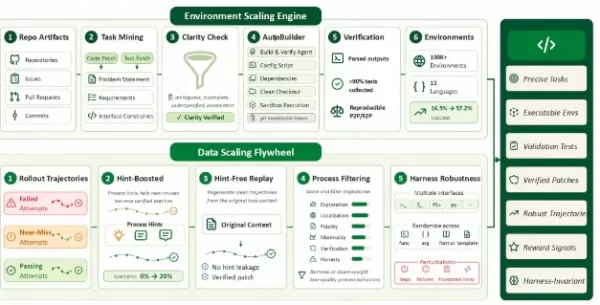
On the training side, the team moved away from pure supervised fine-tuning and adopted large-scale Agentic reinforcement learning. They used Harness Scaling to train across multiple mainstream Agent frameworks, preventing overfitting to a single interaction format. An asymmetric PPO architecture was introduced to address credit assignment in long-term tasks. A hierarchical reward mechanism was designed (core task results + behavioral norm constraints + failure exploration incentives) to balance effectiveness and robustness. The model also employs MOPD multi-teacher online strategy distillation to integrate capabilities from five expert models: long-term engineering, general Agentic, terminal usage, front-end aesthetics, and general knowledge. As a result, a single model can now handle multiple scenarios—writing code, running workflows, and generating front-end pages—without needing to switch.
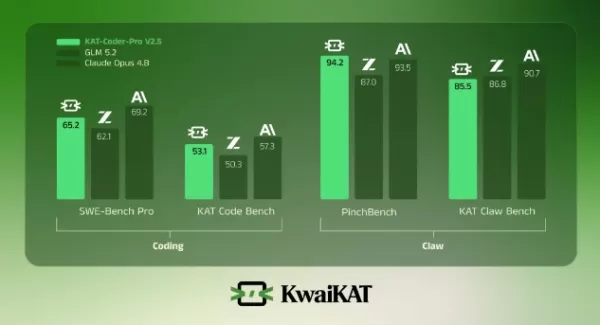
Official evaluation data reveals: in code engineering, the SWE-Bench Pro score is 65.2, and the internal KAT Code Bench score is 53.1, enabling direct handling of complete Issues without manual decomposition. For Agentic tasks, the PinchBench score is 94.2, and the internal KAT Claw Bench score is 85.5, demonstrating excellent full-process stability.
KAT-Coder-Pro V2.5 is now fully available on the StreamLake platform (streamlake.com). It is open for API applications and technical documentation access, and the team has also released technical reports and developer exchange groups.
URL: https://streamlake.com/product/kat-coder
Related article
 DeepMind CEO Hassabis: I sleep six hours a day, usually feel energetic around 1 a.m.
Fortune recently featured an interview with Demis Hassabis, CEO of Google DeepMind, revealing his unconventional approach to rest and productivity. Hassabis disclosed that he sleeps very little, structuring his waking hours into two distinct work blo
OpenAI, Anthropic Vie for Market Share Despite Revenue Shortfalls
Despite recent reports suggesting OpenAI missed revenue targets, creating pressure on tech stocks this Tuesday, private AI lab investors remain resilient. Seasoned backers have confirmed they will not reduce investment despite negative media coverage
California AV Compliance: A New Era of Tickets, Geofences, and 1M Miles
Guident operates an AuveTech shuttle in South Florida, managing a four-mile route in West Palm Beach and a one-mile route in Boca Raton using its remote monitoring technology. | Credit: GuidentCalifornia is redefining the regulatory landscape for dri
Related Special Topic Recommendations
chatbot
DeepMind CEO Hassabis: I sleep six hours a day, usually feel energetic around 1 a.m.
Fortune recently featured an interview with Demis Hassabis, CEO of Google DeepMind, revealing his unconventional approach to rest and productivity. Hassabis disclosed that he sleeps very little, structuring his waking hours into two distinct work blo
OpenAI, Anthropic Vie for Market Share Despite Revenue Shortfalls
Despite recent reports suggesting OpenAI missed revenue targets, creating pressure on tech stocks this Tuesday, private AI lab investors remain resilient. Seasoned backers have confirmed they will not reduce investment despite negative media coverage
California AV Compliance: A New Era of Tickets, Geofences, and 1M Miles
Guident operates an AuveTech shuttle in South Florida, managing a four-mile route in West Palm Beach and a one-mile route in Boca Raton using its remote monitoring technology. | Credit: GuidentCalifornia is redefining the regulatory landscape for dri
Related Special Topic Recommendations
chatbot
 Best AI Roleplay Chat Apps for Language Practice, Interview Prep, and Daily Fluency
2026 Latest Best Top-rated AI Roleplay Chat Apps for Language Practice, Interview Prep, and Daily Fluency! XIX.AI curates a powerful game-changing collection that offers free vs paid comparison, real-world tests, and updated rankings weekly. These must-try tools help you boost writing skills, overcome fluency challenges, and improve communication efficiency across all daily scenarios. Explore now to discover your perfect tool for language growth!
 10 tools
 xix.ai
Music composition
AI Stem Separation Tools for Remix Production, Sampling Prep, and Karaoke Masters
xix.ai
Music composition
AI Stem Separation Tools for Remix Production, Sampling Prep, and Karaoke Masters
2026 Latest Best Top-rated AI Stem Separation Tools Curated for Remix Production, Sampling Prep, and Karaoke Masters. These powerful game-changing tools offer real-world tests to deliver precise audio isolation, boosting productivity significantly. XIX.AI provides a weekly updated free vs paid comparison guide to help you find the must-try solution that suits your needs. Explore now to unlock your AI edge.
8 tools
xix.ai
Data Analysis
AI SQL Copilots for Revenue Dashboards, Funnel Analysis, and Product Metrics
2026 Latest Best AI SQL Copilots Ranked Top-Rated! XIX.AI curates a powerful game-changing collection for weekly updated real-world tests. These must-try tools help you generate accurate revenue dashboards, analyze sales funnels, and track product metrics swiftly, boosting productivity massively. Explore now to Discover your perfect tool for data-driven decision making! 238 characters
9 tools
xix.ai
Music composition
Best AI Melody Writing Tools for Song Drafts
2026 Latest Best Top-Rated AI Melody Writing Tools for Song Drafts! XIX.AI has curated a highly powerful game-changing collection that goes through rigorous real-world tests to deliver the best writing experience. You can find detailed free vs paid comparisons, accurate rankings, and must-try options designed to help you create stunning song drafts effortlessly and boost your creative productivity significantly. Explore now to discover your perfect tool!
8 tools
xix.ai
chatbot
Best AI Conversation Trainer Tools for Interview Practice
2026 Latest Best Top-rated AI Conversation Trainer Tools for Interview Practice are here on XIX.AI! This curated collection features powerful, game-changing tools that go through rigorous real-world tests to deliver accurate feedback. You’ll find a free vs paid comparison and detailed rankings to help you choose the must-try option that boosts your confidence and skills. Explore now to Discover your perfect tool for interview success!
12 tools
xix.ai
Design & Art
Best AI Style Transfer Tools for Creative Experiments
2026 Latest Best Top-rated AI Style Transfer Tools for Creative Experiments! XIX.AI has curated a powerful, game-changing collection of must-try tools that deliver exceptional results through real-world tests and rigorous rankings. These top solutions help creatives boost productivity significantly by accelerating content creation and unlocking endless creative possibilities. Explore now to discover your perfect tool and start creating today!
9 tools
xix.ai

 Comments (0)
0/500
Comments (0)
0/500
Today, the KwaiKAT team officially launched KAT-Coder-Pro V2.5, its flagship Agentic Coding model. This new version introduces systematic upgrades across three key dimensions: long-term engineering capabilities, general Agentic capabilities, and a large-scale Agentic reinforcement learning system. The goal is to evolve from simple code completion to an AI agent that can independently handle complete software engineering tasks and complex business workflows.
For long-term engineering capabilities, the team built a custom AutoBuilder automated pipeline. This increased the success rate of creating runnable repository environments from an industry average of roughly 16.5% to 57.2%, covering 12 programming languages and over 100,000 verified real repository environments. Additionally, high-value failure trajectories are recycled into training data, enabling the model to master cross-file positioning, adherence to project specifications, and self-debugging testing.
For general Agentic capabilities, KwaiKAT developed the KwaiClawEnv system—a dynamically expanding tool pool. It derives numerous complex workflows from real business tasks and retains high-quality training trajectories through dual filtering. The system covers scenarios like data analysis, cross-system integration, and batch document processing, supporting task execution across more than 10 steps.
On the training side, the team moved away from pure supervised fine-tuning and adopted large-scale Agentic reinforcement learning. They used Harness Scaling to train across multiple mainstream Agent frameworks, preventing overfitting to a single interaction format. An asymmetric PPO architecture was introduced to address credit assignment in long-term tasks. A hierarchical reward mechanism was designed (core task results + behavioral norm constraints + failure exploration incentives) to balance effectiveness and robustness. The model also employs MOPD multi-teacher online strategy distillation to integrate capabilities from five expert models: long-term engineering, general Agentic, terminal usage, front-end aesthetics, and general knowledge. As a result, a single model can now handle multiple scenarios—writing code, running workflows, and generating front-end pages—without needing to switch.
Official evaluation data reveals: in code engineering, the SWE-Bench Pro score is 65.2, and the internal KAT Code Bench score is 53.1, enabling direct handling of complete Issues without manual decomposition. For Agentic tasks, the PinchBench score is 94.2, and the internal KAT Claw Bench score is 85.5, demonstrating excellent full-process stability.
KAT-Coder-Pro V2.5 is now fully available on the StreamLake platform (streamlake.com). It is open for API applications and technical documentation access, and the team has also released technical reports and developer exchange groups.
URL: https://streamlake.com/product/kat-coder








 DeepMind CEO Hassabis: I sleep six hours a day, usually feel energetic around 1 a.m.
Fortune recently featured an interview with Demis Hassabis, CEO of Google DeepMind, revealing his unconventional approach to rest and productivity. Hassabis disclosed that he sleeps very little, structuring his waking hours into two distinct work blo
DeepMind CEO Hassabis: I sleep six hours a day, usually feel energetic around 1 a.m.
Fortune recently featured an interview with Demis Hassabis, CEO of Google DeepMind, revealing his unconventional approach to rest and productivity. Hassabis disclosed that he sleeps very little, structuring his waking hours into two distinct work blo
 OpenAI, Anthropic Vie for Market Share Despite Revenue Shortfalls
Despite recent reports suggesting OpenAI missed revenue targets, creating pressure on tech stocks this Tuesday, private AI lab investors remain resilient. Seasoned backers have confirmed they will not reduce investment despite negative media coverage
California AV Compliance: A New Era of Tickets, Geofences, and 1M Miles
Guident operates an AuveTech shuttle in South Florida, managing a four-mile route in West Palm Beach and a one-mile route in Boca Raton using its remote monitoring technology. | Credit: GuidentCalifornia is redefining the regulatory landscape for dri
OpenAI, Anthropic Vie for Market Share Despite Revenue Shortfalls
Despite recent reports suggesting OpenAI missed revenue targets, creating pressure on tech stocks this Tuesday, private AI lab investors remain resilient. Seasoned backers have confirmed they will not reduce investment despite negative media coverage
California AV Compliance: A New Era of Tickets, Geofences, and 1M Miles
Guident operates an AuveTech shuttle in South Florida, managing a four-mile route in West Palm Beach and a one-mile route in Boca Raton using its remote monitoring technology. | Credit: GuidentCalifornia is redefining the regulatory landscape for dri

2026 Latest Best Top-rated AI Roleplay Chat Apps for Language Practice, Interview Prep, and Daily Fluency! XIX.AI curates a powerful game-changing collection that offers free vs paid comparison, real-world tests, and updated rankings weekly. These must-try tools help you boost writing skills, overcome fluency challenges, and improve communication efficiency across all daily scenarios. Explore now to discover your perfect tool for language growth!
10 tools
xix.ai

2026 Latest Best Top-rated AI Stem Separation Tools Curated for Remix Production, Sampling Prep, and Karaoke Masters. These powerful game-changing tools offer real-world tests to deliver precise audio isolation, boosting productivity significantly. XIX.AI provides a weekly updated free vs paid comparison guide to help you find the must-try solution that suits your needs. Explore now to unlock your AI edge.
8 tools
xix.ai

2026 Latest Best AI SQL Copilots Ranked Top-Rated! XIX.AI curates a powerful game-changing collection for weekly updated real-world tests. These must-try tools help you generate accurate revenue dashboards, analyze sales funnels, and track product metrics swiftly, boosting productivity massively. Explore now to Discover your perfect tool for data-driven decision making! 238 characters
9 tools
xix.ai

2026 Latest Best Top-Rated AI Melody Writing Tools for Song Drafts! XIX.AI has curated a highly powerful game-changing collection that goes through rigorous real-world tests to deliver the best writing experience. You can find detailed free vs paid comparisons, accurate rankings, and must-try options designed to help you create stunning song drafts effortlessly and boost your creative productivity significantly. Explore now to discover your perfect tool!
8 tools
xix.ai

2026 Latest Best Top-rated AI Conversation Trainer Tools for Interview Practice are here on XIX.AI! This curated collection features powerful, game-changing tools that go through rigorous real-world tests to deliver accurate feedback. You’ll find a free vs paid comparison and detailed rankings to help you choose the must-try option that boosts your confidence and skills. Explore now to Discover your perfect tool for interview success!
12 tools
xix.ai

2026 Latest Best Top-rated AI Style Transfer Tools for Creative Experiments! XIX.AI has curated a powerful, game-changing collection of must-try tools that deliver exceptional results through real-world tests and rigorous rankings. These top solutions help creatives boost productivity significantly by accelerating content creation and unlocking endless creative possibilities. Explore now to discover your perfect tool and start creating today!
9 tools
xix.ai












