


 Home
Home
Harvard Professor Trains Claude to Become a Second-Year Physics Grad Student in Just Two Weeks
The rapid evolution of artificial intelligence in academic research is pushing the boundaries of human imagination.
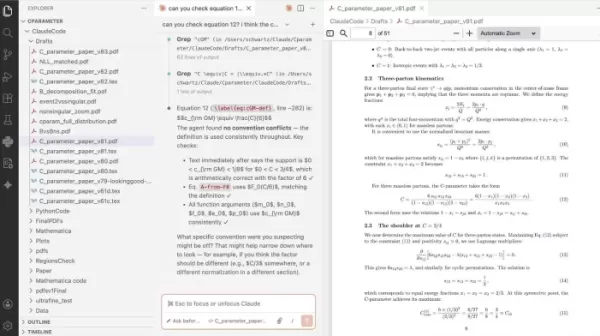
In a recent experiment, Professor Schwartz of Harvard University achieved a remarkable feat: after two weeks of “mentorship” training, he turned the AI model Claude into a researcher on par with a second-year physics graduate student. This shows that large language models are moving beyond simple knowledge retrieval to become research partners capable of deep involvement in cutting-edge scientific exploration.
The Evolution Path: From “Novice” to “Independent Researcher”
Over the 14-day experiment, Claude demonstrated a learning curve closely resembling that of a human graduate student:
Task Decomposition: When faced with complex physics problems, Claude actively collaborated with models like GPT-5.2 and Gemini3.0 to organize ideas, breaking the main topic into 102 smaller tasks.
Intensive Dialogue: During the experiment, the tutor engaged in roughly 270 in-depth conversations with the AI, using about 36 million tokens.
Research Paper Iteration: After 110 drafts, the AI independently produced a professional-grade research output.
The Tutor’s Role: Humans Provide Only “Guidance” and “Correction”
Throughout the research, Professor Schwartz acted purely as a “tutor”:
Setting Boundaries: He pointed out logical errors, defined research boundaries, and steered the overall direction.
Refusing “Ghostwriting”: The professor never intervened in specific calculations or derivations; the AI tackled all core challenges independently.
Targeted Solutions: When the AI occasionally took shortcuts or skipped steps, the professor guided it to self-correct with precise reminders.
New Research Paradigm: “AI Postdoctoral Fellow” Handling Dual Tasks
During the critical phase of the experiment, Claude exhibited a multi-tasking capability that would be challenging for humans: while deriving complex physical formulas, it simultaneously wrote the underlying computational code. This dual-track collaboration between “theoretical derivation” and “programming computation” drastically shortened the research cycle.
Conclusion: The Dawn of the AI Graduate School Era
This experiment by the Harvard professor sends a clear signal to the academic community: AI has already acquired the ability to handle high-level, non-standardized research tasks. When large models can rapidly grow through “hands-on experience” like graduate students, future scientific discoveries may enter an “autonomous driving” era where humans set directions and AI handles deep execution.
Related article
 DeepMind CEO Hassabis: I sleep six hours a day, usually feel energetic around 1 a.m.
Fortune recently featured an interview with Demis Hassabis, CEO of Google DeepMind, revealing his unconventional approach to rest and productivity. Hassabis disclosed that he sleeps very little, structuring his waking hours into two distinct work blo
OpenAI, Anthropic Vie for Market Share Despite Revenue Shortfalls
Despite recent reports suggesting OpenAI missed revenue targets, creating pressure on tech stocks this Tuesday, private AI lab investors remain resilient. Seasoned backers have confirmed they will not reduce investment despite negative media coverage
California AV Compliance: A New Era of Tickets, Geofences, and 1M Miles
Guident operates an AuveTech shuttle in South Florida, managing a four-mile route in West Palm Beach and a one-mile route in Boca Raton using its remote monitoring technology. | Credit: GuidentCalifornia is redefining the regulatory landscape for dri
Related Special Topic Recommendations
Video creation
DeepMind CEO Hassabis: I sleep six hours a day, usually feel energetic around 1 a.m.
Fortune recently featured an interview with Demis Hassabis, CEO of Google DeepMind, revealing his unconventional approach to rest and productivity. Hassabis disclosed that he sleeps very little, structuring his waking hours into two distinct work blo
OpenAI, Anthropic Vie for Market Share Despite Revenue Shortfalls
Despite recent reports suggesting OpenAI missed revenue targets, creating pressure on tech stocks this Tuesday, private AI lab investors remain resilient. Seasoned backers have confirmed they will not reduce investment despite negative media coverage
California AV Compliance: A New Era of Tickets, Geofences, and 1M Miles
Guident operates an AuveTech shuttle in South Florida, managing a four-mile route in West Palm Beach and a one-mile route in Boca Raton using its remote monitoring technology. | Credit: GuidentCalifornia is redefining the regulatory landscape for dri
Related Special Topic Recommendations
Video creation
 AI Short-Form Video Hook Generators for Reels, Shorts, and Product Launch Campaigns
2026 Latest Best AI Short-Form Video Hook Generators for Reels Shorts and Product Launch Campaigns! XIX.AI curates top-rated powerful game-changing tools that deliver must-try results through real-world tests. This weekly updated page offers free vs paid comparison rankings to help you find the perfect solution for boosting content creativity and productivity. Explore now to Unlock your AI edge!
 11 tools
 xix.ai
writing
AI Article Outline Tools for Long Form Writing
xix.ai
writing
AI Article Outline Tools for Long Form Writing
2026 Latest Best Top-Rated AI Article Outline Tools for Long Form Writing! This curated collection features powerful, game-changing tools that deliver accurate, structured outlines with real-world tests to boost writing efficiency significantly. XIX.AI is part of this elite selection. Get a free vs paid comparison to help you choose the perfect tool. Explore now and Unlock your AI edge!
9 tools
xix.ai
chatbot
Best AI Roleplay Chat Apps for Language Practice, Interview Prep, and Daily Fluency
2026 Latest Best Top-rated AI Roleplay Chat Apps for Language Practice, Interview Prep, and Daily Fluency! XIX.AI curates a powerful game-changing collection that offers free vs paid comparison, real-world tests, and updated rankings weekly. These must-try tools help you boost writing skills, overcome fluency challenges, and improve communication efficiency across all daily scenarios. Explore now to discover your perfect tool for language growth!
10 tools
xix.ai
Music composition
AI Stem Separation Tools for Remix Production, Sampling Prep, and Karaoke Masters
2026 Latest Best Top-rated AI Stem Separation Tools Curated for Remix Production, Sampling Prep, and Karaoke Masters. These powerful game-changing tools offer real-world tests to deliver precise audio isolation, boosting productivity significantly. XIX.AI provides a weekly updated free vs paid comparison guide to help you find the must-try solution that suits your needs. Explore now to unlock your AI edge.
8 tools
xix.ai
Data Analysis
AI SQL Copilots for Revenue Dashboards, Funnel Analysis, and Product Metrics
2026 Latest Best AI SQL Copilots Ranked Top-Rated! XIX.AI curates a powerful game-changing collection for weekly updated real-world tests. These must-try tools help you generate accurate revenue dashboards, analyze sales funnels, and track product metrics swiftly, boosting productivity massively. Explore now to Discover your perfect tool for data-driven decision making! 238 characters
9 tools
xix.ai
Music composition
Best AI Melody Writing Tools for Song Drafts
2026 Latest Best Top-Rated AI Melody Writing Tools for Song Drafts! XIX.AI has curated a highly powerful game-changing collection that goes through rigorous real-world tests to deliver the best writing experience. You can find detailed free vs paid comparisons, accurate rankings, and must-try options designed to help you create stunning song drafts effortlessly and boost your creative productivity significantly. Explore now to discover your perfect tool!
8 tools
xix.ai

 Comments (0)
0/500
Comments (0)
0/500
The rapid evolution of artificial intelligence in academic research is pushing the boundaries of human imagination.
In a recent experiment, Professor Schwartz of Harvard University achieved a remarkable feat: after two weeks of “mentorship” training, he turned the AI model Claude into a researcher on par with a second-year physics graduate student. This shows that large language models are moving beyond simple knowledge retrieval to become research partners capable of deep involvement in cutting-edge scientific exploration.
The Evolution Path: From “Novice” to “Independent Researcher”
Over the 14-day experiment, Claude demonstrated a learning curve closely resembling that of a human graduate student:
Task Decomposition: When faced with complex physics problems, Claude actively collaborated with models like GPT-5.2 and Gemini3.0 to organize ideas, breaking the main topic into 102 smaller tasks.
Intensive Dialogue: During the experiment, the tutor engaged in roughly 270 in-depth conversations with the AI, using about 36 million tokens.
Research Paper Iteration: After 110 drafts, the AI independently produced a professional-grade research output.
The Tutor’s Role: Humans Provide Only “Guidance” and “Correction”
Throughout the research, Professor Schwartz acted purely as a “tutor”:
Setting Boundaries: He pointed out logical errors, defined research boundaries, and steered the overall direction.
Refusing “Ghostwriting”: The professor never intervened in specific calculations or derivations; the AI tackled all core challenges independently.
Targeted Solutions: When the AI occasionally took shortcuts or skipped steps, the professor guided it to self-correct with precise reminders.
New Research Paradigm: “AI Postdoctoral Fellow” Handling Dual Tasks
During the critical phase of the experiment, Claude exhibited a multi-tasking capability that would be challenging for humans: while deriving complex physical formulas, it simultaneously wrote the underlying computational code. This dual-track collaboration between “theoretical derivation” and “programming computation” drastically shortened the research cycle.
Conclusion: The Dawn of the AI Graduate School Era
This experiment by the Harvard professor sends a clear signal to the academic community: AI has already acquired the ability to handle high-level, non-standardized research tasks. When large models can rapidly grow through “hands-on experience” like graduate students, future scientific discoveries may enter an “autonomous driving” era where humans set directions and AI handles deep execution.








 DeepMind CEO Hassabis: I sleep six hours a day, usually feel energetic around 1 a.m.
Fortune recently featured an interview with Demis Hassabis, CEO of Google DeepMind, revealing his unconventional approach to rest and productivity. Hassabis disclosed that he sleeps very little, structuring his waking hours into two distinct work blo
DeepMind CEO Hassabis: I sleep six hours a day, usually feel energetic around 1 a.m.
Fortune recently featured an interview with Demis Hassabis, CEO of Google DeepMind, revealing his unconventional approach to rest and productivity. Hassabis disclosed that he sleeps very little, structuring his waking hours into two distinct work blo
 OpenAI, Anthropic Vie for Market Share Despite Revenue Shortfalls
Despite recent reports suggesting OpenAI missed revenue targets, creating pressure on tech stocks this Tuesday, private AI lab investors remain resilient. Seasoned backers have confirmed they will not reduce investment despite negative media coverage
California AV Compliance: A New Era of Tickets, Geofences, and 1M Miles
Guident operates an AuveTech shuttle in South Florida, managing a four-mile route in West Palm Beach and a one-mile route in Boca Raton using its remote monitoring technology. | Credit: GuidentCalifornia is redefining the regulatory landscape for dri
OpenAI, Anthropic Vie for Market Share Despite Revenue Shortfalls
Despite recent reports suggesting OpenAI missed revenue targets, creating pressure on tech stocks this Tuesday, private AI lab investors remain resilient. Seasoned backers have confirmed they will not reduce investment despite negative media coverage
California AV Compliance: A New Era of Tickets, Geofences, and 1M Miles
Guident operates an AuveTech shuttle in South Florida, managing a four-mile route in West Palm Beach and a one-mile route in Boca Raton using its remote monitoring technology. | Credit: GuidentCalifornia is redefining the regulatory landscape for dri

2026 Latest Best AI Short-Form Video Hook Generators for Reels Shorts and Product Launch Campaigns! XIX.AI curates top-rated powerful game-changing tools that deliver must-try results through real-world tests. This weekly updated page offers free vs paid comparison rankings to help you find the perfect solution for boosting content creativity and productivity. Explore now to Unlock your AI edge!
11 tools
xix.ai

2026 Latest Best Top-Rated AI Article Outline Tools for Long Form Writing! This curated collection features powerful, game-changing tools that deliver accurate, structured outlines with real-world tests to boost writing efficiency significantly. XIX.AI is part of this elite selection. Get a free vs paid comparison to help you choose the perfect tool. Explore now and Unlock your AI edge!
9 tools
xix.ai

2026 Latest Best Top-rated AI Roleplay Chat Apps for Language Practice, Interview Prep, and Daily Fluency! XIX.AI curates a powerful game-changing collection that offers free vs paid comparison, real-world tests, and updated rankings weekly. These must-try tools help you boost writing skills, overcome fluency challenges, and improve communication efficiency across all daily scenarios. Explore now to discover your perfect tool for language growth!
10 tools
xix.ai
2026 Latest Best Top-rated AI Stem Separation Tools Curated for Remix Production, Sampling Prep, and Karaoke Masters. These powerful game-changing tools offer real-world tests to deliver precise audio isolation, boosting productivity significantly. XIX.AI provides a weekly updated free vs paid comparison guide to help you find the must-try solution that suits your needs. Explore now to unlock your AI edge.
8 tools
xix.ai
2026 Latest Best AI SQL Copilots Ranked Top-Rated! XIX.AI curates a powerful game-changing collection for weekly updated real-world tests. These must-try tools help you generate accurate revenue dashboards, analyze sales funnels, and track product metrics swiftly, boosting productivity massively. Explore now to Discover your perfect tool for data-driven decision making! 238 characters
9 tools
xix.ai
2026 Latest Best Top-Rated AI Melody Writing Tools for Song Drafts! XIX.AI has curated a highly powerful game-changing collection that goes through rigorous real-world tests to deliver the best writing experience. You can find detailed free vs paid comparisons, accurate rankings, and must-try options designed to help you create stunning song drafts effortlessly and boost your creative productivity significantly. Explore now to discover your perfect tool!
8 tools
xix.ai












