


 Home
HomeGraph Convolutional Networks Revolutionize Training in Graph Databases
In our increasingly interconnected digital landscape, graph technologies unlock unprecedented insights. Graph databases revolutionize how we store relationship-rich data, while graph convolutional networks (GCNs) transform how we analyze these complex connections. This article examines the powerful intersection of these technologies, demonstrating how in-database GCN training accelerates predictive analytics while maintaining data integrity. Discover practical implementation strategies, measurable performance benefits, and real-world applications through our comprehensive case study.
Key Points
Graph databases optimize storage and query performance for interconnected datasets.
GCNs utilize graph topology to enhance machine learning accuracy beyond traditional methods.
In-database training eliminates costly data transfers between systems.
Native graph processing enables continuous model refinement with fresh data.
TigerGraph's architecture uniquely supports scalable in-database GCN implementations.
Understanding Graph Convolutional Networks and Graph Databases
What is a Graph Convolutional Network (GCN)?

Graph Convolutional Networks represent a neural architecture specifically engineered for relational data structures. While conventional neural networks process grid-based (images) or sequential (text) inputs, GCNs directly operate on graph topologies—preserving and leveraging connection patterns during learning. These networks progressively aggregate neighborhood information through localized operations, generating sophisticated node embeddings that encode both intrinsic attributes and contextual relationships.
Their architecture proves particularly effective for social network analysis, molecular research, recommendation systems, and knowledge graph applications where relationship context significantly impacts outcomes. Through iterative message passing between connected nodes, GCNs outperform traditional algorithms by capturing higher-order network dynamics—delivering more accurate predictions through learned representations rather than handcrafted features.
What is a Graph Database?
Unlike tabular databases, graph databases employ node-edge-node structures that mirror real-world relationships natively. Entities become nodes while their connections manifest as edges—creating intuitive data models that enable efficient relationship traversal without complex joins. This architecture delivers superior performance for fraud detection, supply chain mapping, network analysis, and recommendation engines where relationship patterns drive business value.
The explicit representation of connections allows graph databases to evolve organically—accommodating new relationship types and schema modifications without costly migrations. Their query efficiency grows linearly rather than exponentially with relationship complexity, making them indispensable for modern connected data applications. Advanced systems like TigerGraph further enhance these capabilities with parallel processing and real-time analytics features.
Why Train GCNs in a Graph Database?
Converging GCN training with graph database operations creates several strategic advantages: Simplified data pipelines remove transformation overhead, native graph operators accelerate computation, and real-time updates maintain model relevance—all within a unified environment. This architectural synergy significantly reduces infrastructure complexity while improving model performance on evolving datasets.
Key Benefits of Training GCNs Within a Graph Database
Reduced Data Movement
Traditional analytics architectures suffer from costly extract-transform-load operations between storage and compute environments. In-database training eliminates these bottlenecks by keeping petabytes of graph data resident—allowing computations to occur where the information lives rather than transferring it across networks.
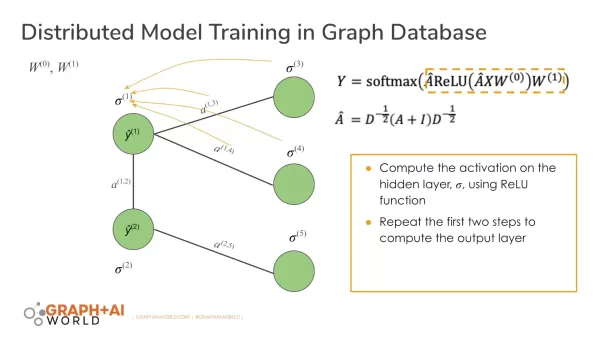
This localized processing reduces latency by orders of magnitude while minimizing storage duplication—critical advantages when training on expansive knowledge graphs or dynamic social networks where terabytes may interconnect.
Enhanced Performance
Graph databases implement specialized indexes and traversal algorithms optimized for connection patterns that traditional indexes poorly support. By leveraging these native optimizations during training, GCNs achieve superior throughput—particularly beneficial when executing the neighborhood aggregation steps fundamental to graph learning. Distributed graph architectures further scale these advantages horizontally.
Real-Time Model Updates
Dynamic environments require models that evolve alongside their data sources. In-database training pipelines enable continuous learning workflows—automatically incorporating new nodes, edges, and attributes without complete retraining. This proves invaluable for financial surveillance, IoT networks, and recommendation systems where concept drift impacts model validity.
Simplified Infrastructure
Maintaining separate analytics and operational systems introduces architectural complexity and synchronization challenges. Integrated platforms consolidate graph storage, processing, and machine learning—reducing administrative overhead while improving resource utilization through shared computing resources.
Training GCNs within TigerGraph
Data Storage and Graph Creation
TigerGraph's schema-first approach ensures proper modeling of domain relationships before ingestion. Flexible vertex and edge definitions accommodate complex property graphs—whether modeling biomedical interactions, supply chain networks, or digital twins.
GCN Implementation
TigerGraph's Turing-complete GSQL language supports implementing sophisticated neural architectures including attention mechanisms and sampling strategies—all while leveraging the database's optimized storage and parallel processing capabilities.
Training and Prediction
The distributed query engine handles both batch and streaming graph updates—enabling everything from offline model development to online learning scenarios. Production deployments benefit from TigerGraph's high-availability features while maintaining millisecond latency.
FAQ
What types of data are suitable for GCNs in graph databases?
GCNs deliver exceptional value for recommendation systems, biological networks, cybersecurity graphs, and other domains where relationships contain predictive signals that traditional feature engineering struggles to capture.
What are the challenges of training GCNs within a graph database?
Effective implementation requires blending graph algorithms with neural architecture expertise. Resource planning becomes crucial when dealing with billion-edge graphs—though distributed architectures mitigate these concerns.
What are the advantages of using TigerGraph for training GCNs?
TigerGraph's parallel processing architecture delivers linear scalability while maintaining ACID guarantees—uniquely supporting both transactional and analytical workloads on massive graphs.
Related Questions
How do GCNs compare to other graph-based machine learning techniques?
Unlike shallow embeddings or manually engineered features, GCNs learn adaptive representations tuned to both local and global graph structures—often achieving superior accuracy through automated feature learning.
What is the future of GCNs and graph databases?
The convergence of graph databases with differentiable programming promises transformative applications—from real-time fraud detection to automated scientific discovery—as these technologies mature.
Related article
 Tencent Accelerates AI Push With Doubled-Size Hunyuan Hy4, Morgan Stanley Lifts Target to HKD 550
Tencent has officially unveiled the preview of HuanYuan Hy4, accelerating its timeline ahead of Morgan Stanley’s September forecast and fulfilling the company’s Q2 earnings commitment to launch the model within the year. Since appointing Yao Shunyu a
Pearson’s Dave Treat: AI Should Guide Learning, Not Cheat
Pearson’s Chief Technology Officer, Dave TreatOn academic integrity, AI adoption, and the critical skills that matter as agentic AI transforms educationDave Treat joined Pearson nearly two years ago as Chief Technology Officer, later assuming the rol
OpenAI Launches GPT-5.6-Cyber, Boosting Zero-Day Detection with AI Automation
OpenAI has expanded its Daybreak cybersecurity initiative, introducing a two-tier access system and launching GPT-5.6-Cyber, a model purpose-built for security operations. This move addresses the growing reality that threat actors are leveraging AI t
Related Special Topic Recommendations
code
Tencent Accelerates AI Push With Doubled-Size Hunyuan Hy4, Morgan Stanley Lifts Target to HKD 550
Tencent has officially unveiled the preview of HuanYuan Hy4, accelerating its timeline ahead of Morgan Stanley’s September forecast and fulfilling the company’s Q2 earnings commitment to launch the model within the year. Since appointing Yao Shunyu a
Pearson’s Dave Treat: AI Should Guide Learning, Not Cheat
Pearson’s Chief Technology Officer, Dave TreatOn academic integrity, AI adoption, and the critical skills that matter as agentic AI transforms educationDave Treat joined Pearson nearly two years ago as Chief Technology Officer, later assuming the rol
OpenAI Launches GPT-5.6-Cyber, Boosting Zero-Day Detection with AI Automation
OpenAI has expanded its Daybreak cybersecurity initiative, introducing a two-tier access system and launching GPT-5.6-Cyber, a model purpose-built for security operations. This move addresses the growing reality that threat actors are leveraging AI t
Related Special Topic Recommendations
code
 Best AI Coding Chatbots: Debug Python, JS, and SQL in One Place
2026 Latest Best Top-Rated AI Coding Chatbots Curated for Developers! Experience powerful game-changing tools that help you debug Python, JS, and SQL issues quickly. Get a free vs paid comparison along with real-world tests and detailed rankings to find the perfect fit for boosting your coding productivity. Try XIX.AI today to unlock your AI edge! Explore now.
 12 tools
 xix.ai
Prompt
AI Prompt Versioning Platforms for Reusable Claude and ChatGPT Playbooks
xix.ai
Prompt
AI Prompt Versioning Platforms for Reusable Claude and ChatGPT Playbooks
2026 Latest Best Top-rated AI Prompt Versioning Platforms for Reusable Playbooks are here on XIX.AI! Our curated list includes powerful game-changing tools that help you keep track of all prompts, test variations efficiently, and boost productivity across writing, content creation, and more. Get a free vs paid comparison along with real-world tests and updated rankings weekly. Explore now to discover your perfect tool for staying ahead in AI tasks!
9 tools
xix.ai
writing
Best AI Writing Assistants for Long Articles: Outline and Draft Faster
2026 Latest Best AI Writing Assistants for Long Articles: Outline and Draft Faster. XIX.AI curates the top-rated, must-try tools that offer powerful, game-changing support to boost writing efficiency significantly. You’ll find detailed free vs paid comparison, real-world tests, and updated rankings weekly. Explore now to Discover your perfect tool and Start creating today to Unlock your AI edge.
8 tools
xix.ai
Education and Learning
ChatGPT Study Tools for Exam Revision, Flashcards, and Homework Explanations
2026 Latest Best ChatGPT Study Tools for Exam Revision, Flashcards, and Homework Explanations! XIX.AI has curated a top-rated list of powerful game-changing tools designed to boost your productivity. These must-try solutions offer free vs paid comparison, real-world tests, and detailed rankings to help you find the perfect option for efficient exam preparation and homework support. Explore now to unlock your AI edge!
10 tools
xix.ai
Education and Learning
AI Study Planner Tools for Exam Preparation
2026 Latest Best Top-Rated AI Study Planner Tools for Exam Preparation are here on XIX.AI! This curated collection features powerful, game-changing tools that help you streamline your review process, boost focus, and create personalized study schedules. We conduct real-world tests to determine the top options, offering a free vs paid comparison along with weekly updated rankings. Must-try solutions designed to maximize your productivity and help you ace every exam. Explore now to find your perfect tool!
14 tools
xix.ai
SEO
Best AI Keyword Gap Tools for Organic Growth
2026 Latest Best Top-rated AI Keyword Gap Tools for Organic Growth! XIX.AI has carefully curated a powerful, game-changing collection of the best tools available, featuring weekly updated rankings and real-world tests. You can find a detailed free vs paid comparison to help you choose the perfect option that boosts your content creation efficiency and unlocks your AI edge. Explore now!
8 tools
xix.ai

 Comments (4)
0/500
Comments (4)
0/500
![EricAllen]()
Graph-Datenbanken sind ja schon länger im Gespräch, aber dass jetzt auch noch GCNs dazukommen... das wird echt spannend! 😅 Ich frage mich, ob das in der Praxis schon stabil läuft oder ob da noch viel Forschungsarbeit nötig ist. Die Kombination klingt auf jeden Fall nach einem mächtigen Werkzeug für Netzwerkanalysen oder Empfehlungssysteme.
![GregoryAdams]()
이 기사가 요즘 뜨는 GNN에 대한 이야기네요. 제 전공 외에서는 '그래프'하면 차트(chart)를 떠올리던 친구들이 많아서, '인사이트를 발견하는 방식 자체를 바꾼다'는 설명이 와닿아요. 실제로 추천 시스템에서 얼마나 효과가 좋은지 궁금하네요. 기술 발전 속도에 조금 뒤쳐지는 느낌? 😅
![WilliamMiller]()
Finalmente algo que explica GCN de forma clara! Sempre tive dificuldade em entender como redes neurais aplicam em dados relacionais. Alguém já testou isso com dados de redes sociais? Será que detecta comunidades fake? 🤔
![RogerSanchez]()
이런 기술 발전이 실제 업계에서 어떻게 적용될지 상상을 해보니 정말 흥미롭네요. 특히 소셜 네트워크나 추천 시스템에서 어떤 변화를 가져올지 궁금해요. 근데 데이터 프라이버시 문제는 어떻게 해결할까요? 🤔
In our increasingly interconnected digital landscape, graph technologies unlock unprecedented insights. Graph databases revolutionize how we store relationship-rich data, while graph convolutional networks (GCNs) transform how we analyze these complex connections. This article examines the powerful intersection of these technologies, demonstrating how in-database GCN training accelerates predictive analytics while maintaining data integrity. Discover practical implementation strategies, measurable performance benefits, and real-world applications through our comprehensive case study.
Key Points
Graph databases optimize storage and query performance for interconnected datasets.
GCNs utilize graph topology to enhance machine learning accuracy beyond traditional methods.
In-database training eliminates costly data transfers between systems.
Native graph processing enables continuous model refinement with fresh data.
TigerGraph's architecture uniquely supports scalable in-database GCN implementations.
Understanding Graph Convolutional Networks and Graph Databases
What is a Graph Convolutional Network (GCN)?
Graph Convolutional Networks represent a neural architecture specifically engineered for relational data structures. While conventional neural networks process grid-based (images) or sequential (text) inputs, GCNs directly operate on graph topologies—preserving and leveraging connection patterns during learning. These networks progressively aggregate neighborhood information through localized operations, generating sophisticated node embeddings that encode both intrinsic attributes and contextual relationships.
Their architecture proves particularly effective for social network analysis, molecular research, recommendation systems, and knowledge graph applications where relationship context significantly impacts outcomes. Through iterative message passing between connected nodes, GCNs outperform traditional algorithms by capturing higher-order network dynamics—delivering more accurate predictions through learned representations rather than handcrafted features.
What is a Graph Database?
Unlike tabular databases, graph databases employ node-edge-node structures that mirror real-world relationships natively. Entities become nodes while their connections manifest as edges—creating intuitive data models that enable efficient relationship traversal without complex joins. This architecture delivers superior performance for fraud detection, supply chain mapping, network analysis, and recommendation engines where relationship patterns drive business value.
The explicit representation of connections allows graph databases to evolve organically—accommodating new relationship types and schema modifications without costly migrations. Their query efficiency grows linearly rather than exponentially with relationship complexity, making them indispensable for modern connected data applications. Advanced systems like TigerGraph further enhance these capabilities with parallel processing and real-time analytics features.
Why Train GCNs in a Graph Database?
Converging GCN training with graph database operations creates several strategic advantages: Simplified data pipelines remove transformation overhead, native graph operators accelerate computation, and real-time updates maintain model relevance—all within a unified environment. This architectural synergy significantly reduces infrastructure complexity while improving model performance on evolving datasets.
Key Benefits of Training GCNs Within a Graph Database
Reduced Data Movement
Traditional analytics architectures suffer from costly extract-transform-load operations between storage and compute environments. In-database training eliminates these bottlenecks by keeping petabytes of graph data resident—allowing computations to occur where the information lives rather than transferring it across networks.
This localized processing reduces latency by orders of magnitude while minimizing storage duplication—critical advantages when training on expansive knowledge graphs or dynamic social networks where terabytes may interconnect.
Enhanced Performance
Graph databases implement specialized indexes and traversal algorithms optimized for connection patterns that traditional indexes poorly support. By leveraging these native optimizations during training, GCNs achieve superior throughput—particularly beneficial when executing the neighborhood aggregation steps fundamental to graph learning. Distributed graph architectures further scale these advantages horizontally.
Real-Time Model Updates
Dynamic environments require models that evolve alongside their data sources. In-database training pipelines enable continuous learning workflows—automatically incorporating new nodes, edges, and attributes without complete retraining. This proves invaluable for financial surveillance, IoT networks, and recommendation systems where concept drift impacts model validity.
Simplified Infrastructure
Maintaining separate analytics and operational systems introduces architectural complexity and synchronization challenges. Integrated platforms consolidate graph storage, processing, and machine learning—reducing administrative overhead while improving resource utilization through shared computing resources.
Training GCNs within TigerGraph
Data Storage and Graph Creation
TigerGraph's schema-first approach ensures proper modeling of domain relationships before ingestion. Flexible vertex and edge definitions accommodate complex property graphs—whether modeling biomedical interactions, supply chain networks, or digital twins.
GCN Implementation
TigerGraph's Turing-complete GSQL language supports implementing sophisticated neural architectures including attention mechanisms and sampling strategies—all while leveraging the database's optimized storage and parallel processing capabilities.
Training and Prediction
The distributed query engine handles both batch and streaming graph updates—enabling everything from offline model development to online learning scenarios. Production deployments benefit from TigerGraph's high-availability features while maintaining millisecond latency.
FAQ
What types of data are suitable for GCNs in graph databases?
GCNs deliver exceptional value for recommendation systems, biological networks, cybersecurity graphs, and other domains where relationships contain predictive signals that traditional feature engineering struggles to capture.
What are the challenges of training GCNs within a graph database?
Effective implementation requires blending graph algorithms with neural architecture expertise. Resource planning becomes crucial when dealing with billion-edge graphs—though distributed architectures mitigate these concerns.
What are the advantages of using TigerGraph for training GCNs?
TigerGraph's parallel processing architecture delivers linear scalability while maintaining ACID guarantees—uniquely supporting both transactional and analytical workloads on massive graphs.
Related Questions
How do GCNs compare to other graph-based machine learning techniques?
Unlike shallow embeddings or manually engineered features, GCNs learn adaptive representations tuned to both local and global graph structures—often achieving superior accuracy through automated feature learning.
What is the future of GCNs and graph databases?
The convergence of graph databases with differentiable programming promises transformative applications—from real-time fraud detection to automated scientific discovery—as these technologies mature.








 Tencent Accelerates AI Push With Doubled-Size Hunyuan Hy4, Morgan Stanley Lifts Target to HKD 550
Tencent has officially unveiled the preview of HuanYuan Hy4, accelerating its timeline ahead of Morgan Stanley’s September forecast and fulfilling the company’s Q2 earnings commitment to launch the model within the year. Since appointing Yao Shunyu a
Tencent Accelerates AI Push With Doubled-Size Hunyuan Hy4, Morgan Stanley Lifts Target to HKD 550
Tencent has officially unveiled the preview of HuanYuan Hy4, accelerating its timeline ahead of Morgan Stanley’s September forecast and fulfilling the company’s Q2 earnings commitment to launch the model within the year. Since appointing Yao Shunyu a
 Pearson’s Dave Treat: AI Should Guide Learning, Not Cheat
Pearson’s Chief Technology Officer, Dave TreatOn academic integrity, AI adoption, and the critical skills that matter as agentic AI transforms educationDave Treat joined Pearson nearly two years ago as Chief Technology Officer, later assuming the rol
Pearson’s Dave Treat: AI Should Guide Learning, Not Cheat
Pearson’s Chief Technology Officer, Dave TreatOn academic integrity, AI adoption, and the critical skills that matter as agentic AI transforms educationDave Treat joined Pearson nearly two years ago as Chief Technology Officer, later assuming the rol
 OpenAI Launches GPT-5.6-Cyber, Boosting Zero-Day Detection with AI Automation
OpenAI has expanded its Daybreak cybersecurity initiative, introducing a two-tier access system and launching GPT-5.6-Cyber, a model purpose-built for security operations. This move addresses the growing reality that threat actors are leveraging AI t
OpenAI Launches GPT-5.6-Cyber, Boosting Zero-Day Detection with AI Automation
OpenAI has expanded its Daybreak cybersecurity initiative, introducing a two-tier access system and launching GPT-5.6-Cyber, a model purpose-built for security operations. This move addresses the growing reality that threat actors are leveraging AI t

2026 Latest Best Top-Rated AI Coding Chatbots Curated for Developers! Experience powerful game-changing tools that help you debug Python, JS, and SQL issues quickly. Get a free vs paid comparison along with real-world tests and detailed rankings to find the perfect fit for boosting your coding productivity. Try XIX.AI today to unlock your AI edge! Explore now.
12 tools
xix.ai

2026 Latest Best Top-rated AI Prompt Versioning Platforms for Reusable Playbooks are here on XIX.AI! Our curated list includes powerful game-changing tools that help you keep track of all prompts, test variations efficiently, and boost productivity across writing, content creation, and more. Get a free vs paid comparison along with real-world tests and updated rankings weekly. Explore now to discover your perfect tool for staying ahead in AI tasks!
9 tools
xix.ai

2026 Latest Best AI Writing Assistants for Long Articles: Outline and Draft Faster. XIX.AI curates the top-rated, must-try tools that offer powerful, game-changing support to boost writing efficiency significantly. You’ll find detailed free vs paid comparison, real-world tests, and updated rankings weekly. Explore now to Discover your perfect tool and Start creating today to Unlock your AI edge.
8 tools
xix.ai

2026 Latest Best ChatGPT Study Tools for Exam Revision, Flashcards, and Homework Explanations! XIX.AI has curated a top-rated list of powerful game-changing tools designed to boost your productivity. These must-try solutions offer free vs paid comparison, real-world tests, and detailed rankings to help you find the perfect option for efficient exam preparation and homework support. Explore now to unlock your AI edge!
10 tools
xix.ai

2026 Latest Best Top-Rated AI Study Planner Tools for Exam Preparation are here on XIX.AI! This curated collection features powerful, game-changing tools that help you streamline your review process, boost focus, and create personalized study schedules. We conduct real-world tests to determine the top options, offering a free vs paid comparison along with weekly updated rankings. Must-try solutions designed to maximize your productivity and help you ace every exam. Explore now to find your perfect tool!
14 tools
xix.ai

2026 Latest Best Top-rated AI Keyword Gap Tools for Organic Growth! XIX.AI has carefully curated a powerful, game-changing collection of the best tools available, featuring weekly updated rankings and real-world tests. You can find a detailed free vs paid comparison to help you choose the perfect option that boosts your content creation efficiency and unlocks your AI edge. Explore now!
8 tools
xix.ai

Graph-Datenbanken sind ja schon länger im Gespräch, aber dass jetzt auch noch GCNs dazukommen... das wird echt spannend! 😅 Ich frage mich, ob das in der Praxis schon stabil läuft oder ob da noch viel Forschungsarbeit nötig ist. Die Kombination klingt auf jeden Fall nach einem mächtigen Werkzeug für Netzwerkanalysen oder Empfehlungssysteme.
이 기사가 요즘 뜨는 GNN에 대한 이야기네요. 제 전공 외에서는 '그래프'하면 차트(chart)를 떠올리던 친구들이 많아서, '인사이트를 발견하는 방식 자체를 바꾼다'는 설명이 와닿아요. 실제로 추천 시스템에서 얼마나 효과가 좋은지 궁금하네요. 기술 발전 속도에 조금 뒤쳐지는 느낌? 😅
Finalmente algo que explica GCN de forma clara! Sempre tive dificuldade em entender como redes neurais aplicam em dados relacionais. Alguém já testou isso com dados de redes sociais? Será que detecta comunidades fake? 🤔
이런 기술 발전이 실제 업계에서 어떻게 적용될지 상상을 해보니 정말 흥미롭네요. 특히 소셜 네트워크나 추천 시스템에서 어떤 변화를 가져올지 궁금해요. 근데 데이터 프라이버시 문제는 어떻게 해결할까요? 🤔












