


 Home
HomeGPT Image 2 Surpasses Nano Banana2 in Global Visual Model Rankings
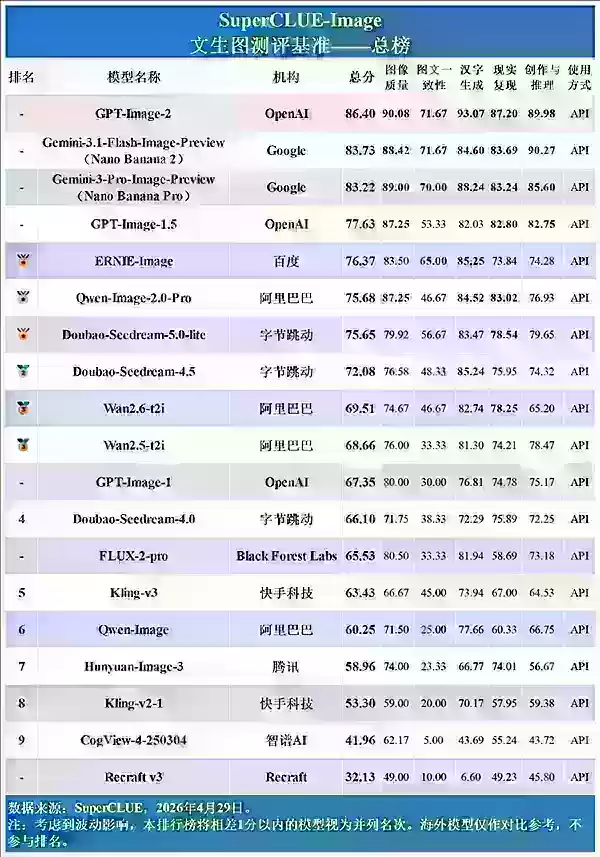
OpenAI's latest text-to-image model, GPT Image2, has demonstrated impressive performance in recent authoritative benchmarks. According to the latest data from SuperCLUE, the model has now overtaken Google's Nano Banana2 to secure the top spot in global text-to-image model rankings. Reports indicate that since its launch on April 21st, the model has shown significant improvements in image quality, prompt comprehension, and detail fidelity, establishing a new benchmark for the industry.
In these evaluations, GPT Image2 exhibited strong capabilities across multiple core metrics. Notably, in the area of Chinese character generation—a historically challenging task for non-native models—it achieved a high score of 93.07, with text accuracy earning a perfect rating. The model can not only accurately recognize and generate complex Chinese characters but also seamlessly integrate text with various material textures like acrylic and blue-and-white porcelain, effectively resolving technical issues such as text "floating" and character corruption.
Beyond its advancements in text handling, the model also showed a high degree of adherence to complex instructions when recreating detailed scenarios. From a traditional, lively bakery to a dynamic display of intangible cultural heritage like iron flower art, GPT Image2 accurately captures nuanced visual details. Furthermore, when faced with lengthy prompts and tasks requiring logical reasoning, the model can generate challenging content such as scientific diagrams and professional posters, demonstrating exceptional consistency between text and image.
While the evaluation report noted that GPT Image2 still has room for improvement in areas like spatial relationship understanding and deep knowledge reasoning, its strengths in photorealistic generation and creative reasoning are sufficient to distinguish it from competitors like Google and Baidu.
Industry analysts suggest that the release of GPT Image2 not only reaffirms OpenAI's leading position in visual generation but also signals a shift in text-to-image technology from basic image creation towards a more sophisticated phase focused on high precision and logical coherence. As model optimization continues, the boundaries of AI-powered visual creation are set to expand further.
Related article
 DeepMind CEO Hassabis: I sleep six hours a day, usually feel energetic around 1 a.m.
Fortune recently featured an interview with Demis Hassabis, CEO of Google DeepMind, revealing his unconventional approach to rest and productivity. Hassabis disclosed that he sleeps very little, structuring his waking hours into two distinct work blo
OpenAI, Anthropic Vie for Market Share Despite Revenue Shortfalls
Despite recent reports suggesting OpenAI missed revenue targets, creating pressure on tech stocks this Tuesday, private AI lab investors remain resilient. Seasoned backers have confirmed they will not reduce investment despite negative media coverage
California AV Compliance: A New Era of Tickets, Geofences, and 1M Miles
Guident operates an AuveTech shuttle in South Florida, managing a four-mile route in West Palm Beach and a one-mile route in Boca Raton using its remote monitoring technology. | Credit: GuidentCalifornia is redefining the regulatory landscape for dri
Related Special Topic Recommendations
Video creation
DeepMind CEO Hassabis: I sleep six hours a day, usually feel energetic around 1 a.m.
Fortune recently featured an interview with Demis Hassabis, CEO of Google DeepMind, revealing his unconventional approach to rest and productivity. Hassabis disclosed that he sleeps very little, structuring his waking hours into two distinct work blo
OpenAI, Anthropic Vie for Market Share Despite Revenue Shortfalls
Despite recent reports suggesting OpenAI missed revenue targets, creating pressure on tech stocks this Tuesday, private AI lab investors remain resilient. Seasoned backers have confirmed they will not reduce investment despite negative media coverage
California AV Compliance: A New Era of Tickets, Geofences, and 1M Miles
Guident operates an AuveTech shuttle in South Florida, managing a four-mile route in West Palm Beach and a one-mile route in Boca Raton using its remote monitoring technology. | Credit: GuidentCalifornia is redefining the regulatory landscape for dri
Related Special Topic Recommendations
Video creation
 AI Short-Form Video Hook Generators for Reels, Shorts, and Product Launch Campaigns
2026 Latest Best AI Short-Form Video Hook Generators for Reels Shorts and Product Launch Campaigns! XIX.AI curates top-rated powerful game-changing tools that deliver must-try results through real-world tests. This weekly updated page offers free vs paid comparison rankings to help you find the perfect solution for boosting content creativity and productivity. Explore now to Unlock your AI edge!
 11 tools
 xix.ai
writing
AI Article Outline Tools for Long Form Writing
xix.ai
writing
AI Article Outline Tools for Long Form Writing
2026 Latest Best Top-Rated AI Article Outline Tools for Long Form Writing! This curated collection features powerful, game-changing tools that deliver accurate, structured outlines with real-world tests to boost writing efficiency significantly. XIX.AI is part of this elite selection. Get a free vs paid comparison to help you choose the perfect tool. Explore now and Unlock your AI edge!
9 tools
xix.ai
chatbot
Best AI Roleplay Chat Apps for Language Practice, Interview Prep, and Daily Fluency
2026 Latest Best Top-rated AI Roleplay Chat Apps for Language Practice, Interview Prep, and Daily Fluency! XIX.AI curates a powerful game-changing collection that offers free vs paid comparison, real-world tests, and updated rankings weekly. These must-try tools help you boost writing skills, overcome fluency challenges, and improve communication efficiency across all daily scenarios. Explore now to discover your perfect tool for language growth!
10 tools
xix.ai
Music composition
AI Stem Separation Tools for Remix Production, Sampling Prep, and Karaoke Masters
2026 Latest Best Top-rated AI Stem Separation Tools Curated for Remix Production, Sampling Prep, and Karaoke Masters. These powerful game-changing tools offer real-world tests to deliver precise audio isolation, boosting productivity significantly. XIX.AI provides a weekly updated free vs paid comparison guide to help you find the must-try solution that suits your needs. Explore now to unlock your AI edge.
8 tools
xix.ai
Data Analysis
AI SQL Copilots for Revenue Dashboards, Funnel Analysis, and Product Metrics
2026 Latest Best AI SQL Copilots Ranked Top-Rated! XIX.AI curates a powerful game-changing collection for weekly updated real-world tests. These must-try tools help you generate accurate revenue dashboards, analyze sales funnels, and track product metrics swiftly, boosting productivity massively. Explore now to Discover your perfect tool for data-driven decision making! 238 characters
9 tools
xix.ai
Music composition
Best AI Melody Writing Tools for Song Drafts
2026 Latest Best Top-Rated AI Melody Writing Tools for Song Drafts! XIX.AI has curated a highly powerful game-changing collection that goes through rigorous real-world tests to deliver the best writing experience. You can find detailed free vs paid comparisons, accurate rankings, and must-try options designed to help you create stunning song drafts effortlessly and boost your creative productivity significantly. Explore now to discover your perfect tool!
8 tools
xix.ai

 Comments (1)
0/500
Comments (1)
0/500
![HaroldHarris]()
Oh great, another 'top model' ranking... But seriously, let's see how GPT Image 2 handles complex prompts without giving me nightmare fuel. 🙃
OpenAI's latest text-to-image model, GPT Image2, has demonstrated impressive performance in recent authoritative benchmarks. According to the latest data from SuperCLUE, the model has now overtaken Google's Nano Banana2 to secure the top spot in global text-to-image model rankings. Reports indicate that since its launch on April 21st, the model has shown significant improvements in image quality, prompt comprehension, and detail fidelity, establishing a new benchmark for the industry.
In these evaluations, GPT Image2 exhibited strong capabilities across multiple core metrics. Notably, in the area of Chinese character generation—a historically challenging task for non-native models—it achieved a high score of 93.07, with text accuracy earning a perfect rating. The model can not only accurately recognize and generate complex Chinese characters but also seamlessly integrate text with various material textures like acrylic and blue-and-white porcelain, effectively resolving technical issues such as text "floating" and character corruption.
Beyond its advancements in text handling, the model also showed a high degree of adherence to complex instructions when recreating detailed scenarios. From a traditional, lively bakery to a dynamic display of intangible cultural heritage like iron flower art, GPT Image2 accurately captures nuanced visual details. Furthermore, when faced with lengthy prompts and tasks requiring logical reasoning, the model can generate challenging content such as scientific diagrams and professional posters, demonstrating exceptional consistency between text and image.
While the evaluation report noted that GPT Image2 still has room for improvement in areas like spatial relationship understanding and deep knowledge reasoning, its strengths in photorealistic generation and creative reasoning are sufficient to distinguish it from competitors like Google and Baidu.
Industry analysts suggest that the release of GPT Image2 not only reaffirms OpenAI's leading position in visual generation but also signals a shift in text-to-image technology from basic image creation towards a more sophisticated phase focused on high precision and logical coherence. As model optimization continues, the boundaries of AI-powered visual creation are set to expand further.








 DeepMind CEO Hassabis: I sleep six hours a day, usually feel energetic around 1 a.m.
Fortune recently featured an interview with Demis Hassabis, CEO of Google DeepMind, revealing his unconventional approach to rest and productivity. Hassabis disclosed that he sleeps very little, structuring his waking hours into two distinct work blo
DeepMind CEO Hassabis: I sleep six hours a day, usually feel energetic around 1 a.m.
Fortune recently featured an interview with Demis Hassabis, CEO of Google DeepMind, revealing his unconventional approach to rest and productivity. Hassabis disclosed that he sleeps very little, structuring his waking hours into two distinct work blo
 OpenAI, Anthropic Vie for Market Share Despite Revenue Shortfalls
Despite recent reports suggesting OpenAI missed revenue targets, creating pressure on tech stocks this Tuesday, private AI lab investors remain resilient. Seasoned backers have confirmed they will not reduce investment despite negative media coverage
California AV Compliance: A New Era of Tickets, Geofences, and 1M Miles
Guident operates an AuveTech shuttle in South Florida, managing a four-mile route in West Palm Beach and a one-mile route in Boca Raton using its remote monitoring technology. | Credit: GuidentCalifornia is redefining the regulatory landscape for dri
OpenAI, Anthropic Vie for Market Share Despite Revenue Shortfalls
Despite recent reports suggesting OpenAI missed revenue targets, creating pressure on tech stocks this Tuesday, private AI lab investors remain resilient. Seasoned backers have confirmed they will not reduce investment despite negative media coverage
California AV Compliance: A New Era of Tickets, Geofences, and 1M Miles
Guident operates an AuveTech shuttle in South Florida, managing a four-mile route in West Palm Beach and a one-mile route in Boca Raton using its remote monitoring technology. | Credit: GuidentCalifornia is redefining the regulatory landscape for dri

2026 Latest Best AI Short-Form Video Hook Generators for Reels Shorts and Product Launch Campaigns! XIX.AI curates top-rated powerful game-changing tools that deliver must-try results through real-world tests. This weekly updated page offers free vs paid comparison rankings to help you find the perfect solution for boosting content creativity and productivity. Explore now to Unlock your AI edge!
11 tools
xix.ai
2026 Latest Best Top-Rated AI Article Outline Tools for Long Form Writing! This curated collection features powerful, game-changing tools that deliver accurate, structured outlines with real-world tests to boost writing efficiency significantly. XIX.AI is part of this elite selection. Get a free vs paid comparison to help you choose the perfect tool. Explore now and Unlock your AI edge!
9 tools
xix.ai
2026 Latest Best Top-rated AI Roleplay Chat Apps for Language Practice, Interview Prep, and Daily Fluency! XIX.AI curates a powerful game-changing collection that offers free vs paid comparison, real-world tests, and updated rankings weekly. These must-try tools help you boost writing skills, overcome fluency challenges, and improve communication efficiency across all daily scenarios. Explore now to discover your perfect tool for language growth!
10 tools
xix.ai

2026 Latest Best Top-rated AI Stem Separation Tools Curated for Remix Production, Sampling Prep, and Karaoke Masters. These powerful game-changing tools offer real-world tests to deliver precise audio isolation, boosting productivity significantly. XIX.AI provides a weekly updated free vs paid comparison guide to help you find the must-try solution that suits your needs. Explore now to unlock your AI edge.
8 tools
xix.ai

2026 Latest Best AI SQL Copilots Ranked Top-Rated! XIX.AI curates a powerful game-changing collection for weekly updated real-world tests. These must-try tools help you generate accurate revenue dashboards, analyze sales funnels, and track product metrics swiftly, boosting productivity massively. Explore now to Discover your perfect tool for data-driven decision making! 238 characters
9 tools
xix.ai

2026 Latest Best Top-Rated AI Melody Writing Tools for Song Drafts! XIX.AI has curated a highly powerful game-changing collection that goes through rigorous real-world tests to deliver the best writing experience. You can find detailed free vs paid comparisons, accurate rankings, and must-try options designed to help you create stunning song drafts effortlessly and boost your creative productivity significantly. Explore now to discover your perfect tool!
8 tools
xix.ai

Oh great, another 'top model' ranking... But seriously, let's see how GPT Image 2 handles complex prompts without giving me nightmare fuel. 🙃












