


 Home
AI Startup OpenArt Launches One-Click Brain Rot Video Generation
Videos featuring AI-generated "brain rot" content are gaining significant traction across the internet, particularly captivating younger audiences. These clips often showcase bizarre characters, such as a shark sporting sneakers or a ballerina with a cappuccino for a head.
Pioneering this trend is the startup OpenArt, established in 2022 by two former Google employees. The platform reportedly attracts around three million active users each month.
The company recently introduced a new "one-click story" feature in open beta. This tool enables users to transform a single sentence, a full script, or even a song into a one-minute video with a clear narrative arc. It supports a wide range of content, from lighthearted TikTok stories to more substantial explainer videos or music videos for YouTube. OpenArt also sees potential for this feature in advertising applications.
One-Click Story offers three primary templates: Character Vlog, Music Video, or Explainer. For a character vlog, users begin by uploading an image of their character and providing a descriptive prompt. If a song is uploaded, the software analyzes the lyrics and generates animations that reflect the song's themes, such as illustrating flowers blossoming in a garden.
Users can refine their videos by revisiting the editor's storyboard mode to edit individual clips and adjust prompts for better results. The platform integrates over 50 different AI models, giving users the flexibility to choose their preferred tools, including DALLE-3, GPT, Imagen, Flux Kontext, and Stable Diffusion.
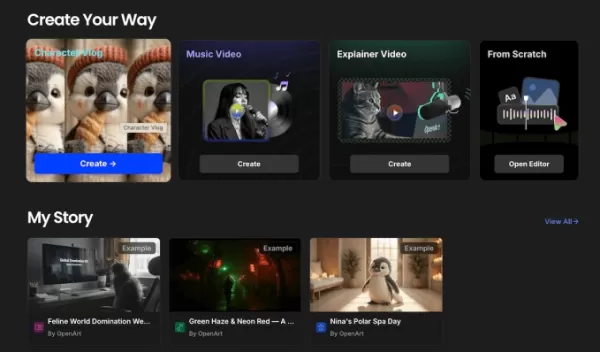
Image Credits:OpenArt The primary goal of this new feature is to make AI creation even more accessible. Despite ongoing debates, AI-generated content remains immensely popular.
While these tools offer substantial benefits—like enabling creators to rapidly produce original content with unique characters and stories—they also raise several ethical concerns. Key issues include the potential for imitating other artists' styles, intellectual property rights, and the risks of misuse for creating misinformation.
Techcrunch event Tech and VC Heavyweights Join the Disrupt 2025 Agenda
Netflix, ElevenLabs, Wayve, Sequoia Capital, Elad Gil — these are just a few of the industry leaders joining the Disrupt 2025 agenda. They will share key insights to drive startup growth and give you a competitive edge. Don't miss the 20th anniversary of TechCrunch Disrupt, a prime opportunity to learn from the top minds in technology — secure your ticket now and save over $600 before prices increase.
Tech and VC Heavyweights Join the Disrupt 2025 Agenda
Netflix, ElevenLabs, Wayve, Sequoia Capital — these are just some of the notable figures confirmed for the Disrupt 2025 agenda. They are here to provide the knowledge that fuels startup success and hones your competitive advantage. Don't miss the 20th anniversary of TechCrunch Disrupt and the chance to gain wisdom from leading tech voices — get your ticket today and save up to $675 before the price goes up.
San Francisco | October 27-29, 2025 REGISTER NOW During our testing, we observed that the Character Vlog option could venture into a legally ambiguous area due to the types of characters available—such as Pikachu, SpongeBob, and Super Mario—which may carry a risk of intellectual property (IP) infringement. This concern was highlighted in June when Disney and Universal filed a lawsuit against the AI firm Midjourney over AI-generated imagery.
Users should be aware that if their videos are found to infringe on copyright, the content could be removed from social media platforms. Furthermore, if a user is deemed to have contributed to the infringement, they could face liability under copyright law and potential legal action from the rights holder.
"We try to be very cautious regarding IP infringement," Coco Mao, co-founder and CEO, explained to TechCrunch. "When you upload certain protected characters, the models we use are designed to reject them by default, preventing the creation of that character. However, sometimes it slips through."
Mao added that the company is open to discussions with major IP holders to secure official licensing for characters.
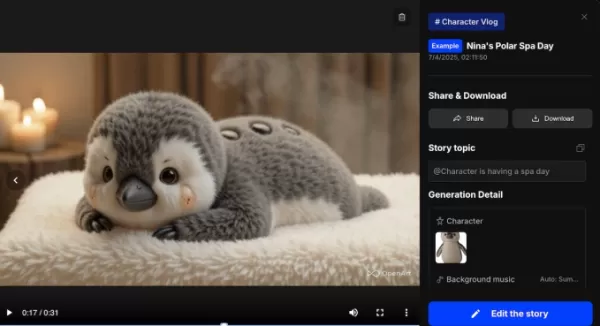
Image Credits:OpenArt OpenArt believes its capability to maintain character consistency is a key differentiator. The company argues that while many average video models produce simple, standalone clips that users must manually assemble, OpenArt focuses on ensuring both the visual elements and the narrative remain coherent throughout the video.
"A significant challenge that many AI systems haven't mastered is keeping a character consistent within the same video... If the character changes, it becomes difficult for the audience to become immersed in the story," Mao stated.
Looking forward, the company plans to enhance the one-click feature by enabling users to create videos featuring dialogues between two distinct characters. Another item on the roadmap is the development of a dedicated mobile application.
OpenArt operates on a credit-based pricing model. It offers four main plans: a basic plan at $14 per month for 4,000 credits, which includes up to four One-Click stories, 40 videos, 4,000 images, and four characters. An advanced plan costs $30 monthly for 12,000 credits and includes up to 12 One-Click stories. The Infinite plan is $56 per month for 24,000 credits, and there is also a team plan available for $35 per month per member.
To date, OpenArt has secured $5 million in funding from investors like Basis Set Ventures and DCM Ventures. The company also reports positive cash flow and is on a trajectory to achieve an annual revenue run rate exceeding $20 million.
Related article
 Stripe to Acquire OpenRouter as AI Model Routing Gains Momentum
Stripe has agreed to acquire OpenRouter, an AI model-routing platform that gives developers access to hundreds of models through a single interface. The deal adds model selection and routing to Stripe’s existing work around AI usage and token-based b
Former OpenAI Researcher Barrett Zoph Returns to Google to Support Gemini Development
Barret Zoph, who previously abruptly left and joined OpenAI due to a disagreement with Thinking Machines Lab CEO Miriam Mularati, has once again changed employers. Alphabet's Google announced that Zoph will return as Vice President of Research, bring
How Recursive Intelligence Raised $335M at $4B Valuation in 4 Months
The co-founders of startup Ricursive Intelligence seemed destined to be co-founders.Anna Goldie, CEO, and Azalia Mirhoseini, CTO, are so well-known in the AI community that they were among those AI engineers who “got those weird emails from Zuckerber
Related Special Topic Recommendations
Design & Art
 Top AI Illustration Tools: Create Editorial Scenes and Cover Art Faster
2026 Latest Top-rated AI Illustration Tools: Our curated list features the best powerfully designed tools for creating stunning editorial scenes and eye-catching cover art quickly. Each option has gone through rigorous real-world tests, offering a free vs paid comparison to help you find the perfect match for your workflow. Try these must-try solutions today to unlock your AI edge and boost your creative productivity. Explore now at XIX.AI.
 10 tools
 xix.ai
Education and Learning
Top AI Tutors for Exam Prep: Practice Math, Science, and English
2026 Latest Top-Rated Best AI Tutors for Exam Prep are here on XIX.AI! Our curated list features powerful game-changing tools that offer free vs paid comparison, real-world tests, and weekly updated rankings. They help boost your writing efficiency, simplify complex topic learning, and unlock your academic potential. Explore now to Discover your perfect exam prep tool and Start creating today to Unlock your AI edge!
10 tools
xix.ai
Finance
AI Budget Planning Tools for Personal Money Management
2026 Latest Best Top-Rated AI Budget Planning Tools for Personal Money Management are here on XIX.AI! This curated collection features powerful, game-changing solutions that help you conduct real-world tests, understand spending habits, and create personalized plans to boost productivity. Enjoy a free vs paid comparison along with detailed rankings. Must-try tools designed to simplify money management and unlock your AI edge. Explore now!
11 tools
xix.ai
Health & Wellness
AI Sleep Tracking Assistants: Improve Recovery with Better Bedtime Habits
2026 Latest Best Top-Rated AI Sleep Tracking Assistants curated for ultimate recovery. This fully updated weekly guide features powerful tools that deliver real-world tests, free vs paid comparison, and detailed rankings to help you find the must-try solution that boosts sleep quality and supports better bedtime habits. Explore now at XIX.AI to Unlock your AI edge.
10 tools
xix.ai
Data Analysis
AI SQL Copilots for Product and Revenue Analytics
2026 Latest Best Top-Rated AI SQL Copilots for Product and Revenue Analytics! XIX.AI has curated a powerful, game-changing collection of must-try tools that undergo real-world tests through weekly updated rankings. These tools help users boost productivity significantly by accelerating data analysis, streamlining complex queries, and generating accurate insights to drive smarter business decisions. Explore now to Discover your perfect tool for unlocking your AI edge!
14 tools
xix.ai
Education and Learning
Best AI Homework Helpers That Teach: Learn Concepts, Not Just Answers
2026 Latest Best Top-Rated AI Homework Helpers That Teach Core Concepts Not Just Answers Powerful Tools for Students Must-Try Curated List Weekly Updated Free vs Paid Comparison Real-World Tests Accurate Rankings to Help You Unlock Your Full Learning Potential Explore now to Discover your perfect tool for smarter studying.
10 tools
xix.ai

 Comments (1)
0/500
![RaymondAllen]()
One-click brain rot videos? Seriously, the internet is just feeding the algorithm's appetite for weirdness now. As a parent, it's a bit concerning how instantly this stuff hooks the youth. What's next, AI-generated homework excuses that go viral? 😅 The tech is fascinating, but the 'lol so random' content feels like it's actively lowering our collective attention span.
Videos featuring AI-generated "brain rot" content are gaining significant traction across the internet, particularly captivating younger audiences. These clips often showcase bizarre characters, such as a shark sporting sneakers or a ballerina with a cappuccino for a head.
Pioneering this trend is the startup OpenArt, established in 2022 by two former Google employees. The platform reportedly attracts around three million active users each month.
The company recently introduced a new "one-click story" feature in open beta. This tool enables users to transform a single sentence, a full script, or even a song into a one-minute video with a clear narrative arc. It supports a wide range of content, from lighthearted TikTok stories to more substantial explainer videos or music videos for YouTube. OpenArt also sees potential for this feature in advertising applications.
One-Click Story offers three primary templates: Character Vlog, Music Video, or Explainer. For a character vlog, users begin by uploading an image of their character and providing a descriptive prompt. If a song is uploaded, the software analyzes the lyrics and generates animations that reflect the song's themes, such as illustrating flowers blossoming in a garden.
Users can refine their videos by revisiting the editor's storyboard mode to edit individual clips and adjust prompts for better results. The platform integrates over 50 different AI models, giving users the flexibility to choose their preferred tools, including DALLE-3, GPT, Imagen, Flux Kontext, and Stable Diffusion.
The primary goal of this new feature is to make AI creation even more accessible. Despite ongoing debates, AI-generated content remains immensely popular.
While these tools offer substantial benefits—like enabling creators to rapidly produce original content with unique characters and stories—they also raise several ethical concerns. Key issues include the potential for imitating other artists' styles, intellectual property rights, and the risks of misuse for creating misinformation.
Techcrunch eventTech and VC Heavyweights Join the Disrupt 2025 Agenda
Netflix, ElevenLabs, Wayve, Sequoia Capital, Elad Gil — these are just a few of the industry leaders joining the Disrupt 2025 agenda. They will share key insights to drive startup growth and give you a competitive edge. Don't miss the 20th anniversary of TechCrunch Disrupt, a prime opportunity to learn from the top minds in technology — secure your ticket now and save over $600 before prices increase.
Tech and VC Heavyweights Join the Disrupt 2025 Agenda
Netflix, ElevenLabs, Wayve, Sequoia Capital — these are just some of the notable figures confirmed for the Disrupt 2025 agenda. They are here to provide the knowledge that fuels startup success and hones your competitive advantage. Don't miss the 20th anniversary of TechCrunch Disrupt and the chance to gain wisdom from leading tech voices — get your ticket today and save up to $675 before the price goes up.
San Francisco | October 27-29, 2025 REGISTER NOWDuring our testing, we observed that the Character Vlog option could venture into a legally ambiguous area due to the types of characters available—such as Pikachu, SpongeBob, and Super Mario—which may carry a risk of intellectual property (IP) infringement. This concern was highlighted in June when Disney and Universal filed a lawsuit against the AI firm Midjourney over AI-generated imagery.
Users should be aware that if their videos are found to infringe on copyright, the content could be removed from social media platforms. Furthermore, if a user is deemed to have contributed to the infringement, they could face liability under copyright law and potential legal action from the rights holder.
"We try to be very cautious regarding IP infringement," Coco Mao, co-founder and CEO, explained to TechCrunch. "When you upload certain protected characters, the models we use are designed to reject them by default, preventing the creation of that character. However, sometimes it slips through."
Mao added that the company is open to discussions with major IP holders to secure official licensing for characters.
OpenArt believes its capability to maintain character consistency is a key differentiator. The company argues that while many average video models produce simple, standalone clips that users must manually assemble, OpenArt focuses on ensuring both the visual elements and the narrative remain coherent throughout the video.
"A significant challenge that many AI systems haven't mastered is keeping a character consistent within the same video... If the character changes, it becomes difficult for the audience to become immersed in the story," Mao stated.
Looking forward, the company plans to enhance the one-click feature by enabling users to create videos featuring dialogues between two distinct characters. Another item on the roadmap is the development of a dedicated mobile application.
OpenArt operates on a credit-based pricing model. It offers four main plans: a basic plan at $14 per month for 4,000 credits, which includes up to four One-Click stories, 40 videos, 4,000 images, and four characters. An advanced plan costs $30 monthly for 12,000 credits and includes up to 12 One-Click stories. The Infinite plan is $56 per month for 24,000 credits, and there is also a team plan available for $35 per month per member.
To date, OpenArt has secured $5 million in funding from investors like Basis Set Ventures and DCM Ventures. The company also reports positive cash flow and is on a trajectory to achieve an annual revenue run rate exceeding $20 million.








 Stripe to Acquire OpenRouter as AI Model Routing Gains Momentum
Stripe has agreed to acquire OpenRouter, an AI model-routing platform that gives developers access to hundreds of models through a single interface. The deal adds model selection and routing to Stripe’s existing work around AI usage and token-based b
 Former OpenAI Researcher Barrett Zoph Returns to Google to Support Gemini Development
Barret Zoph, who previously abruptly left and joined OpenAI due to a disagreement with Thinking Machines Lab CEO Miriam Mularati, has once again changed employers. Alphabet's Google announced that Zoph will return as Vice President of Research, bring
 How Recursive Intelligence Raised $335M at $4B Valuation in 4 Months
The co-founders of startup Ricursive Intelligence seemed destined to be co-founders.Anna Goldie, CEO, and Azalia Mirhoseini, CTO, are so well-known in the AI community that they were among those AI engineers who “got those weird emails from Zuckerber

2026 Latest Top-rated AI Illustration Tools: Our curated list features the best powerfully designed tools for creating stunning editorial scenes and eye-catching cover art quickly. Each option has gone through rigorous real-world tests, offering a free vs paid comparison to help you find the perfect match for your workflow. Try these must-try solutions today to unlock your AI edge and boost your creative productivity. Explore now at XIX.AI.
10 tools
xix.ai

2026 Latest Top-Rated Best AI Tutors for Exam Prep are here on XIX.AI! Our curated list features powerful game-changing tools that offer free vs paid comparison, real-world tests, and weekly updated rankings. They help boost your writing efficiency, simplify complex topic learning, and unlock your academic potential. Explore now to Discover your perfect exam prep tool and Start creating today to Unlock your AI edge!
10 tools
xix.ai

2026 Latest Best Top-Rated AI Budget Planning Tools for Personal Money Management are here on XIX.AI! This curated collection features powerful, game-changing solutions that help you conduct real-world tests, understand spending habits, and create personalized plans to boost productivity. Enjoy a free vs paid comparison along with detailed rankings. Must-try tools designed to simplify money management and unlock your AI edge. Explore now!
11 tools
xix.ai

2026 Latest Best Top-Rated AI Sleep Tracking Assistants curated for ultimate recovery. This fully updated weekly guide features powerful tools that deliver real-world tests, free vs paid comparison, and detailed rankings to help you find the must-try solution that boosts sleep quality and supports better bedtime habits. Explore now at XIX.AI to Unlock your AI edge.
10 tools
xix.ai

2026 Latest Best Top-Rated AI SQL Copilots for Product and Revenue Analytics! XIX.AI has curated a powerful, game-changing collection of must-try tools that undergo real-world tests through weekly updated rankings. These tools help users boost productivity significantly by accelerating data analysis, streamlining complex queries, and generating accurate insights to drive smarter business decisions. Explore now to Discover your perfect tool for unlocking your AI edge!
14 tools
xix.ai

2026 Latest Best Top-Rated AI Homework Helpers That Teach Core Concepts Not Just Answers Powerful Tools for Students Must-Try Curated List Weekly Updated Free vs Paid Comparison Real-World Tests Accurate Rankings to Help You Unlock Your Full Learning Potential Explore now to Discover your perfect tool for smarter studying.
10 tools
xix.ai

One-click brain rot videos? Seriously, the internet is just feeding the algorithm's appetite for weirdness now. As a parent, it's a bit concerning how instantly this stuff hooks the youth. What's next, AI-generated homework excuses that go viral? 😅 The tech is fascinating, but the 'lol so random' content feels like it's actively lowering our collective attention span.












